
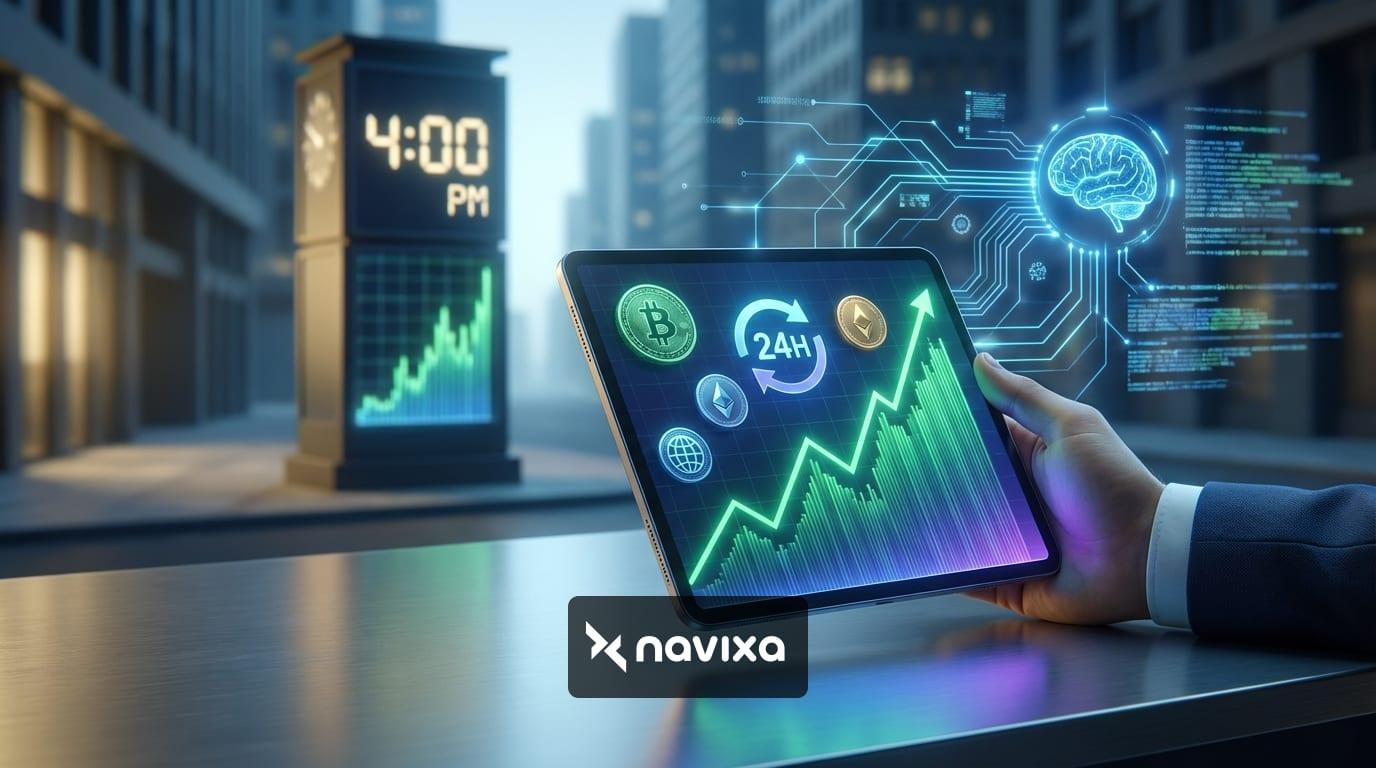
At 4:00 PM EST on Friday, Wall Street breathes a collective sigh of relief. The closing bell rings, terminals go dark, and traders head to the Hamptons or the pub. But for the cryptocurrency market, Friday afternoon is just another timestamp on an endless, seamless timeline. There is no opening bell, no closing auction, and absolutely no downtime. Welcome to the world of 24/7 crypto trading—a financial frontier that never sleeps.
For traditional investors used to the rigid 9:30 AM to 4:00 PM schedule of the NYSE or Nasdaq, the perpetual motion of Bitcoin and Ethereum can be jarring. It offers unparalleled freedom—you can trade at 3 AM on a Sunday or during your lunch break on Tuesday. However, this freedom comes with a hidden cost: the risk of burnout and the challenge of navigating a market where liquidity shifts dramatically depending on which part of the world is awake.
In this guide, we will break down exactly how to master the 24/7 cycle, why the "weekend effect" has changed in 2025, and how to protect your portfolio (and your sleep schedule) from the volatility of a market that refuses to close.
The Three Global Sessions: Following the Liquidity
Just because the market is open 24 hours doesn't mean it behaves the same way around the clock. Crypto liquidity "travels" with the sun, moving through major global financial hubs. Understanding these sessions is critical for timing your entries and exits.
1. The Asian Session (Tokyo/Hong Kong/Singapore)
Often the first to react to weekend news, the Asian session (starting roughly 8 PM EST) sets the tone for the trading day. Markets here can be highly volatile, especially for altcoins popular in Korea and Japan. If you see a sudden pump in the middle of the US night, it’s often driven by Asian retail volume.
2. The European Session (London/Frankfurt)
Starting around 3 AM EST, this session bridges the gap between East and West. Volatility often ticks up as European institutions come online. This is often where "fake-outs" occur—price moves that reverse once the US wakes up.
3. The US Session (New York)
The heavyweight champion of volume. From 8 AM EST to 4 PM EST, institutional flows dominate. This is where the highest liquidity is found, especially with the introduction of Spot Bitcoin ETFs, which only trade during these hours. The overlap between the end of the London session and the start of the NY session (8 AM – 11 AM EST) is widely considered the "golden window" for day traders due to peak volume.
The New "Weekend Effect" in 2025
For years, the "weekend effect" in crypto meant wild volatility. With banks closed, it was harder to move fiat money into exchanges, leading to thin order books. "Whales" (large holders) could push prices around easily with smaller amounts of capital.
However, the dynamic has shifted. Recent data indicates that weekend trading volumes have dropped significantly, accounting for as little as 13-16% of weekly volume in 2024 and 2025. Why? Because the "smart money" (institutions) now trades primarily through ETFs during the week. When the stock market closes on Friday, the institutional liquidity dries up.
This creates a double-edged sword: liquidity is lower (making it riskier to execute large orders without slippage), but the market is often calmer, dominated by retail bots and smaller traders. However, caution is advised: low liquidity means that a single large piece of news on a Sunday can cause outsized price swings simply because there aren't enough orders to absorb the shock.
| Feature | Stock Market (Traditional) | Crypto Market (24/7) |
|---|---|---|
| Trading Hours | Mon-Fri, 9:30 AM - 4:00 PM | 24 Hours, 365 Days/Year |
| Market Gaps | Common (Price jumps at open) | Rare (Continuous pricing) |
| Circuit Breakers | Yes (Halts trading on crashes) | No (Free fall possible) |
| Primary Participants | Institutions, Algorithms, Retail | Global Retail, Whales, 24/7 Bots |
| Best for... | Structured investing, work-life balance | Global arbitrage, active trading |
Strategies to Survive a Market That Never Stops
Since you cannot physically stay awake for 24 hours a day to monitor charts, you must adapt your strategy. Trying to manually trade a 24/7 market is a one-way ticket to emotional ruin. Here is how successful traders cope:
1. Automate or Perish
Automation is not optional in crypto; it is a necessity. Grid trading bots are particularly effective in 24/7 markets. These bots automatically buy low and sell high within a set range, allowing you to profit from the "sideways chop" that often happens during low-volume weekends or overnight sessions while you sleep.
According to recent market analysis, algorithmic trading now accounts for a significant portion of retail crypto volume, precisely because it removes the need for constant monitoring.
2. Hard Stops vs. Mental Stops
In the stock market, you might get away with a "mental stop loss" because the market closes at 4 PM. In crypto, a 20% flash crash can happen at 4 AM while you are dreaming. Always use hard stop-loss orders entered directly into the exchange. This protects your capital when you are offline.
3. Swing Trading Over Scalping
Unless you are using bots, scalping (trading small moves over minutes) is exhausting in a 24/7 environment. Swing trading—holding positions for days or weeks—aligns better with human limitations. It allows you to ignore the minute-by-minute noise and focus on broader 4-hour or daily trends that play out regardless of the time zone.
The Mental Game: Avoiding "Crypto Burnout"
The most dangerous risk in 24/7 trading isn't a chart pattern; it's your own psychology. The compulsion to check prices constantly leads to what industry experts call "crypto burnout." This state of chronic stress leads to revenge trading, poor decision-making, and eventually, a blown account.
"The market can stay irrational longer than you can stay solvent—and in crypto, it can stay open longer than you can stay awake."
To combat this, set specific "office hours" for yourself. Decide that you will only trade the London/NY overlap (8 AM - 12 PM) and then step away. Use price alerts instead of staring at the screen. If you feel anxious when you aren't looking at the chart, your position size is likely too big.
Key Takeaways for the 24/7 Trader
Mastering the 24/7 crypto market requires a shift in mindset from traditional stock trading. It is not about working harder or longer; it is about working smarter.
Remember these core rules: respect the liquidity sessions, beware of low-volume weekends, use automation to protect your sleep, and never trade without a hard stop-loss. The market will always be there when you wake up—make sure your capital is too.
For more insights on market volatility and trading volume trends, check out resources like CoinGecko's volatility reports to stay ahead of the curve.