
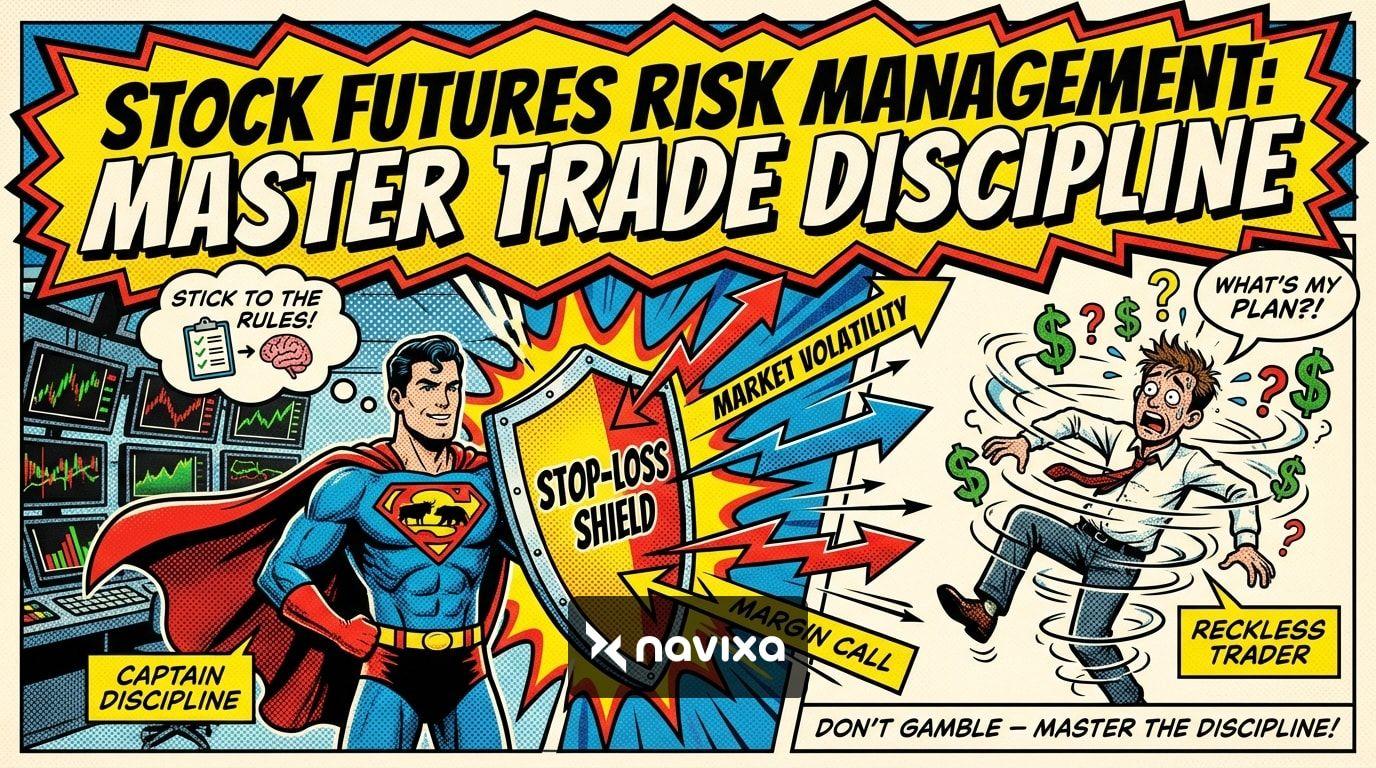
The allure of leverage in the financial markets has consistently drawn traders toward derivative instruments. However, navigating these waters requires a masterclass in stock futures risk management. Unlike traditional spot trading, the futures market allows you to control massive positions with a fraction of the capital, magnifying both potential profits and catastrophic losses. In an era where macroeconomic forces tightly interlace traditional finance with digital assets, developing an unbreakable trade discipline is your only shield against market volatility.
As we progress through 2026, the trading landscape is more interconnected than ever. With benchmark indices like the S&P 500 futures (ES) trading above the 6,600 mark and leading cryptocurrencies such as Bitcoin oscillating in the $66,000 to $68,000 range, market participants are witnessing unprecedented macro-driven price movements. This high-stakes environment underscores why a comprehensive risk management protocol is not just a recommendation—it is a survival requirement.
In this exhaustive guide, we will unpack the core mechanics of managing risk when trading stock futures. We will explore everything from leverage controls and technical analysis to psychological resilience and actionable daily routines, giving you the blueprint needed to master trade discipline.
Understanding the Mechanics of Leverage and Margin
Before diving into advanced stock futures risk management strategies, it is crucial to understand the fundamental mechanics that differentiate futures from traditional equity trading.
Initial Margin vs. Maintenance Margin
When you enter a futures contract, you are not required to pay the full notional value of the asset. Instead, you post a good-faith deposit known as the initial margin. This capital requirement varies depending on the volatility of the underlying index and the exchange's rules.
Once a position is open, the account must maintain a minimum balance known as the maintenance margin. If a trade moves against you and your account balance dips below this threshold, you will receive a margin call. In volatile conditions, failing to meet a margin call promptly can result in the broker automatically liquidating your position at the worst possible time.
The Double-Edged Sword of Leverage
Leverage is the defining characteristic of futures trading. For instance, a single E-mini S&P 500 (ES) contract controls $50 times the price of the index. If the ES is trading near 6,629, the notional value of one contract is over $330,000. If your broker requires an initial margin of just $15,000, you are effectively trading with over 20:1 leverage.
While this leverage can supercharge returns during a favorable market trend, a mere 2% drop in the index translates to a massive loss—a devastating hit to a poorly capitalized account. Recognizing this asymmetry is the foundational step in building an elite risk management framework.
Core Trading Strategies and Technical Analysis
Risk management should be organically integrated into your trading strategy. A robust system relies on high-probability setups supported by stringent technical analysis.
Trend Following vs. Mean Reversion
Traders typically employ one of two primary strategies in the futures market:
1. Trend Following: This approach seeks to capture extended directional moves. Trend followers buy into strength and sell into weakness. In this model, risk management relies on wider stop-loss orders to avoid being prematurely stopped out by minor pullbacks. 2. Mean Reversion: This strategy assumes that extreme price movements will eventually revert to their historical averages. Mean reversion traders often fade strong moves at key resistance or support levels. Risk management here demands tight stop-loss orders, as being wrong about a reversal can lead to devastating losses if a strong trend continues.
Integrating Technical Indicators
To manage risk effectively, you must understand market volatility. Several technical indicators are indispensable for stock futures traders:
* Average True Range (ATR): The ATR measures market volatility by decomposing the entire range of an asset price for a given period. By understanding the current ATR, you can set dynamic stop-loss orders that breathe with the market rather than relying on arbitrary dollar amounts. For more detailed insights on how this indicator functions, you can explore Investopedia's Guide to ATR. * Volume Weighted Average Price (VWAP): Institutional traders heavily rely on VWAP. It provides a benchmark that filters out intraday noise, helping you ensure that you are not entering a position at overextended price levels. * Moving Averages (e.g., 50-EMA, 200-SMA): These act as dynamic support and resistance levels. A key rule of trade discipline is to avoid initiating long positions directly under major moving average resistance unless a confirmed breakout occurs.
"The goal of a successful trader is to execute the best possible plan. The money is secondary. If you strictly adhere to a well-defined risk management protocol, the profits will naturally follow."
The Four Pillars of Stock Futures Risk Management
To consistently survive and thrive, you must construct your trading business upon four non-negotiable pillars.
1. Position Sizing: The 1% to 2% Rule
The golden rule of stock futures risk management is never to risk more than 1% to 2% of your total trading capital on a single trade. Position sizing in futures requires calculating the distance to your stop-loss and the point value of the contract.
Example Calculation: Imagine you have a $50,000 trading account. A 1% risk limit means you are willing to lose exactly $500 on your next trade. If you are trading Micro E-mini S&P 500 (MES) futures, where each point is worth $5, your $500 risk budget allows for a maximum adverse excursion of 100 points on a single contract. If your technical analysis dictates a 25-point stop-loss, you can safely trade up to four MES contracts ($5 per point \\* 25 points \\* 4 contracts = $500).
2. Stop-Loss and Take-Profit Orders
Entering a futures trade without a hard stop-loss is financial suicide. The futures market can experience violent spikes driven by unexpected macroeconomic data releases, such as an unscheduled central bank announcement or sudden geopolitical shifts.
* Hard Stops vs. Mental Stops: Always use hard stops placed directly into the exchange's order book. Mental stops fail because human psychology naturally hesitates when faced with realizing a loss. * Trailing Stops: As a trade moves in your favor, trailing your stop-loss locks in accrued profits while giving the asset room to run without limiting its upside potential.
3. Managing the Risk of Ruin and Drawdowns
Drawdowns are inevitable. Even the most successful algorithmic trading systems experience losing streaks. The "Risk of Ruin" refers to the probability that a trader's account will be depleted to a point from which recovery is mathematically improbable. By strictly adhering to the 1% risk rule, it would theoretically take 100 consecutive losses to blow up an account—making the risk of ruin infinitesimally small for a disciplined trader.
4. Psychological Trade Discipline
Your emotional state is your biggest vulnerability. Revenge trading (trying to immediately win back a loss) and over-leveraging are the direct results of compromised trade discipline. Establish a daily loss limit. If you lose a predetermined amount (e.g., 3% of your account) in a single session, mandate a "pencils down" rule. Turn off your monitors and walk away until the next trading day.
Bridging the Gap: Stock Futures and Crypto Markets
As a modern trader, you cannot view stock futures in a vacuum. In recent years, the correlation between traditional equities and the cryptocurrency market has tightened significantly. In early April 2026, Bitcoin's recovery in the mid-to-upper $60,000s coincides closely with momentum shifts in the broader index futures, indicating macro-driven market moves largely tied to interest rate expectations and global liquidity.
Both markets react aggressively to the same macroeconomic catalysts: inflation data, interest rate decisions, and global liquidity trends. Traders migrating from crypto futures to stock futures—or vice versa—will find that the core principles of risk management are identical. The high-leverage environment of offshore crypto exchanges closely mimics the margin dynamics of traditional commodities and index futures. You can learn more about contract specifications and margin requirements directly from the CME Group.
Comparison: Spot Trading vs. Stock Futures vs. Crypto Futures
To fully grasp the risk profile of stock futures, it helps to compare them side-by-side with other popular asset classes.
| Feature | Spot Stocks | Stock Futures (e.g., ES) | Crypto Futures (e.g., BTC-PERP) |
|---|---|---|---|
| Leverage | None (or up to 2:1 on margin) | High (Often 10:1 to 20:1) | Extreme (Up to 100:1) |
| Capital Required | High (Full notional value) | Low (Initial margin only) | Very Low |
| Trading Hours | 9:30 AM - 4:00 PM EST | Nearly 24/5 | 24/7/365 |
| Settlement | T+1 or T+2 Days | Cash or Physical Delivery | Continuous (Funding Rates) |
| Risk Level | Moderate | High (Requires strict discipline) | Very High (Extreme volatility) |
Actionable Steps to Master Trade Discipline
Knowledge without execution is meaningless. To implement proper stock futures risk management, you must build actionable, repeatable habits into your daily routine.
1. Develop a Pre-Market Routine
Do not jump into the market blind. Before the opening bell, review the economic calendar for the day. High-impact news events (like Non-Farm Payrolls, FOMC meetings, or CPI data) can cause extreme slippage where your stop-loss is bypassed entirely. Professional traders often flatten their positions or widen their stops minutes before these volatile data releases.
2. Maintain a Detailed Trading Journal
A trading journal is the ultimate tool for accountability. Log every trade you take, including the entry price, exit price, position size, and—most importantly—your emotional state at the time of execution. Reviewing your journal weekly will reveal toxic patterns, such as consistently moving your stop-loss further away as a trade goes against you.
3. Practice on a Simulator
If you are new to futures, do not risk real capital immediately. The speed at which the E-mini S&P 500 or Nasdaq 100 (NQ) moves can be paralyzing. Use a paper trading account to practice executing your position sizing calculations and placing bracket orders until the process becomes second nature.
Practical Takeaways
* Protect the Principal: Your primary job is capital preservation; making a profit is secondary. * Know Your Contract Specs: Understand the exact tick value and margin requirements of the specific futures contract you are trading before entering a position. * Respect the ATR: Use volatility indicators to set logical, dynamic, and non-arbitrary stop-loss levels. * Avoid Overtrading: Establish strict daily loss limits to prevent emotional spiraling, over-leveraging, and revenge trading. * Adapt to the Macro Picture: Keep an eye on correlated markets, including major cryptocurrencies, to gauge broader risk-on or risk-off sentiment accurately.
Conclusion
Mastering stock futures risk management is a lifelong journey. It is not merely about mathematical formulas or chart patterns; it is about cultivating an ironclad mindset that respects the devastating power of leverage. By consistently applying the 1% risk rule, utilizing technical tools like the ATR to set intelligent stops, and holding yourself accountable through a detailed trading journal, you elevate yourself from a gambler to a professional speculator.
Do not let one bad trade erase weeks of hard work. Take the time to refine your strategy in a simulated environment, build your psychological resilience, and implement these essential risk management pillars today. Your future self—and your trading account balance—will thank you.
Frequently Asked Questions
What is the most critical rule in stock futures risk management?
The most critical rule is position sizing, specifically adhering to the 1% to 2% rule. By never risking more than a tiny fraction of your account capital on a single trade, you protect yourself against the risk of ruin and ensure you can survive inevitable losing streaks without blowing up your account.
How does leverage affect stock futures trading?
Leverage allows you to control a large amount of an underlying index (like the S&P 500) with a relatively small margin deposit. While this amplifies your potential profits during a winning trade, it equally magnifies your losses. A small percentage drop in the underlying index can easily wipe out your margin deposit if strict stop-losses are not used.
Why do crypto traders often transition to stock futures?
Many crypto traders transition to stock futures because they are accustomed to high-leverage, macro-driven environments. Stock futures offer a heavily regulated, highly liquid market with defined trading hours (with short institutional breaks), which can provide a more structured daily routine compared to the exhausting 24/7 nature of cryptocurrency markets.
What is a margin call in futures trading?
A margin call occurs when your account balance falls below the broker's maintenance margin requirement due to losing open positions. When this happens, your broker will demand that you deposit additional funds immediately. If you fail to do so, the broker retains the right to automatically liquidate your open positions to prevent further capital loss.
Can gap risk be avoided in stock futures?
Gap risk—the risk that the market opens significantly higher or lower than its previous close—cannot be entirely avoided in futures, especially over the weekend. To mitigate gap risk, many disciplined day traders choose to close all their open positions before the Friday close, ensuring they are "flat" and not exposed to unforeseen geopolitical or economic news events over the weekend.