
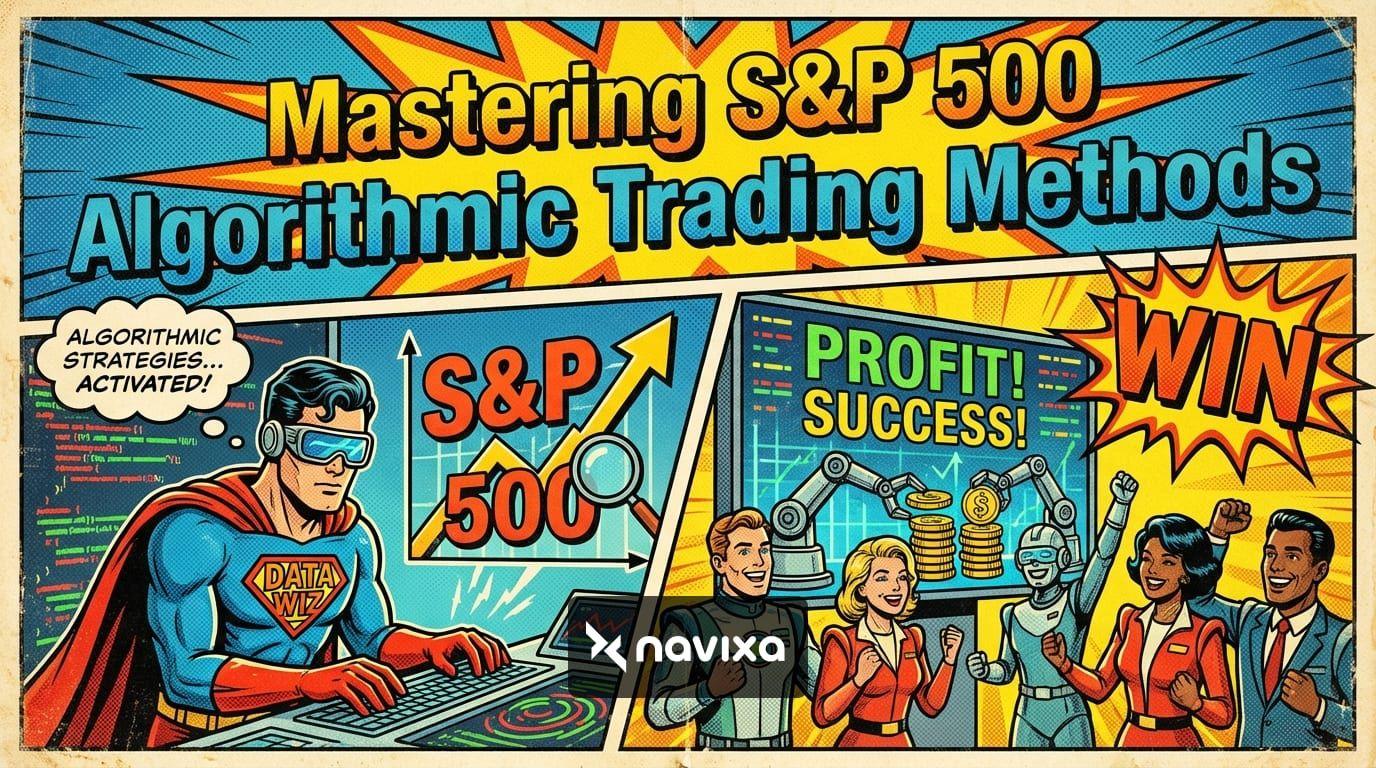
The financial markets have undergone a profound transformation over the last decade, with automated systems now accounting for the vast majority of global equity trading volume. At the heart of this technological revolution is S&P 500 algorithmic trading. By removing human emotion from the equation, retail and institutional traders alike can systematically exploit market inefficiencies. Whether you are trading the highly liquid SPY exchange-traded fund (ETF), the standard E-mini S&P 500 futures (ES), or the widely accessible Micro E-mini contracts (MES), algorithmic strategies currently dominate the order books and dictate intraday price action.
Algorithmic trading leverages computer programming and advanced mathematical models to execute trades based on predefined rules. Instead of manually monitoring charts and reacting to breaking news, traders deploy scripts that parse thousands of data points per second. As soon as the algorithm detects specific technical or fundamental conditions, it automatically fires off buy or sell orders with a speed and precision that no human can match. In this comprehensive guide, we will explore the fundamental concepts, actionable strategies, and rigorous risk management protocols required to succeed in S&P 500 algorithmic trading.
The Evolution of Automated Trading in the S&P 500
The S&P 500 is the ultimate benchmark of the U.S. stock market, representing the performance of 500 of the largest publicly traded companies. Because of its massive liquidity and global importance, it is the premier playground for quantitative analysts and algorithmic traders.
In the early days of automated trading, algorithms were relatively simple. They relied almost exclusively on basic technical indicators, such as moving average crossovers or simple breakout parameters. Today, the landscape is infinitely more complex. Modern S&P 500 algorithmic trading systems incorporate artificial intelligence, machine learning, and natural language processing. These sophisticated machines do not just look at price and volume; they parse news sentiment, analyze earnings reports, and track macroeconomic variables in milliseconds.
"Algorithms do not feel fear during a market crash, nor do they succumb to greed during an exuberant bull run. They execute strictly based on data, making them the ultimate tool for navigating the volatile S&P 500."
For example, recent market dynamics have showcased a distinct algorithmic inverse correlation between crude oil futures and the S&P 500. When geopolitical tensions arise—such as conflicts in the Middle East or supply chain blockades—oil prices typically spike. In response, complex algorithmic trading programs are designed to automatically begin selling S&P 500 futures to de-risk portfolios and hedge against inflationary pressures. Understanding these macro-to-micro algorithmic correlations is vital for anyone looking to build a modern trading system.
Core S&P 500 Algorithmic Trading Strategies
Building a profitable automated system requires a foundational trading strategy. While there are infinite variations of code, most successful S&P 500 algorithmic trading models fall into one of three primary categories: trend-following, mean reversion, and statistical arbitrage.
1. Trend-Following Systems
Trend-following strategies are designed to identify and ride ongoing market trends. They do not attempt to predict tops or bottoms; instead, they wait for a clear directional bias to establish itself before entering the market. Because the S&P 500 has a historical bias toward the upside, long-biased trend-following algorithms are exceptionally popular.
The most classic example of a trend-following algorithm is the moving average crossover, specifically the "Golden Cross." In this model, the algorithm buys the S&P 500 when the 50-day moving average crosses above the 200-day moving average. Conversely, it triggers a "Death Cross" sell signal when the 50-day drops below the 200-day. While this sounds simple, an algorithm can optimize this strategy by adding secondary filters. For instance, the system might require the Average Directional Index (ADX) to be above 25, confirming that the trend is strong enough to warrant a trade.
2. Mean Reversion Strategies
Mean reversion algorithms operate on the premise that asset prices will eventually revert to their historical average. If the S&P 500 experiences a violent, sudden sell-off, a mean reversion algorithm will interpret the move as an overreaction and automatically buy the dip, expecting the price to bounce back to its mean.
These algorithms heavily rely on oscillating indicators like the Relative Strength Index (RSI) and Bollinger Bands. A standard mean reversion script might trigger a long position when the S&P 500 drops below its lower Bollinger Band and the RSI dips below 30 (indicating oversold conditions). The algorithm will then hold the position until the price touches the middle moving average, at which point it automatically takes profit. Mean reversion is highly effective in choppy, sideways markets but can suffer severe drawdowns during aggressive, one-sided trend environments.
3. Statistical Arbitrage and Index Rebalancing
Statistical arbitrage is a highly advanced form of S&P 500 algorithmic trading heavily utilized by institutional quant funds. This strategy involves trading the spread between correlated assets. For example, an algorithm might monitor the price of the SPY ETF against the underlying basket of the 500 individual stocks. If a brief pricing inefficiency occurs—perhaps the ETF lags slightly behind the rapid price changes of the individual components—the algorithm will instantly buy the undervalued asset and short the overvalued one, capturing the risk-free spread.
Another unique subset of this is index rebalancing. The S&P 500 periodically updates its constituents, dropping underperforming companies and adding rising stars. Algorithmic strategies are programmed to anticipate the massive volume surges that occur when index funds are forced to buy the newly added stocks and sell the removed ones, executing front-running strategies to capture predictable momentum.
Choosing the Right Instrument for Your Algorithm
Before you write a single line of code, you must decide which financial instrument your algorithm will trade. The S&P 500 offers several distinct avenues, each with its own capital requirements, liquidity profiles, and leverage parameters. Understanding these differences is crucial for effective S&P 500 algorithmic trading.
Below is a comparison of the three most popular vehicles for automated S&P 500 trading:
| Feature | SPY ETF | E-mini Futures (ES) | Micro E-mini (MES) |
|---|---|---|---|
| Asset Type | Exchange-Traded Fund | Futures Contract | Futures Contract |
| Capital Required | Moderate to High | High (Significant Margin) | Low (Fractional Margin) |
| Liquidity | Very High | Extremely High | High |
| Trading Hours | Regular Market Hours + Ext. | Nearly 24/5 | Nearly 24/5 |
| Leverage | 1x (unless using margin) | High Leverage | High Leverage |
For beginners entering the algorithmic space, the Micro E-mini (MES) contracts are often the best starting point. They allow traders to interact with the futures market and experience near 24-hour trading without the massive capital exposure required by the standard E-mini (ES) contracts. Alternatively, for those who prefer to avoid leverage entirely, algorithms can easily be applied to the SPY ETF through traditional stock brokers.
Steps to Implementing an Automated Trading System
Transitioning from a conceptual strategy to a live, automated money-making machine requires a strict, systematic process. Here is how professional algorithmic traders bring their strategies to life.
Step 1: Strategy Formulation and Coding
The first step is to clearly define the logic of your strategy. This must be a set of binary rules with no room for subjective interpretation. Once the rules are established, the strategy must be translated into a programming language. Python is widely considered the industry standard for financial data analysis, but C++ is often used by high-frequency trading firms that require absolute minimal latency. Platforms like TradeStation or NinjaTrader also offer proprietary coding languages tailored specifically for automated trading.
Step 2: Rigorous Backtesting
Backtesting involves running your algorithm through historical market data to see how it would have performed in the past. This is a crucial step in S&P 500 algorithmic trading. However, traders must be incredibly cautious of "look-ahead bias" and "curve-fitting." It is very easy to tweak an algorithm until it produces a perfectly smooth upward equity curve on past data, only for it to fail miserably in live markets. A robust backtest must account for realistic slippage, commission fees, and varying market conditions (such as the 2020 pandemic crash or the high-interest-rate environment of 2023-2026).
Step 3: Paper Trading and Forward Testing
Once a strategy proves successful in backtesting, it should never be immediately deployed with real capital. Instead, it must be "forward tested" using a paper trading account. This allows the trader to observe how the algorithm executes in real-time, live market conditions. Forward testing reveals technical glitches, API latency issues, and platform disconnections that backtesting cannot simulate.
Step 4: Live Deployment and Infrastructure Setup
For an algorithm to trade the S&P 500 efficiently, it needs a reliable technological infrastructure. Running an algorithm from a standard home Wi-Fi network is risky; a momentary internet outage could leave a position unmanaged. Serious algorithmic traders use Virtual Private Servers (VPS) to host their algorithms. A VPS ensures near 100% uptime and can be geographically located near the exchange's servers to drastically reduce latency.
For more insights into the foundational concepts of systematic trading, you can explore resources like Investopedia's Guide to Algorithmic Trading and review contract specifications via the CME Group E-mini S&P 500 portal.
Risk Management in Automated Trading
The most beautifully coded algorithm in the world will ultimately fail if it lacks strict risk management protocols. In S&P 500 algorithmic trading, risk management is entirely hardcoded into the system.
First, algorithms must utilize strict stop-loss orders to limit catastrophic downside. Because automated systems can trigger dozens of trades a day, a "fat tail" event (an extremely rare but severe market shock) can wipe out an account in minutes if stop-losses are not integrated. Furthermore, developers often code "circuit breakers" into their algorithms. For example, if the system loses 5% of the total account equity in a single trading session, the algorithm will automatically halt trading and flatten all positions, preventing a runaway software glitch from draining the account.
Position sizing is another critical component. Advanced algorithms dynamically adjust their position sizes based on current market volatility. If the S&P 500 is experiencing a period of low volatility (often indicated by a low VIX reading), the algorithm might trade larger size. If volatility spikes due to an unexpected macroeconomic catalyst, the algorithm shrinks its position size to account for wider potential price swings.
The Role of Artificial Intelligence
As we navigate the current landscape of the financial markets, artificial intelligence is reshaping the boundaries of S&P 500 algorithmic trading. Traditional algorithms are static; they obey the exact rules they were given regardless of changing paradigms. AI-driven algorithms, however, are dynamic. Through machine learning, these systems continuously backtest themselves against new daily data, constantly tweaking their own parameters to adapt to shifting market regimes.
While retail traders may not have access to the multi-million-dollar AI supercomputers utilized by hedge funds, they can still integrate machine learning libraries into their Python scripts. By feeding years of S&P 500 price action, volume data, and economic indicators into a neural network, traders can uncover hidden patterns and non-linear relationships that a human analyst would never spot.
Conclusion
Mastering S&P 500 algorithmic trading is not a simple task. It requires a blend of deep financial market knowledge, robust statistical analysis, and proficient computer programming. However, the rewards for those who put in the effort are substantial. By removing the emotional pitfalls of fear and greed, systematically managing risk, and exploiting the immense liquidity of the S&P 500, automated trading offers a scalable path to consistent market outperformance. Whether you choose to follow broad market trends using moving averages or capture quick profits through mean reversion, a well-built algorithm can serve as your most reliable trading partner. Start by paper-trading your ideas, respect the dangers of overfitting, and let the data guide your edge.
Frequently Asked Questions
What is S&P 500 algorithmic trading?
S&P 500 algorithmic trading refers to the use of automated computer programs to execute buy and sell orders on S&P 500-related instruments, such as the SPY ETF or E-mini futures. These programs follow predefined mathematical and statistical rules to identify trading opportunities and execute them without human intervention.
Do I need to know how to code to start algorithmic trading?
While knowing programming languages like Python or C++ is highly beneficial and offers the most customization, it is not strictly required. Many modern trading platforms offer intuitive "drag-and-drop" strategy builders that allow you to construct automated systems using visual interfaces rather than raw code.
Which technical indicators are best for automated S&P 500 strategies?
The "best" indicator depends entirely on the strategy type. For trend-following algorithms, the 50-day and 200-day Moving Averages, as well as the MACD, are widely used. For mean reversion strategies, oscillators like the Relative Strength Index (RSI) and Bollinger Bands are the industry standard for identifying overbought or oversold extremes.
How much capital is required to trade S&P 500 algorithms?
The capital required depends on the financial instrument you choose. Trading the SPY ETF can be done with a standard brokerage account requiring moderate capital. However, if you wish to trade the highly leveraged E-mini S&P 500 futures (ES), you will need substantial margin capital. Alternatively, the Micro E-mini (MES) contracts allow traders to run algorithms with a fraction of the capital requirement.
What is the biggest risk in algorithmic trading?
The biggest technical risk is "overfitting" or "curve-fitting" during the backtesting phase, where a strategy is tailored so perfectly to past data that it fails in live markets. The biggest operational risk is technical failure—such as internet outages, API disconnects, or software bugs—which is why utilizing strict automated stop-losses and Virtual Private Servers (VPS) is essential.