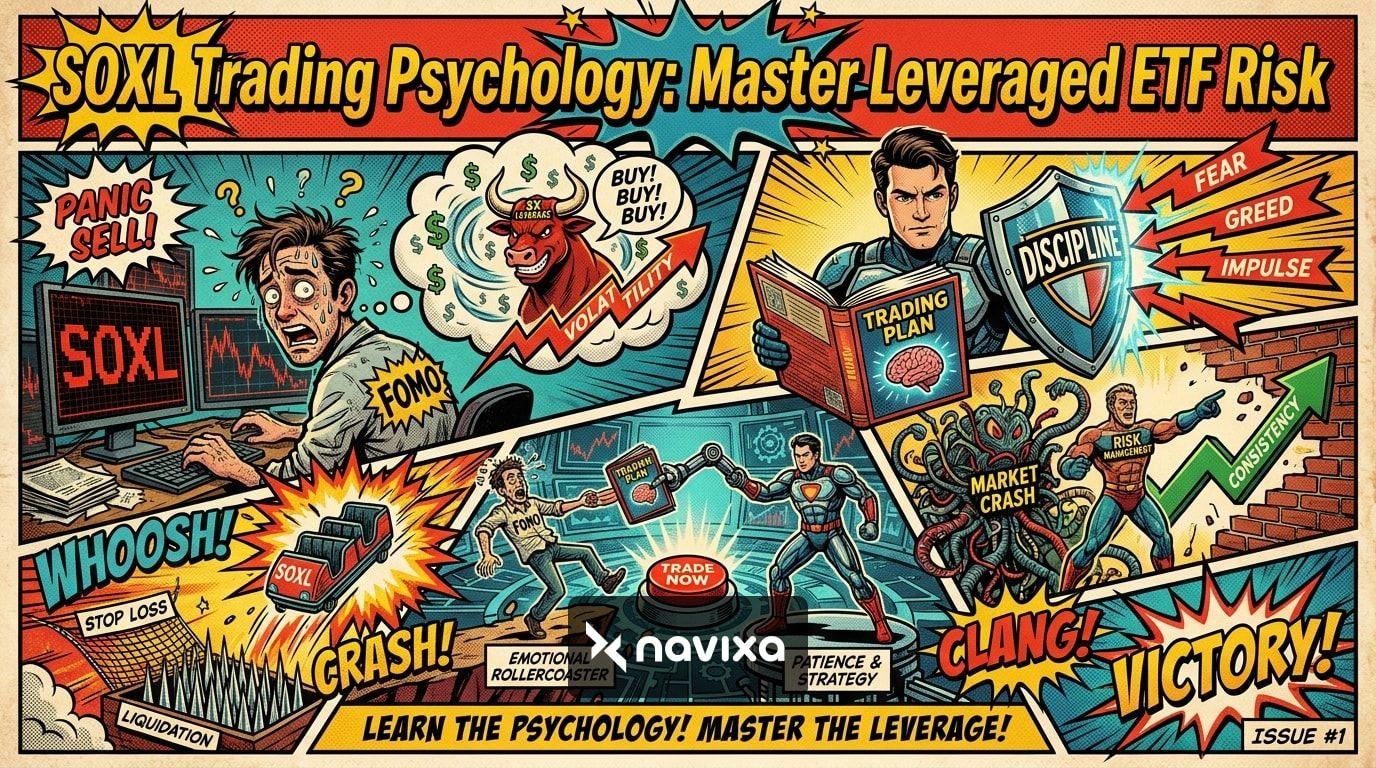
The semiconductor sector is the undisputed engine of the modern economy, powering everything from advanced artificial intelligence systems to global data centers. At the heart of this volatile market lies the Direxion Daily Semiconductor Bull 3X Shares (SOXL), a leveraged exchange-traded fund designed to deliver triple the daily performance of the NYSE Semiconductor Index. But while the potential for massive gains attracts aggressive speculators, mastering SOXL trading psychology is what separates consistently profitable traders from those who blow up their accounts.
Trading a 3x leveraged ETF is not for the faint of heart. As we have seen in mid-May 2026, sudden macroeconomic shifts—like hotter-than-expected inflation reports—can cause SOXL to plummet by 20% in a single session, while anticipation surrounding mega-cap earnings can ignite massive short-term rallies. Navigating these wild swings requires more than just reading a chart; it demands absolute emotional control and an unwavering risk management framework.
- SOXL utilizes 3x daily leverage, which creates dangerous volatility decay during choppy or sideways market conditions.
- Emotional control and strict adherence to stop-losses are critical to surviving double-digit intraday percentage swings.
- Leveraged ETFs are designed primarily for short-term tactical trades, not multi-year buy-and-hold investments.
- Trading psychology must evolve to counter cognitive biases like FOMO, revenge trading, and the sunk cost fallacy.

The Mechanics of SOXL: Why Leverage is a Double-Edged Sword
Before diving into the psychological aspects of trading, you must understand the mathematical reality of the instrument you are trading. SOXL aims to multiply the daily return of its underlying index by three. This means if the index gains 5% in a day, SOXL should rise by approximately 15%. However, this also works in reverse. A 5% drop in the underlying index translates to a brutal 15% loss for SOXL shareholders.
The true danger of leveraged ETFs lies in a mathematical phenomenon known as volatility decay, or beta slippage. Because the fund rebalances its leverage on a daily basis, a choppy market will erode the fund's value over time, even if the underlying index eventually returns to its starting point.
Imagine the index drops 10% on Monday. To get back to its original price on Tuesday, it needs an 11.1% gain. But for SOXL, that 10% drop was magnified to 30%. To recover from a 30% drawdown, the ETF needs a 42.8% gain, which requires a 14.2% move in the underlying index. Over weeks or months of typical market chop, this mathematical drag can destroy a portfolio. Therefore, understanding specific sector catalysts, such as Micron stock volatility, is essential before locking capital into a highly leveraged tech play.
Leveraged ETFs like SOXL reset their exposure on a daily basis. Holding them for extended periods during choppy, volatile markets can result in significant capital erosion known as volatility decay, regardless of the underlying asset's long-term trajectory.
Market Analysis & Trading Psychology
To master SOXL trading psychology, one must first confront the cognitive biases that plague human decision-making. The semiconductor market is highly cyclical and intensely news-driven. Geopolitical tensions, foundry bottlenecks, and AI capital expenditure reports create an environment ripe for emotional extremes.
Overcoming FOMO and Greed
Fear of Missing Out (FOMO) is arguably the most destructive emotion for a SOXL trader. When heavyweights like Nvidia announce robust data center revenues—such as the massive buildup leading into their May 2026 Q1 FY2027 earnings—retail traders often rush into SOXL at the top of a massive intraday spike. They visualize triple returns without acknowledging the outsized risk. This phenomenon is very similar to what we see in the digital asset space, where Bitcoin pushing past $80,000 routinely triggers crypto YOLO trading psychology. Both environments demand a sober, systematic approach rather than blind optimism.
The Disposition Effect and Loss Aversion
Another major psychological hurdle is the disposition effect—the tendency for investors to sell winning positions too early while holding onto losing positions for too long. With a 3x leveraged ETF, holding a loser out of stubbornness is financial suicide. Loss aversion makes it psychologically painful to realize a 15% loss, but in SOXL, that 15% loss can swiftly compound into a 45% drawdown if the broader market experiences a multiday correction. You have to train your brain to view a stop-loss execution not as a personal failure, but as a mandatory business expense that keeps you in the game.

The Battle of the ETFs: SOXL vs. SOXX vs. SMH
To contextualize your risk, it helps to compare SOXL against standard, non-leveraged semiconductor funds. Many traders mistakenly use SOXL for macroeconomic investing when they should be using index funds like SOXX or SMH.
| Feature | SOXL | SOXX | SMH |
|---|---|---|---|
| Leverage | 3x Daily | 1x (None) | 1x (None) |
| Volatility | Extreme | Moderate | Moderate-High |
| Top Holdings Weighting | Capped across index | Broad cap weighting | Highly concentrated (NVDA, TSM) |
| Best Use Case | Intraday/Swing Trading | Long-term investing | Thematic AI investing |
| Psychological Toll | Very High | Low to Moderate | Moderate |
If your psychological makeup cannot handle a 10% portfolio drop before lunch, you should absolutely avoid SOXL and stick to 1x ETFs. Knowing yourself is the cornerstone of trading psychology.
Actionable Risk Management Strategies
Once you accept the math and master your mind, you need a concrete execution framework. You cannot trade a hyper-volatile ETF on intuition alone. You need strict rules governing position sizing, entries, and exits.
Position Sizing for Volatility
Because SOXL moves three times as fast as its benchmark, your position size should theoretically be one-third the size of a standard ETF trade to maintain the same portfolio risk. If you typically allocate $10,000 to an unleveraged tech swing trade, allocating more than $3,333 to SOXL dramatically increases your risk of ruin. Smaller position sizes reduce emotional attachment, allowing your pre-planned QCOM stock trading strategy to unfold without the interference of panic or greed.
Strict Stop-Loss Implementation
Never enter a SOXL trade without a hard stop-loss entered into your broker's platform. Mental stops do not work when a hawkish Federal Reserve comment or a sudden geopolitical headline causes the Nasdaq to drop 2% in five minutes (which equals a 6% drop in SOXL instantly). You must determine your invalidation level before you click buy.

Technical Analysis for Leveraged Semi Trades
To align your psychology with market realities, utilize objective technical analysis. Relying on price action and volume removes subjective bias.
1. Volume Weighted Average Price (VWAP): For intraday trading, VWAP is critical. Institutional traders use VWAP to gauge true value. If SOXL is trading below the daily VWAP, the trend is bearish, and attempting to "catch a falling knife" is a psychologically draining, low-probability endeavor.
2. Key Moving Averages: The 20-day and 50-day moving averages provide context for swing trades. However, because SOXL charts are distorted by daily resets, many professionals prefer to analyze the chart of the underlying index (such as the PHLX Semiconductor Sector) to find support and resistance, and then trade SOXL based on those unleveraged index levels.
3. Breakout and Momentum Trading: Leveraged ETFs excel in strong, directional momentum environments. To capitalize on these bursts without getting chopped out, traders often deploy automated scripts. If you want to refine your execution, utilizing a structured price action breakout strategy can systematize your entries, removing the hesitation that plagues discretionary traders.
Always chart the underlying semiconductor index alongside SOXL. Because of leverage decay, the ETF's price levels may shift, but the index's historical support and resistance zones remain accurate.
Cultivating a Professional Mindset
A professional trader views the market as an environment of probabilities, not certainties. When you trade an instrument as wild as SOXL, you have to accept that you will be stopped out frequently. The goal is not to win every trade, but to ensure that your winners are mathematically larger than your losers.
This is a stark contrast to value investing. For instance, SBUX stock trading psychology typically involves a patient, dividend-focused mindset that can weather months of stagnation. SOXL trading, conversely, is about tactical strikes. You get in when momentum is confirmed, and you get out the moment the trend breaks.

Conclusion
Mastering SOXL trading psychology is a journey of self-discipline. The allure of 3x leverage will always test your emotional fortitude, tempting you to overleverage during bull runs and hold on for dear life during market panics. By recognizing the mathematical reality of volatility decay, deploying strict position sizing, and systematically executing technical setups, you can harness the power of semiconductor volatility rather than being crushed by it.
Trading leveraged instruments is not a gamble if you employ a rigid, statistically backed edge. Protect your capital, manage your mind, and the profits will follow. Ready to take your trading framework to the next level? Take the time to explore Navixa strategies and build a robust, automated approach to today's fastest-moving markets.
Frequently Asked Questions
What is volatility decay in SOXL?
Volatility decay, or beta slippage, occurs because SOXL rebalances its 3x leverage daily. In a sideways or highly volatile market, the daily mathematical compounding effect erodes the overall value of the ETF, causing it to underperform its underlying benchmark over time.
Can I hold SOXL as a long-term investment?
It is highly discouraged. According to fund issuers like Direxion, leveraged ETFs are designed for daily trading or short-term tactical swing trades. Holding SOXL for years exposes you to massive drawdown risks and severe volatility decay, making standard 1x ETFs like SMH or SOXX better suited for long-term horizons.
How do Nvidia's earnings impact SOXL?
Nvidia makes up a massive, influential portion of the broader semiconductor index. Because it is a heavily weighted bellwether, a major beat or miss on Nvidia's earnings will cause aggressive ripple effects across the entire sector, resulting in highly amplified, triple-digit volatility in SOXL.
What are the best technical indicators to use with SOXL?
Traders frequently use Volume Weighted Average Price (VWAP) for intraday trends, Relative Strength Index (RSI) to spot extreme overbought or oversold conditions, and MACD for momentum shifts. However, many experts recommend applying these indicators to the underlying index chart rather than the SOXL chart directly to avoid distorted price levels.