
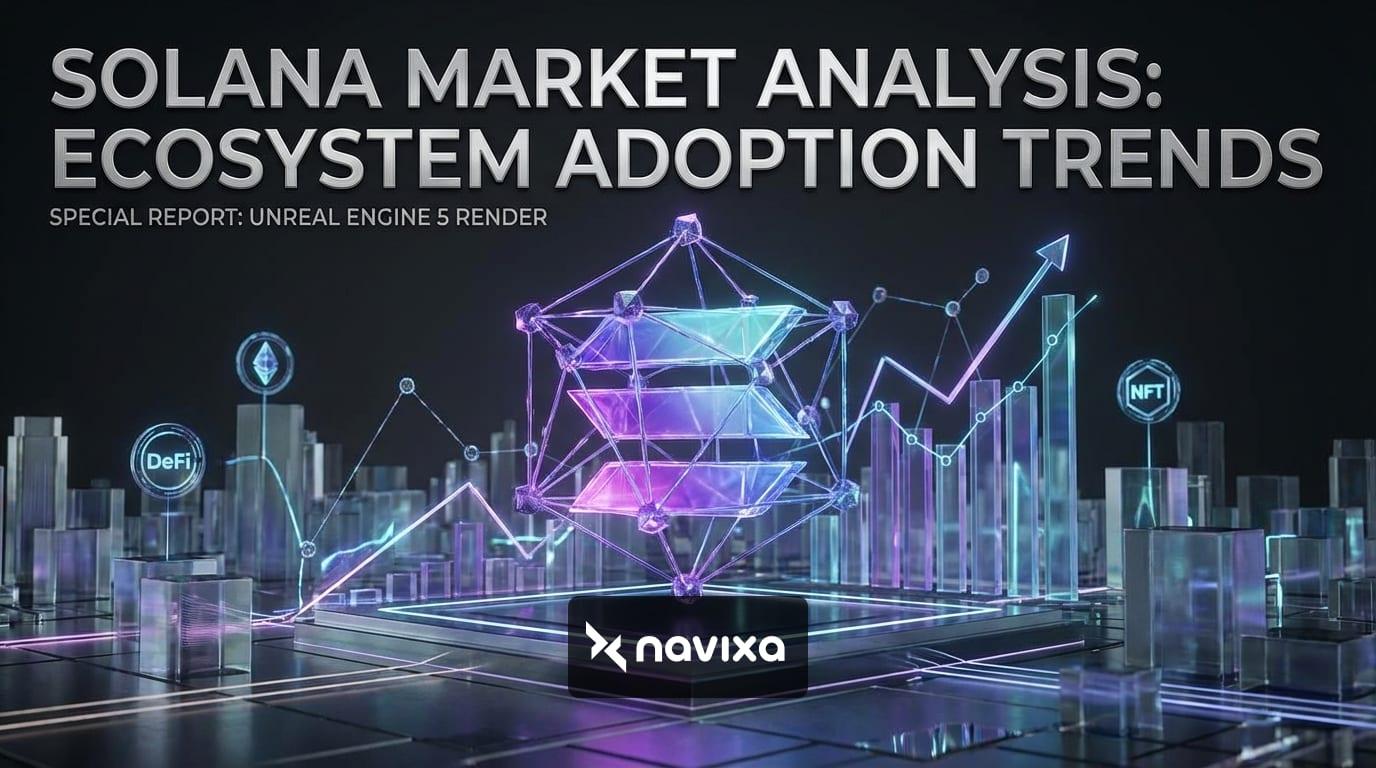
When executing a comprehensive Solana market analysis, it becomes immediately clear that the network has outgrown its previous narrative. Once widely regarded as just an "Ethereum killer," Solana has systematically evolved into a premier destination for institutional capital, decentralized finance (DeFi) innovation, and high-frequency trading. The broader macroeconomic environment has recently tested risk assets, but underlying on-chain data paints a picture of robust health and continuous adoption.
In this article, we dive deep into the ecosystem adoption trends driving the Solana network forward. From the staggering increase in daily active addresses to the integration of real-world assets (RWA) by traditional finance giants, understanding these foundational metrics is critical. Furthermore, we will break down the latest technical analysis, provide effective trading strategies, outline actionable steps for investors, and emphasize crucial risk management principles to navigate this high-beta digital asset.
Ecosystem Adoption Trends: The Engine of Resilience
The true strength of any Layer-1 blockchain lies in its network utilization. A thorough Solana market analysis reveals that user adoption is accelerating at an unprecedented pace, defying broader market contractions. In the first quarter of the year, Solana's active addresses doubled to over 5 million, while daily transaction volume surged from 52 million to an impressive 87 million. This level of activity resulted in daily transaction fees frequently exceeding $1.1 million, indicating that real economic value is flowing through the ecosystem, led heavily by decentralized exchanges (DEXs) and DeFi protocols.
Institutional Capital and Real-World Assets (RWA)
Perhaps the most defining trend in the current Solana ecosystem is the massive influx of institutional capital. The network is increasingly viewed as the ideal infrastructure for serious utility and global commerce. Recent ecosystem reports highlight that Goldman Sachs disclosed $108 million in SOL holdings, while BlackRock's BUIDL fund cleared an astonishing $550 million on the network. Furthermore, major legacy banking institutions like Citigroup have successfully completed full trade finance lifecycles on-chain.
"The gap between external macroeconomic contraction and internal network utilization represents the primary dynamic currently defining the Solana ecosystem."
The total value locked (TVL) denominated in SOL recently crossed the 80 million SOL threshold, hitting an all-time high. This demonstrates that capital is actively being deployed into yield-bearing DeFi applications rather than sitting idle, showcasing a maturation of the participant base.
The Alpenglow Upgrade
From a technological standpoint, the highly anticipated Alpenglow consensus upgrade is a core focus for developers and investors alike. This upcoming network enhancement aims to reduce transaction finality times down to a blistering 100-150 milliseconds. By virtually eliminating latency, Alpenglow will further solidify Solana's position as the blockchain of choice for high-frequency trading and mass-consumer applications.
Technical Analysis: Decoding SOL's Current Price Action
While fundamentals provide the long-term thesis, technical analysis dictates the short-to-medium-term execution. As a high-beta asset relative to Ethereum—often demonstrating a beta of roughly 2.13—Solana tends to amplify the broader market's directional moves.
Moving Averages and Trend Indicators
Recent price action has seen SOL consolidating in the mid-$80s to low-$90s. When analyzing the daily charts, the token has interacted heavily with its key moving averages. The 50-day Simple Moving Average (SMA) and the 200-day SMA serve as critical barometers for momentum.
Currently, the $80 zone has established itself as a formidable psychological and technical support level. A sustained defense of this zone indicates strong buy-side interest, often driven by institutional accumulation and the aforementioned TVL growth. Conversely, the $95 to $104 region presents substantial resistance. A decisive breakout above these resistance clusters, accompanied by a spike in volume, is generally required to confirm a resumption of the macro bullish trend.
Momentum Oscillators
The Relative Strength Index (RSI) on the daily timeframe has frequently hovered in neutral territory, around the 45 to 50 mark. This lack of extreme overbought or oversold conditions suggests a period of healthy market equilibrium and consolidation. Traders should monitor the Moving Average Convergence Divergence (MACD) for an upward crossover, which historically precedes strong localized rallies in the SOL ecosystem.
Effective Trading Strategies for the Solana Ecosystem
Armed with a solid Solana market analysis, traders can deploy various strategies to capitalize on the network's volatility and growth. The speed and low cost of the network make it uniquely suited for strategies that would be prohibitively expensive on other Layer-1 blockchains.
1. On-Chain Momentum Trading
Because Solana transaction fees average around a fraction of a cent, traders can execute high-frequency momentum strategies on native decentralized exchanges. By monitoring real-time liquidity flows and using advanced aggregators, traders can capitalize on micro-trends within the booming memecoin and utility token sectors. Keeping a close eye on platforms like DefiLlama helps identify which protocols are rapidly gaining TVL, offering early entry opportunities.
2. Yield Farming and Liquid Staking
For investors with a longer time horizon, generating yield on SOL holdings is a highly effective strategy. Liquid staking derivatives have gained immense traction. By staking SOL in exchange for a liquid receipt token, investors can earn native network yield while simultaneously deploying that liquid token across lending and borrowing protocols to compound their returns.
3. Macro-Swing Trading
Given its high-beta nature, SOL is an excellent candidate for macro-swing trading. This involves buying heavily at historically significant support levels (such as the $80 demand zone) during periods of extreme market fear, and scaling out near structural resistance levels.
Actionable Steps for Investors and Traders
To successfully navigate the Solana market, participants must move beyond passive holding and actively engage with the data. Here are specific, actionable steps to enhance your trading and investment approach:
1. Track On-Chain Activity Daily: Make it a habit to check network health metrics. Tools like Glassnode and token terminal dashboards provide invaluable data on daily active addresses and transaction volumes. A growing user base is the strongest leading indicator of future price appreciation. 2. Diversify Within the Ecosystem: Do not limit your exposure solely to the native SOL token. Explore high-quality infrastructure plays, decentralized physical infrastructure networks (DePIN), and top-tier DeFi protocols building exclusively on Solana. 3. Monitor Institutional Inflows: Keep an eye on the assets under management (AUM) of spot Solana ETFs and institutional funds. The sustained growth of these financial products provides a protective baseline for the asset's valuation. 4. Secure Your Assets: With the rise in sophisticated on-chain activity comes the need for robust security. Utilize hardware wallets and engage only with audited, reputable decentralized applications. 5. Engage with the Community: The Solana developer and trader community is highly active on social platforms and dedicated forums. Participating in these discussions can provide early alpha on upcoming protocol launches, airdrops, and governance votes that could significantly impact market dynamics.
Risk Management in High-Beta Crypto Assets
No Solana market analysis is complete without a rigorous discussion on risk management. The very traits that make Solana an attractive investment—its high volatility and rapid ecosystem expansion—also introduce significant risks that must be mitigated.
Volatility and Position Sizing
As demonstrated by its historical price action, Solana can experience 10% to 15% intraday swings based on broader market sentiment or macroeconomic news. Never allocate your entire portfolio to a single entry point. Utilize dollar-cost averaging (DCA) to build a position over time, which smooths out the impact of short-term volatility.
Macroeconomic Sensitivity
As seen in recent market cycles, global economic policies—such as tariff hikes, interest rate adjustments by central banks, and shifts in global liquidity—can trigger immediate deleveraging in the crypto sector. In early 2026, an unexpected tariff announcement resulted in billions of dollars in liquidations across the broader market over a single weekend. Solana, given its liquidity and trading volume, is not immune to these macro shocks. Traders must keep a close watch on traditional financial news and be prepared to hedge their portfolios when macroeconomic indicators point toward a risk-off environment.
Stop-Loss Mechanisms and Leverage
If engaging in derivatives trading, the use of strict stop-loss orders is non-negotiable. Because SOL reacts aggressively to Bitcoin's price movements and macroeconomic data, leveraged positions can be liquidated in a matter of minutes. Always maintain adequate margin buffers and calculate your risk-to-reward ratio before executing a trade.
Smart Contract Risks
While the core Solana network has dramatically improved its stability—largely eliminating the outage issues of its early years—the decentralized applications built on top of it still carry smart contract risks. Always diversify your DeFi positions across multiple protocols to prevent a single hack or exploit from devastating your portfolio.
Comparison: Solana vs. Ethereum Market Dynamics
To fully contextualize Solana's market position, it is helpful to compare its operational dynamics against the industry standard, Ethereum.
| Metric | Solana (SOL) | Ethereum (ETH) |
|---|---|---|
| Consensus Mechanism | Proof-of-History (PoH) & PoS | Proof-of-Stake (PoS) |
| Transaction Speed (TPS) | Up to 65,000 | 15 - 30 (Layer 1) |
| Average Transaction Fee | ~$0.00025 | ~$2.00 - $10.00 |
| Network Finality | ~400 milliseconds | ~12 - 15 minutes |
| Institutional Focus | High-frequency trading, RWA | Store of value, Complex Smart Contracts |
This fundamental difference in architecture explains why Solana is capturing the majority of high-frequency retail trading and real-world asset tokenization, while Ethereum continues to dominate as a decentralized store of value.
Practical Takeaways
* Adoption is Accelerating: With active addresses surpassing 5 million and daily transactions reaching 87 million, the network's foundational health is stronger than ever. * Institutions are Here: The presence of heavyweights like BlackRock, Goldman Sachs, and Citigroup validates Solana's technology for enterprise-grade applications. * Technical Levels Matter: The $80 support zone is crucial for maintaining the current structural range, while a break above $95 is needed for bullish continuation. * Manage Your Risk: Embrace the volatility but protect your capital through strict position sizing, stop-loss orders, and by minimizing leverage in uncertain macroeconomic conditions.
Frequently Asked Questions
What makes a Solana market analysis different from analyzing other cryptocurrencies?
A Solana market analysis heavily prioritizes on-chain throughput, active wallet addresses, and institutional integration metrics. Because the network processes thousands of transactions per second, analyzing DEX volume and decentralized application (dApp) engagement provides a more accurate real-time picture of value creation than merely looking at speculative price action.
How does the Alpenglow upgrade impact Solana's future value?
The Alpenglow upgrade is designed to reduce transaction finality to 100-150 milliseconds. This hyper-speed finality is crucial for competing with traditional centralized financial systems, making Solana an even more attractive platform for institutional market makers, payment processors, and decentralized exchanges. Improved technology often correlates with increased adoption and subsequent value appreciation.
Is the Solana DeFi ecosystem still growing despite market volatility?
Yes, the ecosystem has shown incredible resilience. Recently, the network's SOL-denominated Total Value Locked (TVL) reached an all-time high of over 80 million SOL. This indicates that users and institutions are continuing to deploy their assets into yield-generating protocols, demonstrating long-term confidence regardless of short-term price fluctuations.
What are the main risk factors when trading SOL?
The primary risks include high historical volatility, macroeconomic sensitivity, and smart contract vulnerabilities within the DeFi ecosystem. Because Solana is a high-beta asset, it tends to react sharply to broader market downturns or regulatory news. Traders must implement robust risk management strategies, such as strict stop-losses and careful position sizing, to navigate these rapid market movements safely.
Conclusion
Conducting a thorough Solana market analysis reveals a blockchain network transitioning from an experimental technology to a foundational pillar of global decentralized finance. The impressive surge in active addresses, skyrocketing daily transaction volumes, and undeniable institutional adoption highlight a fundamentally sound ecosystem. While the broader macroeconomic landscape will continue to induce volatility, Solana's technical advancements—such as the upcoming Alpenglow upgrade—position it uniquely for sustained long-term growth.
Whether you are a day trader looking to capitalize on high-beta price swings or a long-term investor seeking yield through DeFi, the data suggests that Solana will remain a dominant force in the digital asset space. Stay disciplined, continuously monitor on-chain metrics, and adapt your strategies to the ever-evolving pulse of the market.