
Introduction
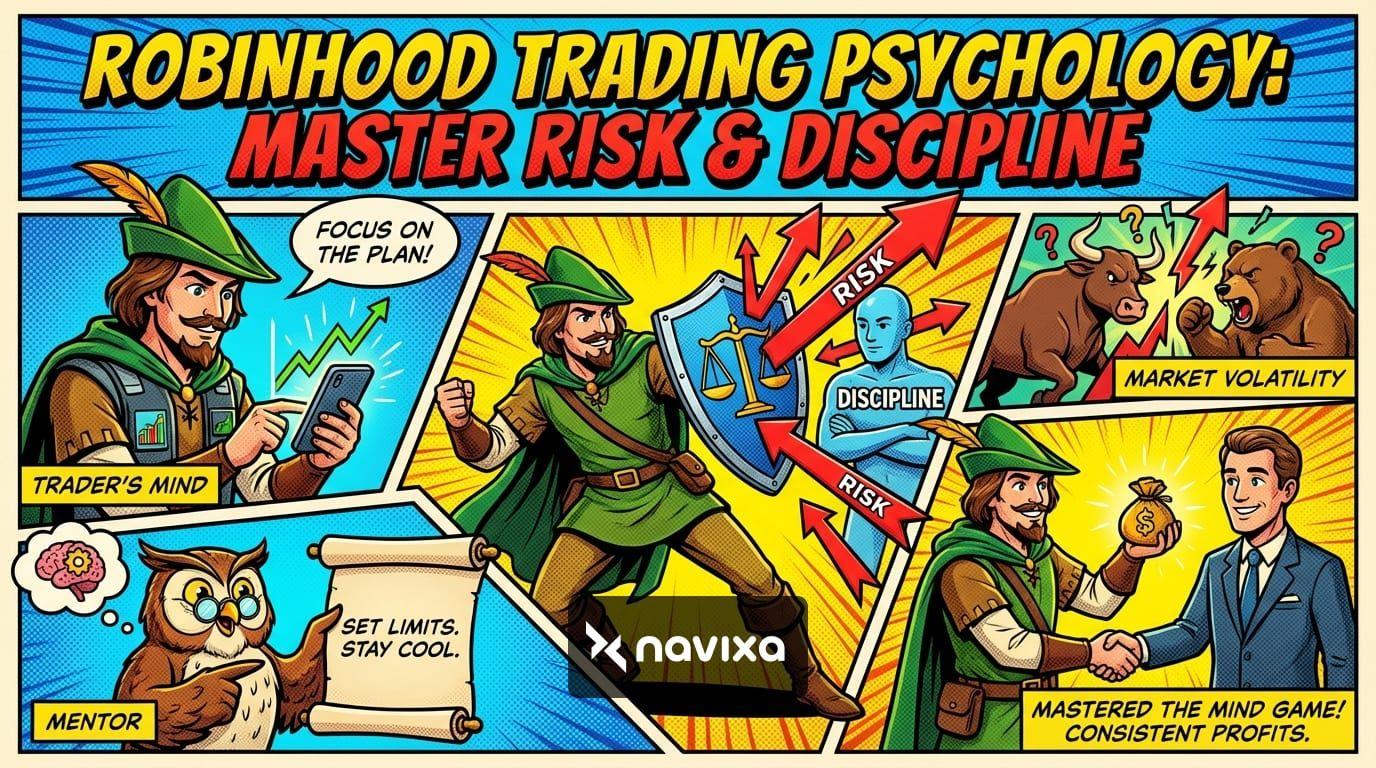
The rise of zero-commission mobile brokers has forever changed the landscape of personal finance. At the forefront of this revolution is Robinhood, an application praised for democratizing access to financial markets. However, the true barrier between a novice and a consistently profitable trader isn't access—it is Robinhood trading psychology. Managing your emotions, maintaining discipline, and executing a sound strategy are the true keys to long-term success.
The barrier to entry has vanished, meaning anyone with a smartphone can instantly trade stocks, options, and cryptocurrencies. But this ease of access brings a hidden cost: an environment primed for emotional, reactive decision-making. When you can buy or sell thousands of dollars of assets while waiting in line for coffee, the gravity of risk can easily be lost.
In this comprehensive guide, we will explore the nuances of Robinhood trading psychology, unpack the cognitive biases that plague mobile traders, and provide actionable steps to build an unshakeable, data-driven approach to the markets.
The Gamification of Investing: Understanding the App's Psychological Pull
Before mastering your own mind, you must understand the environment in which you are operating. Robinhood's interface is celebrated for its sleek, user-friendly design. Yet, from a behavioral finance perspective, this design employs subtle psychological triggers.
The Illusion of Zero-Fee Trading
While Robinhood eliminated traditional commission fees, this structural shift drastically altered trader behavior. Psychologically, when there is a perceived "zero cost" to entering and exiting a trade, users are far more likely to overtrade. Overtrading is the phenomenon where individuals execute excessive transactions, mistakenly equating high activity with high productivity. In reality, constant buying and selling often leads to portfolio decay due to poor timing and wide bid-ask spreads.
Color Psychology and Dopamine Loops
The app utilizes bright, vibrant colors—vivid greens for gains and stark reds for losses. This color psychology triggers immediate emotional responses. Seeing a portfolio surge in bright green releases dopamine, the brain's reward chemical, mimicking the neurological loops experienced in gaming. Conversely, a sea of red can induce panic, triggering the amygdala's "fight or flight" response and leading to premature, fearful selling.
"The stock market is a device for transferring money from the impatient to the patient." — Warren Buffett
When interacting with highly optimized mobile interfaces, you must constantly remind yourself that you are engaging in serious financial transactions, not playing a mobile game.
Common Psychological Traps in Robinhood Trading
To conquer Robinhood trading psychology, you must first identify the cognitive biases that influence your decisions. Even the most seasoned professionals battle these psychological traps.
Fear of Missing Out (FOMO)
FOMO is arguably the most destructive psychological force for retail traders. When a specific stock or cryptocurrency begins to trend on social media platforms, the Robinhood app often highlights these "Top Movers." Seeing an asset up 50% in a single day creates an intense psychological pressure to jump in so you don't miss the windfall. Unfortunately, buying at the peak of a FOMO-driven rally usually results in purchasing the asset right before a massive correction.
Loss Aversion and the Sunk Cost Fallacy
Behavioral economists have proven that the psychological pain of losing money is twice as powerful as the joy of gaining the same amount. This is known as Loss Aversion. On Robinhood, this manifests when traders refuse to sell a losing position, hoping it will "bounce back" to break even. They fall victim to the Sunk Cost Fallacy, holding onto depreciating assets while their capital is tied up, instead of cutting losses and moving on to better opportunities.
Recency Bias
Recency bias occurs when a trader over-weighs recent events over historical data. If you have a string of three successful trades, you may begin to feel invincible, leading you to take on disproportionate risk on your fourth trade. Conversely, a brief losing streak can completely shatter your confidence, making you hesitant to execute your strategy even when the perfect setup presents itself.
Developing a Resilient Trading Strategy
The antidote to emotional trading is a well-defined, robust trading strategy. A strategy acts as your psychological anchor, keeping you grounded in objective reality when the market becomes chaotic.
Moving from Impulse to Intent
Every trade executed on Robinhood must have a clear purpose. Before swiping up to submit an order, you must answer three critical questions: 1. What is my specific entry trigger for this trade? 2. Where exactly will I take profits if the trade goes in my favor? 3. What is my maximum acceptable loss, and where is my stop-loss order placed?
If you cannot answer these three questions instantly, you are not trading—you are gambling.
Integrating Technical Analysis
Technical analysis (TA) is not just about predicting price movements; it is a vital tool for mastering Robinhood trading psychology. By relying on charting indicators, you shift your decision-making process from the subjective (how you feel) to the objective (what the data shows).
Robinhood offers a variety of built-in charting tools. By utilizing moving averages (MA), the Relative Strength Index (RSI), and MACD, you can visualize market momentum and identify overbought or oversold conditions. For example, if you feel an urge to buy a skyrocketing asset (FOMO), but your RSI indicator shows a value of 85 (highly overbought), the technical data provides a logical reason to override your emotional impulse.
For a deeper understanding of how quantitative data can balance emotional bias, you can explore Investopedia's guide on behavioral finance.
Actionable Steps for Mastering Risk Management
Risk management is the mathematical framework that protects you from your own psychological shortcomings. When your risk is tightly controlled, the emotional weight of any single trade is drastically reduced.
The 1% Rule
One of the most universally respected rules in trading psychology is the 1% Rule. This principle states that you should never risk more than 1% of your total account capital on a single trade. If you have a $10,000 portfolio, your maximum risk per trade should be $100. By keeping your risk minimal, a string of losses will not devastate your portfolio or your mental state.
Utilizing Stop-Loss and Limit Orders
Robinhood offers advanced order types that are crucial for removing emotion from the equation. - Limit Orders: Never use market orders for volatile assets. Market orders execute at the next available price, which can result in severe slippage. A limit order ensures you only buy or sell at your predetermined price point. - Stop-Loss Orders: A stop-loss automatically sells your position if it drops to a certain level. Setting a stop-loss the moment you enter a trade takes the decision-making out of your hands when panic sets in. It forces discipline upon you.
Position Sizing and Margin Caution
Robinhood Gold allows users to trade on margin (borrowed money). From a psychological standpoint, margin magnifies both gains and losses, which exponentially increases emotional stress. Novice traders should strictly avoid margin trading until they have demonstrated a long-term track record of emotional discipline.
For further reading on protecting your investments and understanding market risks, the SEC Investor Education portal is an invaluable resource.
Emotional vs. Disciplined Trading
To clearly visualize the difference between a trader controlled by the app's psychology versus a trader who has mastered their mindset, review the comparison table below:
| Trait | Emotional Robinhood Trader | Disciplined Robinhood Trader |
|---|---|---|
| Entry Catalyst | Social media hype, FOMO, "Top Movers" list | Pre-defined technical and fundamental setups |
| Order Execution | Immediate Market Orders | Calculated Limit Orders |
| Risk Management | Bets large portions of portfolio to recover losses | Employs the 1% Rule, strictly limits downside risk |
| Reaction to Losses | Holds onto losers hoping they bounce back | Cuts losses quickly based on predefined stop-loss |
| Trading Frequency | Overtrades daily due to zero-fee structure | Waits patiently for high-probability setups |
Practical Takeaways to Improve Your Trading Psychology
Transforming your mindset does not happen overnight. It requires daily practice and self-reflection. Implement these practical takeaways to build an impenetrable trading psychology:
1. Keep a Trading Journal: Document every trade you make. Record not just the financial outcome, but your emotional state at the time of entry and exit. Over time, you will identify your personal psychological triggers. 2. Implement Mandatory Cool-Downs: If you suffer three consecutive losses, close the Robinhood app. Step away from your phone for at least 24 hours. This breaks the cycle of "revenge trading"—trying to win back lost money aggressively. 3. Turn Off Push Notifications: Robinhood's push notifications are designed to pull you back into the app. Constant alerts about price movements trigger anxiety. Turn off non-essential notifications and check the markets only during your designated trading hours. 4. Focus on the Process, Not the Profits: Stop staring at the total account balance. Focus entirely on executing your strategy perfectly. If your process is flawless, the profits will naturally follow.
Conclusion
Mastering Robinhood trading psychology is the ultimate prerequisite for long-term profitability. The platform's accessibility and zero-commission structure are incredible tools, but they require a high degree of emotional intelligence to navigate safely. By understanding the psychological traps of FOMO and Loss Aversion, implementing strict risk management rules, and relying on objective technical analysis rather than impulse, you can transform from a reactive app-user into a disciplined, systematic trader.
Take control of your financial future today. Start by reviewing your recent trade history, identify your emotional missteps, and commit to a data-driven trading plan moving forward. The market rewards discipline—make sure you have it.
Frequently Asked Questions
What is Robinhood trading psychology?
Robinhood trading psychology refers to the emotional and cognitive factors that influence investors using the Robinhood app. Because the platform offers zero-commission trading, a highly engaging interface, and instant mobile access, it often triggers behavioral biases like overtrading, FOMO (Fear of Missing Out), and impulsive decision-making.
How does the Robinhood app encourage overtrading?
By eliminating commission fees and making order execution as simple as a swipe, the friction traditionally associated with buying and selling assets is gone. This ease of use, combined with engaging visual feedback, can psychologically encourage users to trade more frequently than a disciplined, long-term strategy would dictate.
What is the best way to control emotions while trading on Robinhood?
The most effective way to control your emotions is to implement a strict, pre-defined trading plan. This includes using limit orders instead of market orders, setting automatic stop-loss limits the moment you enter a trade, and strictly adhering to risk management principles like the 1% Rule.
How can technical analysis help my trading psychology?
Technical analysis removes the emotional guesswork from trading. By basing your entry and exit points on mathematical indicators (like RSI or Moving Averages) and historical chart patterns, you anchor your decisions in objective data rather than relying on gut feelings, social media hype, or fear.
Should beginners use Robinhood Gold and margin trading?
It is highly recommended that beginners avoid margin trading altogether. Borrowing money to trade amplifies both your potential gains and your potential losses. Psychologically, trading with borrowed money induces extreme stress, which heavily impairs judgment and often leads to catastrophic emotional decision-making.