
The digital asset market has officially grown up. Gone are the days when surviving the market meant indiscriminately buying meme coins and hoping for an overnight miracle. Today, successful cryptocurrency trading requires a disciplined, long-term approach, rooted in fundamental analysis and robust risk management.
As the industry matures—highlighted by a global market capitalization stabilizing around $2.5 trillion and massive institutional adoption through spot Exchange-Traded Funds (ETFs)—the rules of the game have changed. Investors can no longer rely on hype and raw momentum. Instead, treating digital assets as a legitimate, albeit volatile, alternative asset class is the key to building sustainable wealth.
Whether you are transitioning from traditional equities or you are a seasoned crypto enthusiast looking to refine your approach, mastering long-term cryptocurrency trading strategies is essential. In this comprehensive guide, we will explore the foundational techniques, advanced technical metrics, and psychological frameworks necessary to thrive in the modern crypto landscape.
The Paradigm Shift in Cryptocurrency Trading
Historically, the crypto market was characterized by extreme volatility, largely driven by retail speculation, regulatory uncertainty, and fragile exchange infrastructure. However, the current landscape is fundamentally different.
With institutional titans managing over $125 billion in spot Bitcoin ETFs and stablecoins settling trillions of dollars in annual transaction volume, the ecosystem is transitioning from a speculative frontier into a foundational pillar of the global financial system.
"The evolution of cryptocurrency trading is marked by a shift from emotional, hype-driven buying to strategic, data-backed investing. Patience is now the ultimate edge."
For the modern trader, this maturation means that long-term strategies are more viable—and more necessary—than ever before. Sharp 30% corrections still occur, but the underlying liquidity and structural support prevent the catastrophic, multi-year "winters" of the past from entirely wiping out fundamentally sound projects. To capitalize on this, traders must shift their focus from day-to-day price action to macroeconomic trends and protocol utility.
Core Pillars of Long-Term Fundamental Analysis
Unlike short-term cryptocurrency trading, which relies heavily on momentum and sentiment, long-term trading requires a deep understanding of what gives a digital asset its inherent value. Here are the core metrics you must evaluate before allocating capital for the long haul:
1. Tokenomics and Supply Dynamics
A project's tokenomics—the economic model governing its token—is arguably the most critical factor in its long-term viability. You must analyze the maximum supply, circulating supply, and emission schedule. Is the asset inflationary or deflationary? For example, Bitcoin's hard cap of 21 million coins and its halving cycle create built-in scarcity. Conversely, an altcoin with a low circulating supply but aggressive future token unlocks will likely suffer from severe price dilution, making it a poor long-term hold.
2. Network Effects and Adoption
For smart contract platforms and decentralized finance (DeFi) protocols, utility drives value. Traders should monitor on-chain metrics such as Total Value Locked (TVL), daily active addresses, and transaction fees generated. A network that consistently attracts developers and users possesses a strong "moat" against competitors.
3. Regulatory Compliance and Security
In a maturing market, regulatory headwinds can decimate a project overnight. Long-term traders must assess whether a project risks being classified as an unregistered security or if it operates within compliant frameworks. Furthermore, the project's security history is paramount. Protocols that have survived multiple stress tests and independent audits are far more suitable for long-term portfolios.
Actionable Long-Term Cryptocurrency Trading Strategies
Once you have identified fundamentally strong assets, the next step is determining how to build and manage your positions. Here are the most effective long-term cryptocurrency trading strategies utilized by successful investors.
Dollar-Cost Averaging (DCA)
Dollar-Cost Averaging is the gold standard for mitigating volatility. Instead of deploying your capital all at once, you purchase a fixed dollar amount of an asset at regular intervals (e.g., weekly or monthly), regardless of the asset's current price.
By doing this, you buy more units when prices are low and fewer units when prices are high, effectively smoothing out your average entry price. This strategy completely removes the emotional burden of trying to "time the market," which is notoriously difficult in the crypto sector.
Dynamic DCA and Value Averaging
For more advanced traders, Dynamic DCA involves adjusting your purchase amounts based on technical indicators. For instance, if an asset falls below its 200-day moving average or enters an "oversold" territory on the Relative Strength Index (RSI), a dynamic DCA strategy would dictate increasing your purchase size to capitalize on the discount.
Sector Rotation
The crypto market moves in distinct cycles and narratives. Money often flows from large-cap assets like Bitcoin into mid-cap smart contract platforms, and eventually into specialized sectors like Web3 gaming, Artificial Intelligence (AI) protocols, or Tokenized Real-World Assets (RWAs). A long-term rotation strategy involves identifying these macroeconomic shifts early and rebalancing your portfolio to capture the upside of emerging sectors while securing profits from overextended ones.
Yield Farming and Staking
Long-term cryptocurrency trading isn't just about capital appreciation; it is also about passive accumulation. By staking Proof-of-Stake (PoS) assets or providing liquidity to decentralized exchanges, you can earn yield on your holdings. Over a multi-year horizon, the compounding effect of these rewards can significantly lower your effective cost basis and boost overall returns.
Technical Analysis for the Patient Trader
While fundamental analysis tells you *what* to buy, technical analysis (TA) can help you optimize *when* to buy or rebalance. Long-term traders largely ignore 5-minute or hourly charts, focusing instead on high-timeframe data.
High-Timeframe Moving Averages
The 50-day and 200-day Simple Moving Averages (SMA) are critical barometers of market health. A "Golden Cross" (when the 50-day SMA crosses above the 200-day SMA) often signals the beginning of a prolonged macroeconomic bull trend. Conversely, the 200-week moving average has historically served as a generational bottom for major assets like Bitcoin.
Weekly and Monthly RSI
The Relative Strength Index (RSI) measures the speed and change of price movements. On a weekly or monthly chart, an RSI below 30 typically indicates deep capitulation and a prime accumulation zone for long-term investors. An RSI pushing past 80 on these timeframes warns of irrational exuberance, suggesting it might be time to take partial profits.
Support and Resistance Zones
Rather than trading every minor breakout, long-term investors identify macro support and resistance zones. For example, understanding that a major psychological level (like previous all-time highs) will act as a battleground allows traders to set realistic limit orders and avoid panic buying during sudden spikes. You can leverage platforms like CoinGecko for macroeconomic charting and Glassnode for overlapping technicals with on-chain data.
Strategy Comparison: Long-Term vs. Short-Term Trading
Understanding the distinct differences between trading styles can help you align your strategy with your lifestyle, risk tolerance, and financial goals.
| Feature | Long-Term Trading (Position/Swing) | Short-Term Trading (Day/Scalp) |
|---|---|---|
| Time Horizon | Months to Years | Minutes to Days |
| Primary Analysis | Fundamental & Macro-Technical | Price Action & Micro-Technical |
| Time Commitment | Low (Few hours per week) | High (Constant screen time) |
| Stress Level | Moderate (Requires patience) | High (Requires rapid reactions) |
| Tax Implications | Generally favorable (Long-term gains) | Often heavily taxed (Short-term gains) |
| Volatility Impact | Absorbed over time | Amplified and traded directly |
Risk Management: The Key to Longevity
The most brilliant cryptocurrency trading strategy will fail without strict risk management. Capital preservation must always be your primary objective.
1. Position Sizing and Allocation
Never risk more than a predetermined percentage of your net worth on digital assets. Within your crypto portfolio, maintain a hierarchy of risk. A standard conservative long-term allocation might consist of 60% Bitcoin, 25% established large-cap altcoins, and only 15% dedicated to higher-risk, speculative projects. This ensures that even if a smaller project goes to zero, your core portfolio remains intact.
2. Embracing Self-Custody
"Not your keys, not your coins" remains the most crucial mantra in the industry. Storing your long-term holdings on a centralized exchange exposes you to counterparty risk, hacks, and regulatory freezes. Utilize reputable hardware wallets (cold storage) to secure the bulk of your portfolio, keeping only what you actively need for yield generation or rebalancing on connected platforms.
3. Taking Profits Systematically
Many traders excel at buying but fail miserably at selling. A successful long-term strategy includes a predefined exit plan. Consider scaling out of your positions as an asset hits specific price targets or macro-technical resistance levels. Taking original capital off the table allows you to ride the remaining "moonbag" completely risk-free.
The Psychology of the Long-Term Trader
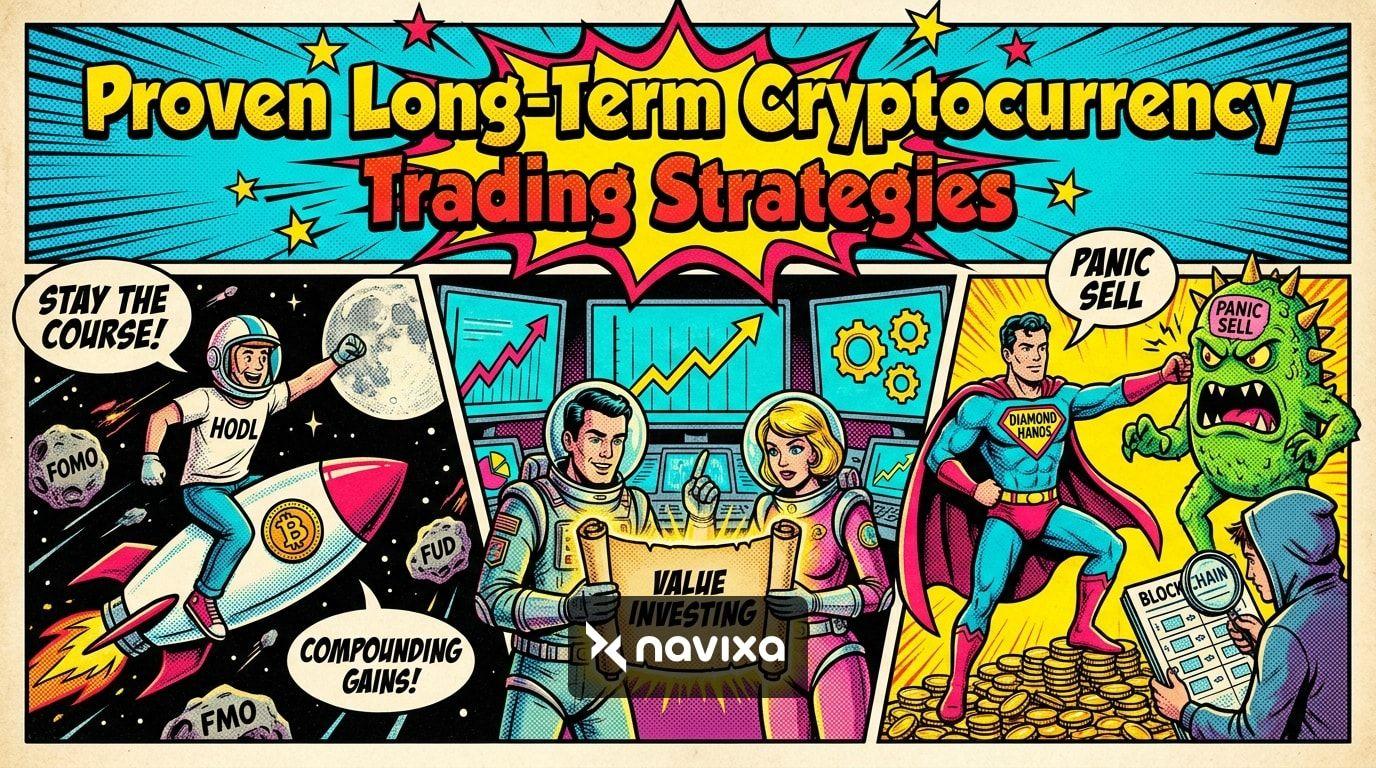
Perhaps the most challenging aspect of long-term cryptocurrency trading is managing your own psychology. The digital asset market operates 24/7/365, bombarding participants with an endless stream of Fear, Uncertainty, and Doubt (FUD), as well as Fear Of Missing Out (FOMO).
To succeed, you must cultivate emotional detachment. When the market experiences a 30% drawdown, novice traders panic sell; veteran long-term traders view it as a discount opportunity. By sticking rigorously to your DCA schedule, relying on your fundamental thesis, and limiting your daily exposure to sensationalist social media, you can maintain the mental clarity required to see your strategy through to fruition.
Practical Takeaways
To begin implementing these concepts immediately, follow this actionable checklist:
* Define Your Goals: Clearly outline your financial objectives and your time horizon (e.g., 3, 5, or 10 years). * Automate Your DCA: Set up recurring purchases on a trusted exchange to eliminate emotional interference. * Secure Your Assets: Transfer your long-term holdings to a hardware wallet. * Track High-Timeframe Metrics: Ignore hourly charts and focus on weekly moving averages and macro support levels. * Plan Your Exits: Write down the exact conditions under which you will take profits, and stick to that plan.
Conclusion
Mastering long-term cryptocurrency trading is a journey of discipline, continuous education, and psychological resilience. The days of treating the crypto market like a casino are fading, replaced by an era where strategic planning and fundamental analysis reign supreme. By leveraging strategies like Dollar-Cost Averaging, understanding tokenomics, and applying rigorous risk management, you position yourself to extract maximum value from this revolutionary asset class.
Stop chasing the daily noise. Step back, look at the macro picture, and start building a robust, resilient portfolio that can withstand the tests of time and market volatility.
***
Frequently Asked Questions
What is the most reliable long-term cryptocurrency trading strategy?
For the majority of investors, Dollar-Cost Averaging (DCA) combined with cold storage custody is the most reliable strategy. It mathematically reduces the impact of volatility, lowers the average cost basis over time, and completely removes the stress of trying to time unpredictable market bottoms.
How often should I rebalance a long-term crypto portfolio?
Portfolio rebalancing depends on your specific goals, but a quarterly or bi-annual review is standard for long-term investors. You might also consider threshold-based rebalancing—for example, if a single altcoin drastically outperforms and grows to represent over 40% of your portfolio, you may rebalance to lock in profits and redistribute risk.
Can technical analysis predict long-term macro trends?
While no tool can predict the future with 100% accuracy, high-timeframe technical analysis (such as weekly RSI, 200-day moving averages, and Fibonacci retracements) provides high-probability frameworks. These indicators help traders identify historical accumulation zones and distribution phases, giving them a significant edge over purely emotional traders.
Is it safe to leave long-term holdings on a cryptocurrency exchange?
No. While centralized exchanges have improved their security and regulatory compliance, leaving assets on an exchange exposes you to counterparty risk, potential platform insolvency, and hacking. Long-term holdings should always be stored in self-custodial hardware wallets where you control the private keys.
How do changing macroeconomic conditions affect long-term crypto trading?
Cryptocurrency is increasingly correlated with global macroeconomic factors such as interest rates, inflation data, and institutional liquidity. When central banks inject liquidity and lower interest rates, risk-on assets like crypto typically thrive. Long-term traders must stay informed about these macro trends to better anticipate broad market cycles.