
Introduction to Planet Labs (PL) Price Action
When it comes to trading disruptive technology companies, PL stock technical analysis is an essential skill for traders looking to capitalize on market volatility. Planet Labs PBC (ticker: PL) has positioned itself as a titan in Earth-imaging and geospatial data. As alternative data becomes a cornerstone for AI trading models and quantitative macro analysis, the demand for PL's satellite intelligence has surged, resulting in dynamic price movements on the charts.
Currently, PL stock has experienced a significant uptrend, trading in the mid-$30s range following robust revenue growth and expanding government defense contracts. For traders, this kind of momentum presents a golden opportunity. However, jumping into a high-momentum stock without a clear roadmap is a recipe for disaster.
"In trading, the trend is your friend, but the indicators are your roadmap."
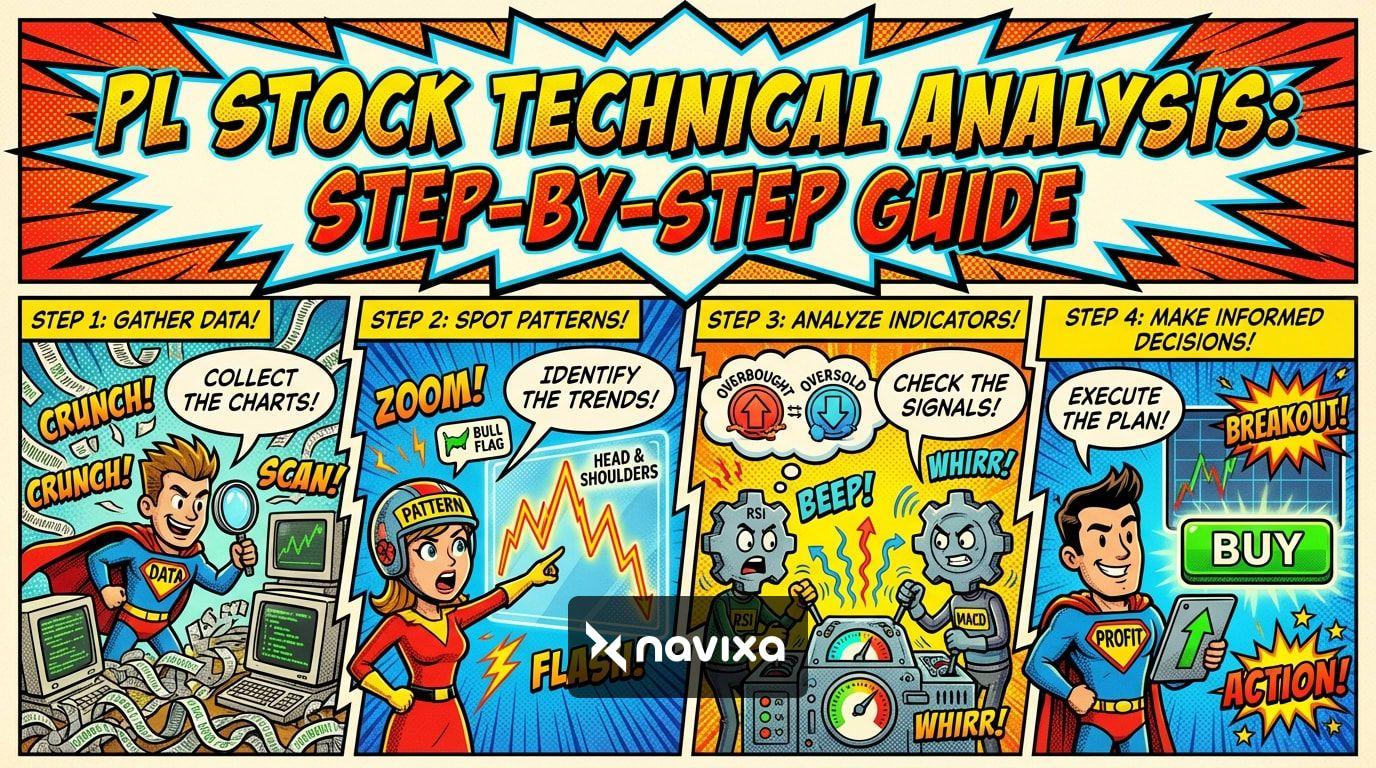
This step-by-step guide will walk you through a comprehensive technical analysis of PL stock. Whether you are a swing trader, a day trader, or a macro investor looking for an optimal entry point, mastering the charts is your first line of defense.
Understanding the Fundamental Catalyst
Before diving into moving averages and oscillators, it is crucial to understand the fundamental forces driving PL stock's technical setup. Technical analysis does not exist in a vacuum; it is the visual representation of mass psychology and fundamental catalysts.
Recently, Planet Labs reported total revenue exceeding $81 million, marking an impressive 33% year-over-year growth. Their Remaining Performance Obligations (RPO) surged significantly, fueled by defense and intelligence contracts in regions like Germany and Japan. This robust financial health has directly translated into bullish chart patterns. When fundamental strength aligns with technical breakouts, the probability of a successful trade increases exponentially.
Step 1: Chart Setup and Timeframe Selection
The foundation of any successful PL stock technical analysis is setting up your charting software correctly. Popular platforms like TradingView offer all the necessary tools to dissect price action.
Choosing the Right Timeframe
Depending on your trading style, you must select the appropriate timeframe: - Day Traders: Focus on the 5-minute and 15-minute charts to capture intraday volatility. - Swing Traders: The 1-hour and Daily (1D) charts are your primary battlegrounds. They filter out intraday noise and reveal the broader trend. - Position Traders: The Weekly (1W) chart provides a macro view of support and resistance over months or years.
For this guide, we will focus primarily on the Daily chart, as it provides the most reliable signals for short-to-medium-term trading strategies.
Step 2: Analyzing Moving Averages (MAs)
Moving averages smooth out price data to create a single flowing line, making it easier to identify the direction of the trend. For PL stock, we focus on the Simple Moving Average (SMA) and the Exponential Moving Average (EMA).
The 50-Day and 200-Day SMA
Currently, PL stock exhibits a classic Strong Buy signal based on its moving averages. With the price trading aggressively around the $33 to $34 mark, it sits comfortably above its 50-day SMA (approximately $26.67) and its 200-day SMA (approximately $24.86).
When the 50-day SMA crosses above the 200-day SMA, it creates a "Golden Cross," a historically bullish signal indicating long-term upward momentum. Traders should watch these levels closely. If PL stock begins to pull back, the 50-day SMA will serve as a critical dynamic support level.
Short-Term Momentum: 10-Day and 20-Day EMA
For traders looking for faster signals, the 10-day and 20-day EMAs are vital. Because EMAs give more weight to recent prices, they react faster to trend changes. A pullback to the 20-day EMA often presents a low-risk entry point in a strong uptrend.
Step 3: Decoding Momentum Indicators
While moving averages tell us the direction of the trend, momentum oscillators tell us the strength of that trend. They are particularly useful for identifying overbought or oversold conditions.
Relative Strength Index (RSI)
The RSI measures the speed and change of price movements on a scale of 0 to 100. Traditionally, an RSI above 70 indicates an overbought condition, while an RSI below 30 indicates an oversold condition.
As of the latest market data, PL stock's 14-day RSI is hovering around 74.48. This confirms that the stock is currently overbought. While an overbought RSI does not mean you should immediately short the stock—strong trends can stay overbought for extended periods—it does suggest that new long positions should be approached with caution. Traders might want to wait for the RSI to cool down towards the 50-60 range before initiating new swing longs.
Moving Average Convergence Divergence (MACD)
The MACD is a trend-following momentum indicator that shows the relationship between two moving averages. PL's MACD currently sits at a positive 2.26, indicating strong bullish momentum. When the MACD line crosses above the signal line, it triggers a buy signal. Conversely, if the MACD histogram begins to print smaller green bars or shifts to red, it may signal that bullish momentum is waning, hinting at a potential consolidation phase.
Step 4: Identifying Support and Resistance Levels
Support and resistance are the invisible floors and ceilings of the market. Identifying these levels is critical for setting entry points, take-profit targets, and stop-loss orders.
Based on recent pivot point calculations for PL stock: - Immediate Support (S1): $32.93 - Major Support (S2): $28.00 (aligning closely with the 50-day moving average) - Immediate Resistance (R1): $33.62 - Major Resistance Target: $40.00 (aligning with Wall Street analyst high forecasts)
If PL breaks above the $33.62 resistance with high trading volume, it could trigger a continuation of the rally toward the $40.00 target. However, a breakdown below $32.93 could see the price retracing to test the moving average supports in the high $20s.
The Intersection of Alternative Data and Technical Analysis
As a trader specializing in modern markets, including crypto and AI-driven systems, it is impossible to ignore how Planet Labs' core product—geospatial data—intersects with algorithmic trading. Quantitative hedge funds use PL's satellite images to monitor global supply chains, track oil reserves, and measure agricultural yields.
This alternative data feeds into automated trading algorithms, influencing macro market movements. When you conduct a PL stock technical analysis, you are essentially charting the market's valuation of a company that powers the very AI algorithms used by institutional traders. This creates a meta-layer of volatility, making PL highly responsive to both tech-sector trends and macroeconomic shifts.
Top Trading Strategies for PL Stock
Armed with technical indicators, how do you actually execute trades? Here are three proven strategies for trading Planet Labs stock.
1. The Breakout Strategy
This strategy involves entering a trade when the price moves outside a defined support or resistance level with increased volume. If PL consolidates between $32 and $34 for several days, forming a "bull flag" pattern, traders will place a buy-stop order just above the $34.00 resistance. The surge in volume confirms the breakout, and the stop-loss is placed just below the consolidation pattern.
2. The EMA Pullback Strategy
Since PL is in a strong uptrend, chasing the stock at the top can be risky (as indicated by the 74+ RSI). Instead, wait for a natural market correction. When the price dips to touch the 20-day EMA, watch for a reversal candlestick pattern (like a hammer or a bullish engulfing candle). This provides a high-probability entry with a tight stop-loss.
3. Gap-and-Go Trading
Earnings reports and major government contract announcements often cause PL to "gap" up or down at the market open. In a Gap-and-Go scenario, if PL opens significantly higher and sustains the first 15 minutes of buying pressure, momentum day traders will buy the stock, riding the institutional volume for quick intraday profits.
Technical Indicators Comparison for Planet Labs
To summarize the current technical posture of PL stock, review the comparison table below, which contrasts the signals provided by different timeframes and indicators.
| Indicator / Metric | Current Value | Signal Implication | Trader Action |
|---|---|---|---|
| 50-Day SMA | ~$26.67 | Strong Uptrend | Hold / Buy on dips |
| 200-Day SMA | ~$24.86 | Long-term Bullish | Confirm trend direction |
| 14-Day RSI | 74.48 | Overbought | Caution on new longs |
| MACD (12,26) | +2.26 | Bullish Momentum | Trail stop-losses |
| Volume Trend | Increasing | Trend Confirmation | Validate breakouts |
Risk Management: The Golden Rule of Trading
No PL stock technical analysis is complete without a robust risk management framework. Even the most perfect technical setups can fail due to unexpected news or broader market sell-offs. For more foundational knowledge on protecting your capital, refer to the Investopedia Technical Analysis Guide.
1. Position Sizing: Never risk more than 1% to 2% of your total trading account on a single trade. If your account is $10,000, your maximum loss on a PL trade should be $100 to $200. 2. Strict Stop-Losses: Always place a hard stop-loss. If you buy PL at $33 based on a 20-day EMA bounce, place your stop-loss slightly below the EMA (e.g., $31.50) to invalidate the trade if the trend breaks. 3. Take Profit Scaling: Because PL can be highly volatile, consider scaling out of your position. Sell 50% of your shares when you hit a 2:1 risk-to-reward ratio, and let the remaining 50% ride the trend with a trailing stop.
Frequently Asked Questions
Is PL stock a buy, sell, or hold based on technicals?
Based on the convergence of moving averages (MA5 to MA200), PL exhibits a "Strong Buy" signal. However, because short-term momentum oscillators like the RSI are in overbought territory (74.48), aggressive new entries should be approached with caution. A "Hold" or waiting for a pullback to support is a prudent strategy.
What are the major moving averages indicating for Planet Labs?
The 50-day SMA is well above the 200-day SMA, indicating a sustained long-term uptrend. The price is currently trading above both of these key levels, which act as major dynamic support floors in the event of a market correction.
What is the current resistance level for PL?
Immediate technical resistance is found near the recent highs of $33.62. If the stock breaks through this level with significant volume, the next major psychological and technical resistance target forecasted by Wall Street analysts is the $40.00 mark.
How do alternative data and fundamentals impact PL's charts?
Planet Labs generates geospatial data used heavily by quantitative funds and AI systems. When the company announces new government or defense contracts, or reports revenue surges—like their recent 33% YoY growth to over $81 million—it creates massive influxes of institutional volume, which directly forms the explosive breakout patterns seen on the charts.
Conclusion
Mastering PL stock technical analysis requires a blend of patience, discipline, and a deep understanding of market mechanics. Planet Labs PBC is a fundamentally strong company with a chart that currently reflects overwhelming bullish sentiment.
By systematically applying the tools discussed in this guide—from moving averages and MACD crossovers to rigorous risk management—you can navigate the volatility of PL stock with confidence. Always remember to let the charts dictate your actions rather than emotions. Set your support and resistance lines, wait for the perfect setup, and execute your trades flawlessly.