
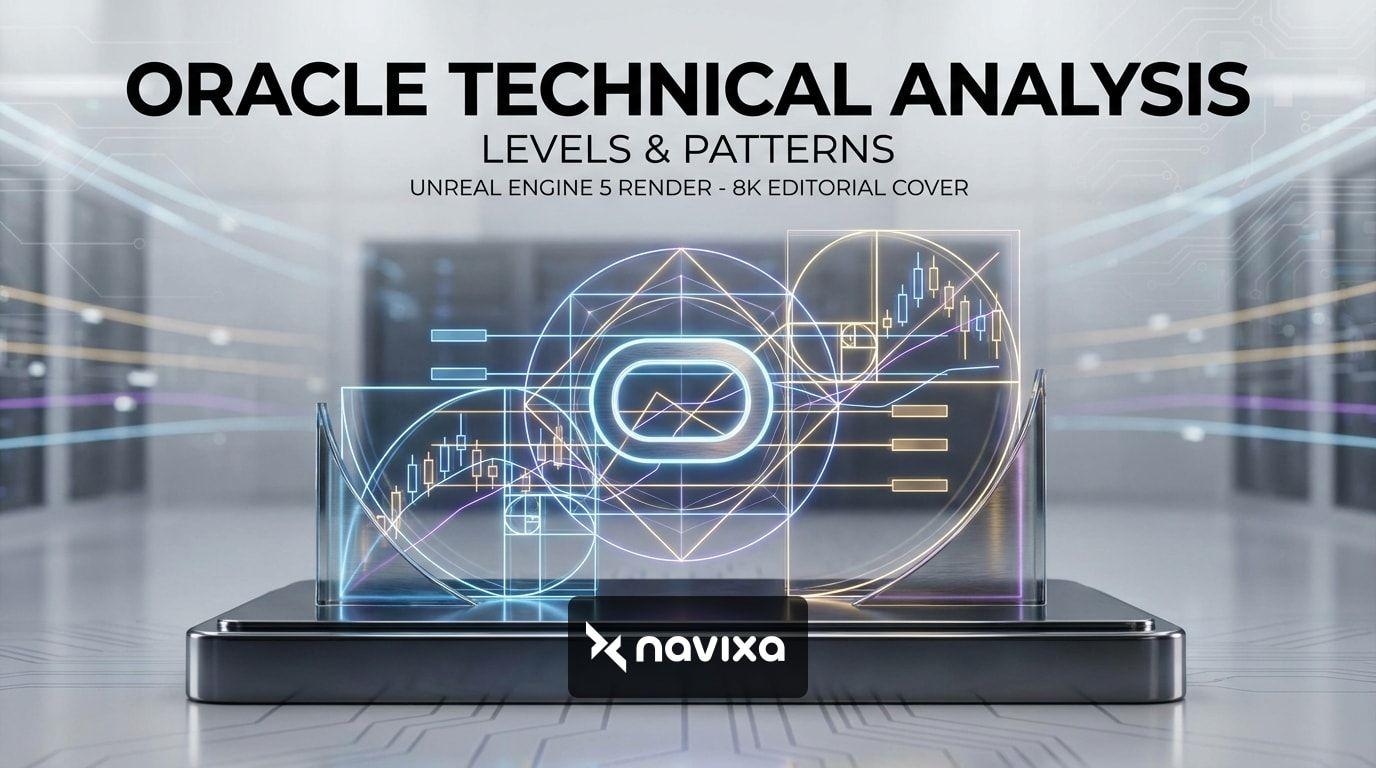
The Intersection of Fundamentals and Oracle Stock Technical Analysis
The landscape of enterprise technology has undergone a seismic shift, and few companies embody this transformation quite like Oracle Corporation (NYSE: ORCL). Once viewed primarily as a legacy relational database provider, Oracle has reinvented itself as a powerhouse in artificial intelligence (AI) and cloud infrastructure. For active traders and long-term investors alike, mastering Oracle stock technical analysis is critical to navigating the extreme volatility that has characterized the stock's recent market cycles.
Technical analysis is never performed in a vacuum. To truly understand the supply and demand dynamics printed on the ORCL price chart, one must acknowledge the massive institutional capital flowing into the tech sector. By analyzing candlestick patterns, volume profiles, and momentum oscillators, traders can pinpoint high-probability entry and exit zones. This comprehensive guide will dissect Oracle's current technical posture, key chart patterns, and actionable strategies to help you navigate its price action effectively.
The Fundamental Catalyst: Q3 FY2026 Earnings Breakdown
Before diving into the charts, we must contextualize the price action with the latest fundamental data. Technical breakouts are often triggered by fundamental catalysts, and for Oracle, the March 2026 earnings report served as a massive volatility event.
On March 10, 2026, Oracle released its fiscal Q3 2026 results, delivering a significant beat that immediately altered its short-term technical trajectory. The company reported adjusted earnings per share (EPS) of $1.79 (beating the $1.70 consensus) and total revenue of $17.19 billion, representing a 22% year-over-year increase. More importantly, Oracle's Cloud Infrastructure (IaaS) revenue skyrocketed by 84%, and its Remaining Performance Obligations (RPO)—a critical metric for future contracted revenue—reached a staggering $553 billion, up 325% year-over-year.
"A stock's technical posture is inextricably linked to its fundamental catalysts. For Oracle, the transition from legacy software to an AI cloud infrastructure giant has created extreme price volatility, offering lucrative opportunities for astute technical traders."
Despite concerns over a massive $50 billion capital expenditure commitment to build AI data centers—which previously drove the stock down—the sheer volume of future revenue visibility triggered a massive influx of institutional buying, resulting in a pronounced post-earnings technical gap-up.
Oracle Stock Technical Analysis: The Macro View
The Historical 2025 Peak and Subsequent Correction
To perform an accurate Oracle stock technical analysis, we must zoom out to the weekly and monthly timeframes. In September 2025, driven by euphoric AI sentiment and aggressive cloud infrastructure contract announcements, ORCL reached an all-time high of $345.72. However, parabolic advances rarely sustain themselves without periods of mean reversion.
Over the following six months, Oracle entered a severe cyclical correction within its broader secular bull market. Concerns over negative free cash flow, ballooning debt, and the capital intensity of scaling AI data centers caused institutional investors to take profits. By early March 2026, ORCL had depreciated by more than 50%, trading down into the $148 to $152 range. This aggressive sell-off structurally reset the technical landscape, clearing out weak hands and establishing a new base of operations for long-term buyers.
Fibonacci Retracement and Market Structure
Applying Fibonacci retracement tools from the pre-AI breakout lows to the $345.72 peak reveals that the recent drop into the $150 region perfectly aligns with the 61.8% to 78.6% retracement zone—often referred to by technical analysts as the "golden pocket." This area historically acts as a massive liquidity pool where algorithmic trading systems and institutional value investors begin to aggressively accumulate shares. The stabilization at this level strongly suggests that the macro market structure remains intact, transitioning from a markdown phase into an accumulation phase.
Key Chart Patterns and Price Action
Descending Channel and Breakaway Gap
On the daily timeframe, Oracle's price action from October 2025 to early March 2026 formed a textbook descending channel. This pattern is characterized by lower highs and lower lows, bound by two parallel downward-sloping trendlines.
However, the technical narrative shifted dramatically following the Q3 2026 earnings release. The stock printed a powerful "Breakaway Gap" in after-hours and early morning trading, slicing straight through the upper resistance line of the descending channel. In technical analysis, a breakaway gap on high relative volume signifies a high-probability trend reversal. The gap leaves trapped short-sellers scrambling to cover their positions, which inadvertently fuels further upward momentum.
Moving Average Dynamics: The Path to Recovery
Moving averages are essential trend-following indicators. During the prolonged correction, ORCL experienced a "Death Cross"—where the 50-day Simple Moving Average (SMA) crossed below the 200-day SMA—signaling deep bearish momentum.
Currently, the price action is attempting to reclaim these pivotal levels. The breakaway gap has pushed the price aggressively toward the 50-day SMA, which sits near the $175 level. A sustained daily close above the 50-day SMA would be the first major confirmation that the intermediate-term trend has shifted from bearish to bullish. The 200-day SMA, hovering around the $210 to $220 mark, now serves as a primary upside price target for swing traders.
Technical Indicators Deep Dive
Relative Strength Index (RSI) and Momentum
The Relative Strength Index (RSI) is a momentum oscillator that measures the speed and change of price movements on a scale of 0 to 100. Prior to the March earnings report, the daily RSI for Oracle was deeply submerged in oversold territory (below 30). Historically, whenever ORCL's RSI drops below 30, it precedes a sharp relief rally.
Following the recent fundamental catalyst, the RSI has sharply pivoted upwards, crossing the neutral 50 centerline. This bullish divergence indicates that selling pressure has exhausted itself, and upside momentum is rapidly accelerating.
MACD (Moving Average Convergence Divergence)
The MACD is another foundational tool in Oracle stock technical analysis. By tracking the relationship between two moving averages of a security’s price, it helps identify trend direction and strength. On the daily chart, the MACD line (the fast line) has just crossed above the signal line (the slow line) while still below the zero baseline. This specific formation—a bullish crossover deep in negative territory—is widely regarded as one of the most reliable early-warning signals of a macroeconomic bottom.
Volume Profile and Institutional Accumulation
Price action without volume is simply market noise. The volume profile on Oracle's chart is incredibly telling. During the slow grind down from $345 to $150, selling volume steadily contracted, indicating a lack of aggressive distribution at lower prices. Conversely, the breakout in March 2026 was accompanied by a massive volume spike—trading tens of millions of shares well above the 29 million average daily volume. This volume expansion validates the price move, confirming that deep-pocketed institutional buyers are stepping in to accumulate shares based on the $553 billion RPO backlog.
Technical Indicators Summary Table
To summarize the current technical posture of Oracle (ORCL), the following table provides a snapshot of key indicators and their corresponding trading signals based on the March 2026 data.
| Indicator / Metric | Current Reading (Post-Q3 2026) | Technical Signal |
|---|---|---|
| Relative Strength Index (RSI) | Rebounding from 28 to 55 | Bullish Reversal / Momentum Shift |
| MACD | Fast line crossed above Signal line | Strong Buy Signal |
| 50-Day Moving Average | ~$175.50 | Price approaching from below (Key Resistance) |
| 200-Day Moving Average | ~$210.00 | Long-term Target / Macro Resistance |
| Trading Volume | Surging >50M shares on earnings | Institutional Accumulation / Trend Validation |
| Price Pattern | Breakaway Gap / Channel Breakout | Bullish Trend Reversal |
For real-time updates on these indicators, traders frequently utilize charting platforms like TradingView and financial screeners such as Finviz.
Critical Support and Resistance Levels
Successful trading requires a clear map of the battlefield. Based on historical price memory and liquidity zones, here are the critical levels to monitor for ORCL:
Immediate Support Zones
* $145 - $152 (The Fundamental Floor): This area served as the ultimate capitulation point prior to the Q3 2026 earnings. It represents a massive demand zone. Any retest of this level should be viewed as a high-value buying opportunity, provided broader market conditions remain stable. * $160 (Gap Fill Support): Gaps in technical analysis often act as magnets for price. If the initial earnings euphoria fades, the stock may attempt to retrace and "fill the gap" down to $160 before resuming its upward trajectory.
Overhead Resistance Targets
* $175 (50-Day SMA): The first major test for the bulls. Overcoming the declining 50-day moving average is required to attract momentum-based algorithmic buying. * $210 - $220 (200-Day SMA & Supply Zone): This area represents the next major structural hurdle. It coincides with the long-term 200-day moving average and a previous consolidation zone from late 2025 where many retail traders may be trapped and looking to exit at breakeven. * $280+ (Wall Street Consensus Target): If the technical breakout is sustained and Oracle's massive AI backlog begins converting into recognized revenue at higher margins, the stock will likely target the $280 to $300 region over the medium-to-long term, filling the massive void left by the recent crash.
Actionable Trading Strategies for ORCL
Strategy 1: The Gap-and-Go Breakout
For momentum traders, the "Gap-and-Go" strategy is highly effective in this scenario. This involves entering a long position as the stock holds its post-earnings gap and breaks above the first 15-minute or 1-hour candle high. The thesis is that institutional demand is so overwhelming that the stock will not fill the gap in the near term. A trailing stop-loss can be placed just below the gap's lower boundary to protect capital.
Strategy 2: Swing Trading the Consolidation
For more conservative traders, waiting for the initial volatility to subside is the optimal approach. Often, after a massive breakaway gap, a stock will consolidate sideways for several days or weeks, forming a "bull flag" or "pennant" pattern. Buying near the lower support line of this consolidation phase allows for a highly asymmetric risk-to-reward ratio. You can hold the position as the stock predictably stair-steps toward the 200-day moving average.
Risk Management and Stop-Loss Placement
No Oracle stock technical analysis is complete without a stringent risk management framework. While the upside potential for ORCL is significant given its $553 billion backlog and 84% cloud infrastructure growth, the tech sector remains vulnerable to macroeconomic shocks, interest rate fluctuations, and AI sentiment shifts.
Traders should always employ position sizing rules, risking no more than 1% to 2% of their total account equity on a single trade. For long positions initiated in the $160 range, a hard stop-loss placed just below the recent swing low of $145 ensures that if the breakout fails and the market structure breaks down, catastrophic losses are avoided. Remember, preserving capital in volatile markets is just as important as capturing upside alpha.
Frequently Asked Questions
Why did Oracle stock drop so drastically from its 2025 highs?
Oracle experienced a massive parabolic rally, peaking at $345.72 in September 2025, driven by AI market euphoria. However, the stock corrected sharply down to the $150 region by early 2026. This aggressive drawdown was primarily due to institutional concerns over Oracle's massive $50 billion capital expenditure (capex) commitments required to build out its AI data centers. This heavy spending temporarily pushed free cash flow into negative territory and increased long-term debt, triggering a repricing of the stock despite strong overall revenue growth.
Is ORCL a buy based on current technical analysis?
From a purely technical standpoint, Oracle is presenting a highly compelling risk-to-reward setup as of March 2026. The stock recently printed a bullish breakaway gap on massive volume, breaking out of a multi-month descending channel. With momentum indicators like the RSI and MACD rebounding from deeply oversold levels, technical traders view the current posture as a strong buy signal, provided the stock holds its key support above $145.
What are the most important support and resistance levels for Oracle right now?
Currently, the absolute foundational support level sits between $145 and $152, marking the recent capitulation bottom. An intermediate support level is at $160, serving as the post-earnings gap-fill line. On the upside, traders are watching $175 (the 50-day moving average) as immediate resistance, with major macro resistance sitting between $210 and $220.
How does the $553 billion RPO affect Oracle's technical chart?
Fundamentally, Remaining Performance Obligations (RPO) represent contracted future revenue. While it is a fundamental metric, it heavily influences technical charts by creating a "valuation floor." When institutional investors see a massive $553 billion backlog, they utilize algorithmic systems to aggressively buy dips at technical support levels (like the 61.8% Fibonacci retracement). This institutional buying volume is what forms the strong support zones and bullish chart patterns visible to retail traders.
Conclusion
Conducting a thorough Oracle stock technical analysis reveals a compelling narrative of a tech titan transitioning through a period of extreme capital intensity into a phase of unprecedented revenue visibility. The steep correction from the 2025 highs has washed out speculative excess, leaving behind a highly attractive technical setup.
With a confirmed breakaway gap, rebounding momentum indicators, and an influx of institutional volume driven by exceptional Q3 2026 earnings, ORCL is well-positioned for a sustained recovery. Whether you are an active day trader capitalizing on volatility or a swing trader targeting the 200-day moving average, adhering to strict risk management and respecting key support and resistance levels will be your blueprint for success. Stay vigilant, monitor the moving averages, and always let the price action dictate your final trading decisions. For further detailed financial reports, investors should regularly consult Oracle Investor Relations.