
Introduction to On-Chain Crypto Trading
Most retail traders rely entirely on price charts, technical indicators, and market sentiment to make decisions. They wait for moving averages to cross or for the Relative Strength Index (RSI) to signal oversold conditions. Meanwhile, institutional investors, algorithmic traders, and "smart money" are utilizing a much more powerful dataset: the blockchain itself.
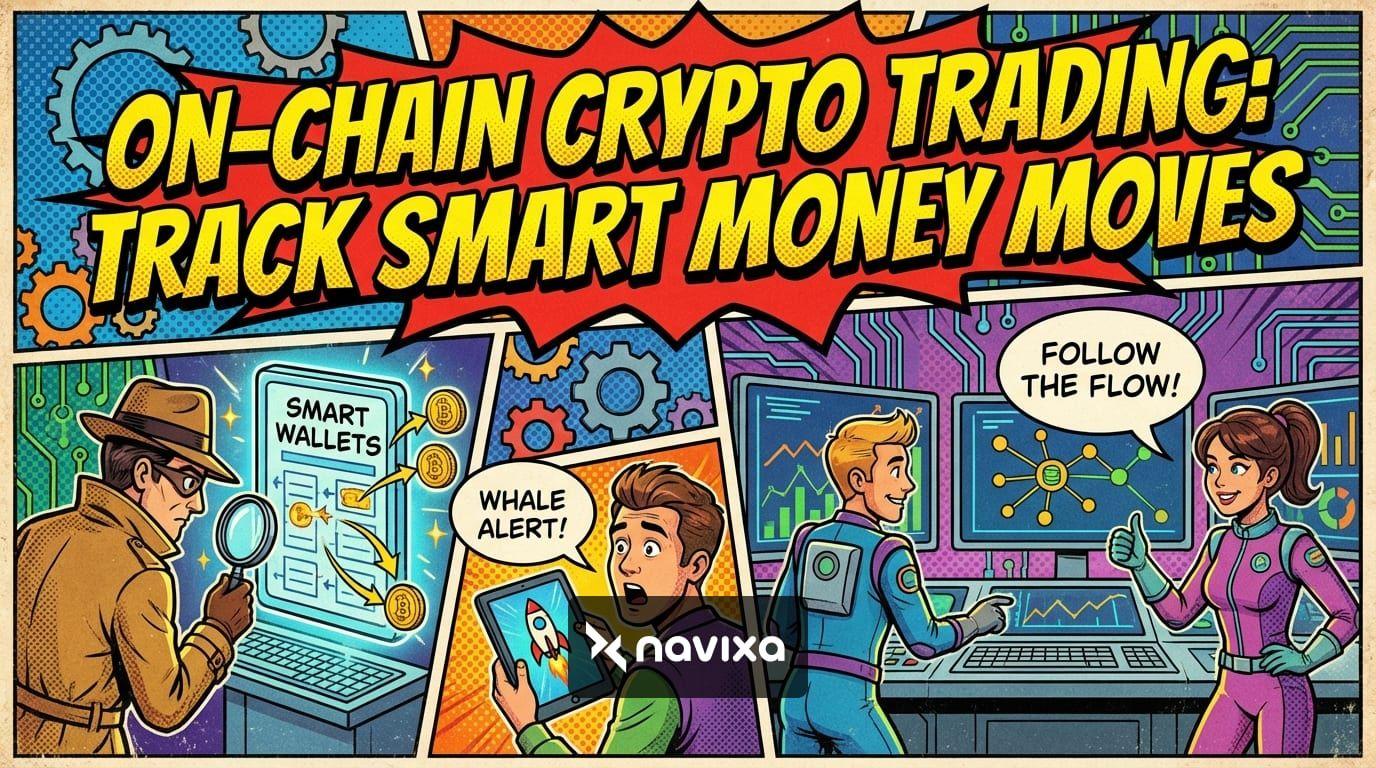
Welcome to the world of on-chain crypto trading. Unlike traditional financial markets—where institutional capital flows, dark pool trades, and broker-dealer inventories are hidden behind closed doors—cryptocurrency networks operate on transparent public ledgers. Every transaction, wallet balance, and contract interaction is permanently recorded and broadcasted in real-time. By leveraging this transparency, traders can track exactly where the most profitable market participants are moving their capital.
Recent market data highlights why this is critical. Decentralized Exchange (DEX) market share of spot trading volume has steadily trended upwards, capturing roughly 14% of the global market, with absolute spot trading volumes on DEXs surpassing the $230 billion mark. In high-performance ecosystems, DEX volumes are reaching staggering highs—such as Solana's decentralized exchanges processing over $117 billion in a single month. To navigate a market with this much decentralized capital flow, mastering on-chain analysis is no longer optional; it is a fundamental requirement.
What is On-Chain Crypto Trading?
At its core, on-chain crypto trading is the practice of analyzing raw blockchain data to make informed buying or selling decisions. Instead of looking at a stock's quarterly earnings report, you are looking at real-time supply and demand dynamics natively on the network.
"Trading without on-chain data is like playing high-stakes poker without looking at your own cards. The blockchain provides a transparent, immutable ledger of every move your opponents make."
Traditional Technical Analysis (TA) is reactive. It tells you what the price has already done. On-chain analysis is proactive. It tells you what network participants are doing *before* that action reflects significantly on the exchange price. For example, if a whale wallet that has been dormant for three years suddenly moves $50 million worth of Ethereum to a centralized exchange deposit address, on-chain traders know immediately that severe selling pressure is likely imminent.
By analyzing network activity, you can categorize participants into different cohorts: short-term holders, long-term holders, miners, and exchanges. Understanding how these distinct groups behave during various market phases gives you a definitive edge.
Why On-Chain Analysis Beats Traditional Indicators
The major limitation of traditional trading indicators is that they are entirely derived from price and volume. While useful, they lack the context of *who* is trading and *why*.
Real-Time Capital Flow
If Bitcoin drops 5%, TA might indicate a bearish breakdown. But on-chain crypto trading tools might reveal that the drop was manufactured by low-volume retail panic, while massive institutional wallets were simultaneously accumulating heavily.
Entity-Level Intelligence
Modern analytical platforms have evolved beyond simple network scanning. With the advent of AI clustering, platforms can now track entities rather than just disjointed alphanumeric wallet addresses. This means you can monitor the exact movements of nation-states (like massive governmental Bitcoin treasuries), massive asset managers, and prominent venture capital firms.
Decentralized Finance (DeFi) Visibility
With the rise of automated market makers (AMMs) and liquidity pools, a vast amount of trading occurs entirely on-chain. Monitoring smart contract interactions, liquidity pool depths, and token approvals provides unparalleled insight into decentralized market trends before they hit centralized exchanges like Binance or Coinbase.
Core Metrics to Track Smart Money Moves
To build a successful strategy around on-chain crypto trading, you must understand the foundational metrics that drive market cycles.
1. Exchange Inflows and Outflows
One of the most immediate signals of market intent is the movement of assets to and from centralized exchanges. * Exchange Inflows: When large amounts of a cryptocurrency are transferred from private cold wallets to exchange wallets, it typically indicates an intent to sell or trade, increasing the available supply and creating downward price pressure. * Exchange Outflows: When users withdraw their assets from exchanges to private cold storage, it signals accumulation and a long-term holding mindset. This reduces the liquid supply, making price appreciation more likely if demand remains constant.
2. NUPL (Net Unrealized Profit/Loss)
NUPL maps the total paper profits or losses held by all investors, normalized against the market capitalization. It calculates the difference between the current price and the price at which every coin was last moved. * When NUPL reaches extreme highs (Euphoria), it means the vast majority of the network is deeply in profit, historically signaling a market top. * When NUPL plunges below zero (Capitulation), the market is holding at a loss, signaling a deep macro bottom.
3. MVRV Z-Score
The Market Value to Realized Value (MVRV) Z-Score helps identify when an asset is heavily overvalued or undervalued relative to its "fair value." It compares the total market capitalization to the realized capitalization (the value of all coins at the price they were last moved). A low MVRV Z-Score suggests an asset is undervalued with room for growth, while a score above 7 traditionally screams extreme overvaluation.
4. Whale Tracking and Smart Money Labels
"Smart money" refers to entities with a proven track record of profitability, large institutional funds, or algorithmic bots that consistently outperform retail traders. Tracking their specific wallet addresses allows you to mimic their entry and exit points. If an address that accurately top-ticked the last bull run suddenly starts heavily accumulating a new decentralized finance token, it warrants immediate investigation.
Top Tools for On-Chain Crypto Trading
To execute an on-chain strategy, you need platforms that decode raw hexadecimal blockchain data into readable, actionable dashboards. Below is a comparison of the industry's leading tools.
| Platform | Best For | Key Features | Pricing Tier |
|---|---|---|---|
| Arkham Intelligence | Entity Tracking & Real-Time Alerts | AI clustering, Intel Exchange, Mobile trading app | Free (with enterprise options) |
| Nansen | Smart Money Tracking & DeFi | Token God Mode, labeled wallet tracking, DEX trades | Paid (Premium subscriptions) |
| Glassnode | Macro Network & Cycle Analysis | Advanced metrics (NUPL, MVRV), institutional charts | Freemium / High-tier Paid |
| Dune Analytics | Custom Dashboards & Niche Protocols | SQL-based custom queries, community-built visual charts | Free / Paid for private data |
*Note: The tools you choose should align with your specific trading style. Day traders benefit highly from Nansen and Arkham, while swing and macro traders often rely on Glassnode.* For further exploration into entity-level intel, you can check out Arkham Intelligence or look at macro trends via Glassnode.
Building Your On-Chain Crypto Trading Strategy
Having access to on-chain data is only half the battle; the real skill lies in interpreting the data and executing a disciplined trading strategy. Here is a step-by-step framework for integrating on-chain analysis into your routine.
Step 1: Establish the Macro Context
Before taking any short-term trades, check the macro on-chain indicators. Look at the MVRV Z-Score and Bitcoin's NUPL. Are we in a phase of capitulation, hope, optimism, or euphoria? Additionally, monitor institutional flows. For instance, analyzing ETF inflow and outflow data provides critical context regarding traditional finance's appetite for digital assets.
Step 2: Monitor Liquidity and DEX Volumes
Liquidity acts as a magnet for price. By monitoring liquidity heatmaps and volume spikes on Decentralized Exchanges (DEXs), you can identify where the market is most active. For example, sustained high volume on high-speed DEXs indicates network vitality and potential upside for ecosystem tokens. You can track this broad market data using aggregators like CoinGecko.
Step 3: Track the Smart Money Activity
Use tools like Nansen or Arkham to identify trending smart contracts. If you notice a sudden surge in unique active wallets interacting with a newly deployed protocol, and a significant portion of those wallets carry a "Smart Money" label, it represents an asymmetric risk-to-reward opportunity. Investigate the protocol, assess the tokenomics, and consider shadowing the trade.
Step 4: Watch for Distribution Signals
Knowing when to sell is arguably harder than knowing when to buy. Set real-time alerts for the wallets of token founders, foundation treasuries, and early venture capital backers. If a project team suddenly moves millions of dollars' worth of their native token to a public exchange, it is a glaring red flag that distribution (selling) is about to occur.
Risk Management and Limitations
While on-chain crypto trading offers a massive informational advantage, it is not a crystal ball. There are inherent risks and limitations that traders must manage.
* Wallet Splitting and Obfuscation: Sophisticated whales know they are being watched. To avoid causing market panic or front-running, they will often split massive transactions into thousands of smaller wallets, or route funds through privacy mixers and zero-knowledge protocols. * OTC Trades: A large exchange inflow does not always equal an immediate market dump. Many large entities execute Over-The-Counter (OTC) trades. The coins are transferred to an exchange's OTC desk to be traded directly with another institution without immediately affecting the open market order book. * Data Latency: While blockchains are real-time, block times vary. Ethereum produces a block roughly every 12 seconds, while Bitcoin takes about 10 minutes. In high-frequency trading environments, this latency means you might be slightly behind institutional bots that are hardcoded directly into validator nodes.
Always use on-chain metrics as a confluence factor alongside technical analysis and fundamental research. Never trade solely based on a single metric or a solitary wallet movement.
Conclusion
The evolution of digital asset markets has fundamentally shifted the balance of power. What was once proprietary data reserved for Wall Street elites is now freely available on public blockchains. On-chain crypto trading empowers retail and professional traders alike to peel back the curtain and observe the raw, unfiltered mechanics of capital flow.
By mastering metrics like exchange flows, NUPL, and entity tracking, you can strip away the emotional noise of the market and align your portfolio with the moves of smart money. As the crypto ecosystem continues to mature and decentralized trading captures larger market shares, those who can accurately read the blockchain will hold the ultimate edge. Stop reacting to the past, and start tracking the data that dictates the future.
Frequently Asked Questions
What is the best free tool for on-chain analysis?
Arkham Intelligence is widely considered one of the best free tools for entity-level tracking and real-time wallet alerts. Dune Analytics is also a powerful free platform if you are comfortable reading or writing SQL queries to view custom community dashboards.
Does on-chain analysis work for day trading?
Yes, but it requires highly responsive tools. Day traders utilize on-chain analysis by tracking immediate liquidity shifts, DEX volume spikes, and real-time large transactions (whale tracking). However, macro indicators like NUPL are better suited for swing trading and long-term investing.
How do I know if a wallet belongs to a whale or an exchange?
Most top-tier on-chain platforms use advanced clustering algorithms and heuristic analysis to label wallets automatically. They identify exchange wallets by analyzing the sheer volume of unique incoming and outgoing transactions that match known deposit addresses and hot wallet behaviors.
Can whales fake their on-chain data?
Yes, sophisticated participants can engage in "wallet spoofing" or send tokens to high-profile addresses to create false narratives. They may also utilize Over-The-Counter (OTC) markets, which settle large trades off the public order books, meaning a massive on-chain movement might not immediately crash the retail price.
What is the difference between CEX and DEX on-chain trading?
Trading on a Centralized Exchange (CEX) happens off-chain on the exchange's internal servers; only deposits and withdrawals are recorded on the blockchain. Decentralized Exchange (DEX) trading executes completely on-chain via smart contracts, making every single trade, liquidity provision, and token swap visible in real-time.