
Trading Nvidia (NVDA) is no longer just about analyzing corporate earnings or semiconductor supply chains; it has evolved into a masterclass in behavioral finance. With the company firmly cementing itself as the undisputed backbone of the global artificial intelligence boom, its stock movements often resemble the high-octane volatility typically reserved for the cryptocurrency market. For retail traders and institutional investors alike, mastering Nvidia trading psychology is the single most critical factor in determining long-term profitability.
As Nvidia's market capitalization shatters the $4.4 trillion mark, driven by staggering quarterly revenues exceeding $68 billion, the emotional pull of the stock is undeniable. The sheer momentum of the artificial intelligence narrative can easily cloud a trader's judgment, leading to impulsive decisions fueled by market noise rather than empirical data. This comprehensive guide explores the psychological hurdles of trading high-growth assets like Nvidia, offering actionable strategies to master your risk, conquer FOMO (Fear Of Missing Out), and build a resilient trading mindset.
The Allure of Nvidia: Why It Tests Your Mindset
To understand why Nvidia elicits such intense emotional reactions from traders, one must look at its unprecedented market trajectory. The transition from a gaming GPU manufacturer to the architect of modern "AI factories" has resulted in astronomical financial growth. When networking revenue surges by over 260% and data center dominance remains virtually unchallenged, the financial media amplifies every minor price fluctuation into a major news event.
This relentless media coverage creates a hyper-emotional trading environment. Traders are constantly bombarded with bullish price targets, geopolitical updates regarding export restrictions, and macroeconomic data. Navigating this landscape requires emotional detachment, a trait that is incredibly difficult to maintain when a single asset dominates the global financial conversation.
The FOMO Trap
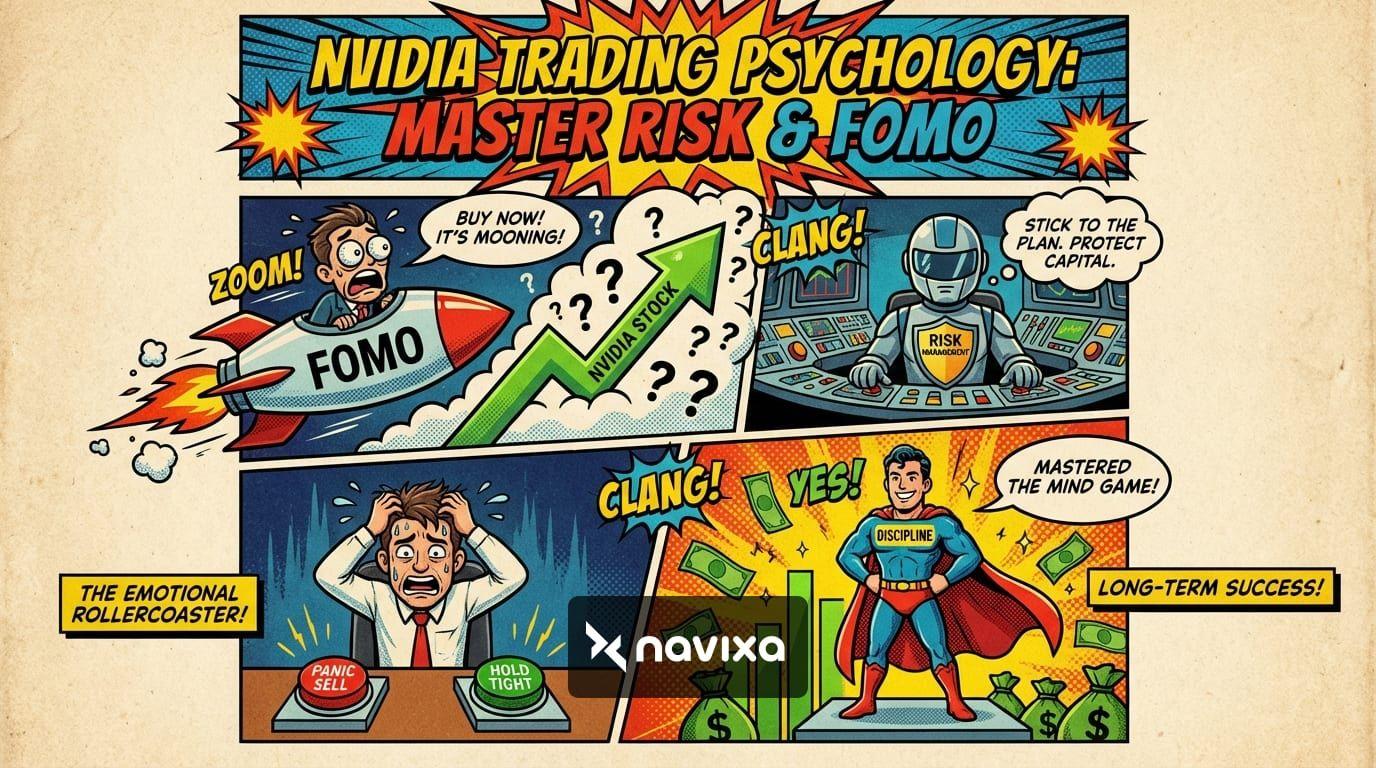
Fear Of Missing Out (FOMO) is perhaps the most destructive emotion a trader can experience. Imagine waking up to find Nvidia shares up 4% in pre-market trading due to a newly announced AI partnership or a better-than-expected earnings report. The immediate psychological response is a profound sense of urgency. Traders often abandon their premeditated strategies, scrambling to buy at the top simply because they fear missing out on the "next big leg up."
"The market is a device for transferring money from the impatient to the patient." — Warren Buffett
Falling into the FOMO trap usually leads to buying at local peaks. When the inevitable intraday pullback occurs, the trader is immediately placed in a losing position, triggering a cascade of secondary emotional responses, such as panic and regret.
The FUD Factor
Conversely, FUD (Fear, Uncertainty, and Doubt) plays an equally disruptive role in Nvidia trading psychology. Because Nvidia carries such a massive valuation, it is highly sensitive to macroeconomic shifts, such as changes in the Federal Reserve's interest rate policies or geopolitical tensions. When negative news breaks, the stock can experience rapid, sharp drawdowns. Traders who lack conviction or a solid risk management plan are often shaken out of their positions at the exact wrong time, selling at the bottom just before a structural rebound.
Core Psychological Biases in NVDA Trading
To master Nvidia trading psychology, you must first identify the subconscious biases that influence your decision-making. Awareness is the first step toward mitigation.
Recency Bias
Recency bias is the tendency to heavily weigh the latest events over historical data. Because Nvidia has experienced monumental rallies in recent years, many traders inherently expect the stock to continuously replicate those exact percentages in the exact same timeframes. This bias blinds traders to the reality of market cycles, leading them to hold leveraged positions during periods of consolidation when they should be taking profits.
Confirmation Bias
When a trader opens a long position on Nvidia, they often fall victim to confirmation bias. This occurs when an individual actively seeks out information that supports their existing beliefs while ignoring contradictory evidence. A trader might read dozens of articles praising Nvidia's new Blackwell architecture while completely dismissing reports about supply chain constraints or reduced corporate spending. To combat confirmation bias, traders must actively seek out the "bear case" for their positions to ensure their thesis remains balanced.
Anchoring and Loss Aversion
Anchoring happens when a trader fixates on a specific price point—often the all-time high or the price at which they entered the trade. If Nvidia drops 15% from its peak, an anchored trader will refuse to sell until the stock "gets back to breakeven." This behavior is deeply tied to loss aversion, the psychological principle that the pain of losing money is twice as intense as the joy of making money. Effective traders do not anchor to past prices; they trade the chart as it exists in the present moment.
Technical Analysis: Your Emotional Anchor
One of the most effective ways to remove emotion from trading is to rely on technical analysis. By trusting data over feelings, traders can execute their strategies with mechanical precision. You can explore TradingView's Advanced Charting to implement these tools effectively.
The Relative Strength Index (RSI)
The RSI is a momentum oscillator that measures the speed and change of price movements. It operates on a scale from 0 to 100. Traditionally, an asset is considered overbought when the RSI is above 70 and oversold when it is below 30. During euphoric AI rallies, Nvidia's RSI can remain elevated for extended periods. However, consulting the RSI before entering a trade can prevent you from buying at moments of extreme retail exhaustion.
Moving Average Convergence Divergence (MACD)
The MACD is a trend-following momentum indicator that shows the relationship between two moving averages of a security's price. When the MACD crosses above its signal line, it generates a bullish signal; when it crosses below, it signals bearish momentum. Relying on crossover events helps traders ignore the noise of intraday news and focus on the broader structural trend.
Support and Resistance Zones
Rather than trading based on a feeling that the stock is "too cheap" or "too expensive," professional traders operate from level to level. By identifying historical zones where buyers have stepped in (support) and where sellers have taken control (resistance), you can set objective entry and exit points before the trading session even begins.
Comparing Nvidia Trading to AI Cryptocurrencies
Because of Nvidia's outsized influence on the tech sector, its price action heavily correlates with decentralized AI assets in the cryptocurrency market. Many crypto traders transition to trading NVDA because the volatility profiles feel remarkably familiar. However, there are key structural differences that require psychological adjustments.
| Feature | Nvidia (NVDA) | AI Crypto Tokens |
|---|---|---|
| Asset Class | Traditional Equities (Mega-Cap Tech) | Digital Assets / Utility Tokens |
| Volatility Profile | High (for traditional markets) | Extreme (susceptible to hyper-volatility) |
| Trading Hours | Traditional Market Hours (with Pre/Post market) | 24/7/365 |
| Market Capitalization | Multi-Trillion Dollar | Typically Micro to Mid-Cap |
| Regulatory Oversight | Strictly SEC Regulated | Highly Variable / Evolving |
| Liquidity | Massive institutional liquidity | Prone to order book slippage |
Understanding these distinctions is crucial. While a crypto trader might be accustomed to holding through a 40% drawdown in a single weekend, applying that same "diamond hands" mentality to a leveraged options play on Nvidia can result in total account liquidation.
Mastering Risk Management and Strategy
Trading psychology and risk management are two sides of the same coin. It is impossible to maintain emotional equilibrium if you are risking capital you cannot afford to lose. For a deeper dive into these concepts, reading Investopedia's guide to Trading Psychology is highly recommended.
Position Sizing
The golden rule of risk management is appropriate position sizing. Professional traders rarely risk more than 1% to 2% of their total account equity on a single trade. If you are risking 20% of your portfolio on a highly speculative Nvidia earnings play, every tick of the chart will induce severe anxiety. Proper position sizing ensures that a losing trade is merely a minor setback, not an account-ending catastrophe.
Utilizing Stop-Losses
A stop-loss order is a predetermined point at which your position will automatically close to prevent further losses. Setting a hard stop-loss removes the burden of decision-making during a panic scenario. When the market turns against you, your stop-loss acts as an emotionless circuit breaker, protecting your capital for the next opportunity.
Taking Profits and Scaling Out
Greed is the inverse of fear, and it can be just as damaging. When a trade is deeply in profit, the desire to squeeze every last dollar out of the move often leads to holding the position too long, only to watch the profits evaporate in a market reversal. Implementing a strategy to "scale out"—selling a portion of your position at predefined targets—allows you to lock in gains while keeping a runner for further upside potential.
Actionable Steps to Build Trading Discipline
Achieving mastery over Nvidia trading psychology does not happen overnight. It requires deliberate practice and the implementation of strict daily habits.
1. Build a Pre-Market Routine: Never enter the market unprepared. Spend the hour before the opening bell reviewing macro data, updating your support and resistance levels, and noting any major catalyst events. 2. Maintain a Trading Journal: Document every trade you make, but more importantly, document how you felt during the trade. Were you anxious? Did you exit early out of fear? Reviewing your psychological state is key to identifying toxic patterns. 3. Step Away from the Screens: Staring at a 1-minute chart of Nvidia for eight hours a day will fry your dopamine receptors and induce overtrading. Set price alerts and walk away. Trust the trading plan you built when you were in a calm, analytical state of mind.
Practical Takeaways
* Acknowledge Your Biases: Recognize when FOMO, FUD, or recency bias is dictating your actions rather than chart data. * Automate Your Execution: Use technical indicators and hard stop-losses to remove the human element from trade management. * Respect the Volatility: Treat Nvidia with the same risk management respect you would give to an explosive cryptocurrency asset. * Prioritize Capital Preservation: Focus on protecting your downside; the upside will take care of itself if you survive long enough.
Conclusion
Mastering Nvidia trading psychology is a continuous journey of self-reflection and discipline. The monumental rise of the AI sector has turned NVDA into a generational trading vehicle, but its massive liquidity and rapid price swings can easily exploit the unprepared mind. By committing to robust risk management, relying on objective technical analysis, and actively combating psychological biases like FOMO and loss aversion, you can transform volatility from a source of anxiety into a landscape of opportunity. Elevate your trading strategy today by journaling your emotions, defining your risk per trade, and executing your plan with unwavering conviction.
Frequently Asked Questions
Why is Nvidia stock so volatile compared to other mega-caps?
Nvidia's volatility stems from its unique position as the central hardware provider for the global AI industry. Because its valuation is heavily tied to future growth projections and the capital expenditures of other major tech companies, any shift in the macroeconomic landscape or AI sentiment causes rapid re-pricing of the stock.
How can I avoid FOMO when Nvidia announces new AI technology?
The best way to avoid FOMO is to have a predefined trading plan before the news breaks. Accept that you cannot catch every market move. If a news catalyst causes a massive pre-market spike, wait for the market to open, let the initial volatility settle, and look for a structural entry point based on technical support rather than buying blindly into the hype.
Does Nvidia's price action affect AI-related cryptocurrencies?
Yes, there is a strong correlation between Nvidia's performance and the price action of AI-focused cryptocurrencies. Nvidia is often viewed as the bellwether for AI sentiment. When Nvidia posts strong earnings or announces technological breakthroughs, it tends to inject bullish momentum into decentralized AI digital assets as well.
What is the best technical indicator for trading Nvidia?
No single indicator guarantees success, but a combination of the Relative Strength Index (RSI) for gauging overbought/oversold momentum, alongside Volume-Weighted Average Price (VWAP) for understanding institutional entry levels, provides a highly effective framework for day-trading and swing-trading Nvidia.