
When it comes to modern financial markets, few assets command as much attention and daily volume as Nvidia (NASDAQ: NVDA). As the undisputed global leader in artificial intelligence computing, semiconductor design, and data center infrastructure, Nvidia has evolved from a niche graphics card manufacturer into a multi-trillion-dollar juggernaut. For active market participants, Nvidia stock trading presents a unique combination of high liquidity, dynamic volatility, and deep institutional backing.
However, successfully trading a mega-cap technology stock requires much more than just following the daily news cycle. It demands a rigorous understanding of fundamental catalysts, technical indicators, and strict risk management protocols. Whether you are a day trader looking to capitalize on intraday momentum or a swing trader aiming to ride a multi-week trend, having a concrete plan is non-negotiable.
This comprehensive guide will walk you through the essential mechanics, strategies, and actionable steps required to excel at Nvidia stock trading.
The Fundamental Case: Why Trade Nvidia?
Before diving into chart patterns and execution strategies, it is crucial to understand the fundamental drivers behind Nvidia's price action. Unlike speculative assets, Nvidia's valuation is anchored by unprecedented enterprise demand and tangible revenue generation.
The AI Compute Monopoly
Nvidia's hardware has become the definitive backbone of the global artificial intelligence economy. The company's data center revenue continually shatters Wall Street estimates. Current-generation architectures, such as the highly coveted Blackwell GPUs (B200 and GB200), are completely sold out through mid-2026. This massive backlog of millions of units from global cloud providers ensures extreme revenue visibility.
Furthermore, the upcoming "Rubin" (R100) architecture promises another massive leap in compute performance, keeping Nvidia lightyears ahead of potential competitors. When trading NVDA, keeping an eye on announcements related to these product cycles is critical, as they often trigger massive institutional buying.
The Impact of the 10-for-1 Stock Split
In June 2024, Nvidia executed a historic 10-for-1 forward stock split. Prior to this corporate action, shares were trading well over $1,200, which priced out many retail traders and made options contracts prohibitively expensive. By bringing the share price down to a more accessible level (currently trading in the $200 range), the split dramatically increased daily liquidity.
For active traders, this liquidity is a massive advantage. Tighter bid-ask spreads and increased options volume mean you can enter and exit large positions with minimal slippage.
Technical Analysis for Nvidia Stock Trading
While fundamental analysis tells you *what* to trade, technical analysis tells you *when* to trade. Because NVDA is heavily traded by algorithmic systems and institutional funds, it respects key technical levels incredibly well.
1. Moving Averages as Dynamic Support
The 50-day and 200-day Simple Moving Averages (SMA) are the most widely watched indicators for Nvidia stock trading. * The 50-Day SMA: This acts as a reliable gauge for the short-to-medium-term trend. During strong bull runs, NVDA tends to bounce aggressively off its 50-day SMA. Swing traders often use this line as a low-risk entry point. * The 200-Day SMA: This represents the long-term macroeconomic trend. A cross below the 200-day SMA often signals a structural shift in market sentiment.
2. Relative Strength Index (RSI)
The RSI is an oscillator that measures the speed and change of price movements, ranging from 0 to 100. Because Nvidia frequently experiences FOMO-driven rallies, it can remain overbought (RSI > 70) for extended periods.
"In mega-cap tech momentum trading, an overbought RSI is often a sign of strength, not an immediate short signal. Look for bearish divergence instead."
Rather than blindly shorting when the RSI hits 75, professional traders look for *divergence*—where the stock price makes a higher high, but the RSI makes a lower high. This usually precedes a healthy consolidation or pullback.
3. Volume Profile and Gap Fills
Nvidia frequently "gaps up" or "gaps down" in response to earnings reports or macroeconomic data (such as CPI prints or Federal Reserve rate decisions). These gaps often act as magnets for future price action. A standard strategy in Nvidia stock trading involves playing the "gap fill," where traders anticipate the price returning to the pre-gap level before resuming its broader trend.
Nvidia Stock Trading: A Step-By-Step Strategy
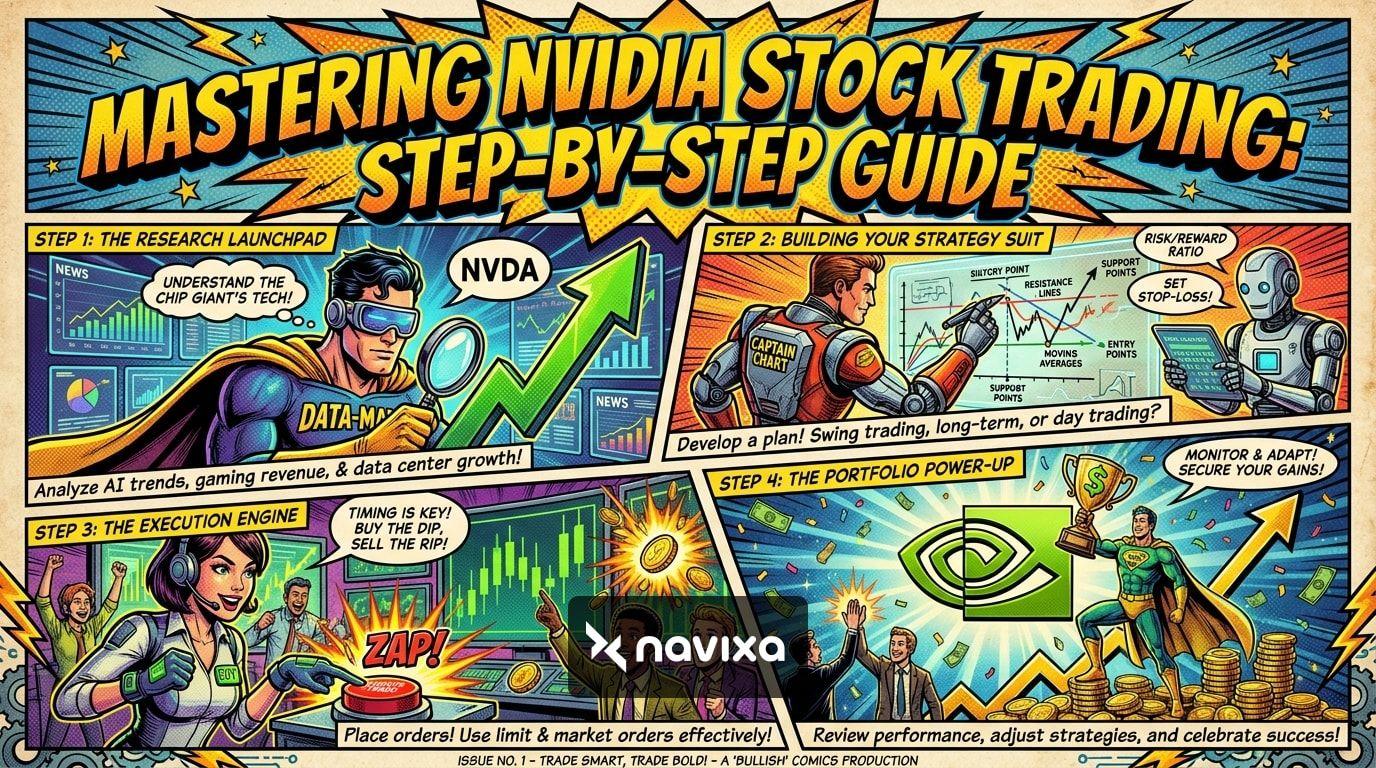
To bridge the gap between theory and execution, here is a structured, step-by-step approach to actively trading NVDA.
Step 1: Define Your Trading Timeframe
Are you looking to hold positions for a few minutes, or are you looking to capture a macro trend over several weeks? Your timeframe dictates your chart setup. * Scalpers: Focus on the 1-minute and 5-minute charts, utilizing VWAP (Volume Weighted Average Price) to gauge intraday institutional control. * Swing Traders: Rely on the Daily and Weekly charts, waiting for broader pullbacks to structural support levels.
Step 2: Establish Your Brokerage and Tools
Successful trading requires real-time data and flawless execution. Ensure your brokerage offers Level 2 market data, zero-commission equity trades, and robust options chains if you plan on utilizing derivatives. For advanced charting, platforms like TradingView are indispensable for overlaying custom technical indicators.
Step 3: Monitor Macro and Micro Catalysts
Nvidia does not trade in a vacuum. Before executing a trade, review the economic calendar. Is the Federal Reserve speaking today? Are inflation numbers being released? Higher interest rates typically pressure high-growth tech stocks. Additionally, monitor supply chain news regarding TSMC (Taiwan Semiconductor Manufacturing Company), as they are the primary fabricator for Nvidia's advanced chips. You can find official corporate announcements directly on the Nvidia Investor Relations page.
Step 4: Execute with Strict Entry and Exit Criteria
Never enter a trade based on emotion. A professional trade setup looks like this: * Entry: Purchasing NVDA at $195 upon a successful retest of the 50-day moving average. * Target: $212 (Previous all-time high resistance). * Stop-Loss: $189 (Just below the local swing low). This provides a highly favorable risk-to-reward ratio, ensuring that your winning trades vastly outperform your losing ones.
Trading Styles Comparison
To help you decide the best approach for your capital and risk tolerance, here is a comparison of the two most popular styles of Nvidia stock trading.
| Feature | Day Trading NVDA | Swing Trading NVDA |
|---|---|---|
| Time Horizon | Minutes to Hours | Days to Weeks |
| Primary Indicators | VWAP, 5-min MACD, Level 2 Data | Daily RSI, 50-day SMA, Volume Profile |
| Capital Requirement | High (Pattern Day Trader rules may apply) | Moderate to High |
| Stress Level | Very High (Requires constant screen monitoring) | Medium (Can be managed via limit orders) |
| Impact of Overnight Gaps | None (Positions closed before market close) | High (Vulnerable to after-hours news) |
Essential Risk Management Rules
Even the most accurate technical analysis is useless without strict risk management. The volatility that makes Nvidia attractive can also be destructive to an undisciplined trader's portfolio.
1. Position Sizing
Never risk more than 1% to 2% of your total trading capital on a single NVDA trade. If you have a $50,000 account, your maximum loss on a single setup should not exceed $500 to $1,000. This ensures that a string of losing trades does not permanently cripple your account.
2. Utilizing Stop-Loss Orders
A hard stop-loss is mandatory. Mental stops are often ignored in the heat of the moment, leading to catastrophic losses when a stock aggressively breaks support. Place your stop-loss just below major technical support zones to avoid being "whipsawed" out of a position prematurely.
3. Hedging with Options
Advanced traders often use the options market to hedge their equity positions. If you are holding a large swing trade in NVDA leading into an earnings report, purchasing out-of-the-money put options can act as an insurance policy against a severe post-earnings gap down.
Conclusion
Mastering Nvidia stock trading requires a delicate balance of macroeconomic awareness, technical precision, and unbreakable psychological discipline. As the AI revolution continues to expand, Nvidia's position as the primary hardware provider ensures that its stock will remain one of the most exciting and lucrative vehicles for active traders.
By utilizing the step-by-step strategies outlined in this guide—respecting moving averages, understanding the underlying fundamental demand for Blackwell and Rubin architectures, and adhering to strict risk management protocols—you can navigate the volatility of NVDA with confidence. Stop gambling on headlines, build a structured trading plan, and let the data guide your executions.
Frequently Asked Questions
What makes Nvidia stock trading unique compared to other tech stocks?
Nvidia is unique due to its near-monopoly on high-end AI compute hardware. Because global mega-corporations are engaged in an "AI arms race," Nvidia's revenue growth has historically outpaced the rest of the tech sector, resulting in higher beta (volatility) and massive institutional volume, making it highly liquid and responsive to technical indicators.
How did the recent stock split affect NVDA trading?
The 10-for-1 stock split executed in June 2024 significantly lowered the nominal price of a single share. This allowed for greater retail participation, dramatically increased options market liquidity, and tightened bid-ask spreads. It made it much easier for traders with smaller accounts to properly size their positions.
What drives Nvidia's stock price the most?
Nvidia's stock is primarily driven by data center revenue, specifically the demand for its AI-focused GPUs like the Hopper, Blackwell, and upcoming Rubin architectures. Furthermore, macroeconomic factors such as Federal Reserve interest rate decisions and the broader health of the semiconductor supply chain (e.g., TSMC manufacturing capabilities) heavily influence price action.
Is Nvidia suitable for beginner traders?
While Nvidia offers incredible opportunities, its high volatility can be challenging for complete beginners. Novice traders should start by "paper trading" (using a simulated account) to understand how NVDA reacts to market open dynamics, economic data, and technical support levels before risking real capital.
What is the best time frame for trading Nvidia stock?
The "best" time frame depends on your strategy. Scalpers prefer the 1-minute and 5-minute charts for rapid intraday moves, utilizing VWAP. Swing traders find the most reliable signals on the daily and weekly charts, focusing on the 50-day moving average and broader macroeconomic trends.