
Introduction
When it comes to dominating the technology sector, few assets have commanded as much attention as Nvidia. Mastering NVDA stock technical analysis is no longer just an option for active traders; it is an absolute necessity. With the rapid evolution of artificial intelligence and advanced data centers, Nvidia has positioned itself as the foundational backbone of the global tech economy. However, fundamental strength does not always equate to a straight line up on the stock chart. To truly capitalize on market movements, traders must understand how to read price action, identify critical support and resistance zones, and interpret momentum indicators.
Nvidia has transformed from a gaming GPU manufacturer into a multi-trillion-dollar behemoth driving the AI revolution. Yet, for all its macroeconomic dominance, the stock remains highly susceptible to technical cycles. Institutional algorithms, options market makers, and retail momentum all interact to create distinct price patterns. By applying rigorous technical analysis, traders can filter out the daily noise, identify high-probability entry and exit points, and protect their capital during inevitable market corrections. This comprehensive guide will break down the essential components of NVDA's price action and provide a blueprint for navigating its future movements.
The Intersection of Fundamentals and Technicals
Before diving deep into chart patterns, it is vital to understand the macroeconomic and fundamental backdrop that fuels Nvidia's volatility. As of early 2026, Nvidia boasts a market capitalization exceeding $4 trillion and recently reported a staggering $215.9 billion in fiscal 2026 revenue. The company continues to push the boundaries of innovation with its Blackwell and Vera Rubin architectures, alongside strategic $2 billion investments in networking partners like Marvell Technology to expand the NVLink Fusion ecosystem.
Despite these exceptionally strong fundamentals, NVDA stock frequently experiences sharp technical pullbacks. Why does this happen? The answer lies in valuation compression, institutional rebalancing, and algorithmic trading. Even when a company dominates the data center AI chip market, its stock price can overextend relative to its moving averages. When NVDA's forward price-to-earnings (P/E) ratio normalizes—currently hovering around a highly attractive 33x—it creates unique technical setups. Understanding NVDA stock technical analysis allows traders to spot the divergence between a company's flawless fundamental execution and its short-term charting weaknesses.
Core Indicators for NVDA Stock Technical Analysis
To master NVDA's price action, traders must rely on a confluence of technical indicators rather than a single metric. Below are the core tools that professionals use to decode the stock's momentum and trend direction.
Moving Averages (SMAs and EMAs)
Moving averages act as the primary trend filters for NVDA. The 50-day and 200-day Simple Moving Averages (SMA) are particularly crucial. Historically, NVDA using the 200-day SMA (currently positioned around $179) as a major pivot point dictates the long-term trend. When the price trades below the 200-day SMA, it signals a broader corrective phase, warning traders to adopt a more defensive or mean-reversion strategy. Conversely, the 20-day and 50-day Exponential Moving Averages (EMA) provide insight into short-term momentum, highlighting immediate resistance levels during bounce attempts.
Relative Strength Index (RSI)
The Relative Strength Index is a momentum oscillator that measures the speed and change of price movements on a scale of 0 to 100. For a high-beta stock like NVDA, the RSI is an invaluable tool for identifying overbought and oversold conditions. Recently, NVDA's daily RSI dropped into the 33-35 range, approaching the critical oversold threshold of 30. Historically, whenever NVDA's RSI dips below 35, it triggers a mean-reversion buy signal, as selling pressure exhausts itself and buyers step in to capitalize on perceived discounts.
Moving Average Convergence Divergence (MACD)
The MACD is a trend-following momentum indicator that shows the relationship between two moving averages of a stock's price. When conducting NVDA stock technical analysis, a MACD crossover below the zero line often confirms a bearish trend, while a crossover above the signal line indicates building bullish momentum. Monitoring the MACD histogram is equally important; decelerating negative momentum on the histogram often precedes a price bottom, giving astute traders an early warning that a reversal is imminent.
Mapping Key Support and Resistance Levels
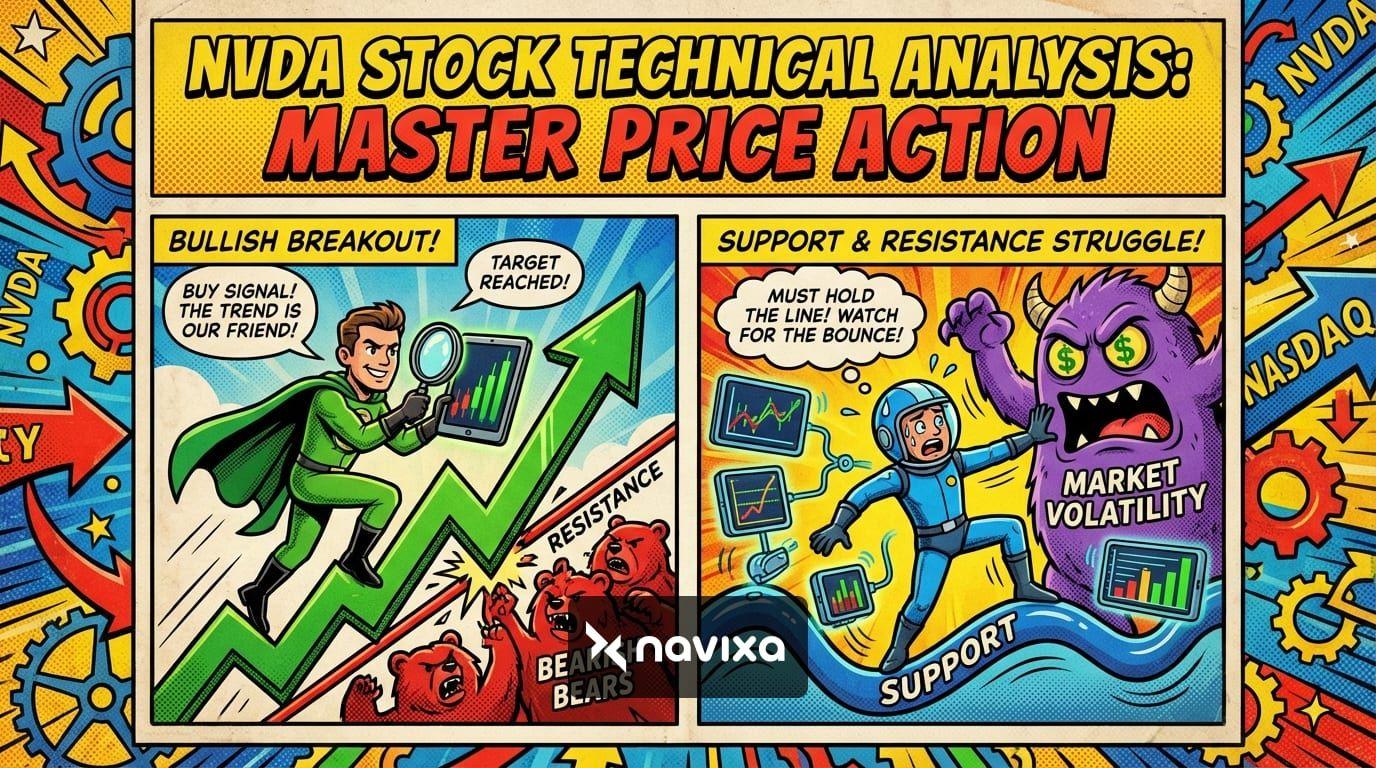
Support and resistance zones are the bedrock of price action trading. They represent psychological levels where institutional buyers and sellers have historically established their positions.
Critical Support Zones: Support is the price level at which a downtrend tends to pause due to a concentration of demand. For NVDA, the $161 to $165 zone has emerged as a massive structural floor. This area aligns with crucial Fibonacci retracement levels and represents a historical accumulation zone. If NVDA breaks decisively below this floor on high volume, it invalidates the short-term bullish thesis and exposes the stock to deeper downside risks toward the $150 psychological level.
Overhead Resistance Zones: Resistance is the level at which an uptrend is halted by an influx of selling pressure. Currently, NVDA faces significant overhead resistance between $178 and $183. This zone is congested with technical hurdles, including the aforementioned 200-day SMA, the daily Ichimoku baseline, and previous broken support levels that have now flipped to resistance. For NVDA to resume a structural bull market, it must reclaim and close above this $183 threshold with convincing volume.
Trading Strategies: Mean Reversion vs. Trend Following
Applying NVDA stock technical analysis effectively requires choosing the right trading strategy for the current market environment.
The Mean Reversion Strategy
When NVDA trades significantly below its moving averages and flashes oversold RSI readings, mean reversion traders step in. This strategy operates on the premise that extreme price deviations are temporary. A trader might execute a long position near the $165 support level, placing a tight stop-loss just below $160. The profit target would be set at the first major moving average or the $178 resistance zone. This approach offers a highly favorable risk-to-reward ratio but requires the discipline to avoid "catching a falling knife" without confirmation.
The Trend Following Strategy
Trend followers wait for confirmation of momentum before deploying capital. Rather than buying at support, a trend follower waits for NVDA to break out above resistance. If NVDA reclaims the $183 level and the MACD flashes a bullish crossover, trend followers will enter long positions, anticipating a retest of the all-time highs near $212. This strategy sacrifices the absolute lowest entry price in exchange for a higher probability of success, as the broader trend is already moving in their favor.
Fundamental vs. Technical Analysis
Understanding how technicals compare to fundamentals is crucial for comprehensive market mastery. Here is a breakdown of the two approaches:
| Feature | Fundamental Analysis | Technical Analysis |
|---|---|---|
| Core Focus | Revenue, earnings, AI chip demand, P/E ratios | Price action, volume, momentum indicators |
| Current Example | FY26 Revenue of $215.9B, Marvell investment | RSI at 34 (oversold), MACD bearish crossover |
| Best Used For | Long-term investing, understanding true value | Short-term trading, precise entry and exit points |
| Key Metrics | Forward P/E (~33.7x), Gross Margins (~71%) | 200-day SMA ($179), Fibonacci Support ($165) |
| Market Psychology | Assumes markets are rational over long periods | Assumes price reflects all known information instantly |
Actionable Steps for Modern Traders
To bridge the gap between theory and execution, traders should follow a systematic approach when analyzing NVDA:
1. Analyze Multiple Timeframes: Never rely on a single chart. Start with the weekly chart to understand the macro trend, zoom into the daily chart to identify key support and resistance zones, and use the hourly chart to pinpoint precise entry and exit levels. 2. Monitor Options Market Expected Moves: Options pricing provides a mathematical probability of future price action. By utilizing tools on platforms like TradingView, traders can calculate the expected weekly move of NVDA, which often acts as a self-fulfilling prophecy for short-term support and resistance. 3. Track Institutional Block Trades: Heavy volume at specific price nodes often indicates institutional accumulation or distribution. Always prioritize setups that are accompanied by above-average trading volume. 4. Stay Updated on Catalysts: Technicals do not exist in a vacuum. Always be aware of upcoming earnings reports, product announcements, or macroeconomic data releases by regularly checking resources like Nvidia's Investor Relations portal.
Risk Management in Highly Volatile Tech Stocks
No discussion of NVDA stock technical analysis is complete without addressing risk management. Nvidia's average true range (ATR) indicates that the stock can easily swing several percentage points in a single trading session. This high volatility is a double-edged sword; it provides lucrative trading opportunities but can also result in devastating losses if not properly managed.
Traders must implement strict position sizing rules. A standard benchmark is to risk no more than 1% to 2% of your total trading capital on any single NVDA trade. Stop-loss orders should be placed technically, not arbitrarily. For example, if entering a long position at $165 based on horizontal support, the stop-loss should be placed slightly below the support zone, perhaps at $160.50, to account for momentary intraday wicks.
Practical Takeaways
- Respect the Trend: The 200-day SMA is the ultimate arbiter of NVDA's long-term trend. Trade in alignment with this indicator whenever possible. - Patience Pays: Wait for the price to reach your predetermined levels. Chasing NVDA in the middle of a trading range often leads to unfavorable risk-to-reward ratios. - Confluence is King: A trade setup is exponentially stronger when multiple indicators—such as horizontal support, an oversold RSI, and a bullish candlestick pattern—align simultaneously. - Adapt to Volatility: Widen your profit targets and stop-losses slightly during periods of elevated market volatility to avoid being prematurely stopped out of a winning position.
Conclusion
Mastering NVDA stock technical analysis is a continuous journey of adapting to shifting market dynamics. Nvidia is undeniably one of the most important companies in the modern financial landscape, powered by the relentless demand for AI infrastructure. However, as recent price action demonstrates, even the strongest fundamental companies must navigate the technical realities of supply, demand, and institutional rebalancing.
By leveraging moving averages, momentum oscillators, and structural price levels, you can transform market volatility from a source of anxiety into a landscape of opportunity. Whether you are executing a swift mean-reversion trade off the $165 support floor or waiting for a macro breakout above $183, discipline and risk management will ultimately determine your long-term success. Start integrating these analytical frameworks into your daily trading routine, and take control of your financial future today.
Frequently Asked Questions
What are the most important technical indicators for trading NVDA stock?
The most crucial indicators for NVDA include the 50-day and 200-day Simple Moving Averages (SMA) for trend identification, the Relative Strength Index (RSI) for spotting overbought or oversold conditions, and horizontal support/resistance levels derived from previous price action and Fibonacci retracements.
How does NVDA's RSI impact its short-term price movements?
NVDA is a highly liquid, momentum-driven stock. When its daily RSI drops below 35 into oversold territory, it historically suggests that selling pressure is exhausted, often triggering a short-term mean-reversion bounce. Conversely, an RSI above 70 indicates the stock is overbought and may be due for a technical pullback.
Why is the 200-day Simple Moving Average significant for Nvidia?
The 200-day SMA is a widely watched indicator by institutional investors. It acts as a barometer for the long-term trend. When NVDA trades above it, the macro trend is considered bullish. When it falls below the 200-day SMA, as seen during major market corrections, it signals a shift toward a bearish or consolidation phase.
Can I rely solely on technical analysis to trade NVDA?
While technical analysis is excellent for timing entries and exits, it should not be used in isolation. NVDA is heavily influenced by fundamental catalysts, such as AI chip demand, data center revenue, and macroeconomic factors like interest rates. The most successful traders combine technical setups with a strong understanding of underlying fundamentals.