
The world of cryptocurrency trading is heavily influenced by headlines. From regulatory announcements and macroeconomic data releases to unexpected protocol hacks and institutional adoption milestones, news serves as the primary catalyst for explosive market volatility. However, without a concrete system for news trading risk management, attempting to profit from these rapid price fluctuations is akin to gambling.
In this comprehensive guide, we will explore how you can master news trading risk management and build the discipline required to survive and thrive in high-volatility environments. Whether you are trading Bitcoin, Ethereum, or mid-cap altcoins, these principles are essential for long-term profitability.
The Mechanics of Event-Driven Volatility
Before diving into risk controls, it is critical to understand how and why news impacts the cryptocurrency market. Crypto is a regime-driven market where narratives dictate capital flows. When a major news event occurs, it forces a rapid repricing of assets as market participants scramble to adjust their positions.
We can broadly categorize news events into two types: 1. Scheduled News: These are known events such as Federal Reserve interest rate decisions, Consumer Price Index (CPI) data releases, or planned protocol upgrades. Traders can prepare for these events days in advance. 2. Black Swan Events: These are unpredictable shocks, such as a major exchange collapse, a sudden regulatory crackdown, or a severe hack. These events test a trader's reflexes and baseline risk management protocols.
To put this into perspective, consider the market conditions of early April 2026. Bitcoin was trading in a highly reactive consolidation range between $66,000 and $70,000, having just closed a volatile first quarter. During this period, the market was hypersensitive to breaking news regarding geopolitical tensions and fluctuating spot ETF inflows. In such a highly charged environment, a single headline could trigger massive liquidations, proving that relying solely on intuition is a recipe for disaster.
The Core Pillars of News Trading Risk Management
Effective news trading risk management relies on a foundation of mathematical boundaries and psychological control. If you want to capitalize on news-driven momentum without exposing your portfolio to catastrophic ruin, you must adhere to the following pillars.
1. Strict Position Sizing
The golden rule of risk management is never to risk more than a small percentage of your total trading capital on a single trade. For day traders, this is typically 1% to 2%. When trading the news, where volatility is exponentially higher, professional traders often cut their standard position size in half.
If your standard risk is 2% per trade, you should reduce it to 1% prior to a major announcement. This fractional sizing ensures that even if the market gaps right through your stop-loss, the resulting drawdown will not cripple your overall portfolio. To understand the foundational concepts of risk mitigation across all financial sectors, you can review traditional finance definitions on Investopedia.
2. Strategic Stop-Loss Placement
A stop-loss order is non-negotiable in news trading. However, placing it correctly requires skill. If your stop is too tight, you will be "wicksed out" by the initial algorithmic volatility before the true trend begins. If it is too wide, your risk-to-reward ratio becomes mathematically unviable.
When a news event is imminent, market makers often pull their liquidity from the order books to protect themselves. This creates "thin" order books, leading to massive price spikes in both directions. Therefore, your stop-loss should be placed behind significant structural support or resistance levels on higher timeframes, rather than arbitrary percentages.
3. Mitigating Slippage
Slippage occurs when your order is executed at a different price than you intended, usually due to a lack of liquidity at your desired price point. During a major news break, a market stop-loss might experience severe slippage. For example, if you place a stop-loss at $67,000, but a catastrophic headline hits, the next available buyer might be at $66,500. Your order will be filled there, resulting in a much larger loss than anticipated.
To combat this, elite traders avoid executing market orders during the exact second the news drops. Instead, they wait for the initial frenzy to subside and enter the market once a clear trend is established.
Integrating Technical Analysis with Fundamental Shocks
Many traders mistakenly believe that technical analysis (TA) becomes useless during a news event. In reality, news trading risk management relies heavily on TA to define the boundaries of the playing field. Fundamentals dictate the direction and speed of the move, but technicals dictate where the move is likely to pause, reverse, or accelerate.
For example, historical data from early 2026 showed that Bitcoin's $67,000 level acted as a critical support zone, with dips below this level repeatedly bought up by the market. If a bearish news event were to push the price toward $67,000, a news trader utilizing technical analysis would monitor that specific zone for either a bounce (to play a mean reversion) or a high-volume breakdown (to short the continuation).
Always mark your charts with key liquidity zones, Fibonacci retracements, and major moving averages before the news hits. This pre-planning prevents you from making emotional decisions in the heat of the moment.
Comparing Approaches to News Trading
The difference between an amateur and a professional trader is most apparent in their preparation. The table below illustrates the contrasting methodologies.
| Feature | Trading Without Risk Management | Trading With Risk Management |
|---|---|---|
| Position Sizing | Random, often risking 10%+ per trade | Fixed, risking only 1-2% of total capital |
| Stop-Loss Use | Mental stops or no stops at all | Hard stops placed based on technical levels |
| Reaction to News | Impulsive, market buying the green candle | Calculated, waiting for the initial volatility to settle |
| Leverage | Maximum leverage to maximize gains | Minimal leverage, adjusted for implied volatility |
| Mindset | Driven by FOMO and excitement | Driven by a strict, pre-defined trading plan |
Actionable Steps: The Pre-News, Execution, and Post-News Plan
To truly master this discipline, you need a repeatable process. Breaking your strategy down into three distinct phases will help automate your decision-making.
Phase 1: Pre-News Preparation
Identify the upcoming event on an economic calendar. Mark your chart with key support and resistance levels. Most importantly, define your risk parameters. Ask yourself: "If the market goes instantly against me, where is my exit, and exactly how much dollar value will I lose?"
Phase 2: Execution
When the news drops, patience is your greatest asset. The initial 60 seconds are often characterized by algorithmic trading bots fighting for direction, resulting in violent price action.
"Amateurs try to predict the news. Professionals wait for the market's reaction to the news, and trade the resulting trend."
Let the market show its hand. Once the "wicks" have settled and a definitive trend is forming alongside increasing volume, you can execute your trade. Additionally, staying updated with reliable, real-time reporting from platforms like CoinDesk is crucial to avoid reacting to unverified rumors on social media.
Phase 3: Post-News Review
Whether you won or lost, review your trade. Did you adhere to your position sizing? Did you execute according to your plan, or did you succumb to FOMO? Journaling these answers is how you build long-term discipline.
The Psychology of Discipline
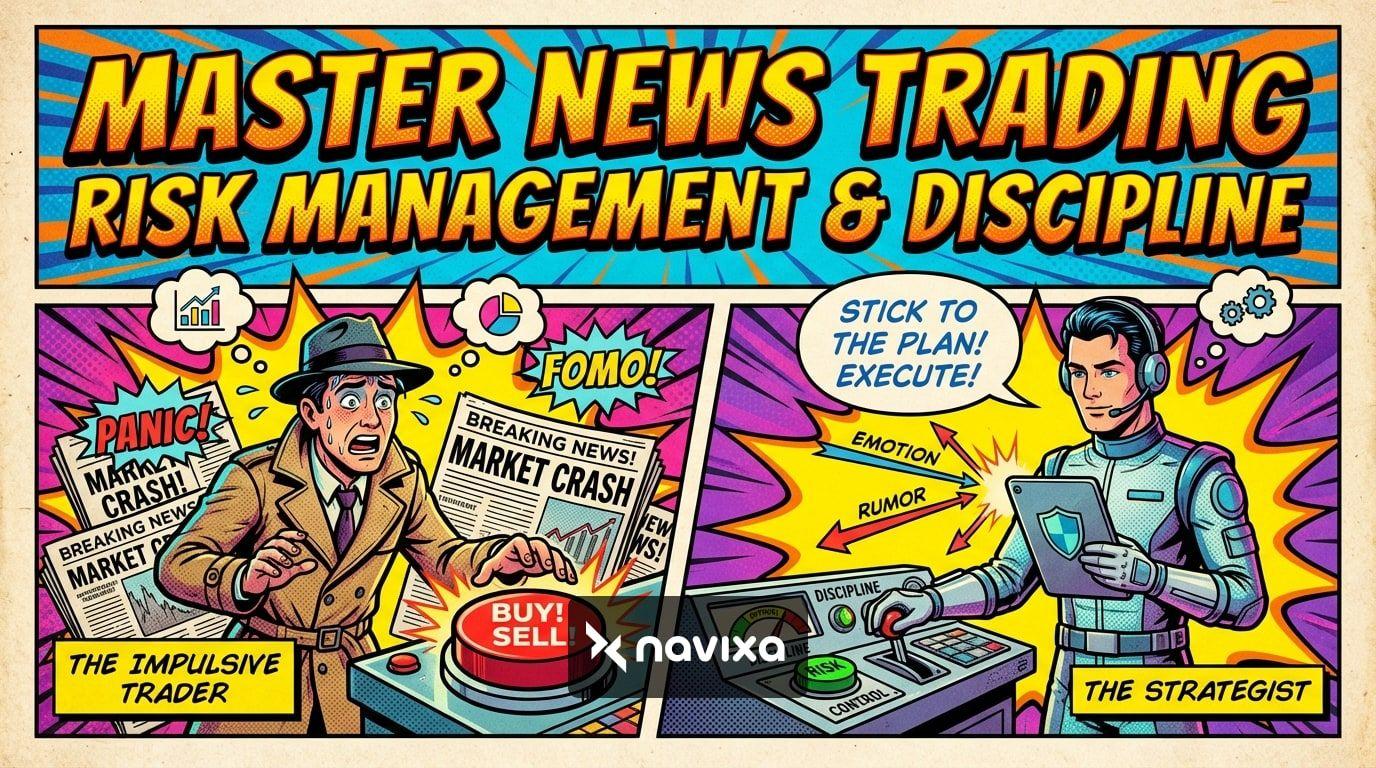
Mastering news trading risk management is, at its core, an exercise in psychological fortitude. The human brain is hardwired to chase excitement and fear missing out (FOMO). When you see a massive green candle erupting on your screen because a sovereign wealth fund announced a Bitcoin purchase, your instinct is to buy instantly.
Discipline means overriding that instinct. It means accepting that you will miss some trades. It means understanding that capital preservation is infinitely more important than capital appreciation. If you protect your downside through rigid risk controls, the upside will eventually take care of itself.
Practical Takeaways
* Never trade without a stop-loss. In the volatile crypto market, a single news event can liquidate an unhedged account. * Reduce your position size. Volatility expands during news events, meaning your risk naturally increases. Counter this by cutting your standard size. * Wait for the dust to settle. Do not trade the initial one-minute candle. Let the algorithms battle it out, and trade the established trend. * Combine TA and Fundamentals. Use news to understand the momentum, and use charts to define your entry, exit, and risk levels. * Keep your emotions in check. Treat trading as a business, not a casino.
Conclusion
News trading can be one of the most lucrative strategies in the cryptocurrency market, provided you approach it with a professional mindset. By implementing strict news trading risk management, you transform a game of chance into a game of probabilities. Remember, your primary job as a trader is not to make money; it is to protect the money you already have. By controlling your position sizing, respecting technical levels, and cultivating ironclad discipline, you will be well-equipped to navigate the chaotic waters of event-driven volatility.
***
Frequently Asked Questions
What is news trading risk management?
News trading risk management refers to the specific set of rules and protocols a trader uses to protect their capital during highly volatile market events. This includes strict position sizing, the use of guaranteed stop-losses, and strategies to mitigate slippage when trading the news.
How much of my portfolio should I risk on a single news event?
Professional traders generally recommend risking no more than 1% to 2% of your total trading capital on any single trade. During high-impact news events where volatility is unpredictable, it is often advisable to cut this risk in half to account for potential slippage.
Does technical analysis still work when breaking news hits?
Yes, technical analysis remains vital. While news dictates the immediate direction and momentum of the market, technical analysis helps identify historical support and resistance zones where price is likely to react, stall, or reverse. This allows traders to set logical risk-to-reward parameters.
What is slippage, and how does it affect news trading?
Slippage is the difference between the expected price of a trade and the price at which the trade is actually executed. During major news events, liquidity can dry up rapidly, causing market orders to "slip" and execute at significantly worse prices than anticipated.
Should I enter a trade before or after the news is announced?
Unless you are using an automated algorithmic strategy, it is generally safer for retail traders to wait until after the news is announced. The initial moments post-announcement are often plagued by erratic, bi-directional price spikes. Waiting for a clear trend to emerge reduces the risk of being stopped out prematurely.