
Introduction
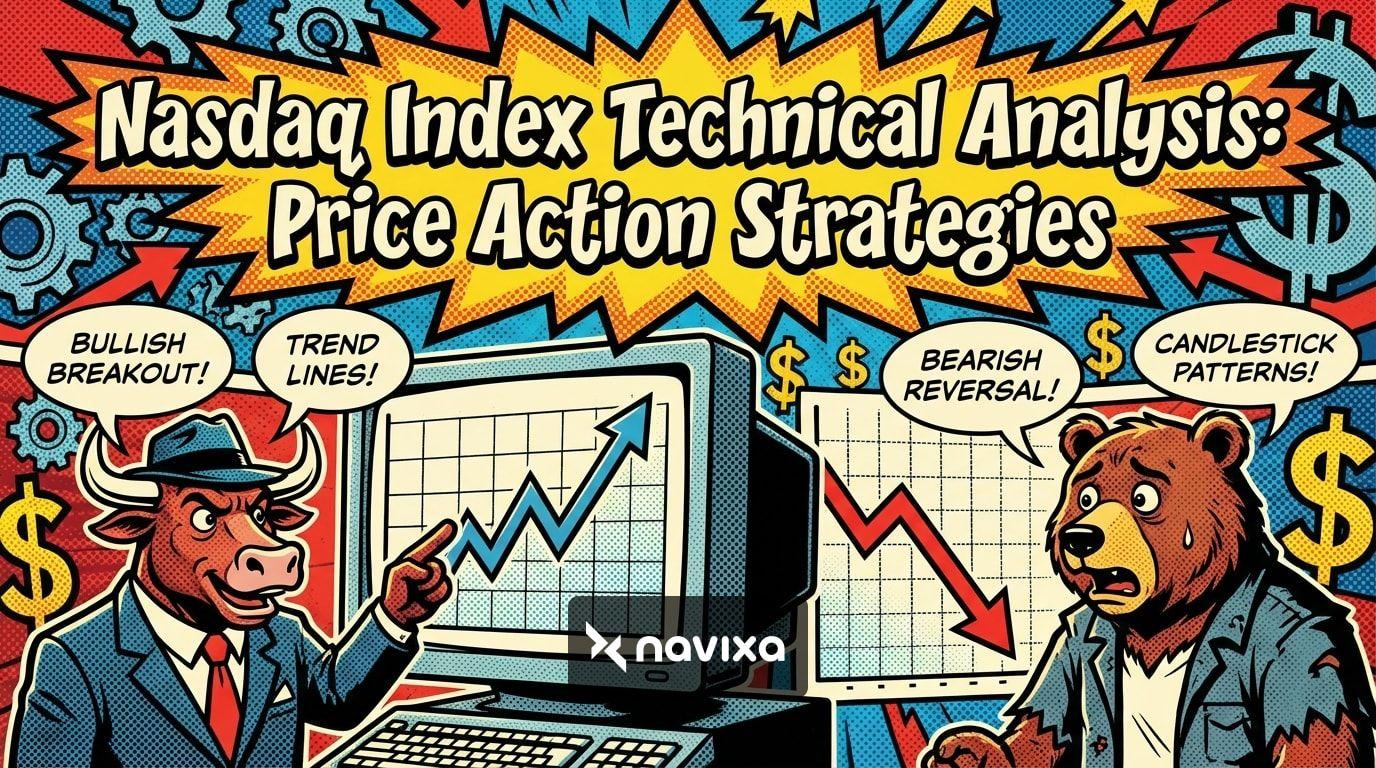
In the fast-paced world of financial markets, mastering Nasdaq index technical analysis is an essential skill for modern traders. Whether you are trading traditional equities, index futures, or high-beta risk assets like cryptocurrency, the Nasdaq 100 (NDX) serves as a critical barometer for global risk appetite. Comprising the 100 largest non-financial companies listed on the Nasdaq exchange—including tech behemoths that dictate global innovation—this index is highly sensitive to macroeconomic shifts, making it a prime candidate for chart patterns and price action strategies.
Technical analysis removes the emotional noise from trading. By focusing on historical price data, trading volume, and market structure, traders can identify high-probability setups and manage risk effectively. In this comprehensive guide, we will explore advanced strategies for analyzing the Nasdaq, examine how technology stocks correlate with the cryptocurrency market, and provide actionable techniques to elevate your day-to-day trading performance.
Why Cryptocurrency Traders Must Watch the Nasdaq
You might wonder why a cryptocurrency expert would emphasize the importance of a traditional stock index. The answer lies in the deep, undeniable correlation between technology stocks and digital assets. Both the Nasdaq and major cryptocurrencies like Bitcoin are widely considered "risk-on" assets. When institutional investors are optimistic about the economy, liquidity flows freely into both tech equities and crypto markets.
"Bitcoin often acts as a high-beta version of the Nasdaq. When the tech index breaks out, crypto typically follows with amplified volatility, and when tech falters, digital assets suffer exponential drawdowns."
By applying Nasdaq index technical analysis, cryptocurrency traders can gain a leading indicator for broader market sentiment. If the Nasdaq encounters heavy resistance or breaks below a critical macro moving average, it frequently foreshadows a widespread liquidity drain. Altcoins, in particular, react aggressively to Nasdaq drawdowns. Understanding where the traditional tech market is heading allows crypto investors to hedge their portfolios before the digital asset market actually turns bearish.
Essential Indicators for Nasdaq Index Technical Analysis
To effectively trade the Nasdaq, you need a robust technical toolkit. While there are hundreds of indicators available on modern charting platforms, the most successful professional traders rely on a select few that provide clear, actionable signals without cluttering the screen.
1. Moving Averages (EMA and SMA)
Moving averages smooth out raw price data to help traders identify the primary trend. For the Nasdaq, the 50-day and 200-day Exponential Moving Averages (EMA) are crucial. The 50-day EMA frequently acts as dynamic support in a strong bull market, providing excellent dip-buying opportunities. The 200-day EMA defines the macro trend. A "Golden Cross" (when the 50-day crosses above the 200-day) is a classic bullish signal, whereas a "Death Cross" suggests impending, long-term bearish momentum.
2. The Relative Strength Index (RSI)
The RSI is a momentum oscillator that measures the speed and change of price movements, fluctuating between a baseline of 0 and 100. Traditionally, an RSI reading above 70 indicates an overbought market, while an RSI below 30 signals oversold conditions. However, in strong, tech-led bull markets, the Nasdaq can remain overbought for extended periods. Traders should specifically look for bearish divergence—where the price makes a higher high but the RSI prints a lower high—as a highly reliable signal of trend exhaustion.
3. MACD (Moving Average Convergence Divergence)
The MACD is a trend-following momentum indicator that shows the relationship between two moving averages of a security’s price. By observing the MACD histogram and the convergence or divergence of the signal lines, traders can accurately gauge the strength of a Nasdaq breakout or breakdown. A bullish crossover occurring below the zero line often provides an excellent entry point for long positions early in a trend reversal.
4. Bollinger Bands
Bollinger Bands measure market volatility by plotting two standard deviations away from a simple moving average. When the bands contract (a "squeeze"), it indicates low volatility and heavily hints that a massive, explosive move is imminent. For traders utilizing platforms like TradingView, monitoring Bollinger Band squeezes on the daily timeframe can capture some of the most lucrative trends in the Nasdaq index.
Advanced Price Action Strategies
While technical indicators are immensely helpful, pure price action remains the most authentic representation of market psychology. Here are three powerful price action strategies tailored specifically for the Nasdaq index.
Support and Resistance Flips (Polarity)
One of the most reliable phenomena in Nasdaq index technical analysis is the concept of polarity, where old resistance becomes new support, and vice versa. For instance, if the Nasdaq forcefully breaks out above a major psychological resistance barrier, that previous ceiling is expected to act as a floor during the subsequent pullback. Buying the initial retest of a newly broken resistance level offers a highly favorable risk-to-reward ratio.
Fibonacci Retracements and Extensions
The Nasdaq is notorious for its swift, aggressive rallies followed by sharp, terrifying corrections. Using Fibonacci retracement levels helps traders identify potential reversal zones during these violent pullbacks. The "Golden Pocket," geographically located between the 0.618 and 0.65 retracement levels, is statistically the most robust bounce zone. When the Nasdaq pulls back into this pocket—especially if it simultaneously aligns with a major moving average or structural support—it presents a prime, high-conviction buying opportunity.
Candlestick Formations at Key Levels
Price action traders rely heavily on candlestick patterns to confirm reversals at key technical levels. Identifying a "Bullish Engulfing" candle or a "Hammer" at macro support provides visual confirmation that buyers are stepping in. Conversely, a "Shooting Star" at major resistance warns that institutional sellers are defending the level, making it an ideal place to initiate a short position or take profits.
Nasdaq vs. Bitcoin: A Technical Comparison
Understanding the technical nuances between traditional tech indices and speculative cryptocurrencies can significantly enhance your cross-market analytical skills.
| Feature | Nasdaq 100 Index (NDX) | Bitcoin (BTC) |
|---|---|---|
| Market Hours | Mon-Fri, 9:30 AM - 4:00 PM EST | 24/7, 365 Days a Year |
| Volatility Profile | Moderate to High | Extreme |
| Key Price Drivers | Corporate earnings, Fed interest rates | Network adoption, liquidity, regulation |
| Technical Reliability | Very high due to massive institutional volume | High, but susceptible to liquidation cascades |
| Gap Trading Patterns | Common (Opening price gaps are frequent) | Rare (Only visible on CME futures charts) |
This comparison highlights exactly why many seasoned crypto traders prefer to analyze the Nasdaq during traditional market hours; it reliably sets the tone for the overall global risk environment, which Bitcoin and altcoins then trade on over the weekend.
Macroeconomic Factors Influencing the Chart
Technical analysis does not exist in a vacuum. The structural levels plotted on a chart are often defended or broken entirely based on underlying macroeconomic conditions. For further reading on how overarching economic indicators impact market behavior, Investopedia offers extensive and easily digestible resources.
The 10-Year Treasury Yield
Technology stocks are uniquely sensitive to interest rates because their massive valuations are heavily based on future earnings potential. When the 10-year Treasury yield spikes aggressively, the cost of corporate borrowing increases, and future tech earnings are discounted at a significantly higher rate. Consequently, a rising yield environment almost always translates to technical breakdowns on the Nasdaq chart, nullifying bullish patterns.
Geopolitical Tensions and Energy Prices
Global instability, such as sudden unrest in oil-producing regions, directly impacts energy prices. A spike in crude oil acts as a direct tax on consumers, raising inflation fears and forcing central banks to maintain restrictive, hawkish monetary policies. When mapping out your Nasdaq index technical analysis, you must always overlay these macro events. A solid technical support level might hold beautifully during a standard market correction, but it can easily shatter if a sudden geopolitical shock triggers a broader institutional panic.
Risk Management for Index Trading
Even the most meticulously accurate technical analysis is entirely useless without strict, disciplined risk management. The Nasdaq's inherent volatility means that unprotected, over-leveraged positions can lead to severe account drawdowns in a matter of hours.
1. Position Sizing: Never risk more than 1% to 2% of your total trading capital on a single Nasdaq trade. Proper position sizing ensures that a natural string of losing trades won't wipe out your account balance. 2. Utilizing the Average True Range (ATR): Instead of placing arbitrary percentage-based stop losses, use the ATR indicator to place your stops outside of the daily market noise. If the Nasdaq has an ATR of 200 points, your stop loss should comfortably accommodate that volatility. 3. Scaling Out: Always take partial profit. As the index quickly approaches key resistance levels, locking in profits protects your capital, secures your gains, and vastly reduces the psychological stress of holding the position.
Conclusion
Mastering Nasdaq index technical analysis requires a dedicated blend of indicator proficiency, pure price action awareness, and a deep understanding of the macroeconomic context. By recognizing how the traditional technology sector directly correlates with speculative assets like cryptocurrency, you can routinely position yourself ahead of major market moves.
Whether you are trading volume breakouts, aggressively buying the Fibonacci golden pocket, or utilizing the NDX purely as a sentiment gauge for your digital asset portfolio, the strategies outlined in this guide provide a mathematically sound foundation for long-term profitability. Take the time to rigorously backtest these methods, respect your stop losses, and continuously adapt to the ever-evolving global financial landscape. Open your charts today, define your key technical levels, and take complete control of your trading destiny.
Frequently Asked Questions
What is the best timeframe for Nasdaq index technical analysis?
The optimal timeframe strictly depends on your personal trading style. Day traders typically use the 5-minute and 15-minute charts for highly precise entries and exits. Swing traders generally prefer the 1-hour and 4-hour charts to capture multi-day trends, while long-term investors should focus almost exclusively on the daily and weekly charts to identify major structural paradigm shifts.
How does the Nasdaq correlate with cryptocurrency?
The Nasdaq and cryptocurrencies, particularly Bitcoin, share a remarkably strong positive correlation because institutional algorithms treat both as high-beta, risk-on assets. Large-scale investors tend to aggressively buy both when global liquidity is abundant and sell both when macroeconomic fears—such as rising interest rates or inflation—take hold of the market.
What are the most important support and resistance levels to watch?
Support and resistance levels constantly evolve based on current market price action. However, major psychological round numbers and historical swing highs or lows are heavily defended by market makers. Additionally, the 50-day and 200-day moving averages frequently act as highly reliable dynamic support and resistance zones during trending environments.
Can technical analysis predict fundamental news events?
No, technical analysis cannot predict completely random or unprecedented news events, such as geopolitical shocks or sudden corporate earnings misses. However, technical analysis *can* clearly show you the key liquidity zones where the market is most likely to react aggressively once the news is released, allowing you to manage your financial risk effectively.