For traders looking to capitalize on the rapid movements of the technology sector, Nasdaq futures trading represents one of the most dynamic and rewarding arenas in the financial markets. The Nasdaq 100 Index is heavily weighted toward some of the world's largest non-financial companies, including mega-cap tech giants, making it incredibly responsive to economic data, earnings reports, and global macro shifts.
Whether you are a traditional equities trader transitioning to derivatives, or a cryptocurrency trader seeking regulated markets with correlated price action, mastering Nasdaq futures provides unparalleled opportunities for leverage and liquidity. This comprehensive guide will walk you through the essential mechanics of these instruments, from understanding contract specifications to executing high-probability trading strategies.
Understanding Nasdaq Futures Trading
At its core, Nasdaq futures trading involves buying or selling standardized contracts that track the price of the Nasdaq 100 Index. When you trade these futures, you are not buying the underlying stocks; rather, you are speculating on the future value of the index itself. Because they are cash-settled derivatives traded on the Chicago Mercantile Exchange (CME), you do not have to worry about taking physical delivery of shares.
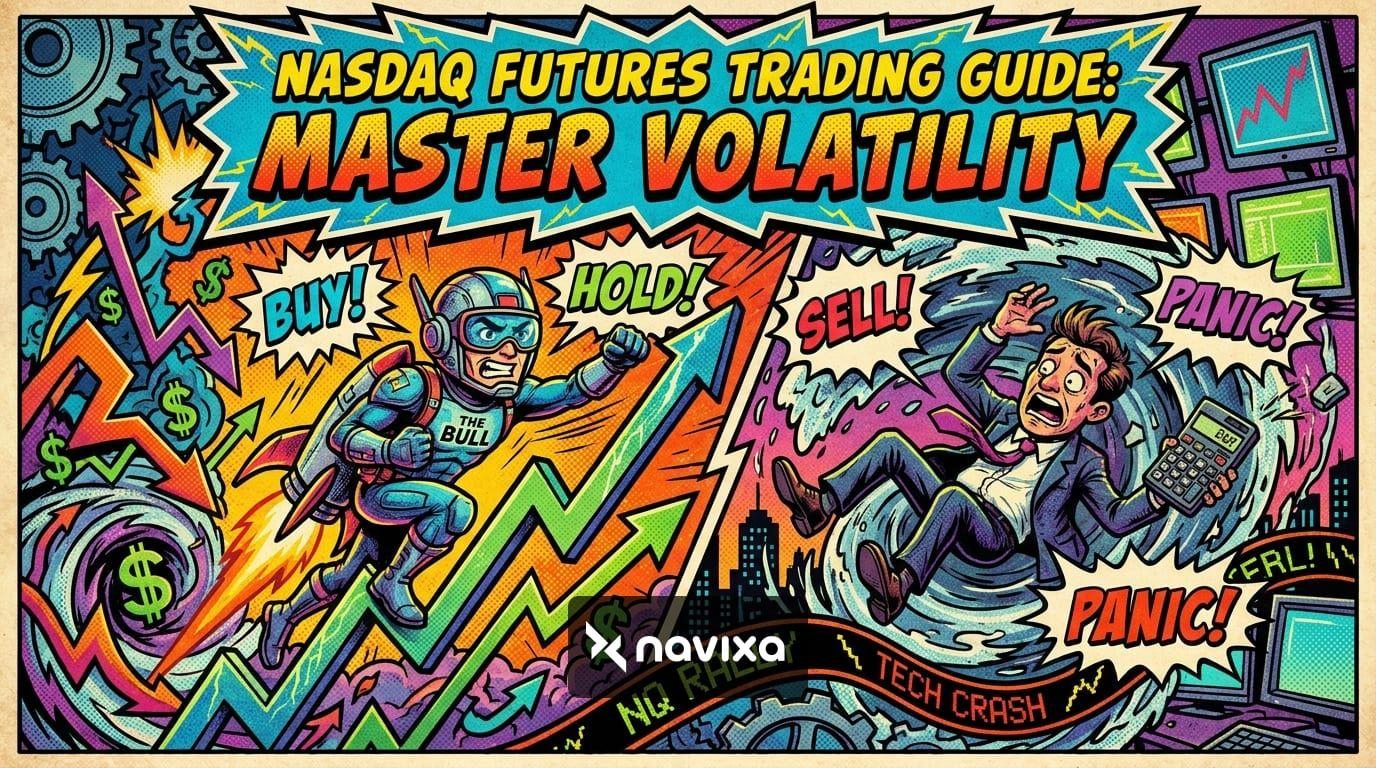
The appeal of these futures lies in their inherent volatility. The technology sector frequently experiences sharp intraday moves, which can be highly profitable for day traders and swing traders who know how to navigate the momentum. Furthermore, the futures market operates nearly 24 hours a day, five days a week, allowing traders to react to overnight news, earnings releases, and international market movements long before the standard stock market opens.
Contract Specifications: E-mini vs. Micro E-mini
To participate in Nasdaq futures trading, you must first choose the appropriate contract size. The CME offers two primary contracts for retail and institutional traders: the E-mini (NQ) and the Micro E-mini (MNQ).
The E-mini Nasdaq 100 (NQ)
Introduced in 1999, the E-mini contract was designed to make futures trading more accessible by offering a fraction of the standard contract size. The NQ has a multiplier of $20 per index point. For example, if the Nasdaq 100 moves up by 50 points, a single long NQ contract yields a profit of $1,000. However, the margin requirements and potential for rapid drawdowns make the NQ better suited for well-capitalized, experienced traders.
The Micro E-mini Nasdaq 100 (MNQ)
Launched in May 2019 to accommodate smaller retail accounts, the Micro E-mini contract is exactly one-tenth the size of the E-mini. With a multiplier of just $2 per index point, the MNQ allows traders to fine-tune their position sizing, scale into trades, and practice strict risk management without the immense financial exposure of the NQ.
Contract Comparison Table
Here is a breakdown of the key specifications for both contracts:
| Feature | E-mini Nasdaq 100 (NQ) | Micro E-mini Nasdaq 100 (MNQ) |
|---|---|---|
| Index Tracking | Nasdaq 100 | Nasdaq 100 |
| Contract Multiplier | $20 x Index | $2 x Index |
| Minimum Tick Size | 0.25 Index Points | 0.25 Index Points |
| Tick Value | $5.00 | $0.50 |
| Point Value | $20.00 | $2.00 |
| Trading Hours | Sun-Fri, 6:00 PM - 5:00 PM (ET) | Sun-Fri, 6:00 PM - 5:00 PM (ET) |
| Exchange | CME Globex | CME Globex |
Why Crypto Traders Are Flocking to Nasdaq Futures
One of the most fascinating developments in modern trading is the growing convergence between traditional tech equities and digital assets. If you are already familiar with cryptocurrency markets, Nasdaq futures trading might feel surprisingly familiar, offering distinct advantages.
High Correlation with Digital Assets
In recent years, the Nasdaq 100 has exhibited periods of strong positive correlation with Bitcoin and the broader cryptocurrency market. Because both asset classes are generally treated as "risk-on" investments, macroeconomic factors like interest rate changes and liquidity shifts often impact them simultaneously. Crypto traders frequently use the NQ or MNQ to hedge their crypto portfolios or to exploit these correlations during regular market hours.
Artificial Intelligence and Web3 Exposure
The composition of the Nasdaq 100 has increasingly become a proxy for emerging technologies, including artificial intelligence (AI), semiconductor manufacturing, and Web3 infrastructure. As mega-cap tech companies dominate the index, traders recognize that a bullish outlook on blockchain and AI natively translates to a bullish stance on the Nasdaq. For crypto-native traders, the MNQ serves as a safer, macro-level instrument to trade the AI and Web3 narrative without taking on the idiosyncratic risks of individual altcoins.
Regulated Leverage and Deep Liquidity
While crypto exchanges offer massive leverage, they can be prone to sudden wicks, liquidations, or platform outages during extreme volatility. The CME, on the other hand, is a highly regulated, centralized exchange. Margin requirements are standardized, and the clearinghouse guarantees counterparty risk. This provides a secure environment to utilize leverage safely. For detailed volume data and institutional insights, you can review the official CME Group Nasdaq 100 resources.
The Impact of Macroeconomics on Nasdaq Futures Trading
Unlike individual stocks, which are heavily influenced by quarterly earnings and corporate announcements, the Nasdaq 100 index is primarily driven by macroeconomics. If you want to excel at Nasdaq futures trading, you must understand how systemic liquidity and monetary policy affect tech valuations.
Federal Reserve Policy and Interest Rates
Tech companies are heavily reliant on future cash flows and cheap borrowing to fund research and development. When the Federal Reserve raises interest rates, the cost of capital increases, which typically compresses tech valuations and sends the NQ lower. Conversely, when the Fed signals rate cuts or quantitative easing, the Nasdaq 100 is usually the first index to rally. Tracking FOMC (Federal Open Market Committee) meetings is non-negotiable for NQ traders.
Inflation Data (CPI and PPI)
The Consumer Price Index (CPI) and Producer Price Index (PPI) are critical data points. High inflation typically forces the Fed to keep rates elevated, causing downside volatility in the Nasdaq. On days when inflation data is released, the NQ can easily swing 100 to 200 points in a matter of seconds. Amateur traders should often flat their positions before these releases, while professional traders use the post-release volatility to execute momentum strategies.
Proven Strategies for Nasdaq Futures Trading
Because the Nasdaq 100 is known for its aggressive trends and sharp reversals, your trading strategy must be tailored to capitalize on momentum while strictly limiting risk.
1. The Opening Drive Breakout
The first hour of the regular trading session (9:30 AM to 10:30 AM ET) often dictates the trend for the entire day. The opening drive breakout strategy involves monitoring the pre-market high and low. Once the market opens, wait for a high-volume breakout beyond these pre-market levels. If the NQ breaks the pre-market high with strong buying volume, you enter a long position, placing a stop-loss just below the breakout level.
2. VWAP Pullback Trading
The Volume Weighted Average Price (VWAP) is an essential institutional indicator. In a trending market, the NQ will often pull back to the VWAP line before continuing its primary trajectory.
"The VWAP acts as an institutional magnet. Buying near the VWAP in an uptrend allows retail traders to align their entries with large institutional capital."
If the Nasdaq is in a clear uptrend, wait for a retracement to the VWAP. Look for a bullish candlestick pattern, such as a hammer or engulfing candle, to form at this dynamic support level before entering the trade.
3. Pairs Trading and Correlation Scalping
Advanced traders often monitor the Nasdaq 100 in tandem with other indices, such as the S&P 500 (ES) or the Russell 2000 (RTY). If the S&P 500 breaks a major resistance level but the Nasdaq is lagging, traders might go long on the NQ, anticipating that it will aggressively catch up.
Essential Technical Analysis Tools
Successful Nasdaq futures trading requires a robust analytical framework. Unlike individual stocks, the index is driven by broader macroeconomic sentiment and institutional order flow.
Volume Profile
Traditional volume histograms show how much was traded during a specific time. The Volume Profile, however, shows how much was traded at specific *price levels*. This allows you to identify High Volume Nodes (HVN) and Point of Control (POC) levels, which act as massive support and resistance zones. When the NQ approaches a heavily traded price level from the past, you can expect a reaction.
Order Flow and Level 2 Data
While charts show the past, Order Flow shows the present. Watching the Level 2 order book (Depth of Market, or DOM) is crucial for Nasdaq futures trading. Because algorithms dominate the NQ, large limit orders are frequently placed and pulled in milliseconds. By mastering the DOM, traders can identify authentic buying pressure and distinguish it from fake liquidity traps.
The Fibonacci Retracement Tool
The NQ is notorious for making deep, fast pullbacks before resuming its trend. Applying Fibonacci retracements to the most recent swing high and swing low helps project where the pullback might end. The 50% and 61.8% retracement levels are particularly critical, as algorithms frequently buy at these exact discounts. To map these out effectively, utilizing a robust charting platform like TradingView is highly recommended.
Strict Risk Management Principles
Trading the NQ without strict risk management is the fastest way to blow up an account. The volatility that makes the Nasdaq so profitable is a double-edged sword.
Use the Micro E-mini to Scale
If you are transitioning to futures or testing a new strategy, start with the MNQ. A 20-point stop loss on the E-mini (NQ) risks $400, which can trigger emotional trading. That same 20-point stop on the Micro E-mini (MNQ) only risks $40. By trading multiple MNQ contracts, you can scale out of profitable trades incrementally rather than employing an all-or-nothing approach.
Respect Daily Loss Limits
Professional proprietary trading firms enforce hard daily loss limits on their traders, and you should do the same. Determine a maximum dollar amount you are willing to lose in a single day (e.g., 2% of your account equity). Once you hit that number, close your trading terminal and walk away. The market will always be there tomorrow.
Beware of Correlation Risks
If you are trading both digital assets and Nasdaq futures simultaneously, you must be aware of correlation risks. Because Bitcoin and the NQ frequently mirror each other during macro events, going long on BTC and long on the NQ means you are effectively doubling your risk exposure to the same economic outcome. A smart risk management strategy involves balancing these positions.
Actionable Steps to Get Started
If you are ready to master Nasdaq futures trading, follow this roadmap to transition from theory to live execution safely:
1. Open a Specialized Futures Brokerage Account: Choose a regulated broker with low commissions, low day-trading margins, and deep integrations with advanced charting software. 2. Master the Micro Contracts First: Trade the MNQ exclusively on a simulator for at least one month. Once you have a proven edge and a positive win rate, fund your account and trade a single live MNQ contract. 3. Keep a Trading Journal: Document every trade, including your entry criteria, emotional state, and exit strategy. The Nasdaq moves fast; a journal forces you to slow down and analyze your performance objectively. 4. Monitor the Macro Environment: Never execute a trade without checking an economic calendar to ensure you aren't caught off-guard by a major data release.
Conclusion
Nasdaq futures trading offers an unparalleled combination of volatility, leverage, and liquidity. By understanding the distinct mechanics of the E-mini and Micro E-mini contracts, implementing momentum-driven strategies, and adhering to uncompromising risk management, you can master the tech market's wild price swings. Whether you use the NQ to hedge a digital asset portfolio or as your primary day-trading vehicle, the key to longevity in this market is discipline. Start small, respect the macroeconomic trends, and let the volatility work to your advantage.
Frequently Asked Questions
What is the difference between trading the Nasdaq 100 futures (NQ) and the QQQ ETF?
Trading the NQ provides nearly 24-hour access to the market, significant built-in leverage without borrowing costs, and favorable tax treatment in certain jurisdictions (such as the 60/40 rule in the US). The QQQ ETF is traded like a regular stock during standard market hours and requires substantially more capital to achieve the same market exposure.
Can I hold Nasdaq futures overnight?
Yes, you can hold futures overnight, but doing so requires meeting the exchange's maintenance margin requirements, which are significantly higher than intraday margin requirements. You also expose yourself to gap risks from overnight global news.
Why do crypto traders trade Nasdaq futures?
Crypto traders favor Nasdaq futures because the Nasdaq 100 historically correlates with tech-centric "risk-on" assets, including Bitcoin and Web3 infrastructure. Furthermore, the CME offers a highly regulated, centralized environment with deep liquidity, serving as a safer alternative to offshore, high-leverage crypto exchanges.
What is a tick in Nasdaq futures trading?
A "tick" is the minimum price movement a futures contract can make. For both the E-mini (NQ) and Micro E-mini (MNQ) Nasdaq 100 futures, the tick size is 0.25 index points. The monetary value of a tick is $5.00 for the NQ and $0.50 for the MNQ.
What are the best hours to trade the NQ?
The highest volume and most predictable volatility occur during the US regular trading hours (RTH) from 9:30 AM to 4:00 PM Eastern Time. The first hour of the open (9:30 AM - 10:30 AM ET) is particularly popular among day traders looking to capture the "opening drive" momentum.