
Introduction
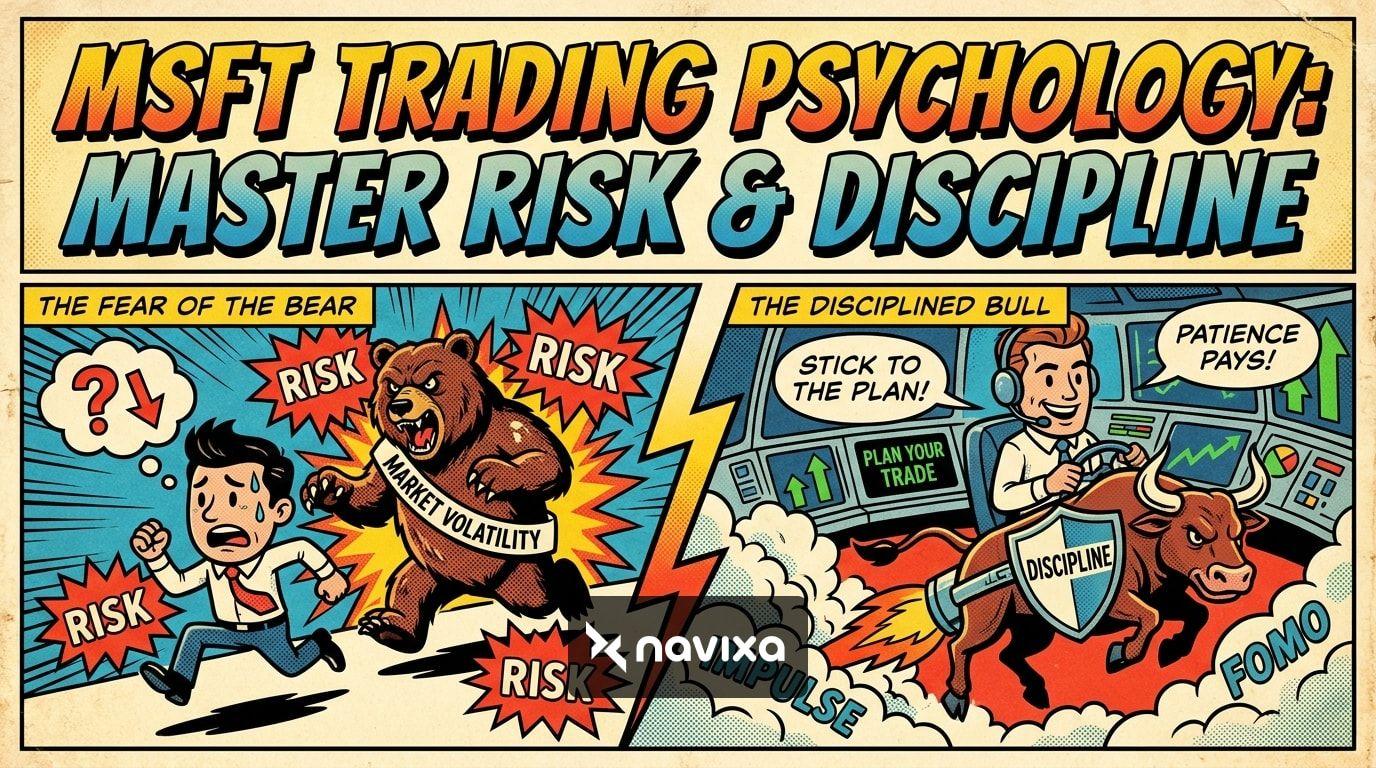
The modern financial landscape is a high-speed collision of traditional equities, cryptocurrency volatility, and algorithmic trading. At the epicenter of this market sits Microsoft Corporation (MSFT), a mega-cap technology behemoth that has transitioned from a stable blue-chip stock into a high-beta asset driven by artificial intelligence (AI) infrastructure investments and Azure cloud growth. For modern traders—many of whom cut their teeth in the relentless, 24/7 cryptocurrency markets—trading MSFT requires more than just technical analysis. It demands a deep mastery of MSFT trading psychology.
Whether you are trading tokenized stocks on a decentralized exchange or utilizing traditional brokerage platforms, the mental fortitude required to trade Microsoft is immense. The stock’s massive liquidity, coupled with sudden news-driven price swings regarding AI capital expenditures or OpenAI partnerships, can easily trigger emotional reactions. Mastering MSFT trading psychology is not just about avoiding panic; it is about building a systematic framework for risk and discipline that allows you to capitalize on market inefficiencies without losing your capital—or your mind.
In this comprehensive guide, we will explore the cognitive demands of trading mega-cap tech, dissect actionable risk management strategies, and provide practical steps to fortify your trading mindset. By understanding the psychological underpinnings of the market, you can transform volatility from a source of anxiety into a landscape of opportunity.
Understanding the Market Context: MSFT's Volatility
To understand the psychology of trading a specific asset, you must first understand the asset's market context. Microsoft is widely viewed as a primary beneficiary of the AI boom. However, as capital expenditures for data centers and AI infrastructure soar into the hundreds of billions, investor sentiment frequently oscillates between extreme greed and intense fear.
For instance, when MSFT experiences a sharp drawdown from its October 2025 peak near $557—driven by concerns over margin pressures or slower-than-expected Copilot monetization—retail traders often succumb to panic selling. Currently navigating the $370 to $400 range due to heavy scrutiny of its $680 billion AI and cloud infrastructure outlays, the stock routinely tests the emotional limits of investors. Conversely, when Microsoft announces a structural breakthrough or an expansion of its Azure capabilities, the fear of missing out (FOMO) triggers aggressive, top-heavy buying.
This cyclical volatility mirrors the wild swings often seen in the cryptocurrency sector. Traders who successfully navigate these waters do not simply react to the price action; they anticipate it. They understand that a 20% retracement is not inherently a fundamental failure of the company, but rather a mechanical recalibration of the market. Recognizing this macro environment is the first step in mastering your MSFT trading psychology. When you accept that volatility is a feature, not a bug, you stop treating every intraday dip as a catastrophe.
The Core Pillars of MSFT Trading Psychology
Successful traders operate on a distinct psychological wavelength. They remove ego from the equation and treat trading as a game of probabilities. When dealing with MSFT, there are several cognitive biases you must actively combat to maintain your edge.
Overcoming Overconfidence During Bull Runs
When tech stocks are in a secular bull market, it is easy to confuse a rising tide with personal trading genius. A series of winning long positions on MSFT can inflate a trader's ego, leading to over-leveraging and relaxed risk parameters. This overconfidence is a silent portfolio killer. The moment you believe you have "figured out" Microsoft's price action is precisely the moment the market will humble you. Maintaining discipline means adhering to your original position sizing, regardless of how many consecutive wins you have secured.
Managing Loss Aversion During Tech Sell-Offs
Human beings are psychologically wired to feel the pain of a financial loss twice as intensely as the joy of an equivalent gain. This cognitive bias, known as loss aversion, is particularly dangerous when trading MSFT. If Microsoft stock breaks below a critical support level—such as its 50-day or 200-day Simple Moving Average (SMA)—loss aversion may cause you to hold onto a losing position, hoping for a miraculous bounce. A disciplined trader accepts the loss, triggers the stop-loss order, and preserves capital for the next high-probability setup.
The Crypto-Trader Mindset in Traditional Tech
Many contemporary traders have developed their psychological resilience in the cryptocurrency markets. The "crypto mindset" involves a high tolerance for extreme volatility, a deep understanding of market cycles, and an appreciation for macroeconomic indicators. Applying this mindset to MSFT trading psychology gives you a distinct edge. It allows you to view sudden 5% intraday drops not as panic-inducing events, but as liquidity grabs or institutional rebalancing that present low-risk entry points.
Building a Resilient Trading Strategy
A robust trading strategy acts as your psychological anchor. When the market becomes chaotic, your strategy dictates your actions, removing the burden of in-the-moment decision-making.
"The stock market is a device for transferring money from the impatient to the patient." – Warren Buffett
Technical Analysis as an Emotional Anchor
Technical analysis is not a crystal ball; it is a risk management framework. By relying on objective data points, you can filter out the emotional noise generated by financial news and social media. When trading MSFT, utilizing indicators like the Relative Strength Index (RSI), Moving Average Convergence Divergence (MACD), and the Ichimoku Cloud provides quantifiable metrics for market sentiment.
For example, if MSFT is trading in deeply overbought territory on the daily RSI and the MACD signals a bearish crossover, a disciplined trader will resist the FOMO to buy the breakout. Instead, they will wait for a structural pullback to a defined support zone, such as the widely watched Ichimoku baseline support. By letting the technicals dictate the trade, you eliminate the emotional guesswork. To delve deeper into how these cognitive frameworks intersect with data, consider exploring resources like Investopedia: Trading Psychology to understand the mechanics of human behavior in financial markets.
Adapting to Algorithmic and Institutional Trading
Microsoft is one of the most heavily traded equities in the world, meaning its price action is largely dictated by institutional algorithms and high-frequency trading (HFT) bots. These algorithms are designed to hunt liquidity, often pushing the price just past obvious retail stop-loss levels before reversing. Understanding this dynamic is crucial for your MSFT trading psychology. When you get stopped out by a sudden wick, it is not a personal attack by the market; it is simply algorithmic mechanics. Adjusting your stop-loss placement to account for this "noise" can save you both capital and emotional distress.
Risk Management: The Antidote to Emotional Trading
Risk management is the mathematical manifestation of trading discipline. You cannot control whether MSFT will beat its quarterly earnings estimates, but you have absolute control over how much capital you expose to that binary event.
Position Sizing and Portfolio Allocation
The golden rule of risk management is to never risk more than 1% to 2% of your total trading capital on a single trade. If your account size is $10,000, your maximum risk per MSFT trade should be between $100 and $200. This does not mean you only buy $200 worth of stock; it means your stop-loss should be positioned so that if it is triggered, your total realized loss is no more than $200. Proper position sizing neutralizes the fear of financial ruin, allowing you to execute trades with a clear, calm mind.
The Importance of Stop-Loss Orders
Trading MSFT without a hard stop-loss is akin to driving a race car without a seatbelt. In the era of algorithmic flash crashes and sudden macroeconomic shifts, a stop-loss is your ultimate protection. Place your stop-loss orders based on technical invalidation levels—such as just below a key moving average or a recent swing low—rather than arbitrary dollar amounts. Once the stop-loss is set, never widen it as the price moves against you. Accepting a small, calculated loss is the hallmark of professional trading.
Establishing a Daily Drawdown Limit
Professional traders often employ a daily loss limit to protect themselves from "tilt"—a poker term used to describe a state of emotional frustration that leads to irrational decision-making. If you hit your daily drawdown limit while trading MSFT, you must shut down your charts and walk away. The market will always be there tomorrow, but your capital will not be if you revenge-trade in an attempt to make the money back immediately.
Emotional vs. Disciplined Trading
To illustrate the stark contrast between a reactive mindset and a professional approach, review the comparison table below. It highlights the behavioral differences that dictate long-term success in the markets.
| Trait | Emotional Trader (Reactive) | Disciplined Trader (Proactive) |
|---|---|---|
| Reaction to MSFT News | Buys immediately on positive headlines, succumbing to FOMO. | Waits for the initial volatility to settle and looks for a technical setup. |
| Stop-Loss Management | Moves or deletes stop-loss orders to avoid realizing a loss. | Accepts the loss, respects the hard stop, and reviews the trade data. |
| Position Sizing | Bets heavily on "sure things," risking significant portfolio percentage. | Strictly limits risk to 1% to 2% of total account capital per trade. |
| Post-Trade Routine | Celebrates wins loudly; ignores losses and blames market manipulation. | Logs all trades in a journal, analyzing both wins and losses objectively. |
| Market Outlook | Focuses solely on immediate profits and getting rich quickly. | Focuses on executing a long-term strategy with consistency and patience. |
Actionable Steps to Master Risk and Discipline
Transforming your MSFT trading psychology from emotional to disciplined requires active, daily effort. Here are several actionable steps you can implement immediately to improve your edge.
1. Maintain a Detailed Trading Journal
A trading journal is the most powerful tool for self-improvement. Record not just the entry price, exit price, and profit/loss of your MSFT trades, but also your emotional state before, during, and after the trade. Were you feeling anxious? Did you rush the entry? Reviewing this data helps you identify and eliminate toxic behavioral patterns that erode your profitability over time.
2. Utilize Simulated Trading Environments
Before risking real capital on high-stakes trades, stress-test your strategies in a simulated or "paper trading" environment. Platforms like TradingView offer excellent tools for backtesting and forward-testing your setups on Microsoft stock. This builds subconscious confidence in your strategy, which directly reduces anxiety when trading with live funds in real market conditions.
3. Practice Mindfulness and Mental Detachment
Trading is inherently stressful. Incorporating mindfulness practices, such as meditation or deep breathing exercises, can help you detach from the emotional swings of your PnL (Profit and Loss). When you separate your self-worth from the outcome of a single MSFT trade, you become a far more objective and effective market participant.
4. Focus on the Process, Not the Outcome
Your goal should not be "to make $500 today." Your goal should be "to execute my trading plan flawlessly today." If you follow your rules, manage your risk, and take high-probability setups, the profits will naturally follow. Shifting your focus from money to execution is the ultimate psychological hack for long-term survival in the markets.
Practical Takeaways
- Acknowledge the Volatility: Understand that MSFT, driven by AI and cloud infrastructure, will experience significant price swings. Use this volatility to your advantage rather than fearing it. - Implement Strict Risk Management: Never risk more than 1% to 2% of your account on a single MSFT trade. Use hard stop-loss orders and stick to them rigidly. - Anchor with Technicals: Use objective indicators (SMAs, RSI, MACD) to filter out emotional noise and validate your trade entries and exits based on data, not feelings. - Journal Everything: Track your psychological state alongside your financial metrics to identify behavioral blind spots and refine your approach. - Embrace the Crypto Mindset: Apply the resilience, patience, and macroeconomic awareness developed in highly volatile crypto markets to your traditional equity trading.
Conclusion
Mastering MSFT trading psychology is a continuous journey of self-discovery and discipline. The market is an uncompromising mirror that reflects your deepest emotional flaws, be it greed, fear, or impatience. By acknowledging the unique volatility of mega-cap tech stocks, implementing unyielding risk management rules, and approaching each session with a process-oriented mindset, you can elevate your trading from a game of chance to a professional enterprise.
Take the time to refine your strategy, safeguard your capital, and cultivate the mental resilience required to thrive. The next time Microsoft shares experience a sudden, violent swing due to institutional rebalancing or macroeconomic news, you will not be reacting with panic. Instead, you will be calmly executing your plan, confident in your discipline and fully prepared to capitalize on the opportunity.
Frequently Asked Questions
Why is trading psychology so important when trading MSFT?
Trading psychology is critical because MSFT is heavily influenced by macroeconomic news, AI developments, and institutional algorithmic trading. This creates sudden volatility that can trigger emotional reactions like FOMO or panic selling. A strong psychological foundation prevents you from making irrational decisions and helps you stick to your trading plan.
How can I stop revenge trading after a big loss on Microsoft stock?
The most effective way to stop revenge trading is to establish a strict daily drawdown limit. If your losses hit a predetermined threshold, you must immediately close your trading terminal and walk away for the day. Additionally, keeping a trading journal helps you process the loss logically rather than emotionally, allowing you to learn from the mistake instead of compounding it.
Is risk management different for tech stocks compared to cryptocurrency?
The fundamental principles of risk management—such as risking only 1% to 2% of your capital per trade and using stop-losses—are identical across both asset classes. However, tech stocks like MSFT often have defined trading hours (with pre-market and after-hours price gaps) and scheduled earnings reports. These require specific risk adjustments, such as not holding highly leveraged short-term positions through an earnings call, which differ from the continuous 24/7 nature of crypto markets.
How do I deal with the fear of missing out (FOMO) when MSFT is rallying rapidly?
Combat FOMO by relying strictly on technical analysis and your predetermined trading strategy. If the stock is breaking out but the technical indicators (like the RSI) show it is extremely overbought, trust your system over your emotions. Remind yourself that the market will always provide another high-probability entry point later on, and chasing green candles often leads to buying at the top.