
Introduction
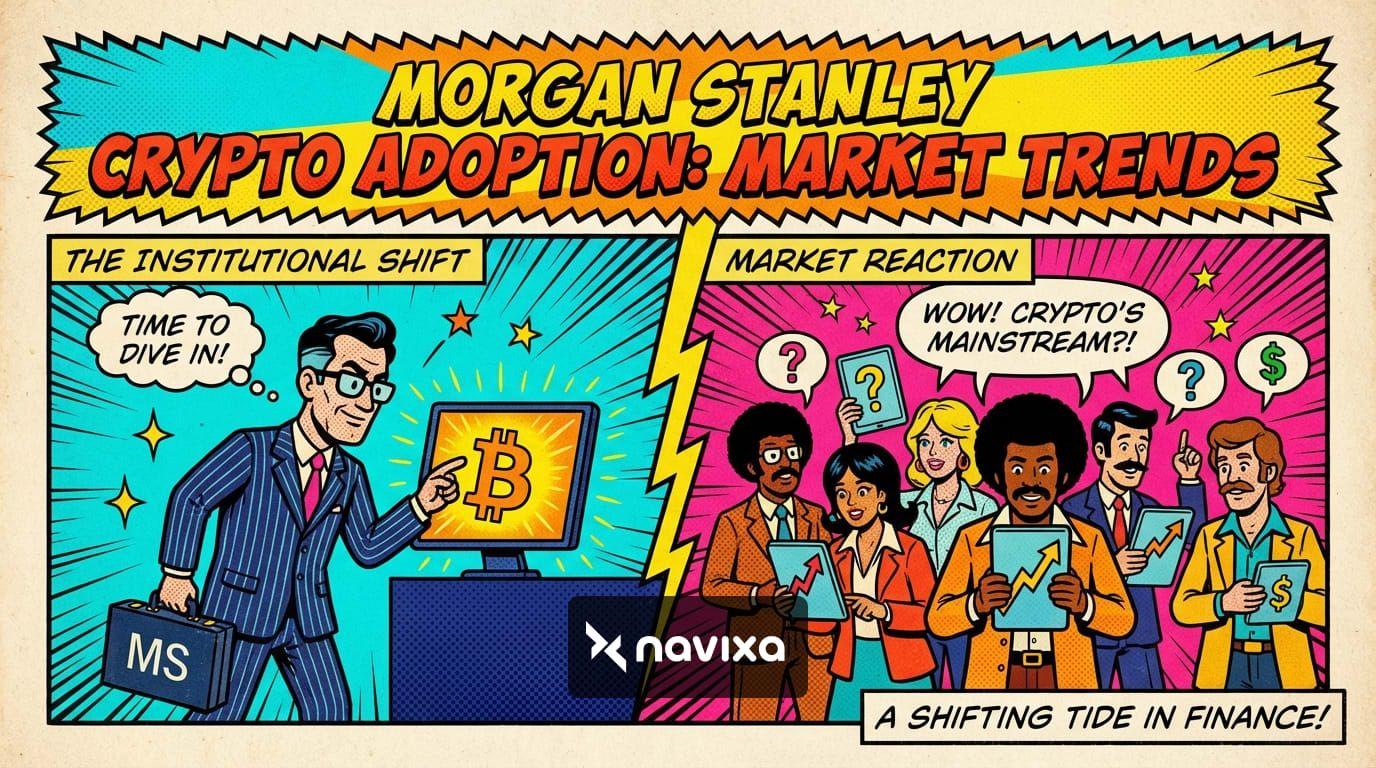
For years, the intersection of traditional finance and digital assets felt like a distant hypothetical. Today, that intersection is the defining financial reality of our era. The narrative surrounding Morgan Stanley crypto adoption has evolved from cautious institutional research to a full-blown embrace of digital asset integration. With landmark developments like the launch of the Morgan Stanley Bitcoin Trust (MSBT) and expanding retail access, the banking giant has firmly planted its flag in the digital economy.
Understanding Morgan Stanley's pivot into the cryptocurrency market provides invaluable insights into broader market trends. When a global systemically important bank (GSIB) handling trillions in client assets recalibrates its wealth management frameworks to accommodate Bitcoin and other digital assets, the ripple effects transform the entire trading landscape.
This comprehensive guide explores the multi-faceted approach Morgan Stanley is taking toward digital assets. We will unpack their latest institutional products, their strategy for categorizing crypto within diversified portfolios, actionable takeaways for independent traders, and the rigorous risk management protocols essential for navigating this high-volatility sector.
The Paradigm Shift: Morgan Stanley Crypto Adoption
Historically, Wall Street approached cryptocurrencies with profound skepticism. However, as client demand surged and regulatory frameworks matured, institutions were forced to adapt. Morgan Stanley has emerged not just as a participant, but as a trailblazer in bank-issued cryptocurrency exchange-traded products (ETPs).
The Launch of the Morgan Stanley Bitcoin Trust (MSBT)
The introduction of the Morgan Stanley Bitcoin Trust represents a watershed moment for institutional crypto adoption. Issued by Morgan Stanley Investment Management (MSIM), this product bridges the gap between traditional brokerage platforms and decentralized digital assets. By offering an ETP with highly competitive sponsor fees—currently sitting at a market-low 0.14%—Morgan Stanley is aggressively competing for market share against other asset management titans.
"Digital assets are increasingly intersecting with traditional markets, and our focus is on helping clients access that evolution through structures they understand and trust." — Morgan Stanley Digital Asset Strategy
To ensure security and regulatory compliance, the trust employs a sophisticated dual-custodian model. It relies on a traditional banking custodian (BNY) for robust record-keeping and a specialized crypto-native custodian (Coinbase) for securing the underlying digital assets. This hybrid approach signifies a maturation in institutional crypto security, demonstrating how traditional finance is assimilating blockchain technology.
Expanding Retail Access
Institutional adoption is only one side of the coin. Morgan Stanley's strategy also targets retail investors through its wealth management divisions and platforms like E*Trade. By facilitating retail crypto spot trading, the firm allows everyday traders to manage digital assets alongside traditional equities, bonds, and mutual funds within a unified portfolio ecosystem. This holistic integration dismantles the technical barriers of entry—such as managing private keys or hardware wallets—that previously deterred mass adoption.
Market Trends: Decoding the Institutional Inflows
The broader market trends highlighted by Morgan Stanley's research indicate that while retail investors initially fueled the crypto boom, institutional capital is now driving sustainable growth. Recent data reveals that crypto ETFs briefly surpassed $200 billion in assets under management, with tens of billions in new inflows continuing to shape the market landscape.
Advisor Adoption is Still in its Infancy
Despite these staggering numbers, Morgan Stanley's internal research suggests that wealth advisor adoption is still in its early innings. Financial advisors are actively navigating the complexities of how much exposure is appropriate for a standard client portfolio. This cautious optimism indicates massive untapped potential. As educational barriers fall and regulatory clarity improves, the deployment of capital from independent financial advisors and family offices is expected to act as the next major catalyst for cryptocurrency market caps.
Trading Strategy: Categorizing Digital Assets as Real Assets
One of the most significant intellectual shifts within Morgan Stanley's wealth management division is how they categorize Bitcoin and other digital assets. The firm's Global Investment Committee (GIC) classifies cryptocurrency as a real asset, placing it in the same broader category as commodities like gold, silver, and real estate.
The Macro Hedge Proposition
Categorizing digital assets as real assets fundamentally alters how portfolio managers utilize them.
* Supply Constraints: Much like precious metals, assets like Bitcoin have a mathematically verifiable capped supply, making them inherently deflationary. * Inflation Sensitivity: Cryptocurrencies are heavily monitored as potential hedges against fiat currency devaluation and broad macroeconomic inflation. * Lack of Cash Flow: Because cryptocurrencies do not yield dividends or interest, their valuation relies purely on supply-demand dynamics, network adoption, and overall market sentiment.
Navigating Correlated Market Stress
While originally touted as a purely uncorrelated asset class, Morgan Stanley notes that cryptocurrencies often exhibit high correlation with risk assets (like tech equities) during periods of acute macroeconomic stress. Traders must factor this dynamic into their technical analysis and broader market strategies. Over-allocating to digital assets under the false assumption that they will completely insulate a portfolio from equity market downturns is a common misstep that modern wealth managers actively avoid.
The Future of Tokenization and Blockchain Utility
Beyond simple price exposure to assets like Bitcoin, Morgan Stanley has consistently emphasized the transformative potential of underlying blockchain technology. While cryptocurrency trading captures the headlines, the backend utility of distributed ledger technology is quietly revolutionizing institutional finance.
Real-World Asset Tokenization
One of the most promising market trends identified by Morgan Stanley is the tokenization of real-world assets (RWAs). This process involves creating a digital representation of physical or traditional financial assets—such as real estate, private credit, or mutual funds—on a blockchain. By utilizing smart contracts, institutions can automate compliance, streamline settlements, and fractionalize ownership. This innovation significantly lowers the barrier to entry for illiquid markets and increases global capital efficiency.
The Role of Stablecoins in Market Infrastructure
Stablecoins, which are cryptocurrencies pegged to fiat currencies like the U.S. dollar, have emerged as a foundational layer for this new financial infrastructure. Morgan Stanley's research indicates that the stablecoin market has experienced explosive growth, driven by the demand for instant, cross-border settlements without the volatility associated with unpegged cryptocurrencies. As regulatory clarity improves—such as legislation governing stablecoin issuance—Morgan Stanley anticipates that payment systems globally will continue to adapt to accommodate digital dollar transactions. This infrastructure build-out is essential for the long-term viability of the broader crypto ecosystem.
Comparing Crypto Exposure: ETPs vs. Direct Ownership
To better understand why Morgan Stanley is heavily investing in the ETP framework, it is crucial to compare regulated exchange-traded products against direct digital asset ownership.
| Feature | Morgan Stanley Crypto ETPs (e.g., MSBT) | Direct Crypto Ownership (Spot Market) |
|---|---|---|
| Custody & Storage | Managed by institutional custodians (BNY/Coinbase). | Requires self-custody (hardware wallets/private keys). |
| Platform Integration | Trades in traditional brokerage accounts alongside stocks. | Requires specialized crypto exchanges. |
| Regulatory Framework | Fully regulated under traditional financial securities law. | Subject to evolving and fragmented global regulations. |
| Fees | Extremely low sponsor fees (e.g., 0.14%). | Trading fees, withdrawal fees, and network gas fees. |
| Asset Portability | Cannot withdraw the underlying digital assets. | Full sovereignty to move assets across networks. |
Actionable Steps for Integrating Crypto into Your Portfolio
For traders and investors looking to emulate institutional strategies, Morgan Stanley's blueprint provides several actionable steps.
1. Optimize Your Position Sizing
Because digital assets exhibit a high volatility profile, Morgan Stanley's guidance emphasizes modest allocations. For a growth-oriented portfolio, a low single-digit percentage allocation can offer meaningful upside exposure without jeopardizing the portfolio's structural integrity during sharp drawdowns. Conservative or income-focused portfolios may opt for even smaller allocations or strictly avoid the asset class until volatility metrics stabilize.
2. Utilize Familiar Brokerage Tools
If managing private keys and seed phrases is unappealing or technically daunting, leverage regulated ETPs. Products like the Morgan Stanley Bitcoin Trust allow investors to gain price exposure to digital assets using the same tax-advantaged accounts and brokerage platforms they already use for traditional investing.
3. Implement Strict Rebalancing Protocols
The rapid price appreciation associated with cryptocurrency bull markets can quickly warp a portfolio's asset allocation. If a 3% target allocation swells to 10% due to a price surge, it fundamentally alters the portfolio's risk profile. Implement disciplined, calendar-based or threshold-based rebalancing to lock in profits and maintain your intended risk exposure.
Risk Management: Navigating Volatility
Institutional adoption does not eliminate the inherent risks of the cryptocurrency market. Morgan Stanley's literature consistently reinforces the importance of risk management.
Assessing Drawdown Risk
Digital assets have historically endured brutal bear markets, often experiencing massive drawdowns from all-time highs. An investor must have the psychological fortitude and financial stability to weather these cycles without panic selling. Consequently, crypto is explicitly deemed unsuitable for investors who cannot afford the loss of their entire allocated principal.
Regulatory and Macroeconomic Variables
The value of the digital asset market remains highly sensitive to regulatory announcements and shifting macroeconomic conditions, such as central bank interest rate decisions. Staying informed on the latest legislative frameworks is mandatory for any serious digital asset trader.
Conclusion
The aggressive expansion into Morgan Stanley crypto products underscores a permanent shift in global wealth management. By offering lowest-in-class fees through MSBT, developing robust dual-custody security models, and expanding retail access, the financial giant is standardizing digital asset investment. For the modern trader, tracking Morgan Stanley's market trends offers a reliable compass for navigating the future of decentralized finance. Whether you choose direct ownership or institutional ETPs, integrating these assets with a focus on disciplined sizing and rigorous risk management is the key to capitalizing on the digital economy.
Frequently Asked Questions
What is the Morgan Stanley Bitcoin Trust (MSBT)?
The Morgan Stanley Bitcoin Trust (MSBT) is an exchange-traded product (ETP) launched by Morgan Stanley Investment Management. It is designed to track the spot price of Bitcoin, allowing investors to gain exposure to the digital asset through traditional brokerage accounts without the need to directly hold or manage the cryptocurrency.
How does Morgan Stanley categorize cryptocurrency in a portfolio?
Morgan Stanley's Global Investment Committee categorizes cryptocurrency as a "real asset," akin to commodities like gold and real estate. This is due to its constrained supply, sensitivity to inflation, and lack of traditional cash flow or dividend generation.
Can retail investors buy crypto through Morgan Stanley?
Yes, Morgan Stanley has been actively expanding its digital asset offerings beyond high-net-worth institutional clients. This includes the integration of spot crypto trading for retail investors through its platforms, such as E*Trade, allowing for comprehensive portfolio management in one ecosystem.
What are the fees associated with Morgan Stanley's Bitcoin ETP?
Morgan Stanley's MSBT launched with an industry-leading unitary delegated sponsor fee of 0.14%, making it one of the most cost-effective vehicles for gaining institutional-grade Bitcoin exposure currently available on the market.
Is crypto investment recommended for conservative portfolios?
Generally, no. Morgan Stanley highlights that due to high volatility and significant drawdown risks, crypto allocations are most suitable as modest, opportunistic positions within growth-oriented portfolios. Conservative portfolios focused heavily on capital preservation or income generation typically avoid or highly restrict digital asset exposure.