
Introduction
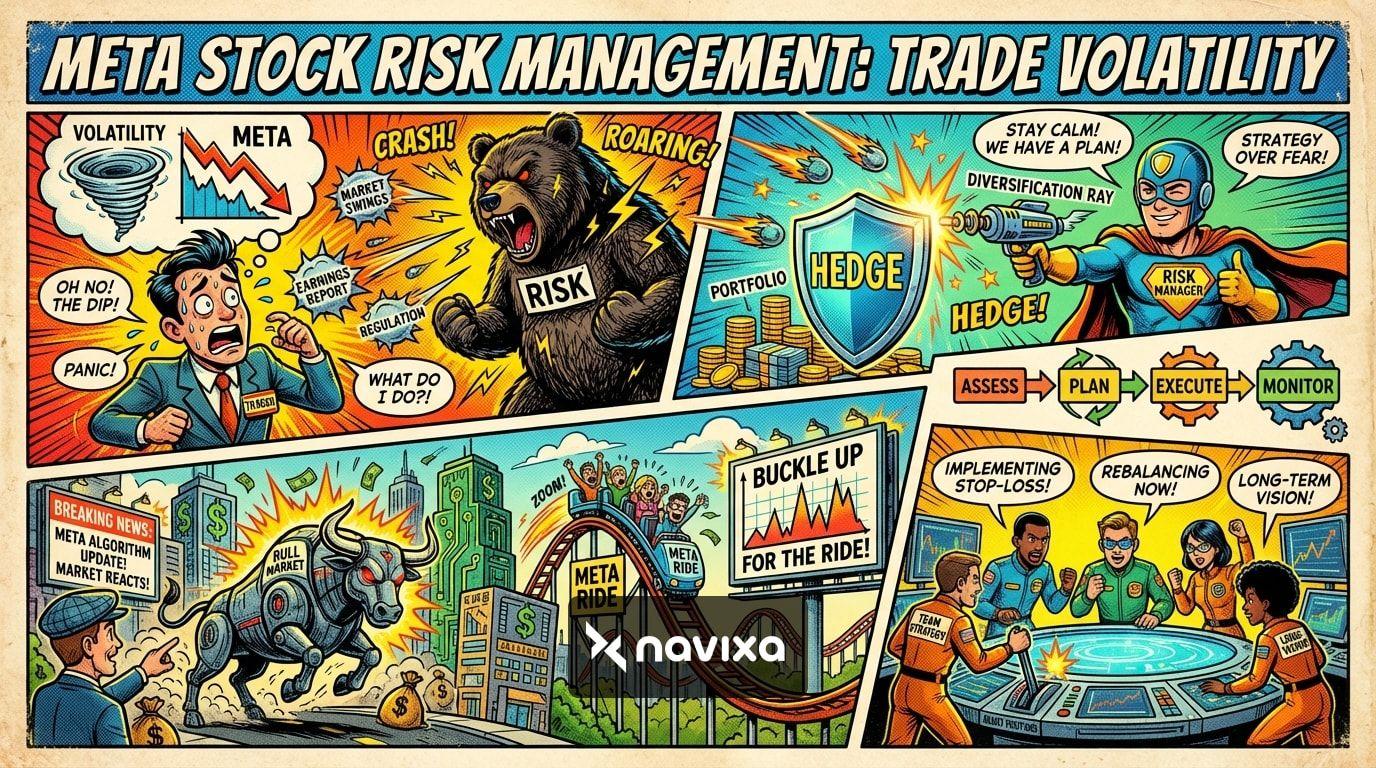
For modern traders, bridging the gap between traditional equities and digital asset markets requires a robust understanding of volatility. Few traditional tech giants embody this cross-market dynamism better than Meta Platforms (NASDAQ: META). As the company accelerates its transition from a social media monopoly to an artificial intelligence powerhouse, META stock risk management has become the defining skill for investors aiming to capitalize on its massive price swings.
Trading high-beta assets demands the same psychological discipline and technical precision required in cryptocurrency markets. With Meta's stock historically experiencing massive price gaps—both upward during earnings beats and downward amidst capital expenditure concerns—relying purely on bullish sentiment is a recipe for disaster.
"Risk comes from not knowing what you are doing. In the realm of high-beta tech equities, risk is magnified when traders ignore the delicate balance between ad revenue and immense capital expenditure."
This article dives deep into the structural drivers of Meta's volatility and outlines master-class trading strategies to protect your capital while maximizing upside potential.
Understanding the Drivers of META Stock Volatility
To master risk, you must first understand the catalysts creating the volatility. In the fast-paced trading environment, Meta's price action is governed by a unique blend of macroeconomic factors, aggressive corporate spending, and shifting investor sentiment.
The AI CapEx Gamble
Meta's aggressive expansion into artificial intelligence infrastructure is the primary fundamental driver of its price variance. With the company projecting annual capital expenditures well above the $115 billion to $135 billion mark to fund its Meta Superintelligence Labs and related data centers, Wall Street remains hyper-focused on the balance between ad-revenue generation and AI spending. For traders, this creates severe binary events around quarterly earnings reports. If revenue growth outpaces CapEx, the stock rallies; if AI spending accelerates faster than expected, the stock faces immediate selling pressure.
High Beta and Sector Rotation
In the trading world, "Beta" measures a stock's volatility relative to the broader market. Meta consistently trades with a Beta significantly higher than 1.0 (often hovering around 1.76), meaning it is 76% more volatile than the S&P 500. When institutional funds engage in sector rotation—moving capital out of tech giants and into small-cap value stocks or alternative assets like cryptocurrency—Meta's high Beta exacerbates the downward momentum.
Corporate Restructuring and Regulatory Headwinds
Internal restructuring, including targeted efficiency layoffs and the unprecedented issuance of executive stock options tied to ambitious future price targets, injects further speculative momentum into the stock. Additionally, lingering regulatory scrutiny regarding data privacy and youth mental health lawsuits acts as a persistent overhang, capable of triggering sudden, headline-driven price drops.
Core Trading Strategies for META Stock Risk Management
Navigating a high-volatility tech stock requires moving beyond simple buy-and-hold strategies. By implementing advanced risk parameters, traders can survive drawdowns and position themselves for asymmetrical returns.
Position Sizing and Capital Allocation
The golden rule of META stock risk management is strict position sizing. Because the asset exhibits crypto-like volatility during earnings season, allocating an oversized portion of your portfolio to Meta exposes you to catastrophic risk. Professional traders typically limit their exposure to any single high-beta equity to 2% to 5% of their total portfolio capital. By keeping position sizes manageable, you ensure that even a 20% overnight gap-down will not trigger a margin call or ruin your trading account.
Beta Hedging and Cross-Market Diversification
If you hold a significant long position in Meta, you must account for its systemic market risk. Traders often use beta hedging to neutralize this exposure. This involves shorting index futures (such as the Nasdaq 100) to offset potential tech-sector downturns. Alternatively, traders with a foot in the digital asset space might diversify into non-correlated cryptocurrencies. Because Bitcoin and select altcoins sometimes move independently of traditional tech equities, a blended portfolio can smooth out the volatility curve and reduce maximum drawdowns.
Leveraging Options for Downside Protection
For active traders and long-term holders alike, the derivatives market offers powerful tools to mitigate risk. Options trading allows you to define your risk precisely, turning unpredictable volatility into a calculated mathematical equation.
Buying Protective Puts
A protective put acts as an insurance policy for your stock position. By purchasing a put option at a strike price slightly below Meta's current market value, you gain the right to sell your shares at that predetermined price, regardless of how far the stock plummets. While purchasing puts requires paying a premium (which eats into potential profits), it mathematically caps your maximum loss. This strategy is highly recommended ahead of volatile events like earnings calls or major regulatory announcements.
Writing Covered Calls
If you anticipate that Meta will enter a period of consolidation—trading sideways after a massive rally—writing covered calls is an excellent strategy to generate passive income and lower your overall cost basis. By selling the right for someone else to buy your shares at a higher strike price, you collect an upfront premium. This premium acts as a small financial buffer against minor downside moves, making it a cornerstone of conservative portfolio defense.
Technical Analysis: Setting Logical Boundaries
Effective risk management is impossible without technical analysis. Understanding where buyers and sellers are congregated helps you place stop-loss orders based on market structure rather than arbitrary percentages.
Moving Averages as Dynamic Support
Moving averages (MAs) are critical for identifying the underlying trend. The 50-day and 200-day moving averages serve as psychological support zones for institutional investors. If Meta's stock price breaks decisively below its 50-day MA on high volume, it signals a shift in short-term momentum. Traders use these levels to set trailing stop-loss orders, ensuring they lock in profits during uptrends and exit quickly when the trend breaks.
RSI and Volatility Contraction
The Relative Strength Index (RSI) is an oscillator that measures the speed and change of price movements. When Meta's RSI climbs above 70, the stock is considered overbought and susceptible to a pullback—a prime signal to tighten your risk management parameters. Conversely, an RSI below 30 suggests the stock is oversold. Combining RSI readings with support levels allows traders to avoid the psychological trap of panic selling at the exact bottom of a correction.
For further technical insights into analyzing high-volatility assets, traders can explore resources on Investopedia's Technical Analysis Guide.
Actionable Steps: Building a Bulletproof Risk Plan
To successfully trade Meta, you must treat your trading operation like a business. Here is a step-by-step framework to bulletproof your strategy:
1. Define Your Maximum Drawdown: Before entering a trade, determine the absolute maximum dollar amount you are willing to lose. Set your stop-loss accordingly. 2. Utilize Trailing Stops: As the stock price moves in your favor, manually or automatically adjust your stop-loss upward to protect unrealized gains. 3. Monitor AI CapEx News: Keep a close watch on Meta's quarterly guidance regarding data center spending and hardware acquisitions, as this dictates institutional sentiment. 4. Hedge Ahead of Earnings: Never hold an unhedged, oversized position through an earnings report. Use options to cap your downside gap risk. 5. Diversify Your Capital: Do not let tech stocks dominate your entire portfolio. Balance your tech exposure with commodities, index funds, or strategic cryptocurrency allocations on platforms like Binance.
Comparing Risk Management Strategies
Different trading environments require different tools. The table below breaks down the most common risk management techniques for handling Meta's volatility.
| Risk Strategy | Complexity | Cost | Primary Benefit |
|---|---|---|---|
| Stop-Loss Orders | Low | Free (Execution spread only) | Prevents catastrophic losses by automatically closing positions. |
| Protective Puts | Medium | Premium paid for the option | Caps downside risk while allowing for unlimited upside potential. |
| Covered Calls | Medium | Caps upside profit potential | Generates premium income and lowers the average cost basis. |
| Position Sizing | Low | Free | Ensures no single trade can mathematically destroy your portfolio. |
| Beta Hedging | High | Margin requirements for shorting | Neutralizes broader market risk, isolating the stock's intrinsic performance. |
Practical Takeaways
- Respect the Beta: Meta is not a slow-moving utility stock. Its high volatility demands active risk monitoring and disciplined execution. - Options are Essential: Relying solely on market orders leaves you vulnerable to overnight gaps. Learn to use the options market for reliable insurance. - Data over Emotion: Use key moving averages and momentum indicators to dictate your exits, rather than panic or greed. - Macro Awareness: Keep an eye on the broader tech sector. Sector rotation can drag Meta down regardless of how strong its internal revenue metrics are.
Conclusion
Mastering META stock risk management is an ongoing process that requires discipline, continuous education, and a willingness to adapt to shifting market conditions. As Meta Platforms continues to pour billions into the artificial intelligence arms race, the stock will remain a battleground for bulls and bears alike. By implementing strict position sizing, leveraging options for downside protection, and adhering to technical boundaries, you can navigate this volatility with confidence. Do not let the massive swings dictate your emotional state—build your risk framework today, protect your capital relentlessly, and position yourself to profit from the future of technology.
Frequently Asked Questions
What does a high Beta mean for META stock?
Beta measures a stock's volatility in relation to the overall market. A Beta of 1.76 means that, historically, Meta's stock is 76% more volatile than the S&P 500. For traders, this indicates that the stock will experience exaggerated price swings, both to the upside and the downside, requiring stricter risk management protocols.
How does Meta's AI spending affect its stock risk profile?
Meta is investing massive amounts of capital—over $100 billion annually—into AI infrastructure and its Meta Superintelligence Labs. While this positions the company for future dominance, it drains free cash flow in the short term. Investors view this heavy capital expenditure as a major risk factor; if AI monetization lags behind spending, the stock typically faces sharp sell-offs.
What is the safest way to hold META stock through an earnings report?
Holding any volatile stock through an earnings report carries "gap risk," where the stock price can open significantly lower than its previous close, bypassing traditional stop-loss orders. The safest approach is to purchase a protective put option prior to the announcement. This mathematically caps your downside risk while allowing you to participate in any upside surprises.
Can cryptocurrency strategies be applied to trading META stock?
Absolutely. Many of the risk management techniques used in crypto—such as asymmetric position sizing, relying heavily on technical indicators for momentum shifts, and hedging with non-correlated assets—are highly effective when trading high-beta tech stocks like Meta. The psychological discipline required to hold through a 20% crypto dip translates perfectly to handling tech sector volatility.