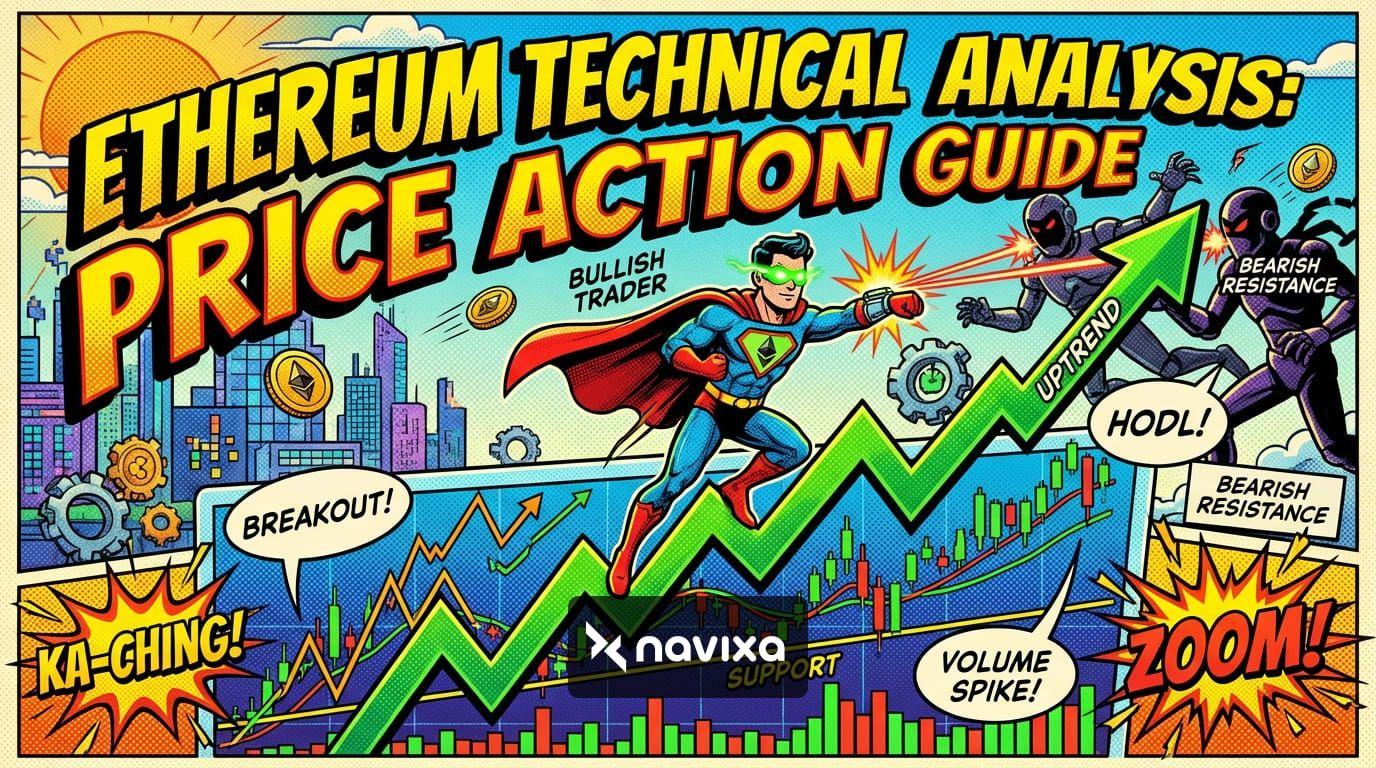


In the fast-paced, highly volatile world of cryptocurrency, understanding Bitcoin price action is the ultimate key to navigating the market. Rather than relying solely on lagging indicators or social media hype, mastering how price moves on a chart allows traders to interpret the raw psychology of buyers and sellers.
As the cryptocurrency landscape evolves into 2026, Bitcoin remains the undeniable bellwether for the broader digital asset market. Whether driven by spot ETF inflows, geopolitical tensions, or complex macroeconomic shifts, every catalyst leaves a distinct footprint on the charts. By learning to decode these footprints, traders can anticipate potential breakouts, avoid bull traps, and position themselves profitably.
This comprehensive guide will walk you through the fundamentals of Bitcoin price action, essential chart patterns, synergistic technical analysis tools, and battle-tested strategies to elevate your crypto trading game.
The Mechanics of Bitcoin Price Action
At its core, price action is the analysis of historical and current price movements to predict future market behavior. It strips away the noise of complex algorithms and focuses entirely on what the market is doing right now.
When you study a Bitcoin chart, you are essentially looking at an ongoing battle between supply and demand. If institutional whales are accumulating, support levels will hold firm. Conversely, if macroeconomic fears—such as shifting Federal Reserve interest rates, global trade tariffs, or geopolitical friction in the Middle East—spook investors, resistance levels will reject the price, leading to bearish momentum.
"Price action is the purest reflection of market sentiment. It is the aggregate result of every fundamental variable, geopolitical event, and trader's emotion processed in real-time."
To analyze this effectively, traders use candlestick charts. Each candlestick tells a story of the open, high, low, and close (OHLC) over a specific timeframe. Long lower wicks suggest aggressive buying pressure (demand), while long upper wicks indicate strong selling pressure (supply).
Core Chart Patterns Every Crypto Trader Should Know
Recognizing recurring visual structures on the chart is a cornerstone of trading Bitcoin price action. These patterns offer high-probability setups by illustrating where the balance of power is shifting.
Bull and Bear Flags
Flags are continuation patterns that occur after a strong directional move (the pole) followed by a period of consolidation in a parallel channel (the flag). * Bull Flags: Form after a rapid price surge. The consolidation slopes downward as weak hands sell, but the volume remains low. A breakout above the upper trendline typically leads to a measured move upward. * Bear Flags: Form after a sharp drop. The price consolidates upward in a weak bounce. For example, during turbulent periods in early 2026, Bitcoin frequently painted 3-day bear flag structures when struggling to maintain key psychological levels like $70,000, ultimately resolving in downward pressure.
Head and Shoulders & Inverted Patterns
The Head and Shoulders (H&S) pattern is a classic reversal structure consisting of three peaks, with the middle peak (the head) being the highest. The line connecting the lows is called the neckline. When Bitcoin breaks below this neckline on high volume, it signals a major shift from a bullish to a bearish trend. The Inverted Head and Shoulders acts in reverse, signaling a bottoming process and the start of a new uptrend.
Symmetrical, Ascending, and Descending Triangles
Triangles represent a compression of volatility. As the price bounces between converging trendlines, it acts like a coiled spring. * Ascending Triangles: Feature a flat resistance line and rising support. They are generally bullish. * Descending Triangles: Feature a flat support line and falling resistance. They are generally bearish. * Symmetrical Triangles: Consist of both lower highs and higher lows, indicating market indecision until a decisive breakout occurs.
Technical Analysis Indicators to Pair with Price Action
While pure price action is powerful, pairing it with select technical analysis (TA) tools can dramatically increase your win rate. The goal is confluence—finding multiple reasons to take a trade.
Volume: The Ultimate Validator
Volume is the lifeblood of price movement. A breakout above a major resistance level—such as Bitcoin crossing the $75,000 threshold—must be accompanied by a spike in trading volume. High volume validates the breakout, confirming that institutional money is participating. Low-volume breakouts are often fakeouts designed to trap retail traders. You can track real-time volume metrics using platforms like CoinGecko.
Moving Averages (EMA 50, 100, 200)
Exponential Moving Averages (EMAs) smooth out price data to identify the broader trend. In a strong bullish environment, Bitcoin will typically hold the 50-day EMA as dynamic support. If the price falls below the 50 EMA, traders look to the 100 or 200 EMA. The 200-day EMA is widely considered the ultimate line in the sand between a macro bull and bear market.
Fibonacci Retracements
The Fibonacci tool helps identify potential hidden support and resistance levels during a pullback. By drawing the tool from a major swing low to a swing high, traders watch key ratios like the 0.382, 0.5, and 0.618 levels. For instance, in an impulsive Bitcoin rally, a pullback to the 0.382 level (often sitting in the low $60,000s during 2026 consolidations) is seen as a healthy correction and a prime buying opportunity.
Comparison: Pure Price Action vs. Indicator-Based Trading
Traders often debate the merits of a naked chart versus one loaded with indicators. Here is a breakdown of how they compare.
| Feature | Pure Price Action Trading | Indicator-Based Trading |
|---|---|---|
| Primary Focus | Candlesticks, support/resistance, trendlines | Moving averages, RSI, MACD, oscillators |
| Response Time | Leading (Real-time data) | Lagging (Based on historical data) |
| Market Context | Adapts quickly to sudden volatility | Can produce false signals in choppy markets |
| Learning Curve | Steep (Requires strong chart reading skills) | Moderate (Easier to formulate mechanical rules) |
| Best Used For | Pinpointing exact entries and exits | Identifying macro trends and momentum shifts |
Proven Trading Strategies for Bitcoin
To capitalize on Bitcoin price action, you need a systematic approach. Here are three highly effective strategies tailored for the cryptocurrency market.
Strategy 1: The Support/Resistance Flip (S/R Flip)
One of the most reliable setups in crypto is the S/R flip. When Bitcoin breaks aggressively above a stubborn resistance level, that former ceiling often becomes a new floor. How to trade it: Wait for the breakout to occur. Do not succumb to FOMO (Fear of Missing Out). Instead, wait for the price to retest the breakout level. If the level holds as support and you see a bullish candlestick pattern (like a hammer or engulfing candle), enter the trade.
Strategy 2: Liquidity Sweeps
Cryptocurrency markets are notorious for hunting stop-losses. A liquidity sweep occurs when the price briefly drops below a major support level—triggering the stop-losses of retail traders—only to immediately reverse back upward. How to trade it: Mark key swing lows on your chart. If the price dips below this level but the daily or 3-day candle closes back above it, leaving a long lower wick, it indicates a liquidity sweep by larger players. This is a high-probability buy signal.
Risk Management in Volatile Macro Environments
No matter how flawless your analysis is, trading Bitcoin carries inherent risks. The asset is sensitive to global liquidity, regulatory news, ETF inflow/outflow dynamics, and broader macroeconomic shifts like inflation data or sudden tariffs.
1. Strict Position Sizing: Never risk more than 1% to 2% of your total trading capital on a single trade. If your stop loss is hit, the damage to your portfolio is negligible. 2. Use Hard Stop Losses: The crypto market operates 24/7. A sudden flash crash triggered by geopolitical news can liquidate an over-leveraged account in minutes. Always have a predefined exit plan before entering a trade. 3. Monitor the Macro Backdrop: In environments where traditional financial markets are risk-averse, Bitcoin often faces downward pressure despite bullish chart patterns. Always factor in the broader economic climate when taking swing trades.
Practical Takeaways
* Analyze Multiple Timeframes: Use the weekly and daily charts for the macro trend, and the 4-hour chart for precise entries. * Validate with Volume: Do not trade in a vacuum; ensure trading volume supports your price action analysis to avoid fakeouts. * Patience Pays Off: Wait for the chart to provide clear confirmation, such as a daily close above resistance, rather than anticipating the move prematurely. * Adapt to the Regime: Use range-bound strategies during consolidation and trend-following strategies during breakouts.
Conclusion
Mastering Bitcoin price action is a continuous journey of adapting to market psychology and honing your technical analysis skills. By understanding how candlesticks interact with support and resistance, identifying core chart patterns, and managing your risk meticulously, you can transform the chaos of cryptocurrency volatility into actionable, profitable setups. Stop letting the market dictate your emotions, and start letting the charts dictate your strategy.
Frequently Asked Questions
What is the best timeframe for analyzing Bitcoin price action?
The best timeframe depends entirely on your trading style. Scalpers may use the 5-minute and 15-minute charts for rapid trades, while day traders prefer the 1-hour and 4-hour charts. For swing traders and long-term investors, the daily and weekly charts are the most reliable, as they filter out intraday noise and provide a clearer picture of the macro trend.
How do macroeconomic events and ETF flows affect Bitcoin's chart patterns?
Macro events—such as Federal Reserve interest rate decisions, global trade tariffs, or geopolitical tensions—can instantly override technical patterns. Similarly, consistent outflows or inflows from institutional spot ETFs can create sustained buying or selling pressure. Price action traders must be aware of these catalysts, as they often dictate the volume and momentum required to validate or invalidate a chart pattern.
Can you trade Bitcoin price action without using any indicators?
Yes. Many professional traders rely on naked charting, meaning they trade using only candlestick patterns, trendlines, and horizontal support or resistance levels. Pure price action focuses on the immediate behavior of buyers and sellers, which is a leading indicator, whereas traditional technical indicators are derived from historical data and inherently lag behind real-time price movements.
Why does Bitcoin sometimes consolidate for long periods?
Consolidation phases occur when the market is searching for equilibrium between buyers and sellers after a significant directional move. During these periods, institutional players are often accumulating or distributing assets quietly to avoid causing massive price spikes. These long sideways ranges build up liquidity and tension, which typically results in explosive volatility once a breakout finally happens.