
The convergence of macroeconomic indicators and cryptocurrency markets has fundamentally changed how digital assets are traded. Gone are the days when Bitcoin and Ethereum moved entirely on their own isolated narratives. Today, they march in lockstep with global liquidity, making a solid jobs report trading strategy an absolute necessity for any serious market participant.
Every month, the U.S. government drops the Non-Farm Payrolls (NFP) report, triggering massive volatility across forex, equities, and crypto markets. For the unprepared, this volatility can be a portfolio killer. For the strategic trader, it represents one of the most lucrative opportunities on the calendar.
In this comprehensive guide, we will break down a step-by-step jobs report trading strategy, explain why employment data dictates cryptocurrency prices, and provide actionable risk management techniques to help you secure consistent gains.
Why the Jobs Report Matters for Crypto and Forex
Before executing any trades, you must understand the underlying mechanics of why employment data moves the market. The U.S. jobs report, compiled and published by the U.S. Bureau of Labor Statistics, serves as a vital barometer for the broader economy. It reveals how many jobs were added or lost, the current unemployment rate, and wage growth.
The Federal Reserve and Interest Rates
The cryptocurrency market is highly sensitive to the cost of capital. When the U.S. economy adds more jobs than expected, it signals economic strength. While this sounds positive on the surface, a hot economy often brings persistent inflation. To cool down inflation, the Federal Reserve may decide to keep interest rates high.
High interest rates strengthen traditional fiat yields, which pulls liquidity out of risk-on assets like Bitcoin. Conversely, a weak jobs report indicates a cooling economy. This prompts the Federal Reserve to consider lowering interest rates to stimulate growth. Lower rates mean cheaper borrowing, expanding liquidity, and a surge of capital into speculative assets.
Key Rule: Better-than-expected jobs data is generally bearish for crypto in the short term, while worse-than-expected data is generally bullish.
Understanding the DXY Correlation
When trading crypto around a jobs report, you must keep an eye on the U.S. Dollar Index (DXY). A strong jobs report usually causes the DXY to spike, which inversely causes Bitcoin (BTC) to drop. By watching the DXY immediately following the data release, you can gauge the strength of the move before entering a crypto position.
Core Components of the NFP Release
When the report hits the wires at exactly 8:30 AM Eastern Time on the first Friday of the month, institutional algorithms parse three critical numbers instantly:
1. Headline NFP Number: The total number of non-farm jobs added. If this beats the consensus estimate, markets react aggressively. 2. Unemployment Rate: The percentage of the total workforce that is unemployed. A rising unemployment rate signals economic weakness (bullish for crypto long-term due to potential rate cuts). 3. Average Hourly Earnings: A measure of wage inflation. High wage growth can spook the markets as it signals sticky inflation.
If these numbers conflict—for example, if job growth is high but unemployment also ticks up—the market will often "whipsaw," shooting violently in both directions before choosing a true trend.
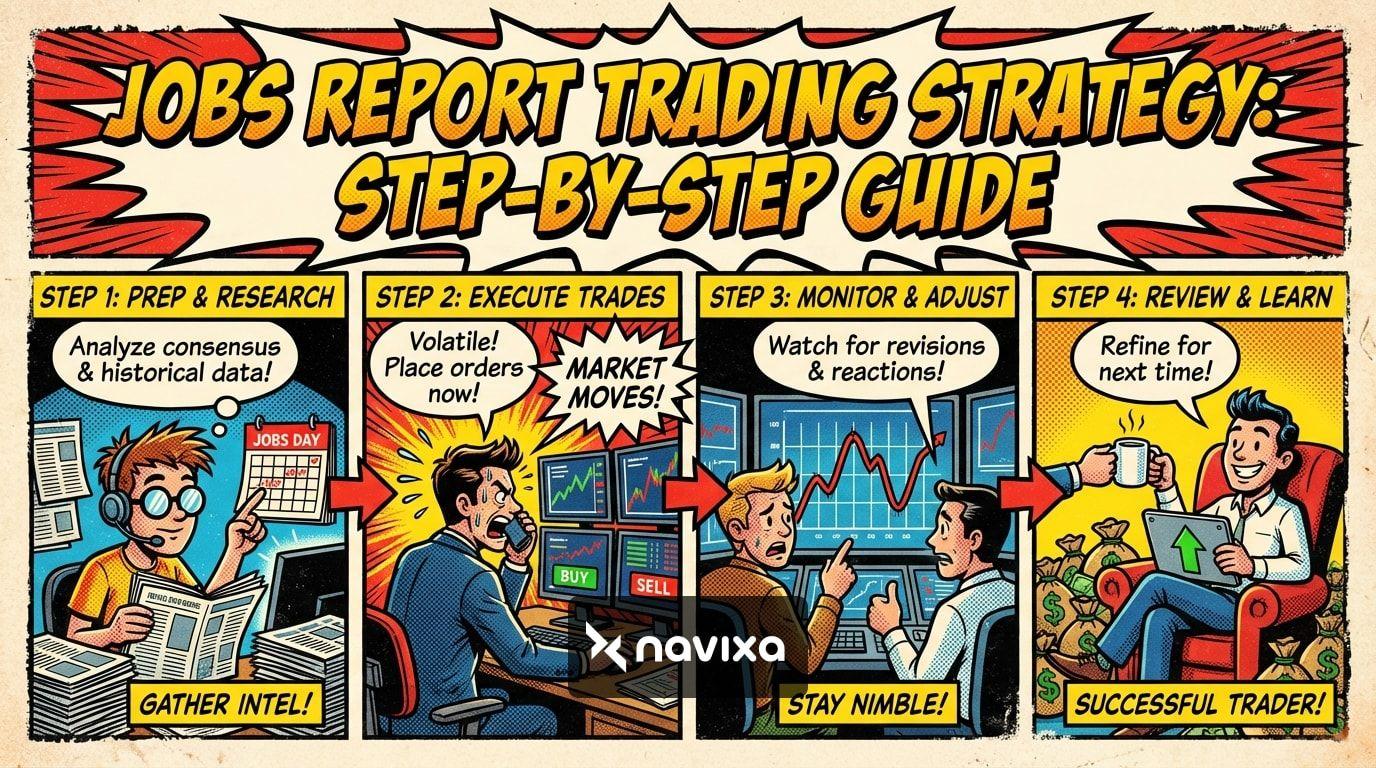
Step-by-Step Jobs Report Trading Strategy
Trading the news is a high-stakes endeavor. Amateurs try to guess the number before it drops, turning trading into a casino. Professionals wait for the data, let the algorithms battle it out, and trade the subsequent trend. Here is a proven, step-by-step jobs report trading strategy.
Step 1: Pre-Release Chart Preparation
About an hour before the release, switch your charts to the 15-minute and 1-hour timeframes. Your goal is to identify key liquidity pools. Mark the previous day's high and low, as well as any obvious support and resistance zones.
Professional traders use tools like the CME FedWatch Tool to understand what the market is pricing in for future interest rates. If the market heavily expects a rate cut, a strong jobs report will catch everyone off guard, resulting in a much larger price swing.
Step 2: Surviving the Initial Whipsaw
At exactly 8:30 AM EST, the data drops. The immediate 1-to-3 minute reaction is almost always pure algorithmic chaos. Spreads widen, liquidity thins out, and massive wicks form on the 1-minute chart.
Do not enter a trade during this window.
The initial spike is often a "liquidity grab" designed to trigger stop-losses and wipe out over-leveraged retail traders. Trying to manually click "Buy" or "Sell" at 8:30 AM is a recipe for severe slippage.
Step 3: Wait for a Market Structure Shift
Once the initial dust settles (usually between 8:40 AM and 8:45 AM EST), watch for a Market Structure Shift (MSS).
If the initial reaction was a violent drop (bearish), wait to see if the price reclaims the pre-news consolidation level. If the 15-minute candle closes back above the support zone it just broke, the initial move was a fake-out. This is your signal to start looking for a reversal trade.
Step 4: Execution and Confluence
Before pulling the trigger, look for confluence. If you are trading Bitcoin, check the traditional markets. Is the S&P 500 futures chart moving in the same direction? Is the DXY fading its initial spike?
If the data supports a bullish bias, and you have a clear 15-minute candle close confirming the trend, enter your trade.
Step 5: Profit Taking and Stop Management
Place your stop-loss just below the extreme wick of the news candle. Because NFP days are highly volatile, use a trailing stop to lock in profits as the trade moves in your favor. Target the next major liquidity zone—usually the high or low of the previous day—as your primary take-profit area.
Actionable Technical Indicators for NFP
To increase your win rate, combine price action with specific technical indicators tailored for high-volatility events:
* Volume Weighted Average Price (VWAP): Institutional traders rely heavily on VWAP. If the price reclaims the VWAP after the initial NFP volatility, it signals strong institutional backing in that direction. * Bollinger Bands: News events cause Bollinger Bands to expand rapidly. A strategy is to wait for the price to snap back inside the bands after a massive deviation. * Relative Strength Index (RSI): Look for RSI divergences on the 5-minute chart. If price makes a lower low during the whipsaw, but the RSI makes a higher low, a reversal is imminent.
NFP Trading Strategies Comparison
There are several ways to attack the market during major economic data releases. Here is a breakdown of the three most common strategies:
| Strategy Type | Entry Timing | Pros | Cons |
|---|---|---|---|
| OCO Bracket Breakout | Pre-release | Captures explosive initial moves immediately | Very high risk of slippage and whipsaws |
| Fade the Initial Move | 1 to 5 minutes post-release | Excellent risk-to-reward ratio | Requires advanced reading of order flow |
| Trend Continuation | 15 to 30 minutes post-release | Safer, clearer market structure | Misses the initial explosive percentage gains |
For most traders, especially those trading cryptocurrency where volatility is already amplified, the Trend Continuation strategy is the most sustainable approach.
Critical Risk Management Rules
Trading without strict risk parameters during a jobs report is financial suicide. The massive influx of volume can easily blow up an unprotected account.
1. Expect Slippage: When the news drops, there is a vacuum of liquidity. Your stop-loss might not get filled at your exact price, resulting in slippage. Account for this by reducing your standard position size by at least 50%. 2. Avoid High Leverage: Because the price can swing 2% to 5% in seconds, high leverage (e.g., 50x or 100x) will almost certainly result in liquidation before the true trend begins. 3. Cancel Pending Orders: If you have resting limit orders near the current price before the release, cancel them. You do not want to be accidentally triggered into a trade right before a massive fundamental shift.
Practical Takeaways for Traders
* Know the consensus: Always know what the market expects the NFP number to be. The reaction is based on the *deviation* from the expectation, not just the raw number. * Patience pays: The most profitable trades often occur 30 to 60 minutes after the release, once the true institutional trend is established. * Macro is king: Remember that a "good" jobs report (strong employment) is usually "bad" for crypto, as it empowers the Fed to keep interest rates higher for longer.
Conclusion
Developing a reliable jobs report trading strategy allows you to turn macroeconomic uncertainty into calculated trading opportunities. By understanding the relationship between employment data, the Federal Reserve, and digital asset liquidity, you elevate yourself from a retail gambler to a macro-aware professional.
Remember to prepare your charts in advance, avoid the dangerous 8:30 AM EST whipsaw, and wait for clear market structure confirmation before executing your trades. If you apply strict risk management and remain patient, the monthly NFP release can become one of the most profitable days of your trading calendar.
Frequently Asked Questions
What is the best timeframe to trade the NFP report?
For analyzing the immediate reaction and looking for entries, the 5-minute and 15-minute charts are ideal. They filter out the extreme noise of the 1-minute chart while still allowing you to catch the intra-day trend early.
How does a strong jobs report affect Bitcoin and the crypto market?
A remarkably strong jobs report suggests the U.S. economy is running hot, which may prevent the Federal Reserve from cutting interest rates. Because crypto thrives on cheap liquidity, a strong report typically leads to a short-term drop in Bitcoin and altcoin prices.
What is slippage, and why does it occur during a news release?
Slippage is the difference between the expected price of a trade and the actual price at which the trade is executed. During a news release like NFP, market makers pull their liquidity to protect themselves. This lack of resting orders means your market order will "slip" to the next available price, which can be significantly worse than you intended.
Should I hold my existing swing positions during the jobs report?
It depends on your timeframe and risk tolerance. If you are holding a long-term spot position, the intra-day volatility of the NFP report shouldn't drastically alter your plan. However, if you are holding a highly leveraged swing trade, it is usually wise to tighten your stop-loss or take partial profits prior to the release to protect against unpredictable whipsaws.