
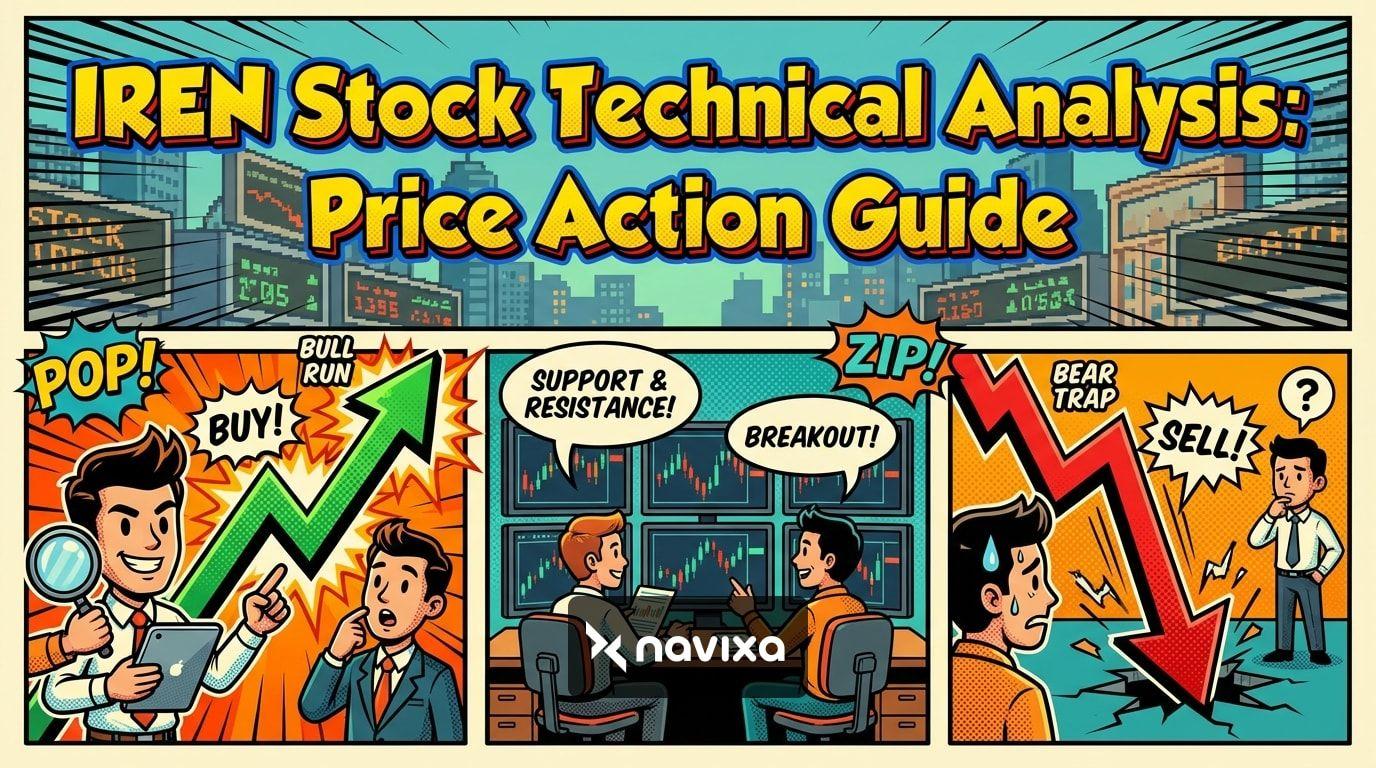
When it comes to high-octane market movements, few equities match the dynamic energy of Iris Energy (IREN). Originally known strictly as a Bitcoin mining powerhouse, the company has rapidly evolved into a formidable "Neocloud" and AI infrastructure player. This dual exposure to cryptocurrency mining economics and high-performance computing (HPC) creates a highly unique market environment. For traders, this translates to extreme volatility—and where there is volatility, there is immense opportunity for those equipped with a solid IREN stock technical analysis strategy.
In this comprehensive guide, we will break down the essential price action principles, indicator setups, and risk management protocols necessary to navigate IREN's chart. Whether you are a swing trader capitalizing on weekly momentum or a day trader hunting intraday breakouts, understanding the technical landscape of IREN is your absolute key to sustained profitability.
The Unique Market Position of IREN
Before diving deep into the charts, it is critical to understand why IREN moves the way it does. Technical analysis does not exist in a vacuum; price action is ultimately driven by fundamental catalysts and institutional order flow.
IREN has aggressively transitioned beyond traditional Bitcoin mining to embrace the artificial intelligence revolution. With massive infrastructure investments—including high-profile cloud service contracts like a multibillion-dollar agreement with Microsoft, and the procurement of tens of thousands of advanced GPUs for AI workloads—the company has attracted a completely new breed of institutional investor. This fundamental shift has transformed IREN into a proxy for two of the most explosive sectors in the financial world: digital assets and AI infrastructure.
Because the stock is influenced by both the price of Bitcoin and the broader macroeconomic sentiment surrounding AI, it exhibits an exceptionally high beta. This means its price swings are often much wider and faster than the broader tech market average. For the technical trader, this requires wider stop-losses, stricter trading discipline, and a deep reliance on historical structural levels.
IREN Stock Technical Analysis: Indicator Breakdown
To build a reliable trading thesis, you must combine multiple technical indicators to form a confluence of signals. Relying on a single metric when trading a high-beta stock is a recipe for getting chopped out of a trade. Here is how the core indicators apply specifically to IREN.
Moving Averages and Trend Confirmation
Moving averages smooth out erratic price data to reveal the underlying trend. For a volatile asset like IREN, a combination of short-term and long-term moving averages provides a holistic view of market sentiment.
* The 20-Day Moving Average (DMA): This is the ultimate pulse of IREN's short-term momentum. When the stock crosses above the 20 DMA, it frequently signals the start of a bullish swing trade phase, attracting momentum buyers. Traders often use the 20 DMA as a dynamic support level to trail their stop-losses during aggressive, multi-day run-ups. * The 50-Day Moving Average: This represents the medium-term trend. A bullish crossover, where the 20 DMA crosses above the 50 DMA, is highly sought after. It attracts algorithmic trading bots and retail buyers looking for sustained momentum. * The 200-Day Moving Average: The ultimate gauge of macro trend health. IREN's interactions with its 200 DMA can often be highly contentious. At times, the 200 DMA acts as a heavy resistance ceiling, indicating a conflicted technical picture where short-term enthusiasm battles long-term structural weakness.
For a deeper dive into how to successfully utilize these lines across various timeframes, you can explore Investopedia's guide on Moving Averages.
Momentum Oscillators: RSI and MACD
Because IREN can experience parabolic surges fueled by sudden press releases or sector rotation, momentum oscillators are vital for spotting exhaustion points before a painful reversal.
* Relative Strength Index (RSI): The RSI measures the speed and magnitude of price movements on a scale of 0 to 100. When IREN's RSI pushes aggressively above 70, it enters overbought territory. In high-beta stocks, an RSI of 70 doesn't mean sell immediately, but it strongly suggests that a pullback or consolidation phase is imminent. Conversely, an RSI dropping below 30 indicates deeply oversold conditions, often presenting a lucrative buy-the-dip opportunity for contrarian traders. * Moving Average Convergence Divergence (MACD): The MACD shows the relationship between two moving averages of a security's price. For IREN, MACD crossovers are powerful confirmation tools. When the MACD line crosses above the signal line while below the zero mark, it suggests that downward momentum is stalling and a structural reversal is brewing. However, traders must beware of false crossovers during tight, low-volume consolidation periods.
Volume Profile and Institutional Footprints
Volume is the actual fuel that drives price action. In IREN stock technical analysis, volume validation is absolutely non-negotiable. A breakout above resistance on low volume is highly suspect and prone to failure, often functioning as a "bull trap." Conversely, a breakout accompanied by a massive volume spike—often confirming institutional accumulation—provides the green light for trend-following strategies. When IREN experiences a positive correlation between price development and expanding volume growth, it is a definitive sign of underlying institutional strength.
Mapping the Grid: Support and Resistance
A core component of any price action guide is identifying the structural floors and ceilings where supply and demand imbalances occur. Due to IREN's volatility, these historical price levels act as heavy battlegrounds for buyers and sellers.
Below is a breakdown of key structural levels that technical traders carefully monitor when plotting their IREN setups:
| Level Type | Price Target Zone | Market Significance |
|---|---|---|
| Major Resistance | $50.18 | A heavy psychological ceiling and historical pivot point where institutional sellers consistently step in. |
| Immediate Resistance | $44.96 - $46.86 | Near-term supply zones that act as initial profit-taking targets for short-term swing traders. |
| Immediate Support | $39.74 | The first line of defense during a pullback; often aligns perfectly with short-term moving average confluence. |
| Structural Floor | $34.52 - $36.42 | A deep consolidation base. A breakdown below this multi-week zone severely damages the overall bullish technical thesis. |
Trading around these exact levels requires extreme patience. Buying directly into major resistance or shorting directly into structural support without waiting for price action confirmation is a common amateur mistake that results in unnecessary losses.
Actionable Trading Strategies for IREN
Understanding the indicators and mapping the grid is only half the battle. Executing a highly disciplined strategy is where the money is made. Here are two primary technical strategies perfectly suited for IREN's erratic price action.
Breakout and Retest Strategy
Given IREN's tendency to build large sideways bases and then explode upward on AI or crypto news, the breakout and retest strategy is highly effective and minimizes risk.
1. Identify the Consolidation: Wait for IREN to trade sideways in a tight range just below a key resistance level (for example, near $46.86). 2. Wait for the Breakout: Watch for a daily or 4-hour candle to close definitively above the resistance level, accompanied by significantly above-average volume. 3. The Retest Entry: Instead of chasing the initial green spike—which often leads to FOMO buying—wait for the price to pull back and test the previous resistance level. This old ceiling should now act as a new support floor. 4. Confirmation: Enter the long trade only when a bullish reversal candle (such as a hammer or a bullish engulfing pattern) forms precisely on the retest.
This methodical approach drastically improves your risk-to-reward ratio compared to blindly buying the initial breakout.
Range-Bound Swing Trading
When the broader crypto and AI markets enter a lull or consolidation phase, IREN will often trade in a wide, defined, horizontal channel.
1. Map the Range: Identify the upper resistance ceiling and the lower structural support floor on the daily chart. 2. Buy the Floor: Enter a long position when the stock touches the support zone (e.g., $39.74) and simultaneously shows bullish divergence on the MACD or oversold readings on the RSI. 3. Sell the Ceiling: Exit the position entirely as the price approaches the upper resistance, especially if momentum indicators suggest the rally is losing steam.
To actively chart these setups and map custom channels, professional platforms like TradingView offer excellent toolsets for real-time tracking.
Essential Risk Management for High-Beta Stocks
No IREN stock technical analysis guide is complete without a stark, unavoidable warning about risk management. The dual-narrative nature of this stock means it can gap up or gap down unexpectedly based on macroeconomic tech earnings or sudden weekend movements in the unregulated crypto markets.
Position Sizing
Never allocate your entire portfolio to a single high-beta asset. Professional traders generally risk no more than 1% to 2% of their total trading capital on a single trade setup. For instance, if your total account value is $10,000, your maximum allowed loss on an IREN setup should be $100 to $200. You calculate your position size by dividing this risk amount by the distance between your planned entry price and your hard stop-loss. This ensures that even a string of bad trades won't blow up your account.
Dynamic Stop-Losses
Because IREN can move violently, static, tight stop-losses can sometimes be "hunted" by market makers during intraday liquidity grabs. Instead, consider using dynamic stops based on the stock's actual volatility, such as the Average True Range (ATR). Setting your stop-loss at 1.5x or 2x the daily ATR below your entry ensures you give the stock enough breathing room to fluctuate normally without prematurely stopping you out of a perfectly valid setup.
Practical Takeaways
* Respect the Market Duality: IREN's charts are heavily influenced by both crypto market cycles and corporate AI infrastructure demand. Beautiful technical setups can be instantly invalidated by massive fundamental news in either sector. * Wait for Volume Confirmation: Never trust a breakout or breakdown on IREN that lacks a significant surge in trading volume. Low volume moves are easily reversed. * Use Multiple Timeframes: Analyze the weekly chart for the macro trend, the daily chart to locate your setup, and the 15-minute or hourly chart for precise entry execution. * Embrace the Retest: Avoid chasing parabolic green candles. Patience pays massive dividends when waiting for structural levels to be retested and confirmed as solid support.
Conclusion
Conducting a profitable IREN stock technical analysis requires a trader to be adaptable, disciplined, and hyper-aware of broader market forces. By mastering moving average crossovers, reading market momentum via RSI and MACD, and rigidly mapping structural support and resistance zones, you can successfully navigate the extreme turbulence of this high-beta equity. Remember that the company's aggressive pivot from purely crypto mining to offering premium AI cloud services brings a new wave of institutional volume, altering its historical price behaviors. Equip yourself with unshakeable risk management, stick religiously to your charted levels, and trade the price action exactly as it unfolds—not as you hope it will.
Frequently Asked Questions
What makes IREN stock technical analysis different from other traditional tech stocks?
IREN is incredibly unique because it functions as a high-beta proxy for both the volatile cryptocurrency market and the rapidly expanding AI infrastructure sector. This dual exposure creates aggressive, fast-paced price swings, requiring traders to use wider stop-losses and rely much more heavily on volume confirmation compared to trading lower-volatility, blue-chip tech stocks.
How do moving averages help in trading IREN?
Moving averages filter out the "noise" of IREN's extreme daily volatility. The 20-day MA helps traders gauge short-term momentum and acts as dynamic support during rallies, while the 50-day and 200-day MAs dictate the macro trend. A sustained break above these long-term averages often signals that institutional buying is overpowering retail selling.
What are the most important technical indicators to use with IREN?
Alongside moving averages, trading volume is the single most critical indicator. Due to the stock's tendency to produce false breakouts, volume validates the authenticity of a move. Additionally, oscillators like the RSI and MACD are absolutely essential for identifying overbought or oversold conditions before a sharp trend reversal occurs.
Should I day trade or swing trade IREN?
Both strategies are highly viable, but they require vastly different approaches. Day traders can capitalize on IREN's massive intraday price ranges using 5-minute or 15-minute charts. Swing traders, however, often find more reliable, stress-free setups by utilizing daily charts to trade from major structural support zones to major resistance zones over a period of several days or weeks.