

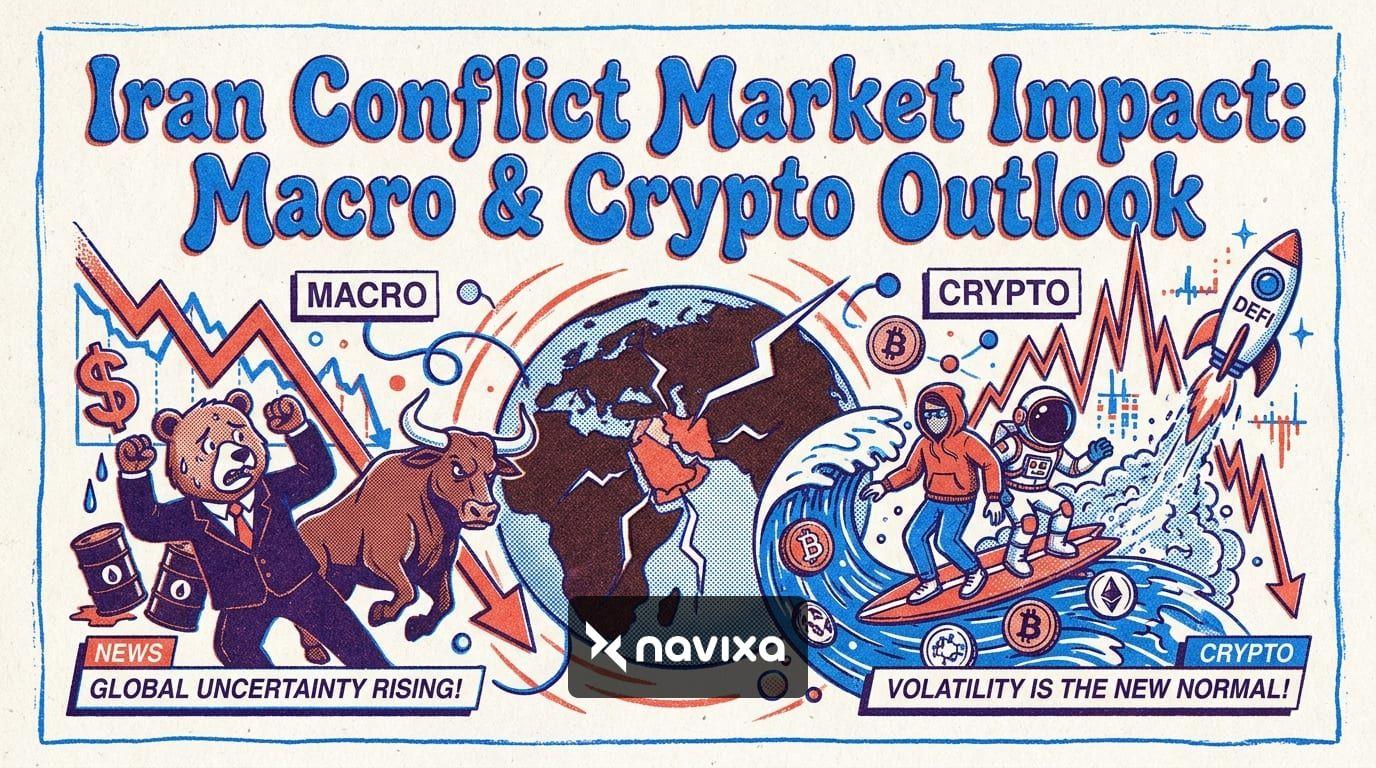
The intersection of global geopolitics and digital assets has never been more pronounced. As tensions escalate in the Middle East, investors and institutional traders are closely monitoring the Iran conflict market impact across both traditional equities and decentralized finance. Historically, localized conflicts sparked predictable flights to traditional safe havens like gold and government bonds. Today, however, the macroeconomic landscape is vastly different, with a staggering $2.78 trillion global crypto market absorbing and reacting to these geopolitical shocks in real-time.
At the time of writing, Bitcoin is demonstrating remarkable resilience, trading robustly around $80,839 with a market dominance of over 58%. The cryptocurrency ecosystem recently absorbed significant geopolitical news when political figures openly criticized recent Middle East developments; notably, a 2.3% Bitcoin rally immediately followed statements calling the latest Iran peace proposal "totally unacceptable." This immediate price action highlights a paradigm shift: digital assets are increasingly functioning as primary barometers for global risk, reacting faster than traditional markets constrained by regional trading hours.
- The Iran conflict market impact is driving immediate capital rotation into borderless digital assets.
- Bitcoin's resilience above $80,000 underscores its growing role as a macroeconomic safe-haven asset.
- Geopolitical volatility creates specific breakout opportunities in highly liquid altcoins like XRP and SUI.
- Traders must adapt their risk management to account for 24/7 news cycle shocks and sudden liquidity vacuums.

The Macroeconomic Backdrop of Geopolitical Strife
When evaluating the broader financial implications of the Middle East conflict, it is essential to understand the interconnected nature of modern energy, equity, and currency markets. Traditional markets typically react to conflicts in oil-producing regions with immediate supply-side fears, driving up energy costs and, consequently, inflation expectations. This dynamic forces central banks into a difficult position, having to balance economic growth against rising consumer prices.
For digital asset investors, these traditional market mechanics are vital context. A persistent rise in inflation driven by geopolitical instability often diminishes the appeal of fiat currencies. In this climate, understanding the macro environment for equities becomes crucial, as institutional capital tends to flow away from vulnerable growth stocks and toward assets with fixed supply schedules. We are witnessing a divergence where legacy markets face supply chain anxieties while decentralized assets benefit from their programmatic scarcity and borderless nature.
According to analysts monitoring these trends via platforms like Bloomberg Markets, the correlation between equities and crypto tends to briefly spike during the initial shock of a conflict, only to decouple as the prolonged realities of fiat inflation set in.
Analyzing the Iran Conflict Market Impact on Crypto
The specific dynamics of the Iran conflict market impact reveal fascinating intra-market rotations within the cryptocurrency sector itself. While Bitcoin acts as the macroeconomic anchor, various altcoin sectors respond uniquely to the changing regulatory and geopolitical landscape.
For example, heightened surveillance and capital control measures often accompany international conflicts. This has historically led to an increased focus on the impact on privacy assets as individuals in conflict zones seek financial autonomy. Furthermore, the volatility isn't limited to privacy coins. Recently, we have observed XRP spike 2.5% to break out above the $1.45 resistance level, alongside Sui (SUI) which experienced an explosive 50% surge driven by zero-fee stablecoin initiatives and staking mechanics. These movements suggest that while macro fear dictates overall market direction, strong protocol-specific fundamentals can still drive massive outperformance during crises.

Market Analysis & Trading Psychology
Navigating a geopolitical crisis requires more than just technical analysis; it demands strict psychological discipline. When news breaks regarding international conflict, the market's initial reaction is almost entirely driven by fear and algorithms programmed to scrape headlines. This results in "liquidity voids"—moments where the order book empties, causing massive slippage for market orders.
During these periods, retail traders often fall victim to emotional trading. They see a sudden drop in Bitcoin's price and panic sell, only to watch the asset recover hours later as institutional buyers step in to absorb the discounted supply. A critical element of trading psychology is recognizing and mitigating cognitive anchoring bias risks, where a trader becomes fixated on a specific price point from before the conflict began.
"Markets can remain irrational longer than you can remain solvent. During geopolitical shocks, price action is dictated by the unwinding of over-leveraged positions, not immediate fundamental changes."
To survive the Iran conflict market impact, traders must shift their mindset from predicting the news to reacting to the market's validated response. This means ignoring the noise of social media speculation and focusing strictly on volume, key support/resistance levels, and order book depth.
Geopolitical news events frequently trigger cascade liquidations in derivatives markets. Never use high leverage during active news breakouts, as sudden wicks can easily trigger stop-losses in both directions before a true trend is established.
Technical Analysis & Actionable Trading Strategies
Translating geopolitical awareness into profitable trades requires a systematic approach. When macro tensions rise, market structure often forms distinct volatility compression patterns, such as ascending triangles or falling wedges, as buyers and sellers reach a temporary equilibrium before the next headline drops.
If you are an active trader looking to capitalize on these specific technical setups, utilizing a proven price action breakout strategy can help automate the detection of these critical chart patterns. By waiting for a confirmed breakout with supporting volume, traders can avoid the "fakeouts" that frequently occur during turbulent news cycles.
Conversely, for investors with a longer time horizon who wish to accumulate fundamentally strong assets without attempting to time the exact bottom of a geopolitical dip, a more measured approach is highly recommended. Implementing a smart DCA trend continuation system allows you to mathematically scale into positions. This method mitigates the risk of deploying all your capital right before a negative headline causes a secondary market drop.

Portfolio Structuring & Safe Havens
How should a modern portfolio be structured when the specter of conflict looms over global markets? The traditional 60/40 portfolio of stocks and bonds is increasingly viewed as insufficient when inflation and geopolitical risks rise simultaneously.
When analyzing the fiat inflation impact outlook, it becomes clear that allocating a percentage of a portfolio to hard, decentralized assets is no longer a fringe strategy—it is a fiduciary necessity. We can observe how different asset classes have historically performed during sudden global shocks.
| Asset Class | Initial Geopolitical Reaction | Recovery Speed | Historical Volatility |
|---|---|---|---|
| Bitcoin (BTC) | Brief correlated dip | Extremely Fast | High |
| Gold | Immediate safe-haven buying | Moderate | Low |
| S&P 500 | Correlated risk-off sell-off | Moderate | Medium |
| USDC / USDT | High demand (flight to cash) | Immediate | Very Low |
Major financial institutions have begun utilizing digital assets as a hedge against sovereign mistakes. As reported by major financial outlets like Reuters Finance, the modern investor must treat liquidity as a premium asset during wartime economies. Having capital allocated to high-yield stablecoins or easily liquidatable top-10 cryptocurrencies allows for rapid maneuvering that traditional real estate or locked equity funds simply cannot match.
Maintain at least 15-20% of your trading portfolio in stablecoins (like USDC or USDT) during periods of high geopolitical tension. This provides "dry powder" to aggressively buy localized dips when the market overreacts to breaking news.

Strategic Conclusion
The ongoing Iran conflict market impact serves as a stark reminder that we operate in a highly interconnected, reactive global economy. While the human cost of conflict is always a tragedy, the financial reality requires traders to be objective, prepared, and unsentimental in their risk management.
Bitcoin's robust performance above the $80,000 threshold, combined with the explosive growth of fundamentally strong altcoins, proves that digital assets have matured into a legitimate macroeconomic hedge. By understanding the psychology of the market, utilizing systematic trading tools, and structuring a resilient portfolio, you can navigate these turbulent waters with confidence. If you are ready to implement these advanced methodologies into your own trading routine, take the time to start trading with Navixa and leverage cutting-edge market strategies.
Frequently Asked Questions
How does the Iran conflict specifically impact Bitcoin's price?
Geopolitical conflicts initially trigger broad market uncertainty, sometimes causing a brief, correlated sell-off in Bitcoin as over-leveraged traders liquidate positions for cash. However, as the conflict persists and inflation fears rise due to energy supply disruptions, Bitcoin typically experiences a strong recovery as investors use it as a non-sovereign safe haven against fiat currency devaluation.
Should I sell my altcoins during geopolitical crises?
It depends on the altcoin's utility and your risk tolerance. While speculative micro-cap tokens often bleed heavily during a "flight to safety," top-tier altcoins with strong narratives (such as privacy, AI, or specific DeFi mechanics) can actually see massive capital inflows. It is generally wise to consolidate weaker positions into Bitcoin, Ethereum, or stablecoins until the volatility subsides.
What is a 'liquidity void' and why is it dangerous during news events?
A liquidity void occurs when market makers pull their orders from the exchange order books during an unexpected news event to avoid being caught on the wrong side of a sudden price swing. This lack of available buyers and sellers means that even relatively small market orders can cause massive price slippage, leading to poor execution prices for retail traders.
Can traditional stock market indices predict crypto movements during a war?
While they are intrinsically linked by macro liquidity, traditional indices like the S&P 500 do not perfectly predict crypto movements during a conflict. Cryptocurrencies trade 24/7 and react to news instantly, whereas stock markets are bound by opening and closing hours. Often, crypto acts as a leading indicator for how traditional markets will open the following day.