

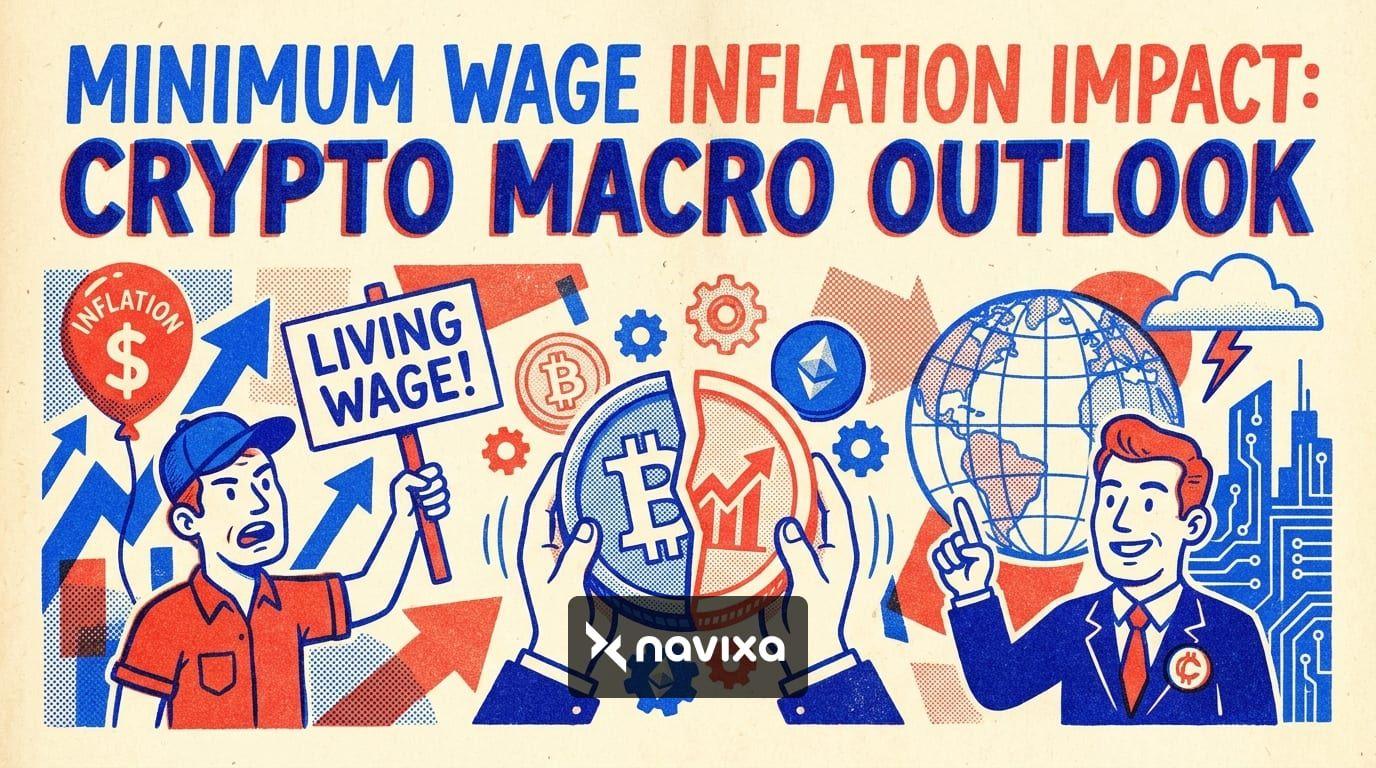
The intersection of labor economics and digital asset markets has never been more pronounced. As state legislatures across the United States enact sweeping pay increases, the minimum wage inflation impact is sending profound shockwaves through traditional financial systems and the cryptocurrency sector alike. In 2026, with over 19 states implementing aggressive minimum wage hikes, the macroeconomic landscape is shifting rapidly. For traders and investors, understanding how localized labor policies dictate global central bank liquidity is no longer optional\u2014it is a prerequisite for survival in a sophisticated digital economy.
Historically, the crypto market operated in a silo, driven by technological narratives and retail enthusiasm. Today, however, assets like Bitcoin and Ethereum are heavily intertwined with traditional finance. As rising wages exert upward pressure on core consumer prices, central banks are forced to maintain restrictive interest rate environments. This dynamic directly chokes off the speculative capital that typically flows into risk assets, fundamentally altering the way modern portfolios are constructed and managed.
- The minimum wage inflation impact creates sticky economic conditions that force central banks to keep interest rates elevated.
- Elevated interest rates restrict the global liquidity that traditionally fuels cryptocurrency market rallies.
- Bitcoin has transitioned from a pure narrative-driven asset to a highly sensitive macroeconomic liquidity proxy.
- Understanding macroeconomic labor data is now a mandatory requirement for navigating digital asset volatility.

The Economics Behind the Minimum Wage Inflation Impact
To grasp why digital assets react to labor policies, one must examine the transmission mechanism of wage-push inflation. In 2026, jurisdictions like California and New York are pushing base compensation toward $17 per hour, with targeted industries aiming even higher. While these policies are designed to alleviate cost-of-living pressures for workers, they significantly increase overhead for businesses.
To preserve profit margins, corporations invariably pass these operational costs onto consumers through higher prices for goods and services. This creates a feedback loop: higher wages lead to higher prices, which in turn spark demands for further wage increases. For the Federal Reserve, this sticky core inflation presents a massive hurdle. To cool the economy, policymakers must lean into a "higher-for-longer" interest rate strategy, delaying the highly anticipated rate cuts that investors crave. If you want to dive deeper into how broad economic measurements affect digital assets, taking the time to understand the GDP impact on crypto is an essential first step.
The largest danger for digital asset investors in a tight liquidity environment is misunderstanding Bitcoin's current market behavior. It no longer acts purely as an inflation hedge; it functions as a highly sensitive global liquidity proxy.
How Wage Hikes Filter into Financial Markets
When the cost of capital remains high due to persistent inflation, institutional investors recalibrate their risk models. Treasury yields become more attractive, drawing capital away from non-yielding assets like digital currencies. Consequently, the minimum wage inflation impact indirectly drains liquidity from the crypto ecosystem. Retail investors, burdened by the rising costs of daily living despite their wage hikes, also have less discretionary income to allocate toward speculative token investments.

Market Analysis & Trading Psychology
When evaluating the overarching minimum wage inflation impact, the shift in market psychology is undeniable. For years, digital asset enthusiasts operated under the assumption that Bitcoin functioned purely as a decentralized hedge against fiat devaluation. However, the maturation of the market has altered this paradigm. Today, institutional participants and algorithmic trading desks dominate the tape. These entities do not view Bitcoin solely as digital gold; instead, they treat it as a high-beta proxy for global liquidity.
This psychological pivot is crucial. When wage hikes fuel persistent inflation, central banks are forced to maintain restrictive monetary policies. The resulting delay in interest rate cuts stifles the free-flowing capital that typically fuels parabolic crypto rallies. Consequently, traders must abandon the purely narrative-driven euphoria of past cycles. A successful approach now demands a disciplined, macro-aware mindset. Patience and risk management become the primary tools for surviving range-bound volatility, as market participants digest mixed economic signals.
Furthermore, the labor market itself is undergoing a technological revolution. As companies face higher wage floors, many are accelerating automation and artificial intelligence integration. This structural shift in the workforce requires investors to monitor AI job market trends closely, as the balance between human labor costs and technological efficiency will dictate future inflation metrics and subsequent central bank policy.
Real-Time Crypto Market Context
The theoretical impact of macroeconomics is clearly reflected in real-time market data. As of early May 2026, Bitcoin is trading near $78,523, while Ethereum holds steadily around $2,318. The global crypto market capitalization sits at a robust $2.68 trillion, with Bitcoin dominance commanding a hefty 58.43% of the market. This outsized dominance highlights a classic "flight to quality" within the digital asset sector; in uncertain macroeconomic times, capital consolidates into the most liquid and established network.
Despite the headwinds of inflation, institutional adoption remains an anchor for the market. Top executives at major financial institutions, such as Morgan Stanley, have openly acknowledged that integrating Bitcoin onto U.S. bank balance sheets is an inevitability, reinforcing the asset's legitimacy. However, retail sentiment remains divided. Recent polls indicate that everyday voters are deprioritizing crypto in midterm elections, expressing skepticism amid massive super PAC spending. This dichotomy\u2014institutional accumulation paired with retail exhaustion\u2014creates the exact type of range-bound consolidation that tests trader patience. Navigating this environment often requires keeping an eye on legacy financial titans and heeding Buffett macro stock warnings to gauge broad institutional risk appetite.

Equities vs. Crypto in a Wage-Strained Economy
Understanding how different asset classes react to wage-induced inflation is vital for portfolio construction. While traditional equities and cryptocurrencies both suffer when liquidity tightens, their fundamental drivers differ significantly.
| Feature | Traditional Equities | Cryptocurrencies |
|---|---|---|
| Direct Labor Cost Exposure | High (Directly impacts corporate profit margins) | Low (Decentralized networks lack traditional payrolls) |
| Interest Rate Sensitivity | Moderate (Offset by earnings reports) | Extreme (Highly dependent on global liquidity) |
| Inflation Hedge Status | Moderate (Companies can raise consumer prices) | Evolving (Acts more like a high-beta tech proxy) |
| Institutional Positioning | Defensive (Shift toward dividend-yielding value stocks) | Accumulation (Buying the dip during macro consolidations) |
Traditional companies face immediate margin compression when minimum wages rise, forcing them to hike product prices or cut costs. Cryptocurrencies do not have direct employee payrolls, insulating their base operational structure from wage hikes. However, they are hyper-sensitive to the secondary effect: the elevated interest rates implemented to combat the resulting inflation.
Trading Strategy & Risk Management
Given the complex macro environment shaped by the minimum wage inflation impact, traders must utilize sophisticated risk management strategies. Relying on impulsive entries based on social media sentiment is a recipe for catastrophic drawdowns in a liquidity-constrained market.
Instead, establishing a long-term crypto holding strategy built on methodical accumulation is highly recommended. By ignoring short-term noise and focusing on the underlying growth of network adoption, investors can insulate themselves from the emotional turbulence of daily price fluctuations.
When higher operating costs compress traditional business margins, consider allocating capital toward decentralized network tokens that rely heavily on automated infrastructure rather than intensive human capital.
Implementing Dollar-Cost Averaging (DCA)
One of the most effective ways to navigate range-bound volatility is through Dollar-Cost Averaging (DCA). By allocating a fixed amount of capital at regular intervals, investors naturally purchase more assets when prices are low and fewer when prices are high, smoothing out the average entry price.
For those utilizing automated charting platforms, integrating a smart DCA trend continuation strategy can optimize these entries. Algorithmic tools remove emotional bias, ensuring that capital is deployed efficiently even when macroeconomic headlines induce panic.

Conclusion
The minimum wage inflation impact is fundamentally reshaping the financial ecosystem in 2026. As labor costs rise and core inflation remains stubbornly sticky, the Federal Reserve's commitment to elevated interest rates will continue to suppress speculative liquidity. Bitcoin and the broader cryptocurrency market have proven resilient, boasting massive market capitalizations and undeniable institutional backing, yet they remain highly sensitive to these macroeconomic cross-currents.
To thrive in this complex environment, market participants must transcend basic technical analysis. True alpha is generated by understanding the deep connections between labor economics, central bank policy, and digital asset liquidity. By maintaining strict risk management and leveraging automated accumulation frameworks, investors can position themselves advantageously for the eventual return of global monetary easing. If you are ready to elevate your market approach and automate your edge, explore Navixa trading strategies to seamlessly adapt to shifting macroeconomic conditions.
Frequently Asked Questions
How does an increase in the minimum wage affect cryptocurrency prices?
Minimum wage increases drive up operating costs for businesses, which often pass those costs to consumers, causing inflation. To fight this inflation, central banks keep interest rates high. High interest rates reduce the availability of cheap capital and global liquidity, which typically puts downward pressure on speculative risk assets like cryptocurrencies.
Is Bitcoin still considered a hedge against inflation in 2026?
While Bitcoin's strictly capped supply of 21 million coins gives it the fundamental properties of an inflation hedge, its current market behavior resembles a high-beta technology asset. It responds more aggressively to changes in global liquidity and interest rates than to standard consumer price index (CPI) fluctuations.
Why does Bitcoin dominance rise during periods of economic uncertainty?
Bitcoin dominance\u2014the ratio of Bitcoin's market cap to the rest of the crypto market\u2014often rises during macroeconomic stress because investors view it as the safest, most liquid, and most established digital asset. Capital naturally flows out of highly speculative altcoins and into Bitcoin in a "flight to quality."
Should I stop trading crypto during periods of high inflation?
Not necessarily. High inflation and tight liquidity environments often cause range-bound, volatile markets. While aggressive long-position swing trading may be difficult, these conditions are ideal for methodical accumulation strategies like Dollar-Cost Averaging (DCA), allowing you to build long-term positions at favorable average prices.
How can automated trading tools help in a macro-driven market?
Automated tools and indicators eliminate the emotional decision-making that plagues retail traders during volatile news cycles. By relying on mathematically proven algorithms and trend continuation scripts, you can execute entries and exits based purely on data, ensuring you remain disciplined amidst confusing macroeconomic headlines.