
The semiconductor landscape is experiencing a massive shift, and crafting a reliable Intel stock trading strategy is essential for capitalizing on the current market dynamics. After overcoming immense structural and financial hurdles, Intel (NASDAQ: INTC) has engineered one of the most compelling turnaround narratives in the technology sector. Driven by major leadership changes and historic external foundry partnerships, Intel is no longer just a legacy chipmaker—it is aggressively positioning itself as a central pillar of global artificial intelligence and robotics infrastructure.
Whether you are a day trader looking to capitalize on intraday volatility, a swing trader aiming to ride medium-term momentum, or a long-term investor focusing on value accumulation, understanding how to trade Intel requires a balanced approach. This step-by-step guide will break down the foundational catalysts, essential technical analysis, actionable methodologies, and strict risk management rules to optimize your Intel stock trading strategy.
Understanding the Fundamental Catalysts
Before diving into charts and indicators, any robust Intel stock trading strategy must be grounded in fundamental analysis. The market valuation of Intel is driven by several highly influential catalysts that dictate both institutional sentiment and retail momentum.
The Turnaround Under Lip-Bu Tan
After facing significant structural losses, Intel hired Lip-Bu Tan as the new CEO in early 2025, ushering in a brutal but necessary restructuring phase. The mandate was clear: stop the bleeding in the traditional PC and server CPU markets while pivoting heavily toward the Intel Foundry Services (IFS) model. While the foundry division incurred substantial operating losses—including a $10.3 billion loss in 2025 during its ramp-up phase—the long-term vision focuses on challenging competitors by achieving process parity and eventual leadership with its 18A and 14A manufacturing nodes.
The Terafab Partnership: A Game-Changing Anchor
The most monumental fundamental driver for Intel is the "Terafab" project. Intel secured an unprecedented $20 billion to $25 billion manufacturing partnership with Elon Musk's network of companies—Tesla, SpaceX, and xAI. By committing its 18A process node and advanced packaging capabilities to a consolidated fabrication campus in Austin, Texas, Intel has secured a massive anchor customer. This multi-billion-dollar deal aims to produce AI edge inference processors for Tesla's Cybercab and Optimus robots, as well as D3 radiation-hardened chips for SpaceX satellite constellations. For traders, this partnership represents a definitive transition from aspirational goals to tangible external revenue generation.
Technological Breakthroughs: GaN and AI Infrastructure
Innovation remains a core driver of INTC stock volatility. Intel's recent breakthrough in gallium nitride (GaN) chiplet technology—creating the world's thinnest GaN-on-silicon chiplet—has massive implications for AI server power delivery and robotics. By successfully integrating GaN with traditional silicon computational logic on 300mm wafers, Intel has uniquely positioned itself in the high-power semiconductor market. When trading Intel, monitoring news surrounding AI infrastructure and advanced packaging (like EMIB and Foveros 3D) is vital, as these updates frequently trigger sharp price movements.
Core Intel Stock Trading Strategy Approaches
Developing a successful Intel stock trading strategy means aligning your market execution with your personal risk tolerance and time horizon. Below are three primary strategic frameworks to consider.
1. Momentum Trading on News and Foundry Updates
Momentum trading involves capitalizing on the intense buying or selling pressure generated by breaking news. With Intel actively securing major external customers for its IFS division, the stock is highly sensitive to press releases. * The Setup: Monitor industry news feeds for announcements regarding hyperscaler partnerships (such as Google or Amazon) or updates on process node yields, such as the recent yield stabilization of 65% for the 18A node in Arizona. * Execution: Enter positions when the stock breaks above key moving averages on high volume following a positive catalyst. Traders typically utilize tight trailing stop-loss orders to capture upside while protecting against sudden reversals.
2. Swing Trading the Volatility Range
For those who prefer a multi-day to multi-week timeframe, swing trading exploits the natural ebb and flow of market sentiment. Given the conflicting analyst ratings on Intel—where some view it as a strong buy due to turnaround prospects, while others maintain a "reduce" rating based on historical unprofitability—the stock often oscillates between identifiable support and resistance zones. * The Setup: Utilize technical indicators such as the Relative Strength Index (RSI) and Bollinger Bands. Wait for the RSI to dip into oversold territory (below 30) near a proven support level. * Execution: Buy at support and set a profit target near the next major resistance level. This strategy ignores the long-term fundamentals and focuses purely on supply and demand imbalances over a defined period.
3. Position Trading and Value Accumulation
If you believe in the long-term viability of Intel's turnaround, position trading allows you to capture macro-level growth. This approach requires weathering short-term storms, such as the intensely negative P/E ratios caused by heavy capital expenditures in the foundry business. * The Setup: Use Dollar Cost Averaging (DCA) to build a position over time, purchasing shares at regular intervals to mitigate the impact of short-term volatility. * Execution: Alternatively, sophisticated traders might use Long-Term Equity Anticipation Securities (LEAPS) to gain leveraged exposure to Intel's future growth without tying up excessive capital.
Technical Analysis and Key Levels
A comprehensive Intel stock trading strategy is incomplete without technical analysis. While fundamentals provide the "why," technicals provide the "when."
Recently, Intel shares have experienced a massive structural rally—rebounding 84% in 2025—moving from 52-week lows in the $18.18 range to trading consistently in the low-to-mid $60s by early 2026. This extraordinary compound growth requires careful technical navigation.
* Resistance Levels: The current 52-week highs near $63.39 act as technical resistance. Breakouts above these levels, sustained by above-average trading volume, signal strong bullish continuation. However, failure to pierce these zones often results in aggressive profit-taking. * Support Zones: When mapping downside risk, traders should look at historical consolidation zones. The 50-day and 200-day Simple Moving Averages (SMA) serve as dynamic support. A "Golden Cross" (when the 50-day crosses above the 200-day SMA) typically reinforces a long-term bullish bias. * Volume Analysis: Pay close attention to trading volume during price advances. A price rally on declining volume is a classic divergence signal, hinting that the upward momentum is losing steam and a correction may be imminent.
For real-time data and technical charting, platforms like Morningstar Intel Summary offer robust insights into moving averages and institutional accumulation.
Trading Styles Comparison
To help you refine your Intel stock trading strategy, the following table compares the typical methodologies, timeframes, and primary indicators used across different trading styles.
| Trading Style | Typical Timeframe | Key Focus Area | Primary Indicators | Risk Tolerance |
|---|---|---|---|---|
| Day Trading | Intraday (Minutes to Hours) | Micro-trends, News impact, Volatility | VWAP, 5-min MACD, Level 2 Data | High |
| Swing Trading | Days to Weeks | Range-bound movement, Sector sentiment | RSI, Bollinger Bands, Volume Profile | Moderate |
| Position Trading | Months to Years | Macro turnarounds, Earnings, Foundry growth | Moving Averages (50/200), CapEx | Low to Moderate |
Actionable Step-by-Step Guide
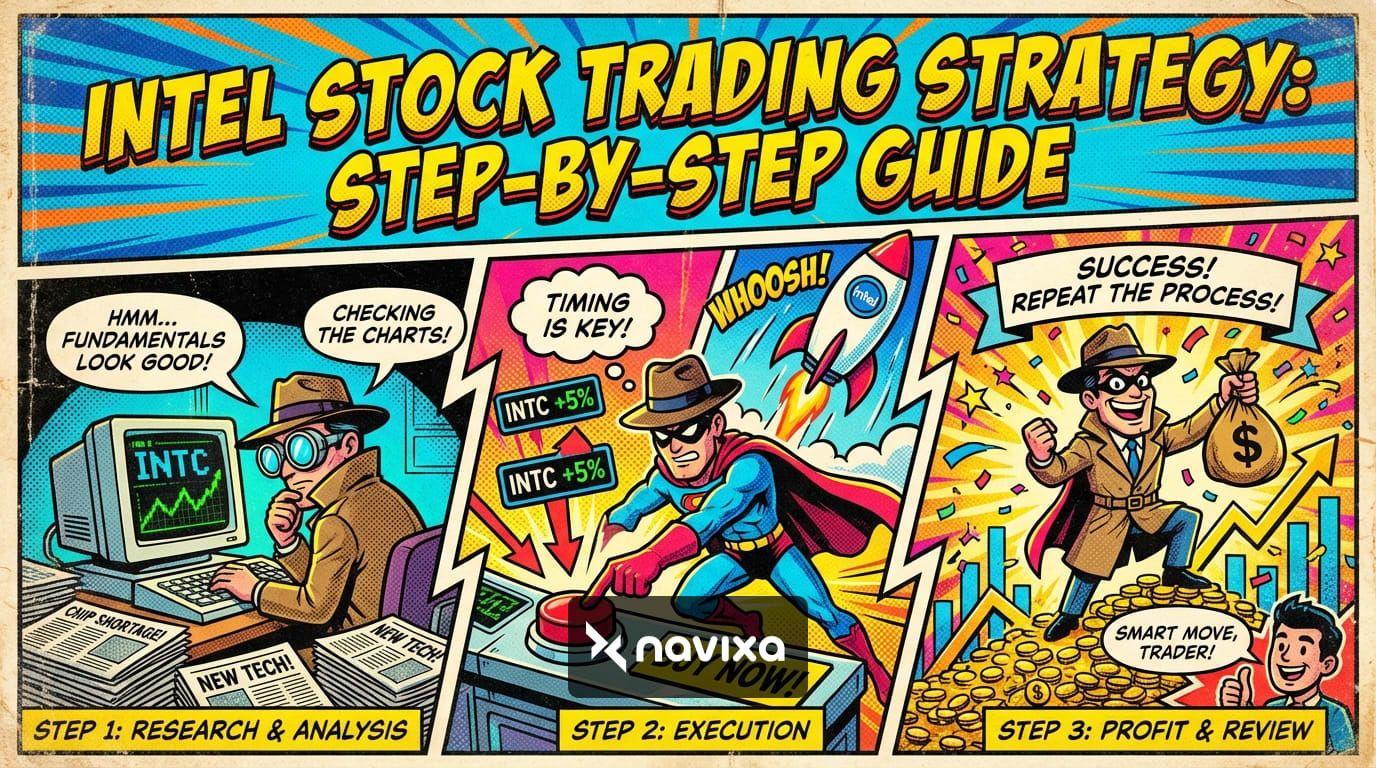
Ready to execute? Follow these actionable steps to implement your Intel stock trading strategy effectively.
Step 1: Conduct Pre-Market Routine
Before the opening bell, review the overnight global market sentiment, specifically focusing on the semiconductor sector. Check for press releases from Intel, updates from competitors like Taiwan Semiconductor (TSMC) or AMD, and broad macroeconomic indicators. Monitoring technology news outlets such as TechPowerUp can provide early alerts on hardware breakthroughs.
Step 2: Define Entry and Exit Parameters
Never enter a trade without a predefined exit plan. If you are going long based on a technical breakout, identify exactly where you will take profits and where you will cut your losses if the trade goes against you. Adhering strictly to a risk-to-reward ratio of at least 1:2 ensures that your winning trades outpace your losing ones over time.
Step 3: Implement Risk Management Protocols
Intel's transition into a foundry model involves massive capital expenditures and execution risks. Negative earnings reports or delays in process node rollouts can cause rapid gap-downs in the stock price. Always use stop-loss orders. For larger positions, consider using options strategies, such as buying protective puts, to hedge against catastrophic downside risk.
Managing Risks and Downsides
No Intel stock trading strategy is foolproof. It is vital to acknowledge the bearish arguments and potential headwinds facing the company.
Despite the high-profile Terafab partnership and technological milestones, Intel operates in an aggressively competitive landscape. Analysts remain divided; a significant portion maintain "hold" or "reduce" ratings, citing the company's negative Price-to-Earnings ratio and the immense financial burden of scaling its foundry operations, which lost $10.3 billion in 2025 alone. Furthermore, consensus price targets often highlight a potential downside, with the average 12-month target hovering around $48.43 if execution falters.
Additionally, insider selling can sometimes signal a lack of short-term confidence. Monitoring SEC filings for executive stock sales, such as the recent offloading by EVP Boise April Miller, provides an extra layer of situational awareness. Always cross-reference optimistic news with objective financial metrics to avoid being caught in a "bull trap."
"Successful trading is not just about making the right predictions; it is about managing your capital effectively when your predictions are wrong."
Conclusion
Crafting a winning Intel stock trading strategy requires a synthesis of fundamental awareness and technical precision. By understanding the massive implications of the Terafab partnership, monitoring the advancements in GaN and 18A node technologies, and respecting key technical levels, traders can navigate Intel's volatility with confidence. Whether you are executing rapid intraday scalps or building a long-term position, discipline and strict risk management must remain at the core of your approach. Stay updated on market catalysts, stick to your predefined trading rules, and adapt as the semiconductor landscape continues to evolve.
Frequently Asked Questions
What is the best timeframe for trading Intel stock?
The optimal timeframe depends entirely on your strategy. Day traders focus on 5-minute or 15-minute charts to capture intraday volatility, while swing traders utilize daily charts to identify multi-week trends. Position traders generally rely on weekly charts to monitor macro-level structural changes.
How does the Intel Foundry Services (IFS) affect the stock price?
IFS is central to Intel's turnaround narrative. News regarding new external partnerships (such as the massive Terafab deal with Tesla and SpaceX) or updates on manufacturing yields directly impact the stock. Positive IFS news tends to drive bullish momentum, while delays or massive capital expenditure losses can trigger immediate sell-offs.
Is Intel stock suitable for beginner traders?
Intel can be highly volatile, particularly around earnings reports and major technological announcements. While it is heavily traded and highly liquid—making it accessible—beginners should start with paper trading or small position sizes. Employing a strict risk management strategy is essential before trading INTC with substantial capital.
Why do some analysts have a pessimistic view of Intel?
Despite its recent technological progress, Intel's aggressive restructuring has resulted in significant operating losses, leading to a largely negative P/E ratio. Bears argue that the costs of achieving process parity with competitors like TSMC are too high, and execution risks on its advanced node rollouts remain a major concern.
Can options be used in an Intel stock trading strategy?
Yes, options are a powerful tool for trading Intel. Traders use call options to leverage upside momentum, put options to hedge against potential downside risk, and strategies like covered calls to generate income on long-term holdings while the stock consolidates.