
Introduction: The New Era of INTC
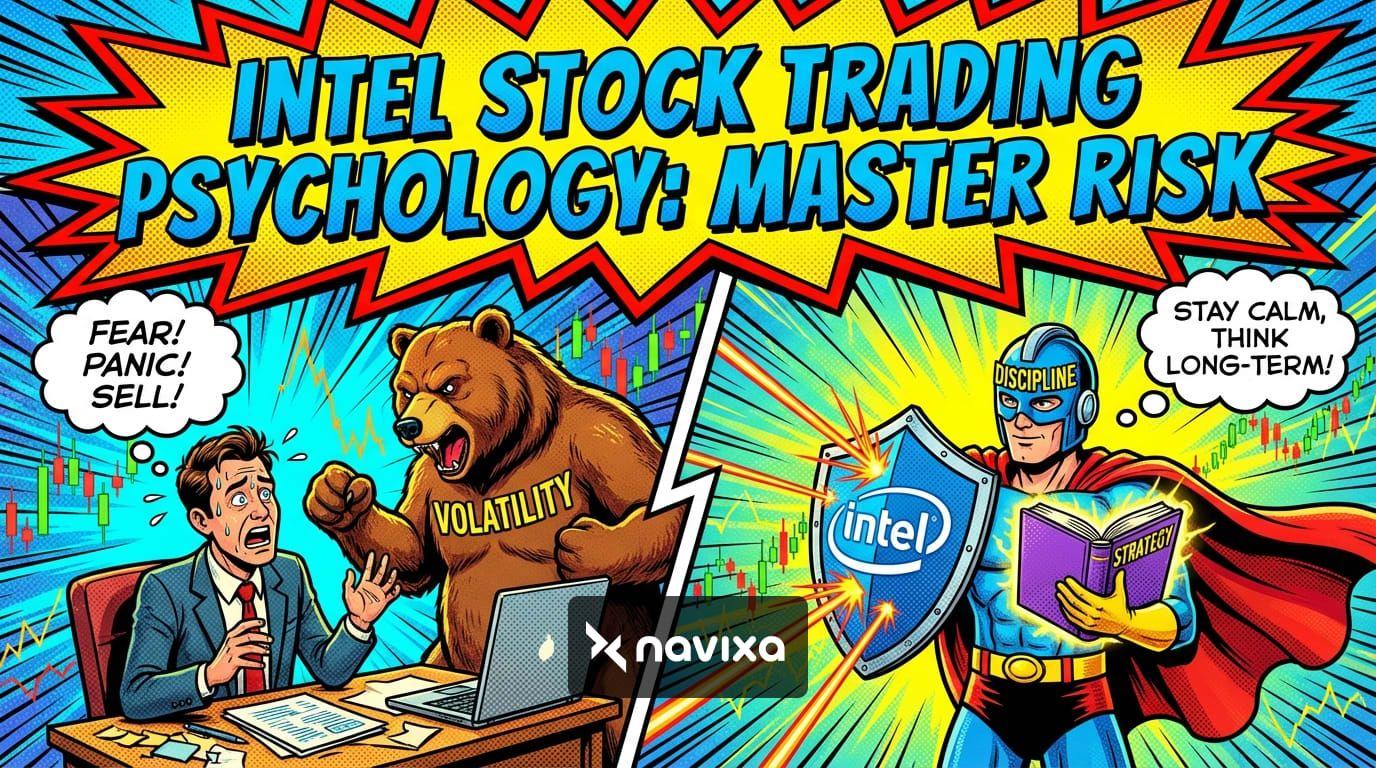
Trading legacy technology stocks used to be a predictable exercise in collecting quarterly dividends and watching slow, incremental growth unfold over decades. But today, trading Intel Corporation (NASDAQ: INTC) is a completely different beast. With the stock experiencing massive multi-month swings—surging aggressively during critical turnaround phases and currently trading in a highly reactive, volatile range—Intel stock trading psychology has become the ultimate differentiator between consistently profitable traders and those left holding the bag.
Whether you are a seasoned equities trader or a professional crossing over from the hyper-volatile world of cryptocurrency, mastering your internal mindset is just as critical as reading a price chart. In this comprehensive guide, we will explore the specific psychological challenges of trading a legacy tech giant in the midst of a massive artificial intelligence pivot. We will break down the cognitive biases that frequently trap retail and institutional INTC traders alike, examine the emotional impact of Intel's high-stakes foundry investments, and provide actionable risk management strategies to safeguard your trading capital in today's unpredictable market.
The Evolution of INTC: From Sleepy Giant to High-Beta Asset
Intel is no longer the predictable blue-chip stock of the 2010s. Under the leadership of its new executive team, the company is executing a massive, capital-intensive transition to become a dominant global foundry and a leader in AI-enabled personal computing [1]. This pivot has injected a level of volatility into INTC shares that rivals some large-cap cryptocurrencies, forcing traders to rapidly adapt their market approach.
Take the market action of early 2026 as a prime example. On April 1, 2026, Intel shares popped nearly 8% in a single day [1]. The catalyst? A major announcement that the company was repurchasing Apollo Global Management's 49% stake in its Ireland Fab 34 facility for $14.2 billion [1]. For the untrained trader, this kind of explosive price action triggers intense emotional responses, leading to impulsive buying at the top of the candle or premature selling of a long-term position.
When a legacy company transitions into a high-growth, high-risk turnaround play, it challenges everything a trader thought they knew. You are no longer trading a stable dividend stock; you are trading a highly sensitive technological narrative. The stock is reacting dynamically to updates on the Intel 18A process node, the rollout of Panther Lake chips, and fierce competition in the semiconductor sector [1]. Traders must adjust their mental frameworks to treat INTC as a volatile growth asset rather than a safe-haven tech stalwart.
Cognitive Biases That Destroy INTC Traders
The foundation of solid trading psychology is recognizing your own mental blind spots. When dealing with a heavily scrutinized stock like Intel, cognitive biases can easily distort your market analysis.
1. Anchoring Bias in Historical Pricing
Anchoring occurs when a trader relies too heavily on past price points to dictate future expectations. Many traders anchor to Intel's historical all-time highs or its recent 52-week highs near the mid-$50s [1]. They assume that because the stock once traded at a certain level, it is naturally "destined" to return there. Conversely, others anchor to the multi-year lows, perpetually believing the stock is a value trap. Successful Intel stock trading psychology requires treating the current chart as a blank slate, analyzing present-day volume, momentum, and macroeconomic conditions without being emotionally tethered to past prices.
2. Confirmation Bias and the AI Hype
Confirmation bias is the tendency to seek out information that validates your existing beliefs while actively ignoring data that contradicts them. If you are extremely bullish on Intel, you might obsessively read news about their AI PC chip rollout and their integration of new data center technologies, while deliberately ignoring reports of foundry delays or increased capital expenditure debts. A disciplined trader actively seeks out the bearish thesis to stress-test their own convictions. If you cannot objectively analyze both the bull and bear cases, your trades are driven by hope, not strategy.
3. Loss Aversion in Turnaround Plays
Loss aversion refers to the psychological reality that the pain of losing money is twice as intense as the joy of making money. In turnaround stocks like Intel, traders often hold onto losing positions much longer than they mathematically should. They rationalize the loss by telling themselves, "Intel is too big to fail," or "It's just a long-term investment now." This mindset destroys capital efficiency. Knowing exactly when to cut a loss is the hallmark of professional trading.
Overcoming FOMO and FUD in the Semiconductor Wars
Intel is locked in a fierce, ongoing battle with rivals like AMD and Nvidia, meaning the stock is highly susceptible to news-driven volatility. This environment breeds two of the most dangerous emotions in the trading world: Fear Of Missing Out (FOMO) and Fear, Uncertainty, and Doubt (FUD).
Managing FOMO During Breakouts
When Intel releases overwhelmingly positive news—such as securing a new external customer for its foundry business or completing the $14.2B Apollo buyout—the stock can surge rapidly [1]. Retail traders often experience severe FOMO, market-buying the stock at the absolute peak of a daily candle just before an inevitable retracement. To combat FOMO, you must trust your predefined trading system. If a breakout occurs and you missed the initial entry, accept that the opportunity has passed. Wait for a healthy consolidation or a retest of key moving averages rather than recklessly chasing green candles.
Navigating FUD During Sector Downturns
Conversely, FUD is rampant when broader semiconductor indices take a hit. If global supply chain issues arise, or regulatory pressures increase, INTC can experience sharp sell-offs. During these periods, emotional traders panic-sell at the exact moment they should be looking for high-value accumulation zones. To master your mindset, you must separate systemic market noise from fundamental changes to Intel's core business model.
"The stock market is a device for transferring money from the impatient to the patient." – Warren Buffett
This quote perfectly encapsulates the mindset required for trading volatile tech stocks. Patience is not just a virtue; it is a highly profitable trading strategy.
Technical Analysis Meets Trading Psychology
Many market participants mistakenly believe that technical analysis is purely mathematical. In reality, technical analysis is the visual representation of mass human psychology. Support and resistance levels are not arbitrary lines drawn on a chart; they are the exact price points where collective fear and greed intersect.
When trading NASDAQ: INTC, understanding the psychology behind the chart is vital. For example, round numbers like $40.00 or $50.00 often act as massive psychological barriers. When Intel's price approaches these levels, the order books fill with limit orders from traders looking to take profits or establish new short positions.
If you find yourself sweating as the price nears your target, you are likely over-leveraged. The psychological pressure of a trade should never cloud your interpretation of the chart. If a stock breaks a critical support level, the chart is objectively telling you that the collective market sentiment has shifted bearish. A disciplined trader respects the chart, executes their stop-loss without hesitation, and moves on to the next setup without any emotional attachment.
Comparing the Psychology: INTC vs. Crypto Markets
As cryptocurrency trading becomes increasingly mainstream, many crypto natives are diversifying their portfolios into traditional tech stocks. While there are similarities in navigating market swings, the psychological demands differ significantly.
| Psychological Factor | Traditional Tech (INTC) | Cryptocurrency |
|---|---|---|
| Market Hours | Fixed market hours with stressful overnight price gaps. | 24/7/365 continuous global trading. |
| Volatility Drivers | Quarterly earnings reports, SEC filings, global supply chains. | Network upgrades, regulatory news, massive liquidation cascades. |
| Regulatory Stress | High transparency, standard equity risk. | High uncertainty, sudden regulatory crackdowns. |
| Mindset Requirement | Patience for multi-month trends and cyclical earnings. | Hyper-vigilance for sudden, severe intraday crashes. |
Transitioning between these markets requires a deliberate mental reset. Crypto traders must adapt to the slower pace and gap-up/gap-down risks of traditional equities, while traditional stock traders must embrace the higher intraday volatility of modern tech turnarounds.
Actionable Risk Management Strategies
Ultimately, the absolute best way to stabilize your Intel stock trading psychology is through rigorous, uncompromising risk management. Emotions only take control of your brain when you are exposed to unmanageable financial risk. By mathematically defining your downside, you effectively strip fear out of the equation.
1. Define Your Risk-to-Reward Ratio
Before entering any trade on INTC, you must explicitly know your exact entry, target, and invalidation points. A professional trader typically looks for a minimum risk-to-reward ratio of 1:2 or 1:3. If your stop-loss dictates a potential loss of $500, your take-profit target must offer a potential gain of at least $1,000 to $1,500. When the math is inherently in your favor, a single losing trade will not trigger an emotional spiral.
2. Implement Strict Position Sizing
Never risk more than 1% to 2% of your total trading capital on a single trade. If you are risking 20% of your portfolio on Intel's next earnings report, you are not trading; you are gambling. Oversized positions amplify performance anxiety, making you hyper-reactive to minor price fluctuations. Proper position sizing ensures that no single market event can blow up your account.
3. Automate Your Trade Execution
Human beings are inherently emotional creatures, especially when hard-earned money is on the line. Once you deeply analyze the chart and determine your technical levels, enter your buy orders, stop-losses, and take-profits into your brokerage platform, and then literally step away from the screen. Micromanaging a trade minute-by-minute feeds anxiety and drastically increases the likelihood of premature, emotional intervention. Trust your initial, unclouded analysis.
4. Keep a Detailed Trading Journal
Track every single trade you make, noting not just the entry and exit prices, but your emotional state at the exact time of execution. Were you feeling FOMO? Were you exhausted? Were you frustrated from a previous loss? By documenting your mental state, you will begin to quickly recognize the emotional patterns that precede your worst trades. You can also learn to analyze institutional data, such as SEC filings, purely logically without letting prevailing market sentiment dictate your actions.
Conclusion: Mastering the Mind Game
Trading Intel stock in the current macroeconomic environment is a high-stakes endeavor that requires deep technical skill, fundamental awareness, and supreme psychological discipline. The company's massive pivot toward AI computing and advanced foundry services guarantees that volatility will remain elevated for the foreseeable future.
By fully understanding the cognitive biases that plague average retail traders, mitigating the destructive forces of FOMO and FUD, and strictly adhering to logical risk management rules, you can transform market volatility from a source of anxiety into a consistent source of profit. Remember, the market does not care about your feelings, your beliefs, or your historical price targets. The only thing you can truly control in trading is yourself. Master your Intel stock trading psychology, execute your edge with mechanical precision, and the profits will naturally follow.
Frequently Asked Questions
What is the biggest psychological mistake when trading Intel stock?
The most common mistake is emotional anchoring. Traders frequently anchor to Intel's historical dominance and past all-time highs, assuming the stock will naturally return to those elevated levels. This blinds them to current market realities, leading them to stubbornly hold onto losing positions instead of cutting losses based on present-day technical analysis and market structure.
How does Intel's transition to an AI-focused foundry affect trading psychology?
Intel's massive structural pivot introduces significant uncertainty, which inherently breeds emotional trading. The stock now reacts aggressively to news regarding its 18A process node, AI PC processor rollouts, and multi-billion dollar facility transactions. Traders must learn to emotionally detach from the daily news hype and learn to trade the actual price action displayed on the chart.
Can cryptocurrency trading strategies be applied to Intel stock?
Yes, absolutely. Because Intel currently exhibits high volatility that is remarkably similar to some crypto assets, the stringent risk management, strict stop-loss discipline, and emotional detachment utilized by successful crypto traders are highly effective when applied directly to INTC.
Why is risk management considered a psychological tool?
Risk management mathematically limits your downside, which directly eliminates the fear of ruin. When you know that the absolute worst-case scenario of a trade is a minor 1% loss of your total portfolio, the intense anxiety associated with an open position disappears. This allows you to think clearly and let your profitable trades run to their full targets without emotional interference.