Introduction to Trading UnitedHealth Group
UnitedHealth Group is an absolute titan in the healthcare sector, and its stock has historically been a cornerstone for both long-term investors and active market participants. For traders wondering how to approach UNH stock, understanding the complex intersection of macroeconomic catalysts, fundamental shifts, and strict technical analysis is absolutely critical. Recent market dynamics have demonstrated that even mega-cap healthcare equities can experience significant volatility, offering highly lucrative opportunities for well-prepared traders who know exactly what to look for.
Whether you are looking to execute short-term swing trades, capitalize on intraday momentum, or structure advanced options spreads, trading this particular asset requires a nuanced, disciplined approach. This comprehensive guide breaks down the essential technical indicators, critical price levels, structural market catalysts, and actionable strategies you need to trade this leading healthcare stock with ultimate confidence and precision.
The Macroeconomic Backdrop for Healthcare Equities
Trading a single equity never happens in a vacuum. The broader macroeconomic picture heavily influences institutional capital allocation into the healthcare sector. Before reading individual stock charts, successful traders analyze the wider environment.
Interest Rates and Sector Rotation
Healthcare stocks are historically viewed as defensive assets. During periods of macroeconomic uncertainty or shifting interest rate policies from the Federal Reserve, institutional money often rotates out of high-growth tech sectors and into stable, dividend-paying stalwarts like UnitedHealth. Conversely, in a rapid risk-on environment, defensive stocks might temporarily underperform. Monitoring bond yields and the broader market's risk appetite is the first step in determining the prevailing trend for health equities.
Artificial Intelligence and Operational Efficiency
In modern markets, technology is blurring the lines between sectors. UnitedHealth is increasingly utilizing Artificial Intelligence (AI) to automate end-to-end underwriting, accelerate claims processing, and streamline policy administration. While this is a fundamental business shift, it acts as a strong bullish trading catalyst. When companies announce margin expansions driven by AI efficiencies, algorithmic trading bots and institutional investors typically front-run the news, creating explosive, high-volume price action that active traders can capitalize on.
Fundamental Catalysts Impacting Price Action
Technical analysis provides the roadmap, but fundamentals provide the fuel. Traders must remain hyper-aware of the fundamental drivers that dictate institutional order flow.
Earnings Outperformance and Margin Expansion
Quarterly earnings reports are the most volatile binary events for any stock. Recent financial disclosures have highlighted the company's resilience. Strong quarterly revenues exceeding the $110 billion mark and adjusted earnings per share (EPS) comfortably beating Wall Street consensus estimates act as massive upside catalysts. When a company demonstrates an ability to lower its Medical Care Ratio (MCR)—a critical profitability metric measuring the percentage of premiums paid out for medical care—institutional buyers aggressively step in. An MCR dropping below the 84% threshold signals improving margins, structurally validating technical breakout patterns.
Regulatory Tailwinds
Healthcare stocks are notoriously sensitive to government and regulatory shifts. Decisions by the Centers for Medicare & Medicaid Services (CMS) regarding Medicare Advantage payment rates can make or break a multi-month trend. When regulators finalize rate increases, it provides a massive systemic tailwind, removing uncertainty and allowing the stock to break out of prolonged consolidation periods. Once regulatory overhangs clear, technical breakouts become significantly more reliable.
"In the modern trading landscape, combining improved medical cost controls with crystal-clear regulatory clarity creates a high-probability environment for sustained momentum and trend continuation."
Technical Analysis: Key Price Levels to Watch
To trade UNH stock effectively, you must map out the battlefield. Institutional algorithms, market makers, and retail traders alike watch specific technical levels to determine precise entries and exits.
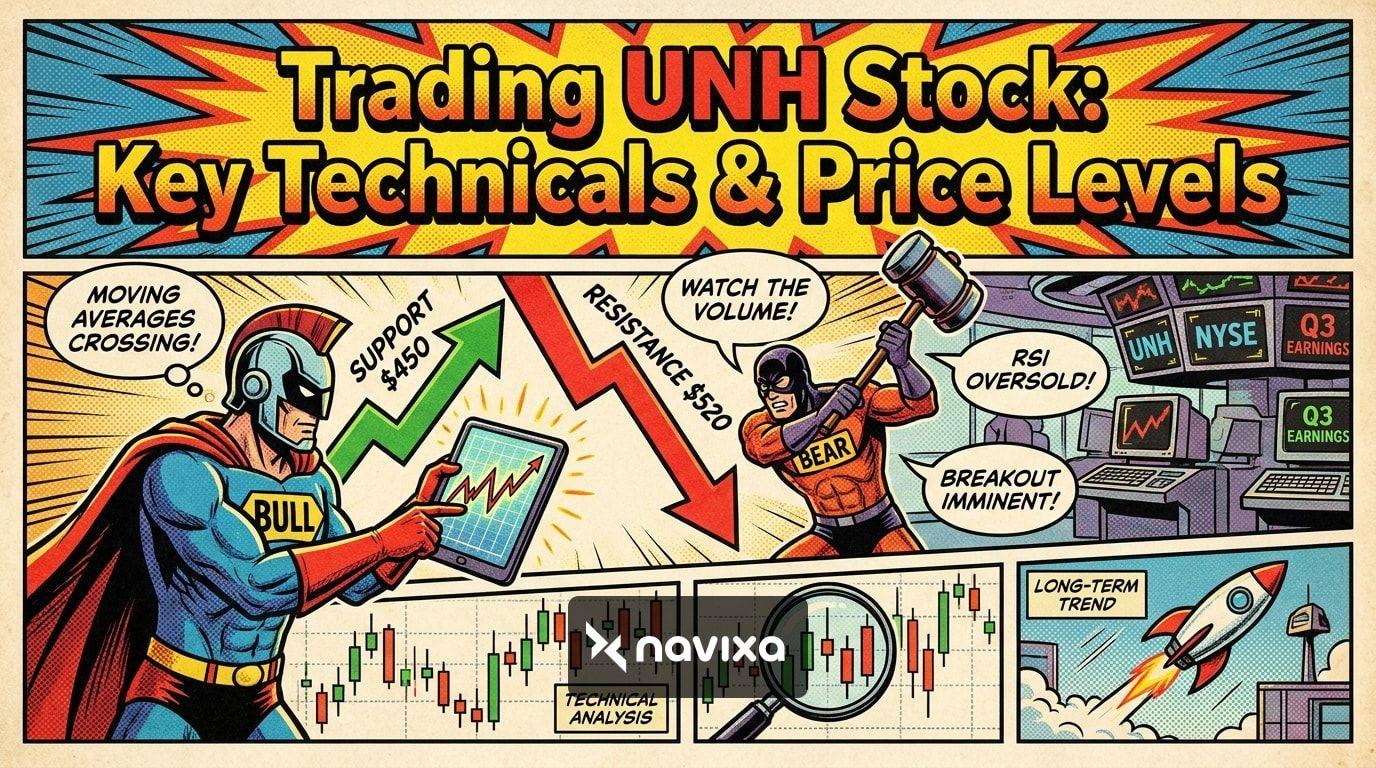
Support Zones and Moving Averages
The foundation of any technical trading strategy is identifying where buyers have historically stepped in to defend the price.
1. The 50-Day Moving Average (MA): Acting as a dynamic short-to-medium-term support level, the 50-day MA is a crucial gauge of momentum. When the stock price crosses and holds above this moving average, it signals a definitive shift from bearish distribution to bullish accumulation. 2. The 200-Day Moving Average: For macro-trend alignment, the 200-day MA is the ultimate line in the sand. A golden cross (when the 50-day MA crosses above the 200-day MA) often precedes prolonged upward trends. Conversely, remaining below this level indicates a macro downtrend. 3. Fibonacci Retracements: When the stock experiences a sharp impulse move, traders use Fibonacci retracements to locate pull-back entry points. The 38.2% and 61.8% golden pocket levels act as hidden support zones where algorithmic buying frequently resumes to continue the primary trend.
Resistance Targets and Breakout Zones
Resistance levels are areas where sellers historically step in to take profits, creating supply zones.
1. The Baseline Resistance Level: In technical charting, the neckline of a macro double-bottom pattern often rests near key psychological zones (e.g., $365 to $375). A high-volume daily close above this structural baseline invalidates the bearish thesis and opens the door for a much larger rally. 2. Psychological Century Marks: Once immediate resistance is cleared, the next major liquidity pools rest at whole numbers, like the $400 mark. Options open interest heavily concentrates around these whole numbers, making them magnetic targets for future price action.
Momentum Indicators (RSI and MACD)
Price action should never be traded in isolation; it must always be confirmed by momentum oscillators.
* Relative Strength Index (RSI): An RSI climbing from oversold territory (below 30) into the neutral/bullish zone (50-60) indicates gathering strength. Traders should aggressively watch for bullish divergence—where the stock makes a lower low, but the RSI makes a higher low—signaling that seller exhaustion is imminent. * Moving Average Convergence Divergence (MACD): A bullish crossover on the daily MACD histogram is a classic buy signal. It is incredibly potent when it occurs below the zero line, indicating an early-stage trend reversal that offers maximum reward for minimal risk.
For more profound insights on how these indicators work across different asset classes, you can review comprehensive resources on Investopedia's Technical Analysis Guide.
Actionable Trading Strategies for UNH Stock
With the fundamental and technical landscape properly defined, how do you actually execute trades? Here are four robust, battle-tested strategies tailored to the unique price action of this healthcare giant.
1. The Breakout Swing Trade
Swing trading involves capturing multi-day or multi-week moves based on technical structure shifts. * Entry: Wait for a daily candle to close cleanly above a major resistance baseline with trading volume at least 150% above the 20-day average. Volume confirms the validity of the breakout. * Stop Loss: Place a trailing stop 2% to 3% below the breakout candle's lowest point to protect capital against fake-outs or bull traps. * Take Profit: Target the next major Fibonacci extension or psychological whole number, scaling out of the position (selling half your shares) to secure profits along the way.
2. Options Strategies: The Bull Call Spread
For traders who want to limit capital outlay while gaining leveraged exposure to large price swings, a Bull Call Spread is highly effective. * Mechanics: Buy an at-the-money (ATM) call option and simultaneously sell an out-of-the-money (OTM) call option expiring in the exact same month. * Advantage: This strategy brilliantly reduces the impact of implied volatility (Vega) and time decay (Theta), which is absolutely crucial when trading a high-priced equity. It firmly caps the maximum loss to the net premium paid upfront.
3. Mean Reversion Day Trading
Intraday traders can capitalize on the stock's Average True Range (ATR) during high-volume sessions. * Setup: If the stock gaps up significantly at the open (often due to earnings reports or CMS regulatory news), wait patiently for the initial morning volatility to subside. Do not chase the open. * Execution: Look for a reversion back to the Volume Weighted Average Price (VWAP). If the price bounces off the VWAP with a bullish reversal candlestick pattern (like a hammer or bullish engulfing), initiate a long position targeting the high of the day.
4. Volume Profile and Liquidity Hunts
Volume profile looks at the volume traded at specific price levels rather than over time. * Point of Control (POC): Identifying the POC allows traders to see exactly where the fairest value was transacted over a given period. If the price dips below the POC on noticeably low volume, it often snaps back rapidly as algorithms arb the difference.
Strict Risk Management Rules
Trading without a mathematical risk management framework is not trading; it is gambling. Professional traders adhere strictly to capital preservation rules to ensure longevity in the markets.
1. Position Sizing: Never risk more than 1% to 2% of your total account equity on a single trade setup. For a $10,000 trading account, your absolute maximum loss per trade should not exceed $100 to $200. 2. Hard Stop Losses: Always use automated hard stop-loss orders. Mental stops are highly prone to emotional overrides. Once a support level fails, your fundamental trade thesis is invalidated—cut the loss immediately without hesitation. 3. Avoid Binary Events: Holding full-sized short-term positions through quarterly earnings reports or major regulatory announcements is exceptionally risky due to gap-down potential. Consider trimming positions significantly or using protective put options to hedge exposure during these volatile windows.
For regulatory guidelines, insider trading disclosures, and corporate filings that might dynamically impact your risk models, always consult the SEC EDGAR Database.
Comparing Market Leaders
To provide greater context, let us look at how this individual stock compares to the broader S&P 500 Healthcare sector regarding core trading metrics.
| Metric | UNH Stock | S&P 500 Healthcare ETF (XLV) | Trading Implication |
|---|---|---|---|
| Beta (Volatility) | ~0.75 | ~0.70 | Moves slightly faster than the broader sector, offering slightly better swing trade ranges. |
| Average Daily Volume | High (Millions) | Very High | Excellent liquidity; minimal to zero slippage on market orders. |
| Options Liquidity | Excellent | Excellent | Tight bid-ask spreads, making it highly favorable for option traders. |
| Dividend Yield | ~1.5% - 2.0% | ~1.5% | Provides a marginal downside cushion for longer-term swing trades. |
Practical Takeaways
Mastering the price action of this healthcare titan requires incredible patience, situational awareness, and unwavering discipline. Here is a rapid summary of the actionable steps: * Respect the Moving Averages: Use the 50-day and 200-day MAs to clearly define the broader trend. Never fight institutional flow. * Monitor the MCR and CMS Rates: Keep a close eye on the Medical Care Ratio and Medicare Advantage rates, as these fundamental metrics explicitly dictate long-term technical channel breakouts. * Implement Options for Leverage: Use defined-risk options spreads to smartly navigate high-priced equities without exposing your entire portfolio to massive capital drawdowns. * Protect Your Capital: Employ strict 1-2% risk parameters on absolutely every setup you take.
Conclusion
Successfully trading UNH stock is about flawlessly aligning macro-fundamental catalysts with highly precise technical entries. By deeply understanding the real-world impact of medical cost ratios, regulatory rate changes, and psychological price resistance levels, traders can construct highly favorable risk-to-reward setups. The stock market inherently rewards meticulous preparation and emotional discipline. Start by charting out the key moving averages, accurately identifying your support and resistance liquidity zones, and strictly defining your mathematical risk management parameters before ever clicking the buy button on your next trade.
***
Frequently Asked Questions
What makes UNH stock attractive for swing traders?
The stock offers exceptionally high liquidity, crystal-clear technical support and resistance levels, and predictable volatility driven by core fundamental healthcare metrics. Its massive market capitalization ensures that technical chart patterns like double bottoms and moving average crossovers are generally respected by institutional trading algorithms.
How do Medicare Advantage rates affect technical price levels?
Medicare Advantage payment rates, completely decided by the CMS, directly impact the future revenue forecasts of health insurers. Favorable rate increases act as a massive bullish catalyst, often causing the stock to gap up forcefully and break through stubborn technical resistance levels, while unfavorable rates can trigger sharp breakdowns below major moving averages.
What is the best technical indicator for trading this stock?
While no single indicator is foolproof in financial markets, a confluence approach works best. Combining the 50-day Moving Average for overarching trend direction, Volume Profile for breakout confirmation, and the Relative Strength Index (RSI) for spotting overbought or oversold extremes provides a highly reliable, institutional-grade trading framework.
Should I trade the underlying equity or use options?
This largely depends on your total account size and personal risk tolerance. Because the share price is relatively high, buying 100 shares requires significant upfront capital. Options strategies, specifically debit spreads like the Bull Call Spread, allow retail traders to gain leverage and exposure to price movements with much lower capital requirements and strictly defined downside risk parameters.