
Trading MicroStrategy (NASDAQ: MSTR) is unlike trading any other stock on the market. Once a quiet enterprise business intelligence company, MicroStrategy—now increasingly operating as a Bitcoin development and treasury company—has transformed into the world's largest publicly traded corporate holder of Bitcoin. For traders, MSTR represents a unique, highly leveraged proxy for Bitcoin's price action.
If you are wondering how to trade MSTR stock, you are entering a high-volatility, high-reward arena. Because the company issues debt and equity to accumulate Bitcoin, its stock price moves with explosive beta relative to the underlying cryptocurrency. In this comprehensive guide, we will break down the mechanics of MicroStrategy’s market behavior, outline actionable trading strategies, and provide a step-by-step framework to help you navigate this volatile asset.
What Makes MicroStrategy (MSTR) Unique?
Before executing your first trade, it is crucial to understand what drives MSTR's valuation. Unlike traditional technology stocks that are valued purely on revenue, cash flow, and software licensing growth, MicroStrategy functions largely as a leveraged Bitcoin investment vehicle.
The Corporate Bitcoin Treasury
Spearheaded by founder Michael Saylor, MicroStrategy adopted its "Bitcoin Standard" in August 2020. Since then, the company has relentlessly accumulated Bitcoin through free cash flow, convertible debt issuances, and at-the-market (ATM) equity offerings. As of early 2026, the firm holds over 780,000 BTC. This massive stockpile means that MSTR's corporate balance sheet is intrinsically tied to the crypto market. When Bitcoin rallies, MSTR often rallies harder; when Bitcoin drops, MSTR frequently experiences steep drawdowns.
The NAV Premium and The 10-for-1 Split
MSTR historically trades at a premium to its Net Asset Value (NAV). This means the market capitalization of the company is often significantly higher than the spot value of the Bitcoin it holds. Investors pay this premium for several reasons: the core software business provides cash flow, the management team actively accretes Bitcoin per share, and there are no direct management fees like those found in traditional ETFs.
Additionally, in August 2024, MicroStrategy executed a 10-for-1 stock split. Prior to this split, shares often traded well above $1,000, creating a high barrier to entry. By splitting the stock, the company drastically improved liquidity and made the shares accessible to a broader base of retail traders, increasing daily trading volume and options activity.
Core Trading Strategies for MSTR Stock
Understanding how to trade MSTR stock requires a grasp of specific strategies tailored to its unique relationship with cryptocurrency. Here are the primary methods utilized by successful traders.
1. The Bitcoin Proxy and Momentum Play
The most common way to trade MSTR is as a high-beta proxy for Bitcoin. Traders monitor Bitcoin’s technical breakouts and use MSTR to capitalize on the momentum. Because traditional equity accounts might not allow direct spot crypto trading or the use of heavy leverage, MSTR serves as a substitute. If Bitcoin breaks a major resistance level over the weekend or during pre-market hours, momentum traders will aggressively buy MSTR at the stock market open to capture the lagging corporate equity reaction.
2. NAV Premium Arbitrage and Mean Reversion
Advanced traders closely monitor the ratio between MSTR’s market capitalization and the value of its Bitcoin holdings. When retail FOMO (Fear Of Missing Out) is at its peak, the MSTR premium to NAV can stretch to 2x or higher. Conversely, during crypto bear markets or times of extreme fear, the premium can shrink dramatically. Mean reversion traders will short MSTR (or buy put options) when the premium reaches historically unsustainable highs, and go long when the premium collapses, betting that the historical ratio will eventually normalize.
3. Volatility and Options Yield Harvesting
Because MSTR experiences massive price swings, its options command incredibly high implied volatility (IV). Experienced options traders sell cash-secured puts or covered calls to collect substantial premiums. For those who prefer not to trade options directly, there are even specialized ETFs that run covered call strategies on MSTR to generate income. However, options selling on MSTR carries immense risk due to the underlying asset's propensity for sudden 10% to 20% intraday moves.
Technical Analysis and Market Drivers
To successfully learn how to trade MSTR stock, you must master dual-charting: analyzing both the traditional equity chart of MSTR and the crypto chart of BTC/USD.
Key Support and Resistance Levels
Technical analysis on MSTR relies heavily on traditional indicators like Moving Averages (MA), the Relative Strength Index (RSI), and Fibonacci retracements. However, an MSTR support level is incredibly fragile if Bitcoin is simultaneously breaking down. Traders should always overlay a Bitcoin chart on their trading terminals to confirm trends. For example, if MSTR is approaching a 200-day moving average support, but Bitcoin is slicing through major structural support, the MSTR moving average is highly likely to fail.
Volume and Beta Profiling
MSTR has a notoriously high beta, often moving 2 to 3 times as much as standard indices, and significantly more than spot Bitcoin itself. Volume profiling is essential here. Breakouts in MSTR need to be accompanied by strong volume to be considered valid. Since the 2024 stock split, average daily volume has surged, making volume-weighted average price (VWAP) an excellent intraday tool for day traders looking for optimal entry and exit points.
"Trading MSTR without watching Bitcoin's live order book is like driving a race car completely blindfolded. The crypto market dictates the broader weather; MSTR is simply a high-performance vehicle driving within it."
How to Trade MSTR Stock: Step-by-Step
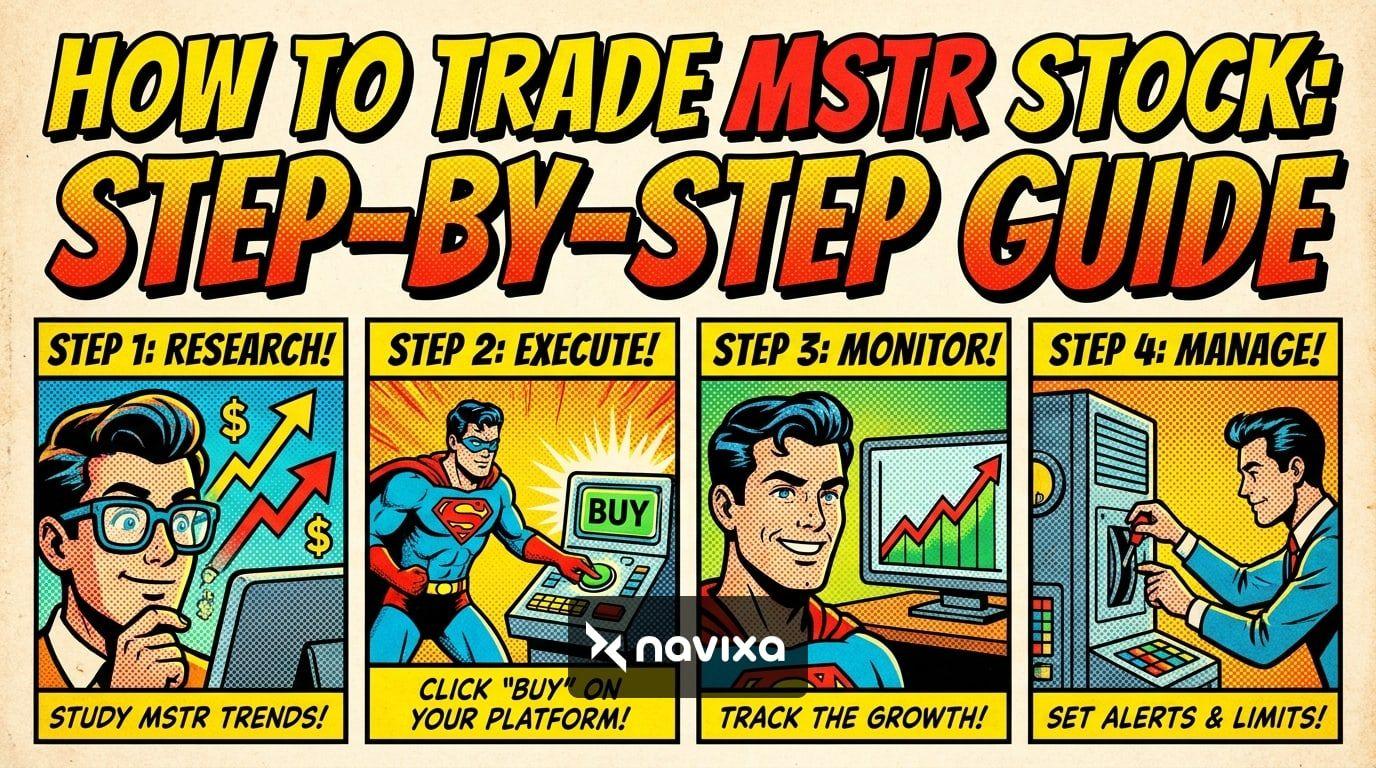
Ready to execute? Follow this actionable step-by-step guide on how to trade MSTR stock safely and effectively.
Step 1: Choose the Right Brokerage Platform
You need a brokerage that offers robust charting, fast execution, and ideally, extended hours trading. Because Bitcoin trades 24/7, significant price moves often happen on weekends or at 3:00 AM. If your broker does not allow pre-market or after-hours trading, you could wake up to a massive gap down that skips your standard stop-loss orders. Make sure your broker provides access to advanced order types and options trading if you plan to use advanced strategies.
Step 2: Analyze the Bitcoin (BTC) Price Action
Before looking at the MSTR ticker, evaluate the broader crypto market. Check the spot price of Bitcoin, analyze crypto funding rates, and look for macro catalysts (like Federal Reserve meetings or global regulatory news). You can use professional platforms like TradingView to compare MSTR's historical correlation with Bitcoin in real time.
Step 3: Check the SEC Filings and Corporate News
MicroStrategy routinely files 8-K forms announcing new debt offerings or major Bitcoin purchases. You can track these corporate actions via the SEC EDGAR database. A sudden debt issuance announcement can cause short-term stock dilution, while a massive Bitcoin purchase announcement can spark a retail buying frenzy. Knowing the corporate calendar is vital.
Step 4: Determine Your Entry, Exit, and Stop-Loss
Define your risk before you press the buy button. Because MSTR is so volatile, position sizing is critical. If your standard risk per trade on a blue-chip stock is $1,000, you might want to halve that for MSTR to accommodate wider stop-losses. Decide whether you are day trading the intraday momentum, swing trading a multi-week Bitcoin breakout, or holding long-term.
Step 5: Execute Your Trade and Monitor
Use limit orders to enter your position. Due to MSTR's rapid price fluctuations, market orders can result in significant slippage. Once you are in the trade, actively monitor both the traditional market indices (like the Nasdaq 100) and the real-time Bitcoin price.
Comparing MSTR to Direct Bitcoin Investment
Many investors wonder if they should trade MSTR, buy spot Bitcoin, or use the newly approved spot Bitcoin ETFs. Here is a breakdown of how they compare:
| Feature | MSTR Stock | Spot Bitcoin | Spot Bitcoin ETFs |
|---|---|---|---|
| Asset Class | Corporate Equity (Stock) | Digital Asset (Cryptocurrency) | Exchange Traded Fund |
| Market Hours | Traditional Stock Market Hours | 24/7 / 365 Days a Year | Traditional Stock Market Hours |
| Leverage Factor | High (Debt used to buy BTC) | None (Unless using margin) | None |
| Custody Risk | Managed by MicroStrategy | Self-custody or via Crypto Exchange | Managed by ETF Issuer / Custodian |
| Management Fees | None (Operating costs apply) | Network transaction fees only | Expense Ratios apply (e.g., 0.25%) |
Essential Risk Management for MSTR Traders
When you learn how to trade MSTR stock, risk management must be your top priority. The very leverage that makes MicroStrategy so attractive during bull markets makes it incredibly dangerous during drawdowns.
First, consider the gap risk. Because the stock market closes on Friday afternoon and opens on Monday morning, but Bitcoin trades all weekend, a weekend crypto crash will cause MSTR to "gap down" severely at the Monday open. Traditional stop-loss orders will execute at the next available price, which could be 15% lower than your target exit. Options hedging (such as buying weekend put options) can mitigate this risk.
Second, understand the debt burden. MicroStrategy relies heavily on convertible notes. If Bitcoin experiences a multi-year bear market and the value of its treasury drops significantly below its debt obligations, solvency concerns can arise, historically causing the stock to underperform Bitcoin itself. Never trade MSTR with money you cannot afford to lose, and avoid utilizing high account margin on an asset that already contains intrinsic corporate leverage.
Practical Takeaways
* MSTR is a Leveraged Proxy: Treat MicroStrategy stock as a high-beta bet on Bitcoin rather than a traditional software company. * Dual-Charting is Mandatory: Never trade MSTR without keeping a close eye on the live spot price of Bitcoin. * Watch the NAV Premium: Understand that MSTR's premium to its underlying Bitcoin holdings fluctuates wildly based on market sentiment. * Beware of Gap Risk: Weekend Bitcoin volatility can bypass your stop-loss orders when traditional markets reopen. * Use the 2024 Split to Your Advantage: The 10-for-1 split has increased liquidity, making tight limit orders and options trading far more viable for retail accounts.
Conclusion
Mastering how to trade MSTR stock requires a hybrid mindset. You must blend the discipline of traditional equity trading with the fast-paced, news-driven awareness of a cryptocurrency trader. By understanding MicroStrategy's corporate treasury model, analyzing the NAV premium, and implementing strict risk management to protect against weekend gap-downs, you can harness the incredible volatility of this unique asset.
Whether you are looking to day trade the momentum or swing trade a macroeconomic cycle, always prioritize capital preservation. Start with small position sizes, backtest your strategies across different Bitcoin market cycles, and continuously adapt to the evolving landscape of institutional crypto adoption.
Frequently Asked Questions
Is trading MSTR the same as trading Bitcoin?
No. While MSTR is highly correlated to Bitcoin due to its massive corporate treasury, it is a traditional corporate stock. Its price is influenced by corporate debt, equity dilution, the performance of its software business, and broader stock market indices. It also trades only during regular stock market hours, whereas Bitcoin trades 24/7.
When did the MSTR stock split happen and how did it affect trading?
MicroStrategy executed a 10-for-1 stock split in August 2024. This action significantly lowered the nominal price per share, making it much more accessible for retail investors. The split led to increased daily trading volume, tighter bid-ask spreads, and a highly active options market.
What drives the premium or discount of MSTR stock to its NAV?
The premium to Net Asset Value (NAV) is driven by investor sentiment, the company's ability to issue low-interest debt to buy more Bitcoin (accretion), and retail demand for a leveraged Bitcoin proxy. During massive bull markets, retail FOMO can push the premium very high, while deep bear markets can compress the premium.
Can I trade options on MSTR stock?
Yes. MSTR has one of the most active and liquid options markets among technology stocks. However, because the stock is incredibly volatile, the implied volatility (IV) on these options is extremely high, making buying options expensive and selling options highly risky without proper hedging.
Why does MSTR stock drop sometimes when Bitcoin is up?
While rare, divergences can occur. If MicroStrategy announces a large convertible debt offering or an at-the-market equity issuance to fund future Bitcoin purchases, the immediate dilution of shares can cause the stock price to drop in the short term, even if the spot price of Bitcoin is rising.