Welcome to the definitive guide on how to trade Ethereum. As the world's leading smart contract platform, Ethereum offers one of the most liquid and dynamic markets in the cryptocurrency sector. Whether you are aiming to accumulate ETH for long-term holding, day trade the volatility, or hedge your portfolio using perpetual futures, understanding the mechanics of the market is crucial.
With Ethereum continually evolving—most recently passing the Pectra and Fusaka upgrades to dramatically improve Layer 2 scalability and smart account functionality—the trading landscape has fundamentally shifted. Gas fees on Layer 2 networks have plummeted, and institutional inflows via spot ETFs have brought a new class of capital into the ecosystem. Navigating this mature yet volatile market requires more than just guessing price directions; it requires strategy, technical proficiency, and ironclad risk management.
This comprehensive guide provides actionable steps, strategic insights, and essential protocols to help you learn how to trade Ethereum effectively, whether you are a complete novice or an intermediate trader looking to refine your edge.
Understanding the Ethereum Market Context
Before you place your first trade, it is critical to understand what drives Ethereum's price. Unlike Bitcoin, which is primarily viewed as a digital store of value and macroeconomic hedge, Ethereum is a yield-bearing asset that powers decentralized finance (DeFi), non-fungible tokens (NFTs), and thousands of decentralized applications (dApps).
In today's market context, Ethereum operates with a market capitalization hovering around $290 billion, making it the second-largest digital asset. Its price action is heavily influenced by a combination of macroeconomic liquidity, on-chain fundamentals, and institutional behavior.
"Trading Ethereum requires a dual focus: tracking broader macroeconomic trends while closely monitoring on-chain activity, network upgrades, and institutional staking yields."
Several primary factors influence ETH's market movements: * Network Upgrades: Major protocol updates affect transaction speed, scalability, and network economics. The recent Fusaka upgrade introduced PeerDAS, exponentially scaling data blob capacity, while the upcoming Glamsterdam fork promises parallel transaction processing. These technological leaps often act as bullish catalysts for the token price. * Institutional Adoption: The introduction and maturity of spot Ethereum ETFs have legitimized ETH as a mainstream financial asset. Tracking ETF inflows and outflows provides retail traders with valuable insights into smart money positioning. * Deflationary Mechanics and Staking: Following its transition to Proof-of-Stake and the implementation of EIP-1559, a portion of transaction fees is permanently burned. When network activity is high, ETH can become deflationary. Furthermore, millions of ETH are locked in staking contracts, which reduces the liquid circulating supply and provides a baseline yield for investors.
How to Trade Ethereum: A Step-by-Step Guide
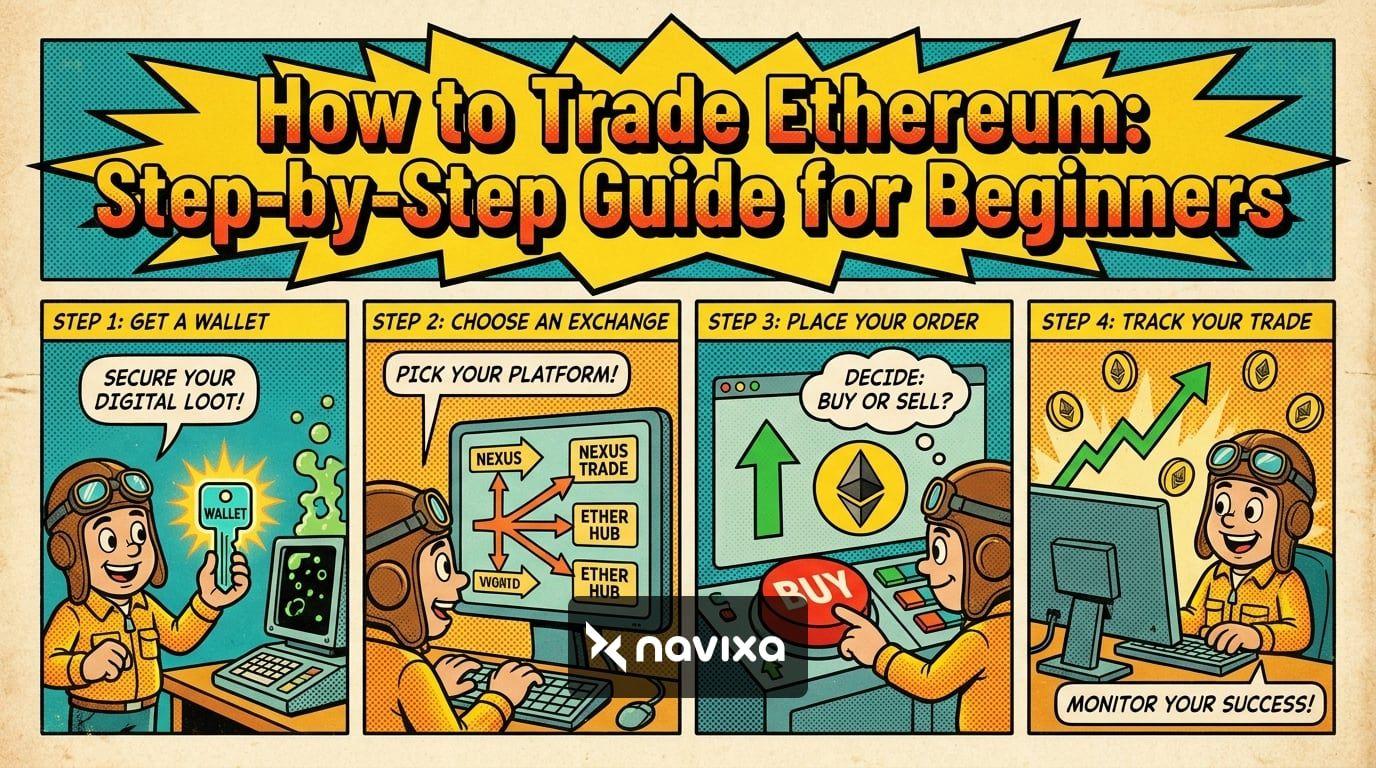
Trading Ethereum successfully requires a structured approach. Follow these foundational steps to establish your trading framework.
Step 1: Choose the Right Trading Platform
Your choice of trading venue will dictate your fees, available trading pairs, and security. You generally have two options: 1. Centralized Exchanges (CEXs): Platforms like Binance, Kraken, and Coinbase act as intermediaries. They offer high liquidity, fiat on-ramps, advanced charting interfaces, and order book trading. These are highly recommended for beginners due to their user-friendly design and customer support. 2. Decentralized Exchanges (DEXs): Platforms such as Uniswap operate directly on the blockchain via Automated Market Makers (AMMs). DEXs allow you to retain custody of your assets and trade without KYC verification. However, you are responsible for network gas fees and managing your own private keys.
Step 2: Fund Your Account and Secure Custody
If you opt for a centralized exchange, you can fund your account using fiat currency (like USD or EUR) via bank wire, ACH, or credit card. Alternatively, you can deposit stablecoins like USDT or USDC.
For decentralized trading, you must set up a non-custodial Web3 wallet, such as MetaMask. Recent protocol improvements, specifically EIP-7702, have revolutionized wallet user experience by allowing standard accounts to function as smart contracts. This means you can now utilize features like sponsored transactions and batched approvals, making on-chain execution smoother than ever.
Step 3: Conduct Rigorous Market Analysis
A successful trader never enters the market blindly. You must formulate a thesis using three distinct types of analysis:
Technical Analysis (TA): Technical analysis involves studying historical price charts to predict future movements. Key tools include: * Moving Averages (MA): The 50-day and 200-day moving averages help identify the broader trend. A crossover (like the "Golden Cross") can signal a major bullish shift. * Relative Strength Index (RSI): This momentum oscillator ranges from 0 to 100. An RSI below 30 typically indicates an asset is oversold, while a reading above 70 suggests it is overbought. * Support and Resistance: Identifying psychological price levels where buying (support) or selling (resistance) historically steps in.
Fundamental Analysis (FA): For Ethereum, fundamental analysis means looking at on-chain data. Metrics such as Total Value Locked (TVL) in DeFi, active daily users, network revenue from transaction fees, and the rate of ETH being burned all provide a picture of the network's intrinsic health.
Sentiment Analysis: The cryptocurrency market is highly emotional. Monitoring funding rates in the perpetual futures market, options open interest, and general social media sentiment can help you gauge whether the market is overly euphoric or deeply fearful.
Step 4: Execute Your Trade
Once your analysis is complete, it is time to execute. You will typically choose between: * Market Orders: These execute your trade immediately at the best available current price. Use this when entering a trade quickly is more important than the exact entry price. * Limit Orders: These allow you to set a specific price at which you want to buy or sell. The trade only executes if the market reaches your predetermined level, ensuring you never pay more (or sell for less) than intended.
Popular Ethereum Trading Strategies
Depending on your risk tolerance, capital, and time horizon, you can apply various strategies to the Ethereum market.
Swing Trading
Swing traders aim to capture medium-term price trends, holding positions for several days to a few weeks. This strategy involves buying ETH during support retests and selling near major resistance zones. Because ETH has a higher beta compared to Bitcoin, it tends to amplify market movements, offering lucrative opportunities for patient swing traders.
Breakout Trading
Breakout traders wait for the price to forcefully breach a well-defined support or resistance level, often accompanied by a surge in trading volume. For instance, if Ethereum has been consolidating below a key resistance for weeks, a high-volume break above that level could trigger a rapid upward continuation. Breakout traders buy the momentum and place a tight stop-loss just below the breakout point.
Perpetual Futures and Scalping
For highly active traders seeking leverage, perpetual futures contracts allow you to control a larger position with a smaller amount of capital. Scalping is a strategy where traders enter and exit futures positions within minutes, capturing tiny price discrepancies. While leverage amplifies gains, it also accelerates losses.
Arbitrage and Yield Strategies
Advanced traders exploit price differences across various exchanges. For example, if ETH is priced at $2,420 on an Asian exchange but $2,425 on a US platform, an arbitrageur simultaneously buys and sells to pocket the difference. Furthermore, utilizing Ethereum's rich DeFi ecosystem, traders can engage in yield farming or basis trading (shorting the futures contract while holding spot ETH and collecting the funding rate).
Trading Methods Comparison
Choosing the appropriate trading instrument is vital. Review the comparison table below to determine which method aligns with your goals.
| Trading Method | Mechanics & Ownership | Key Advantages | Primary Risks | Best Suited For |
|---|---|---|---|---|
| Spot Trading | Buying/selling actual ETH on an exchange. | True asset ownership; no liquidation risk from margin calls. | Requires full capital upfront; lower potential ROI. | Long-term investors and conservative swing traders. |
| Margin Trading | Borrowing funds from a broker to buy ETH. | Amplifies purchasing power; allows short selling. | Incurs daily borrowing fees; moderate liquidation risk. | Intermediate traders looking to maximize capital efficiency. |
| Perpetual Futures | Trading derivative contracts that track ETH's price. | High leverage (up to 100x); deep liquidity; no expiration. | Complex funding rates; extreme risk of rapid liquidation. | Advanced day traders and institutional hedgers. |
Essential Risk Management Protocols
In the cryptocurrency sector, capital preservation is more important than capital appreciation. A brilliant strategy will fail without strict risk management parameters.
Position Sizing and the 1% Rule
Never risk your entire account on a single trade. Professional traders generally employ the 1% rule, meaning they size their positions so that a losing trade will only cost them 1% of their total trading portfolio. This ensures you can sustain a string of losses without blowing up your trading account.
Implement Stop-Loss and Take-Profit Orders
A stop-loss order is a non-negotiable tool that automatically closes your position if the market moves against you by a specified amount. Relying on "mental stops" is a common trap; emotional biases often prevent traders from cutting their losses. Similarly, setting automated take-profit orders ensures you secure gains before the market inevitably retraces.
Understand the Risk-to-Reward Ratio (RRR)
Before entering a trade, calculate your risk-to-reward ratio. If you are risking $100 (your stop-loss distance) to potentially make $300 (your take-profit target), your RRR is 1:3. By consistently taking trades with a favorable RRR, you can remain profitable even if your win rate is less than 50%.
Monitor Gas Fees and Slippage
If you are trading directly on-chain via DEXs, you must account for transaction costs and slippage (the difference between the expected price of a trade and the executed price). While recent protocol upgrades have drastically lowered fees, executing large swaps on the Ethereum mainnet can still be costly. To minimize these expenses, consider utilizing Layer 2 scaling solutions like Arbitrum or Optimism for higher frequency on-chain activity.
Conclusion
Learning how to trade Ethereum is a continuous journey of education, strategy testing, and psychological discipline. By selecting a reliable trading platform, mastering technical and fundamental analysis, and adhering to strict risk management protocols, you can confidently navigate the volatile waters of the crypto market.
As Ethereum continues to upgrade its infrastructure—improving user experience and expanding decentralized finance—the opportunities for informed traders will only multiply. Before diving into the live markets, consider opening a demo account. Practice executing your strategies without risking real capital, analyze your performance, and transition to live trading only when you have established a consistent, profitable edge.
Frequently Asked Questions
What is the best way to trade Ethereum for beginners?
For beginners, spot trading on a reputable centralized exchange is highly recommended. Spot trading involves simply purchasing ETH with fiat currency or stablecoins. It removes the complexities of leverage, borrowing fees, and the risk of forced liquidations, allowing you to focus purely on market timing and analysis.
How do Ethereum network upgrades affect its price?
Protocol upgrades generally act as positive catalysts for Ethereum's price. Upgrades that improve network scalability (like the Dencun and Fusaka updates) lower transaction fees and increase network capacity. This enhances the user experience, attracts more developers, and ultimately drives higher demand for the underlying ETH token.
What are the differences between trading ETH and trading Bitcoin?
While both are highly liquid blue-chip cryptocurrencies, Ethereum typically exhibits higher volatility—or a higher "beta"—than Bitcoin. This means ETH often rallies harder during bull markets and corrects more sharply during bear markets. Furthermore, Ethereum's value is deeply intertwined with its utility in smart contracts and decentralized applications, whereas Bitcoin is primarily traded as a macroeconomic hedge and digital store of value.
Can I trade Ethereum without paying high gas fees?
Yes. If you trade on Centralized Exchanges (CEXs), you do not pay blockchain gas fees, only the exchange's standard maker/taker trading fees. If you prefer decentralized trading, you can bypass mainnet congestion by using Decentralized Exchanges (DEXs) located on Ethereum Layer 2 networks like Base, Arbitrum, or Optimism, where transaction costs are reduced to fractions of a cent.
Is leverage trading safe for the Ethereum market?
Leverage trading is inherently risky and is not recommended for inexperienced traders. While it can amplify your profits, it equally amplifies your losses. Because cryptocurrency markets are subject to sudden and violent price swings, highly leveraged positions can be liquidated entirely in a matter of seconds. Only experienced traders with strict stop-loss protocols should utilize leverage.