
Bitcoin remains the undisputed king of the cryptocurrency market, offering unparalleled liquidity and volatility. Whether you are a day trader looking for quick scalps or a swing trader capitalizing on macroeconomic shifts, learning how to trade BTC price is an essential skill.
In this comprehensive guide, we will break down the exact strategies, technical analysis concepts, and risk management protocols you need to confidently navigate the Bitcoin market.
The Anatomy of Bitcoin Volatility
Bitcoin's market behavior is unique. Unlike traditional equities, the cryptocurrency market operates 24/7, meaning price action never sleeps. If you want to successfully trade BTC price fluctuations, you first need to understand what drives its volatility.
Historically, Bitcoin was driven largely by retail sentiment and macroeconomic news. Today, the landscape is heavily influenced by institutional capital. Following the launch of spot Bitcoin ETFs and the entrance of Wall Street giants like Morgan Stanley and Citi into crypto custody, Bitcoin has matured. However, this maturation has not eliminated its famous price swings.
For instance, after reaching local highs above $95,000 earlier in 2026, Bitcoin found a strong structural floor in the $62,000 to $65,000 range. As it staged a recovery back toward the $75,000 resistance shelf, traders saw massive opportunities. This ebb and flow between structural support and resistance zones is exactly where traders make their profit.
"The market is a device for transferring money from the impatient to the patient." – Warren Buffett.
This quote holds especially true in crypto, where impulsive decisions often lead to rapid capital depletion.
The Psychology of Trading Bitcoin
Technical skills and risk management are foundational, but the psychological aspect of trading is often the hardest to master. Bitcoin's volatility can trigger intense emotional responses, commonly referred to as FOMO (Fear Of Missing Out) and FUD (Fear, Uncertainty, and Doubt).
Overcoming FOMO
When Bitcoin breaks past a major resistance level, the media frenzy often causes retail traders to market-buy at the absolute top. This emotional response ignores technical setups and drastically shifts the risk-to-reward ratio out of your favor. To combat FOMO, rely strictly on your predetermined trading plan. If the price moves without you, accept that the opportunity was missed and wait for the next setup, rather than chasing a vertical green candle.
Managing FUD and Market Panic
Conversely, when macroeconomic factors cause sharp pullbacks, traders often panic-sell at structural support zones. This is usually exactly where smart money is accumulating. By maintaining a logical, data-driven approach, you can recognize when market panic is unjustified and use it to your advantage to secure high-value long entries. Detachment from the dollar value of your portfolio is essential; think in percentages and probabilities instead.
Essential Tools for Trading Bitcoin
Before executing your first order, you need a robust technological stack. Retail and institutional traders alike rely on specific platforms to analyze and trade BTC price effectively.
Charting Software
To analyze trends, you need reliable charting software. Most professional traders use TradingView, which offers advanced charting tools, real-time data, and a vast library of custom indicators. Setting up your workspace cleanly—without cluttering the screen with too many indicators—is the first step toward profitable trading.
Choosing the Right Exchange
Your choice of exchange dictates your trading fees, execution speed, and liquidity. Leading platforms like Binance, Kraken, and Coinbase provide excellent spot and futures markets. When selecting an exchange, look for deep liquidity books to ensure your market orders do not suffer from excessive slippage during volatile price movements. For comprehensive data on exchange volumes, you can always check aggregators like CoinGecko.
Technical Analysis Fundamentals
Technical analysis (TA) is the cornerstone of any strategy designed to trade BTC price action. By reading historical price data, you can probabilistically determine future market movements.
Support and Resistance Levels
Support represents a price floor where buying interest historically overcomes selling pressure. Resistance is the ceiling where selling pressure historically overcomes buying demand. For example, if Bitcoin repeatedly bounces off $62,800, that level acts as a strong support. Conversely, if it struggles to break $75,500, that is immediate resistance. Identifying these zones is your first priority on any timeframe.
Moving Averages (MAs)
Moving averages smooth out price data to create a single flowing line, making it easier to identify the direction of the trend. * 50-Day Moving Average: Often used to gauge the short-to-medium-term trend. * 200-Day Moving Average: The gold standard for identifying the macroeconomic trend. When Bitcoin trades above its 200-day MA, the market is generally considered bullish.
Volume and Momentum Indicators
Price action must always be validated by trading volume. A breakout above resistance on low volume is often a "fakeout," whereas a breakout accompanied by a massive spike in volume signals true conviction. Additionally, oscillators like the Relative Strength Index (RSI) help identify overbought (above 70) or oversold (below 30) conditions, providing potential reversal cues.
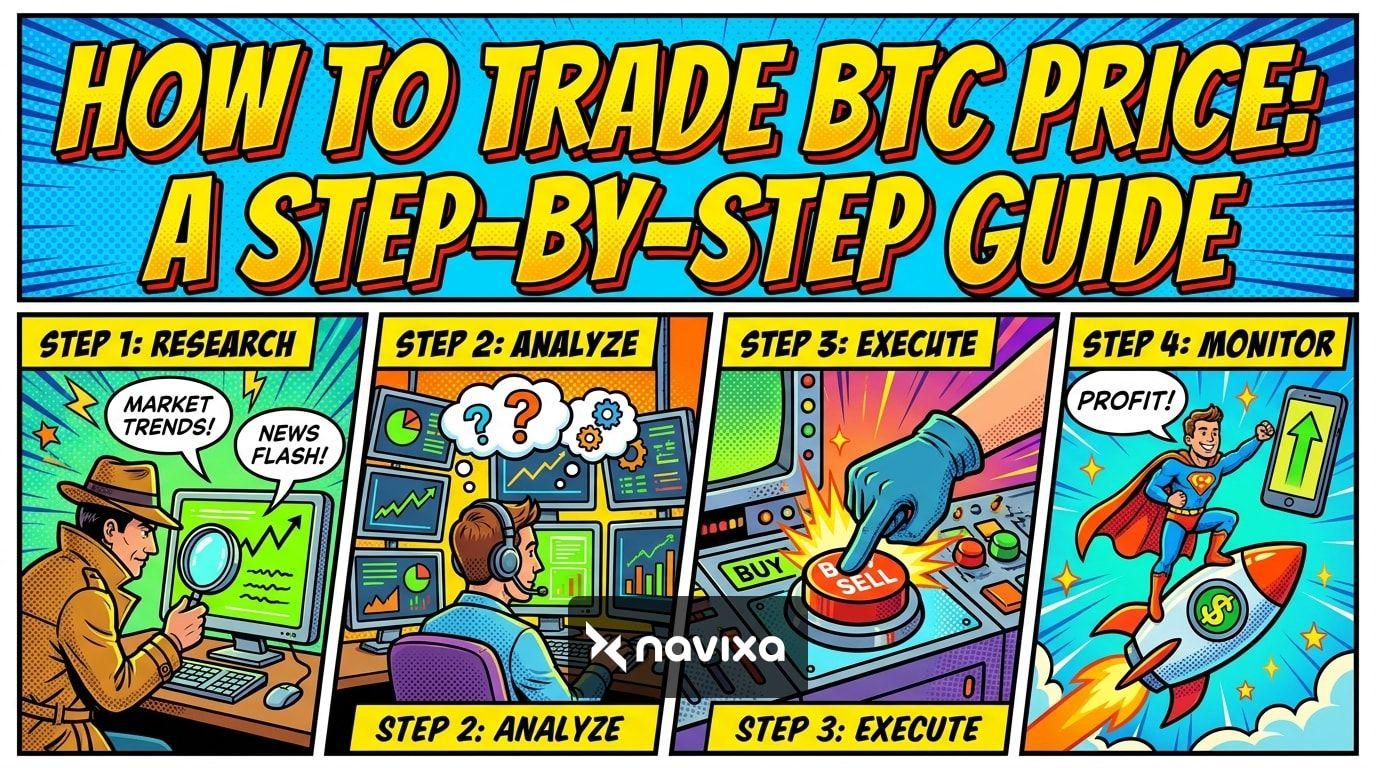
Step-by-Step Strategy to Trade BTC Price
Having the tools and understanding the theory is great, but execution is what separates profitable traders from the rest. Here is an actionable, step-by-step framework to trade BTC price.
Step 1: Establish the Macro Trend
Never trade in a vacuum. Start by looking at the weekly and daily charts to determine the overarching trend. Is Bitcoin making higher highs and higher lows? If so, the macro trend is bullish, and you should ideally look for long setups (buying dips). If the trend is bearish, look for short setups (selling the rallies).
Step 2: Identify Key Liquidity Zones
Drop down to the 4-hour or 1-hour chart to map out your local support and resistance zones. Mark out the areas where the price has recently consolidated or sharply reversed. These are your zones of interest. You are not going to place trades arbitrarily in the middle of a range; you will wait for the price to reach these key levels.
Step 3: Wait for Confirmation
When the price reaches your zone of interest, do not blindly execute a trade. Wait for a confirmation signal. This could be a specific candlestick pattern—like a bullish engulfing candle at support—or a bearish pin bar at resistance. You also want to see an uptick in volume confirming the reaction at these levels.
Step 4: Define Risk and Execute
Before you click the buy or sell button, you must know your exit strategy. Determine exactly where your stop-loss order will be placed (usually just below the support zone or above the resistance zone) and where you will take profit. Once these parameters are set, execute the trade and let the market do the work.
Spot Trading vs. Derivatives
When looking to trade BTC price, you must choose the appropriate financial instrument. The table below highlights the core differences between Spot Trading, Futures Trading, and Options.
| Feature | Spot Trading | Futures Trading | Options Trading |
|---|---|---|---|
| Asset Ownership | You own the actual Bitcoin. | You own a contract representing BTC. | You buy the right to trade at a specific price. |
| Leverage | Typically 1x (no leverage). | High (up to 100x on some exchanges). | Built-in leverage via premium pricing. |
| Risk Level | Low to Moderate. | Extremely High. | High (premium can go to zero). |
| Market Direction | Profit only when price goes up. | Profit in both bullish and bearish markets. | Complex strategies for any market condition. |
For beginners, spot trading is highly recommended. As you build consistency, you can explore derivatives to hedge your portfolio or capitalize on downward price action.
Robust Risk Management Protocols
Even the best trading strategy in the world will fail without strict risk management. Bitcoin's volatility can generate massive profits, but it can wipe out accounts just as quickly.
The 1% Rule
Never risk more than 1% of your total trading capital on a single trade. This does not mean you only buy Bitcoin with 1% of your account. It means the distance between your entry price and your stop-loss should only equate to a 1% loss of your total equity.
Position Sizing
Proper position sizing is mathematical, not emotional. If you have a $10,000 account and are willing to risk 1% ($100), and your stop-loss is 5% away from your entry, you should size your position at $2,000. Understanding this math prevents catastrophic losses during unexpected flash crashes.
Managing Leverage
If you trade futures, treat leverage as a tool, not a lottery ticket. High leverage tightens your liquidation price, meaning even a minor localized wick can force you out of a position. Always use cross margin with caution and stick strictly to isolated margin if you are new to the leverage game.
Macroeconomic Catalysts to Monitor
While technical analysis dictates your exact entries and exits, macro catalysts dictate the broader market environment. Traders must stay informed on external factors:
* ETF Inflows and Outflows: Wall Street's daily accumulation or distribution of Bitcoin through exchange-traded funds has a direct impact on spot market liquidity. Tracking when ETF inflows cool down or accelerate is essential for timing the broader market trends. * Institutional Moves: The ongoing transition of major banks operating as crypto custodians rewires the institutional pipeline. This level of adoption is leading analysts to project ambitious bull-case targets ranging from $170,000 to over $189,000 as long-term market scenarios. * Federal Reserve Policy: Interest rate decisions and inflation data significantly affect risk-on assets. When inflation cools and rates drop, liquidity traditionally flows into Bitcoin.
Practical Takeaways
To effectively trade BTC price, you must detach yourself emotionally from the market. Build a mechanical system based on support, resistance, and volume. Respect the macro trend, utilize proper charting tools, and never compromise on your stop-loss placements. Keep an eye on the broader financial landscape, as traditional finance and cryptocurrency are more intertwined than ever before.
Conclusion
Learning to trade BTC price takes time, patience, and relentless discipline. The market is an unforgiving arena for the unprepared, but a highly lucrative landscape for those who treat it as a profession. By mastering technical analysis, executing step-by-step strategies, and strictly adhering to risk management principles, you can consistently extract value from Bitcoin's legendary volatility. Start on paper, master your emotions, and gradually scale your capital as you build a proven track record.
Frequently Asked Questions
What is the best timeframe to trade BTC price?
The best timeframe depends on your specific trading style. Day traders generally use the 5-minute to 15-minute charts for precise entries, while swing traders rely heavily on the 4-hour and daily charts to capture larger macroeconomic moves. It is highly recommended to use multiple timeframes to get a complete market picture.
Can you trade Bitcoin on weekends?
Yes. Unlike traditional stock markets, the cryptocurrency market operates 24 hours a day, 7 days a week. However, weekend trading volume is typically much lower because institutional players and ETF markets are closed. This lower volume can lead to choppy, unpredictable price action or sudden low-liquidity volatility spikes.
How much capital do I need to start trading Bitcoin?
You can technically start trading with as little as $10 to $50 on most major exchanges due to fractional reserves (you can buy a fraction of a Bitcoin). However, to properly implement risk management rules and withstand trading fees, starting with a base of $500 to $1,000 is generally recommended for serious beginners.
What causes a Bitcoin flash crash?
Flash crashes are typically caused by a cascade of liquidations in the derivatives market. If a large number of traders are highly leveraged on long positions and the price dips slightly, it can trigger automatic sell orders (liquidations). This forces the price down further, triggering more liquidations in a rapid domino effect.
Are Bitcoin trading profits taxable?
Yes, in most jurisdictions, Bitcoin trading profits are subject to capital gains tax. If you buy and sell Bitcoin within a short period, you will typically owe short-term capital gains tax. It is crucial to use tax-tracking software or consult with a certified public accountant to ensure you remain legally compliant in your country.