
Introduction to the Booking Holdings Stock Split
When a massive blue-chip company announces a corporate action, the entire financial landscape pays attention. For decades, Booking Holdings (ticker: BKNG) was known not just for dominating the online travel agency sector with brands like Booking.com, Priceline, Agoda, KAYAK, and OpenTable, but also for its exceptionally high share price. Trading at over $4,200 per share prior to its recent restructuring, the stock was largely out of reach for smaller retail investors and incredibly capital-intensive for options traders.
However, the landscape shifted dramatically with the execution of a historic 25-for-1 forward stock split. This monumental event effectively brought the BKNG share price down into the highly accessible $168 to $200 range, drastically increasing liquidity and unlocking new avenues for active market participants. If you are wondering how to trade the Booking Holdings stock split, you must first understand that this is not merely a cosmetic adjustment to the share price. It represents a fundamental transformation in how retail and institutional capital interacts with the asset.
In this comprehensive guide, we will explore the underlying mechanics of the BKNG stock split, dissect post-split market dynamics, and provide highly actionable trading strategies. Whether you are a swing trader, an options enthusiast, or a long-term investor looking to optimize your entry points, understanding the nuances of this corporate action is vital for your portfolio's success.
Understanding the Mechanics and History of the BKNG Split
To formulate a robust strategy on how to trade the Booking Holdings stock split, traders must first grasp the mechanics and the historical context of the company's stock structure.
The 25-for-1 Forward Split Explained
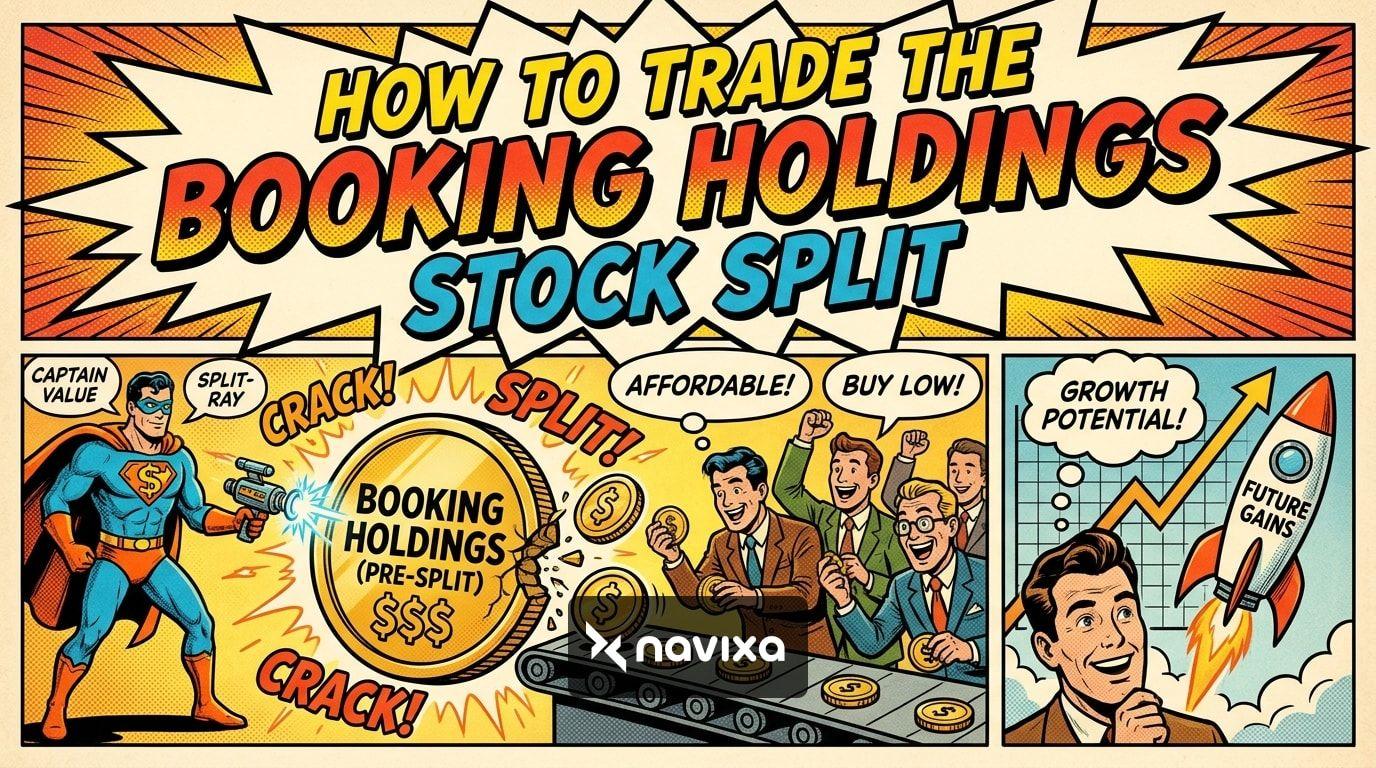
A forward stock split involves a company dividing its existing shares into multiple new shares to lower the trading price of the stock, without altering the company's overall market capitalization or intrinsic value. For Booking Holdings, the 25-for-1 split meant that for every single share an investor held before the effective date, they received 24 additional shares. Consequently, the share price was divided by 25.
"A stock split does not inherently change the valuation of a company, but it significantly alters the behavioral economics of the stock by democratizing access for a broader demographic of investors."
If you held one share of BKNG valued at roughly $4,200, post-split you would hold 25 shares valued at approximately $168 each. The total equity remains exactly the same, but the barrier to entry is completely demolished. The corporate board authorized expanding the common stock pool from 1 billion to 25 billion shares to accommodate this massive shift.
Historical Context: From Survival to Dominance
Interestingly, the 25-for-1 split is only the second stock split in the company's long public history. The first occurred in June 2003, in the aftermath of the dot-com bubble, when the company (then known as Priceline) executed a 1-for-6 reverse stock split. At that time, the reverse split was a defensive maneuver to boost the share price and prevent the risk of delisting from major exchanges.
Fast forward to today, and the forward split is an offensive maneuver. It signals immense confidence from the board of directors, aligning with robust quarterly earnings beats, massive generative AI infrastructure investments, and a strong dividend policy. Understanding this history is crucial because it highlights the fundamental strength underpinning the stock today.
Post-Split Market Dynamics: What Traders Need to Know
When you analyze how to trade the Booking Holdings stock split, you cannot ignore the immediate shifts in market structure that follow such an event. Three primary dynamics emerge:
1. The Surge in Retail Liquidity
High-priced stocks often suffer from lower daily trading volume because retail investors are priced out. While fractional shares have mitigated this somewhat in recent years, many brokerages still do not support fractional limit orders or pre-market/after-hours fractional trading. By lowering the price to the sub-$200 level, BKNG has reopened the door to retail traders who prefer to buy whole shares, execute precise limit orders, and participate in active day trading. This influx of retail capital generally leads to tighter bid-ask spreads and increased intraday liquidity.
2. Options Market Democratization
Perhaps the most profound impact of the stock split is observed in the options market. Standard options contracts represent 100 shares of the underlying asset. Before the split, controlling one BKNG options contract meant controlling over $420,000 worth of stock. This made the premiums exorbitantly expensive, relegating BKNG options exclusively to large institutions and well-capitalized hedge funds. Post-split, a 100-share contract represents roughly $16,800 of underlying stock. This opens up entirely new strategies for retail traders, such as writing covered calls or generating premium through cash-secured puts.
3. Psychological Momentum and the "Split Rally"
Historically, companies that execute significant forward splits often experience a "split rally." This is largely driven by psychological momentum. Even though the fundamental value of the company hasn't changed, human psychology perceives the lower price point as a "discount" or a more attractive entry level. Traders who understand how to trade the Booking Holdings stock split can capitalize on this sentiment-driven momentum. For further reading on the psychological impact of stock splits across various equity markets, consider reviewing Investopedia's guide on stock splits.
Pre-Split vs. Post-Split Comparison
To visualize the sheer magnitude of this corporate action, let's look at a direct comparison of BKNG's market characteristics before and after the 25-for-1 split.
| Metric | Pre-Split Environment | Post-Split Environment |
|---|---|---|
| Approximate Share Price | $4,200.00+ | ~$168.00 - $200.00 |
| Options Contract Underlying Value | $420,000.00+ (Highly Restrictive) | ~$16,800.00 (Highly Accessible) |
| Retail Accessibility | Very Low (Reliant on fractional shares) | Very High (Standard lot purchasing) |
| Bid-Ask Spread Proportions | Generally wider percentage | Generally tighter percentage |
| Corporate Confidence Signal | N/A | Extremely Bullish |
Core Trading Strategies for the BKNG Split
Now that we have established the theoretical groundwork, let's dive into the practical application. Here are three distinct, actionable strategies for trading the newly split Booking Holdings stock.
1. The Post-Split Momentum Play
The most immediate strategy is trading the momentum generated by the newly found liquidity. In the weeks following the effective split date, you can expect elevated volume as institutional algorithms readjust and retail investors initiate new positions.
How to execute: * Identify Support and Resistance: Use shorter-term timeframes (like the 1-hour or 4-hour charts) to map out post-split price action. Because the price scale has changed, historical levels must be mathematically adjusted. * Volume Profile Analysis: Monitor the volume profile. Look for high-volume nodes that act as intraday support. * The Breakout Strategy: If BKNG consolidates in a tight range following the initial split volatility, look for a high-volume breakout above the local resistance. Enter the trade on the confirmed breakout, placing a stop-loss just below the consolidation zone.
2. Options Trading: Covered Calls and Cash-Secured Puts
As mentioned earlier, the split has breathed life into the BKNG options chain for everyday traders. If you are a swing trader or an income-focused investor, this is arguably the best way to trade the Booking Holdings stock split.
The Covered Call: If you are bullish on the travel sector and want to hold BKNG long-term, you can now purchase 100 shares for roughly $16,800 (assuming a $168 share price). Once you own 100 shares, you can sell Out-of-the-Money (OTM) call options against your position. This generates immediate premium income while you wait for the stock to appreciate. If the stock surges past your strike price, your shares will be called away at a profit.
The Cash-Secured Put: If you want to acquire BKNG but feel the current post-split price is slightly too high, you can sell a cash-secured put at a lower strike price. For example, if BKNG is trading at $175, you might sell a $165 put expiring in 30 days. You collect the premium upfront. If the stock drops below $165, you are obligated to buy 100 shares—which was your goal anyway. If it stays above $165, you keep the premium as pure profit.
3. The "Connected Trip" Fundamental Swing Trade
Booking Holdings is not just relying on a stock split to drive value; the company is heavily investing in structural innovations, most notably generative AI and its "Connected Trip" ecosystem. This initiative aims to provide a frictionless, all-in-one booking experience for flights, hotels, rental cars, and restaurant reservations. By building out their hotel networks in Asia and the United States, they are locking in future revenue streams.
How to execute: * Macro Alignment: Align your trades with broader macroeconomic data, specifically global travel volume, consumer discretionary spending, and airline earnings reports. * Position Sizing: Take a medium-to-long-term swing position based on the company's fundamental strength. The increased dividend payout, combined with AI-driven operational efficiencies, provides a strong bullish thesis. * Trailing Stops: As the "Connected Trip" platform scales and reflects in quarterly earnings, use a trailing stop-loss to protect your gains while giving the trade room to breathe. Always stay updated via the Booking Holdings' official investor relations portal for the latest fundamental data.
Risk Management and Technical Analysis
No guide on how to trade the Booking Holdings stock split would be complete without a stern discussion on risk management. While a stock split is generally viewed as a bullish catalyst, it does not immunize the asset from inherent market risks.
Technical Vulnerabilities: Following a stock split, historical charting data is automatically adjusted by charting platforms (like TradingView or ThinkorSwim). However, the psychological moving averages (like the 50-day and 200-day SMA) can sometimes experience a period of "lag" in trader perception. Ensure you are allowing the technical indicators a few weeks of post-split data to normalize before relying on them heavily for highly leveraged swing trades.
Macroeconomic Risks: Booking Holdings operates firmly within the consumer discretionary sector. Its revenue is highly sensitive to global economic health, currency fluctuations, and geopolitical events. If global inflation rises or international travel demand wanes, the stock will face significant downward pressure regardless of how attractive the post-split price currently looks to retail buyers.
Position Sizing: Never allocate more than 2-5% of your total trading capital to a single equity play, no matter how confident you are in the post-split momentum. Implement strict stop-losses, particularly if you are trading short-term intraday breakouts.
Practical Takeaways for Active Traders
To summarize the actionable elements of this comprehensive trading guide:
1. Acknowledge the Liquidity Shift: The massive drop in share price drastically increases liquidity and retail participation. Use this to your advantage by seeking tighter spreads and faster order executions. 2. Explore the Options Chain: The transition from a $400,000+ options barrier to a ~$16,800 barrier is revolutionary for BKNG traders. Look into cash-secured puts for favorable entries and covered calls for sustained income generation. 3. Combine Fundamentals with Corporate Actions: Do not buy blindly just because the stock split occurred. Combine the corporate action with Booking Holdings' strong fundamentals, including their recent Q4 earnings beats, dividend hikes, and aggressive AI expansion strategies. 4. Manage Volatility: Expect elevated volatility in the initial weeks following the effective split date. Trade smaller position sizes until a clear post-split trend and support floor are firmly established.
Conclusion
Learning how to trade the Booking Holdings stock split requires a blend of structural market knowledge, options proficiency, and macroeconomic awareness. The 25-for-1 forward split is a landmark event in the company's history, effectively democratizing access to one of the travel industry's most robust global powerhouses. By employing post-split momentum strategies, utilizing the newly accessible options chain, and maintaining strict risk management protocols, traders can position themselves to capitalize on this unique market event.
The era of $4,200 BKNG shares has officially ended, but an entirely new era of liquidity, accessibility, and strategic trading opportunities has just begun. Evaluate your portfolio, study the split-adjusted technical charts, and execute your trading plan with patience and precision.
Frequently Asked Questions
What was the ratio of the Booking Holdings stock split?
Booking Holdings executed a 25-for-1 forward stock split. This means that for every 1 share an investor owned prior to the split, they received an additional 24 shares, dividing the total per-share price by 25 while keeping the overall market capitalization identical.
Did the stock split change the overall value of the company?
No. A stock split is purely a structural change to the number of outstanding shares and the corresponding price per share. It is often compared to cutting a pizza into more slices; the total amount of pizza remains exactly the same. The company's fundamentals, revenue, and market capitalization remain completely unchanged by the split itself.
Why is the BKNG stock split important for options traders?
Prior to the split, a single standard options contract (representing 100 shares) required controlling over $420,000 worth of underlying equity, making it nearly impossible for average retail traders to participate. Post-split, with the share price significantly lower, the capital required to control 100 shares dropped to a much more accessible level (roughly $16,800). This allows retail traders to employ standard strategies like covered calls and cash-secured puts.
When did Booking Holdings' stock begin trading on a split-adjusted basis?
The stock began trading on a split-adjusted basis at the market open on Monday, April 6, following the post-market distribution of shares on April 2.
Has Booking Holdings ever split its stock before?
Yes, but the circumstances were vastly different. In June 2003, following the dot-com crash, the company (then known as Priceline) executed a 1-for-6 reverse stock split to raise its share price and maintain listing compliance. The recent 25-for-1 forward split is the first forward split in the company's entire history.