
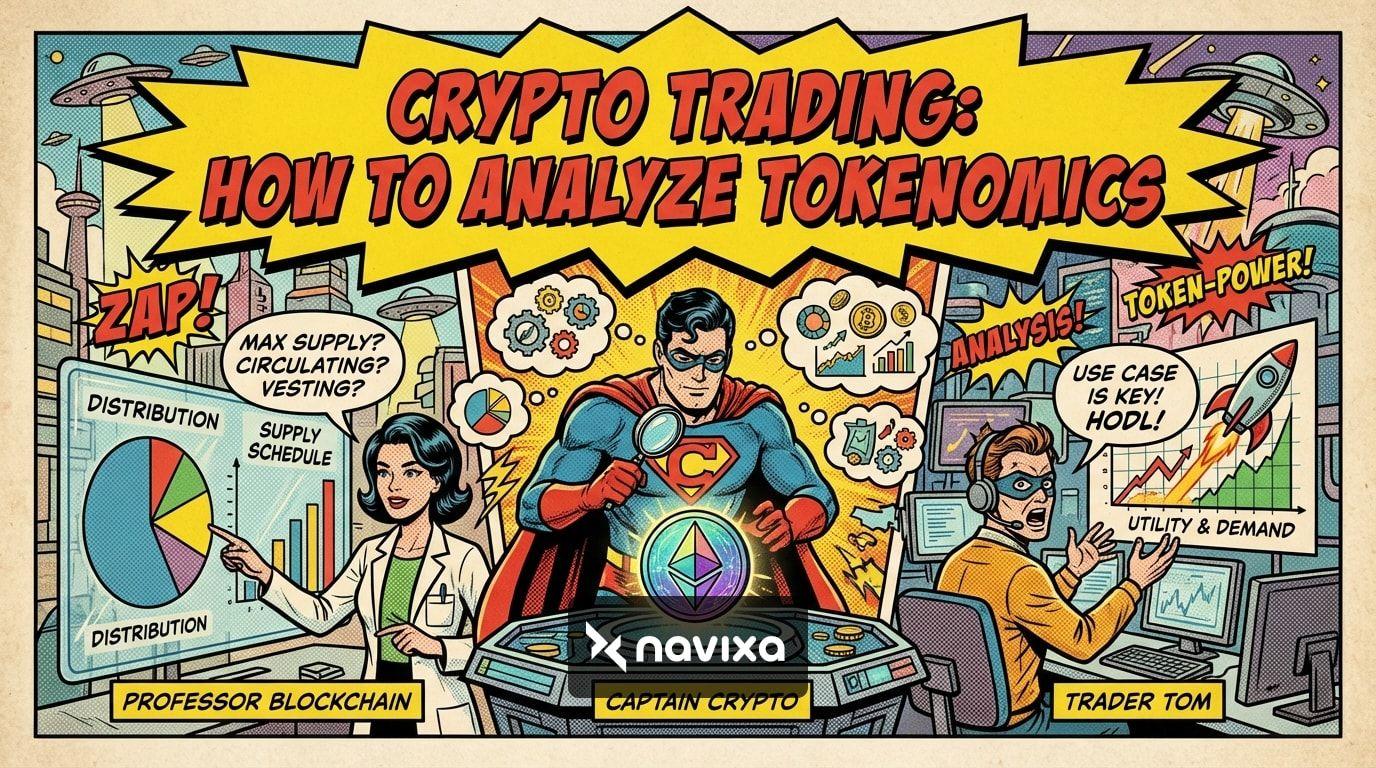
Are you tired of buying into a promising cryptocurrency only to watch its price bleed out over the next few months, despite positive news and a growing community? If so, you might be overlooking one of the most critical aspects of crypto trading: tokenomics.
Understanding how to analyze tokenomics is exactly what separates professional traders from retail investors who rely entirely on hype and emotion. Tokenomics—a clever portmanteau of the words "token" and "economics"—refers to the fundamental, underlying design of a cryptocurrency. It encompasses everything from the initial supply and distribution to the emission schedule, utility, and governance rights associated with the digital asset.
In this comprehensive guide, we will break down exactly how you can evaluate tokenomics to build a more robust crypto trading strategy, effectively manage your downside risk, and spot the next market gems before the broader crowd catches on. Whether you are a day trader looking for short-term catalysts or a swing trader building a long-term portfolio, mastering the mechanics of token supply and demand is non-negotiable for lasting success in the digital asset space.
The Core of a Crypto Trading Strategy: What is Tokenomics?
Before you even think about risking your hard-earned capital on a new digital asset, you must fundamentally understand the economic incentives driving that specific crypto project. Tokenomics dictates the entire lifecycle of a token: how it is initially created, who it is distributed to, how new tokens are introduced into the open market, and how they are eventually removed from circulation.
"Tokenomics is the science of designing the economic incentives that drive human behavior within a decentralized network."
If a digital asset features a mechanism of infinite inflation combined with no real-world utility, early investors and network validators will inevitably dump their accumulating holdings on new, unsuspecting buyers. This is a classic "farm and dump" scenario that has ruined countless portfolios. By actively analyzing these economic structures before you invest, you ensure that you are trading assets with sustainable long-term value architectures rather than short-lived speculative bubbles designed to enrich only the founders.
Key Pillars of Tokenomics Analysis
To truly master how to analyze tokenomics, traders must rigorously evaluate three core pillars: supply dynamics, token utility, and distribution schedules. Missing even one of these pillars can lead to a disastrous investment thesis.
1. Supply Dynamics: Circulating vs. Total Supply
The fundamental relationship between supply and demand is the ultimate driver of a token's market price. When researching a new or existing token, you must look closely at three crucial supply metrics:
* Circulating Supply: This represents the number of tokens that are currently unlocked, in circulation, and available to the general public to trade. This is the supply that directly dictates the current market capitalization. * Total and Maximum Supply: Total supply is the amount of tokens that have already been minted, even if they are currently locked up. Maximum supply is the absolute, hard-coded limit on how many tokens will ever exist in the protocol's history (for example, Bitcoin's famous 21 million hard cap limit). * Market Cap vs. Fully Diluted Valuation (FDV): Market capitalization is simply the current token price multiplied by the circulating supply. FDV, on the other hand, is the current price multiplied by the maximum supply. A token possessing a low market cap but a massively bloated FDV is considered a significant red flag in the industry. It means that heavy future token releases will inevitably and severely dilute the overall value of your current holdings.
2. Token Utility and Demand Drivers
For a cryptocurrency to maintain and grow its value over time, there must be a compelling, fundamental reason for market participants to buy and hold it. If a token's solitary purpose is purely speculative trading, its price action will eventually collapse once the initial hype fades. Strong, sustainable token utility generally falls into several key categories:
* Governance Rights: The ability for token holders to actively vote on crucial protocol upgrades, fee structure changes, or decentralized treasury allocations. * Staking and Yield Generation: The capability to earn passive income by locking up tokens to secure the blockchain network, validate transactions, or provide liquidity to decentralized exchanges. * Network Fee Payments: Utilizing the specific token to pay for transaction costs or smart contract executions, much like how users must hold and spend ETH to cover gas fees on the Ethereum blockchain. * Exclusive Access: Using the token as a digital key to unlock premium features, software tools, or VIP community access within a decentralized application (dApp).
3. Distribution and Vesting Schedules
A critical question every trader must ask is: Who currently holds the tokens, and when are they legally or programmatically allowed to sell them? When a new crypto project officially launches, tokens are rarely distributed equally. Instead, they are often heavily allocated to founding team members, venture capitalists (VCs), angel investors, and early community members through airdrops.
Early institutional investors typically purchase these tokens at a minuscule fraction of the eventual public listing price. If their allocated tokens were to unlock all at once, they would immediately secure their massive profits, causing an overwhelming wave of sell pressure that would decimate the retail market. To mitigate this, projects implement "vesting schedules," which lock tokens for a set period and release them gradually over months or years. Utilizing advanced data platforms like Arkham Intelligence or TokenUnlocks can help you track these crucial vesting schedules, allowing you to anticipate major supply shocks before they reflect on the charts.
Actionable Steps to Evaluate a Crypto Project
If you want to seamlessly integrate tokenomics into your daily trading analysis, you must adopt a systematic approach. Follow these highly actionable steps before initiating a trade:
1. Deep Dive into the Whitepaper: Do not rely on social media threads or unverified summaries. Go directly to the project's official whitepaper or technical documentation. Look for clear, mathematically sound, and transparent documentation detailing exactly how the token sustains its long-term value. 2. Conduct On-Chain Wallet Analysis: Utilize blockchain explorers to verify wallet concentration. Check if a few massive "whale" wallets quietly control an overwhelming percentage of the circulating supply. A high degree of token concentration equates to an astronomically high risk of sudden market manipulation. 3. Monitor Emission Rates and Inflation: Carefully calculate the annual inflation rate of the token. If the token's circulating supply inflates by an aggressive 50% year-over-year, the organic market demand must outpace that massive growth just to keep the token's price trading sideways. 4. Evaluate the Real-World Competitors: Look at similar projects in the same sector. Does the tokenomics structure offer a distinct competitive advantage, or is it merely a poorly copied fork of a more established protocol?
Tokenomics Models Comparison
Understanding the diverse economic models underpinning the crypto ecosystem will significantly elevate your market analysis capabilities. While the exact mechanics can be highly complex, most digital assets utilize one of a few foundational architectures. Here is a clear breakdown of the most common tokenomics models:
| Model Type | Supply Mechanism | Price Impact | Real-World Example |
|---|---|---|---|
| Deflationary | Supply systematically decreases over time through programmed token burns or fee destruction. | Increases asset scarcity, generally acting as a bullish catalyst for long-term price appreciation. | Binance Coin (BNB), Ethereum (ETH post-EIP 1559) |
| Inflationary | Supply continuously and indefinitely increases to reward network miners, validators, or liquidity providers. | Can cause significant and continuous downward price pressure unless directly offset by incredibly high network demand. | Polkadot (DOT), Dogecoin (DOGE) |
| Dual-Token System | Utilizes one core token strictly for governance and investment, alongside a secondary token for day-to-day network utility. | Isolates extreme market volatility, protecting the everyday utility token's purchasing power from speculative trading. | Axie Infinity (AXS & SLP), MakerDAO (MKR & DAI) |
Technical Analysis Meets Tokenomics
A genuinely holistic trading strategy doesn't rely on just one methodology; it actively combines fundamental tokenomics with precise technical analysis. By marrying these two disciplines, traders can unlock incredibly high-probability setups.
For example, if your tokenomics research reveals that a massive venture capital token unlock is scheduled for next Tuesday, you can safely anticipate heavy bearish price action. Traders will often look for a token that is rapidly approaching major overhead resistance levels on the price chart right before this large VC unlock occurs. This potent confluence of fundamental supply overhang and technical price resistance provides an exceptional short-selling opportunity.
Conversely, imagine a token is undergoing a highly publicized, significant "burn" event where millions of tokens will be permanently destroyed. If this token is simultaneously forming a bullish technical breakout pattern—like an ascending triangle—it might aggressively smash through technical resistance due to the sudden, irreversible reduction in circulating supply meeting a spike in retail demand.
Risk Management in Tokenomics Trading
The unspoken golden rule of professional crypto trading is strict capital preservation. Trading assets with inherently poor tokenomics is arguably one of the fastest and most punishing ways to lose money in decentralized financial markets.
To actively practice strict risk management while navigating complex token economies:
* Avoid High-Inflation Tokens in Bear Markets: When overall market liquidity dries up and retail interest wanes, highly inflationary tokens bleed the fastest because there is no fresh capital entering the market to absorb the daily token emissions. * Set Protective Stop-Losses Around Unlock Dates: Historical data proves that volatility violently spikes during significant vesting and unlock events. Always protect your downside by tightening your stop-loss orders as these critical dates approach. * Diversify Across Different Token Models: Do not allocate your entire portfolio to highly experimental, hyper-inflationary yield-farming tokens. Balance your broader portfolio by holding deflationary blue-chip assets that provide a foundational layer of stability.
Practical Takeaways
* Always, without fail, compare a cryptocurrency's current Market Capitalization directly to its Fully Diluted Valuation (FDV) to gauge the true weight of upcoming supply inflation. * Rigorously verify that the token possesses genuine, irrefutable utility within its ecosystem beyond pure, unadulterated speculation. * Actively track all major vesting schedules and unlock cliffs to avoid unknowingly becoming the exit liquidity for early venture capitalists. * Synthesize your fundamental tokenomics analysis with traditional technical chart patterns to optimally time your market entries and strategic exits.
Conclusion
Learning how to analyze tokenomics is no longer just an optional, supplementary skill—it is an absolute, non-negotiable requirement for anyone truly serious about navigating and profiting from crypto trading. By fundamentally understanding intricate supply dynamics, actively tracking institutional vesting schedules, and demanding verifiable token utility, you can effortlessly filter out fundamentally flawed projects. This enables you to focus your capital solely on digital assets that boast sustainable, long-term growth potential.
It is time to stop relying on fleeting social media hype, emotionally driven rumors, and opaque influencer recommendations. Start looking at the hard, unforgiving economic data recorded immutably on the blockchain. Take the time to rigorously research and audit the tokenomics of your current trading portfolio today—your future self will undoubtedly thank you for the financial foresight.
Frequently Asked Questions
What does FDV mean in crypto tokenomics?
FDV stands for Fully Diluted Valuation. It represents the total theoretical market capitalization of a crypto project if its entire maximum supply were currently circulating at the exact current market price. A massive, glaring gap between the current market cap and the FDV mathematically indicates that significant upcoming inflation will eventually dilute the asset's value.
How do token unlocks affect cryptocurrency prices?
Token unlocks systematically introduce new supply into the open, tradable market. If the organic demand for the token does not immediately and proportionally increase to absorb this influx of new supply, the asset's price will naturally drop due to the significantly increased sell pressure from early investors, advisors, or team members finally taking their long-awaited profits.
Where can I find reliable tokenomics data?
You can easily find reliable, baseline token data on reputable aggregator websites like CoinGecko. However, for deeper institutional-level research, you should utilize specialized analytical platforms designed specifically to track complex on-chain data, analyze wallet concentration, and monitor upcoming vesting schedules.
Why is a high circulating supply sometimes better than a low one?
A remarkably high circulating supply relative to the total maximum supply means that the vast majority of the tokens are already actively circulating in the open market. This drastically reduces the looming risk of sudden, aggressive inflation or massive insider dumping, generally making the token's overall price action far more stable and legitimately driven by true organic market demand rather than VC manipulation.