
Introduction
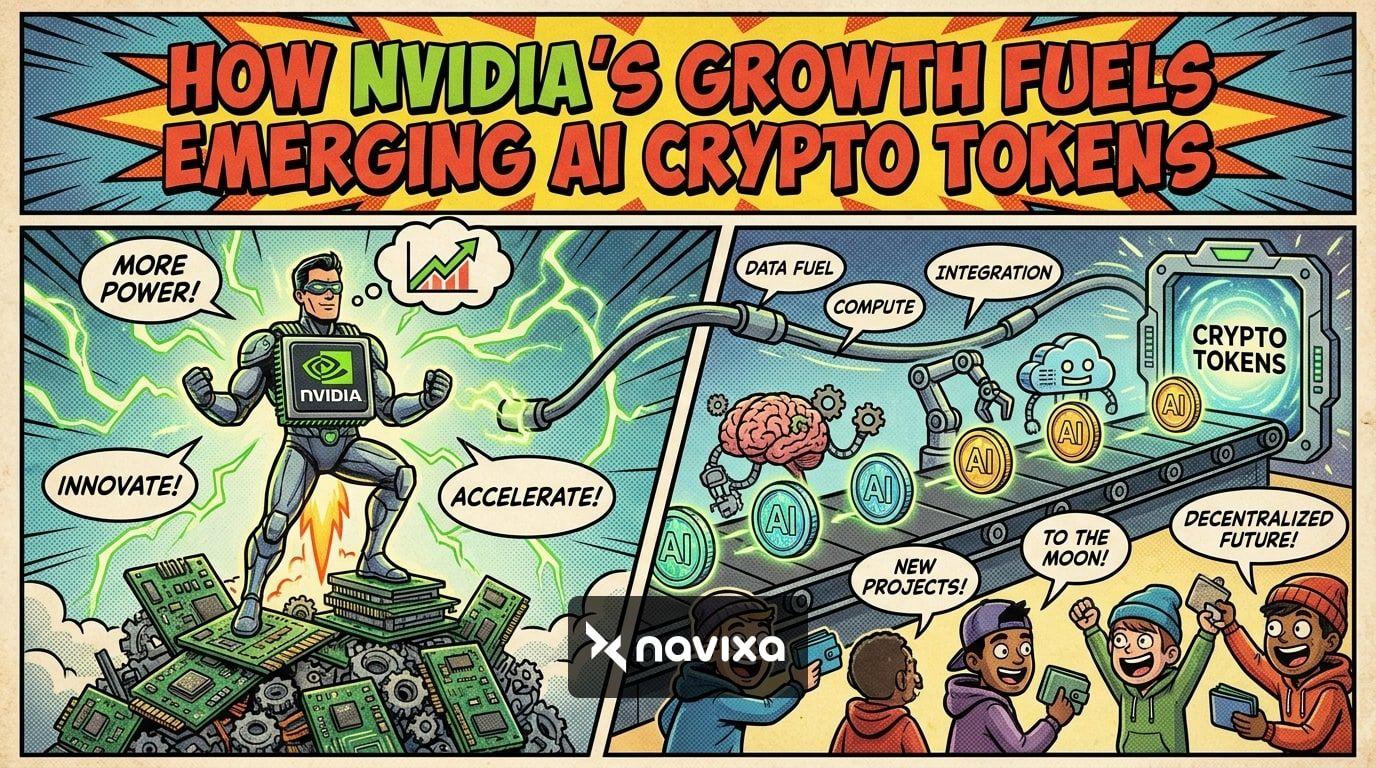
Artificial intelligence is undeniably the defining technological breakthrough of our generation, and the epicenter of this revolution is computational hardware. As traditional financial markets look to silicon manufacturers as the ultimate bellwether for AI demand, a parallel financial ecosystem is quietly absorbing the overflow. By examining recent corporate earnings and shifting market dynamics, we can clearly see how Nvidia's explosive hardware growth fuels the rise of emerging AI crypto tokens.
In its recent fiscal fourth-quarter report, Nvidia posted a staggering $68.1 billion in revenue—a 73% year-over-year increase—bringing its total annual revenue to an unprecedented $215.9 billion. The enterprise world's insatiable appetite for graphics processing units (GPUs) has created massive computational bottlenecks. Major cloud providers and centralized labs are constantly rationing compute power, leading to escalating costs for developers.
This friction has paved the way for decentralized solutions, effectively acting as a macro catalyst for AI crypto tokens. By decentralizing machine learning, visual rendering, and autonomous agent coordination, these blockchain protocols offer a compelling alternative to big tech monopolies. For investors and traders, understanding this symbiotic relationship is critical. The massive capital expenditures by traditional tech giants are trickling down into Web3, turning AI crypto tokens from speculative novelties into robust, revenue-generating infrastructure.
The Core Connection: Nvidia's Hardware and Decentralized AI
The direct link between Nvidia's corporate success and the crypto market lies in the concept of Decentralized Physical Infrastructure Networks (DePIN). As companies race to develop the next iteration of AI models, the demand for processing power has vastly outpaced the supply of centralized data centers. Nvidia's CEO, Jensen Huang, recently projected that the market will see $1 trillion in AI chip demand by 2027.
While centralized entities struggle with long hardware waitlists, decentralized networks leverage blockchain technology to aggregate idle GPU and CPU power globally. When a user holds specific AI crypto tokens, they are essentially participating in a borderless computational marketplace. These tokens act as the medium of exchange, incentivizing hardware owners to plug their idle machines into the network, thereby providing affordable processing power to AI researchers and developers. As Nvidia's growth confirms the world's aggressive pivot toward AI, decentralized networks serve as the necessary pressure release valve for the global hardware crunch.
Deep Dive into Leading AI Crypto Tokens
To capitalize on this sector, traders must separate legitimate infrastructure plays from hype-driven vaporware. By analyzing on-chain utility and market capitalization, several clear leaders emerge.
Bittensor (TAO)
Bittensor has established itself as the premier decentralized machine learning network. Sitting at an approximate $3.4 billion market cap, the network allows specialized AI models to compete across various subnets. Rather than simply promising future tech, Bittensor generated an impressive $43 million in revenue in the first quarter alone. The protocol recently completed "Covenant-72B," the largest Large Language Model (LLM) training run ever executed on a decentralized network. With institutional capital heavily monitoring pending spot ETF filings for TAO, it remains the primary proxy for decentralized AI intelligence.
Render Network (RENDER)
Render addresses the GPU shortage directly by providing a decentralized marketplace for visual computing and AI data processing. Node operators contribute unused GPU capacity and are rewarded in RENDER tokens. Render has processed millions of frames and commands a market cap of over $2.1 billion. As workloads from major companies like OpenAI and other AI labs grow heavier, decentralized rendering provides a fraction-of-the-cost alternative to centralized cloud giants.
Artificial Superintelligence Alliance (FET)
Formed through a historic merger of Fetch.ai, SingularityNET, and Ocean Protocol, the ASI Alliance focuses heavily on "agentic AI". This is the shift from passive AI chatbots to autonomous on-chain agents that can plan, execute, and settle financial transactions on behalf of users. With a market capitalization hovering around $1.8 billion, FET serves as the vital utility token coordinating these digital agents.
Comparison of Top AI Crypto Tokens
Below is a comparison of the top tier tokens leading the decentralized intelligence rotation.
| Token Name | Market Cap (Approx) | Core Utility | Key Market Catalyst |
|---|---|---|---|
| Bittensor (TAO) | $3.4 Billion | Decentralized Machine Learning | Pending ETF filings & Subnet 64 TEE rollouts |
| Render (RENDER) | $2.1 Billion | GPU Compute Marketplace | Deep integration with major AI workloads |
| ASI Alliance (FET) | $1.8 Billion | Autonomous AI Agents | Growth in agent-to-agent on-chain commerce |
| NEAR Protocol (NEAR) | Multi-Billion | Scalable Network Infrastructure | Pivoting to serve as the base layer for AI agents |
Technical Analysis: Charting the AI Rotation
Trading AI crypto tokens requires a synthesis of fundamental tech narratives and rigorous technical analysis. Over recent months, technical setups across this sector have begun to mirror classical breakout formations, heavily influenced by traditional AI equities.
Bittensor (TAO) Price Action
Bittensor has recently faced strong rejection near the $280 to $290 resistance zone, leading to a structural pullback. The asset is currently consolidating around a vital $240 support base. For bullish momentum to safely resume, TAO must definitively reclaim the $260–$280 band. Crucially, open interest in TAO perpetual futures has been rising alongside spot price action, which often signals fresh institutional positioning rather than standard retail short-covering.
Render (RNDR) Momentum
Render's price action shows unique resilience. The token has been actively defending a dynamic rising trendline established in late March, successfully consolidating in the $1.88 to $1.92 range. Traders are closely watching the immediate horizontal resistance at $1.94–$1.95. A high-volume breakout above this level could easily open the path to the $2.00 psychological resistance, fueled by sustained GPU demand narratives.
Trading Strategy: Playing the AI Hardware Narrative
Developing a profitable trading strategy in this niche requires an understanding of cross-market correlations. AI crypto tokens essentially function as high-beta assets tied to Nvidia's momentum and broader enterprise AI spending.
1. Earnings Anticipation Trading: Crypto markets are highly narrative-driven. Traders can position themselves in tokens like TAO and RENDER in the weeks leading up to traditional tech earnings reports. If centralized providers signal extreme demand or hardware constraints, decentralized protocols naturally catch a bid. 2. Breakout Confirmation: Instead of catching falling knives during market corrections, traders should wait for tokens to reclaim structural support. Monitoring platforms like CoinGecko for volume spikes during these reclaim phases ensures you are trading with the prevailing trend. 3. Sector Rotation Tracking: Capital in cryptocurrency moves in cycles. When large-cap assets like Bitcoin consolidate, institutional and retail liquidity frequently rotates into high-conviction narratives. AI is currently the strongest non-monetary narrative in the Web3 space.
Actionable Steps for Investors
If you are looking to integrate AI crypto tokens into your portfolio, systematic execution is required to avoid emotional trading mistakes:
* Allocate Defensively: Despite the powerful narrative, cryptocurrencies remain highly volatile. Limit your dedicated AI token exposure to roughly 5-10% of your total crypto portfolio. This ensures you capture the sector's upside while preserving your baseline capital against sudden macro shocks. * Focus on Revenue Over Hype: Filter out tokens that merely use the phrase "AI" in their marketing. Investigate on-chain metrics to see if the protocol generates real revenue from users purchasing compute or data services. * Diversify Across the Stack: Do not buy just one token. Build a micro-portfolio covering the three pillars of Web3 AI: Compute (Render), Intelligence (Bittensor), and Agent Coordination (FET). * Monitor Institutional Filings: Keep a close watch on traditional financial pipelines. Spot ETF filings for specific altcoins (like TAO) serve as massive structural catalysts that can instantly reprice the asset.
Risk Management in Decentralized AI
While the upside potential is massive, the AI crypto sector is fraught with distinct systemic and technical risks that require rigorous risk management protocols.
First, there is the threat of centralized dominance. Companies like Google, Meta, and Nvidia possess virtually unlimited research budgets. While decentralized networks offer cost advantages, they must constantly fight to prove they can match the latency and reliability of centralized server farms.
Second, security vulnerabilities are evolving. In the decentralized intelligence space, "Data Poisoning" has become a major threat. Malicious actors subtly feed corrupted data into machine learning pipelines to skew AI outputs or bypass smart contract security monitors. Similarly, "All-Green Fraud" exploits automated systems that rely on AI threat detection.
Lastly, tokenomics play a brutal role. Many newer AI crypto tokens suffer from significant supply overhangs and aggressive vesting schedules. Massive token unlocks can severely dilute retail holders, suppressing price action even if the underlying network is growing. Furthermore, it is critical to remember that this exact sector shed nearly $35 billion during speculative market corrections previously, proving that strong narratives do not immunize tokens against steep drawdowns.
Practical Takeaways
The integration of blockchain infrastructure and artificial intelligence is no longer a theoretical whitepaper exercise; it is a measurable, revenue-generating reality. Nvidia's exponential growth confirms a historic shift in global computational needs. As hardware becomes increasingly scarce and expensive, decentralized networks offer a scalable, borderless solution. By carefully analyzing token utility, respecting technical support levels, and adhering to strict risk management, traders can effectively navigate this fast-paced market rotation.
Conclusion
The convergence of artificial intelligence and digital assets represents the most compelling financial frontier of this decade. Nvidia's growth acts as the undeniable bedrock for this movement, highlighting computational gaps that only decentralized networks can currently fill. For proactive investors, emerging AI crypto tokens present an asymmetrical opportunity to participate in the infrastructure of tomorrow. However, success requires moving past the hype—focusing strictly on on-chain revenue, institutional adoption, and robust technical analysis. Explore reputable exchanges, do your own due diligence, and consider positioning yourself in the foundational layers of the decentralized AI economy.
"The transition from centralized server farms to decentralized, token-incentivized computing networks is not just a technological shift; it is a fundamental restructuring of how machine learning will be monetized globally."
Frequently Asked Questions
What are AI crypto tokens?
AI crypto tokens are digital assets built on blockchain networks that directly support artificial intelligence workloads. Unlike general-purpose cryptocurrencies, they serve specific utilities such as decentralizing GPU computing power, incentivizing machine learning models, or coordinating autonomous AI agents.
How does Nvidia's earnings report impact AI crypto tokens?
Nvidia is the primary supplier of AI hardware globally. When Nvidia reports massive earnings and projects heavy future demand, it highlights a global shortage of computational power. This hardware crunch drives developers toward decentralized crypto networks (like Render or Bittensor) that pool idle global computing resources.
What is the safest trading strategy for AI tokens?
Given their volatility, the safest approach involves strict position sizing—allocating no more than 5-10% of your portfolio to the sector. Additionally, traders should employ technical analysis to buy at established structural support levels rather than chasing vertical green candles driven by social media hype.
Are AI tokens safe from standard crypto risks?
No. AI crypto tokens face all standard cryptocurrency risks, including extreme market volatility and regulatory uncertainty. Furthermore, they face unique sector risks, such as token dilution from heavy vesting schedules, severe competition from centralized tech giants, and novel cyber threats like AI data poisoning.
Can AI tokens generate real revenue?
Yes, the leading protocols have transitioned from speculative ideas to functional businesses. For example, decentralized networks like Bittensor generate tens of millions of dollars in quarterly revenue by providing actual machine learning intelligence and computational services to enterprise clients.