
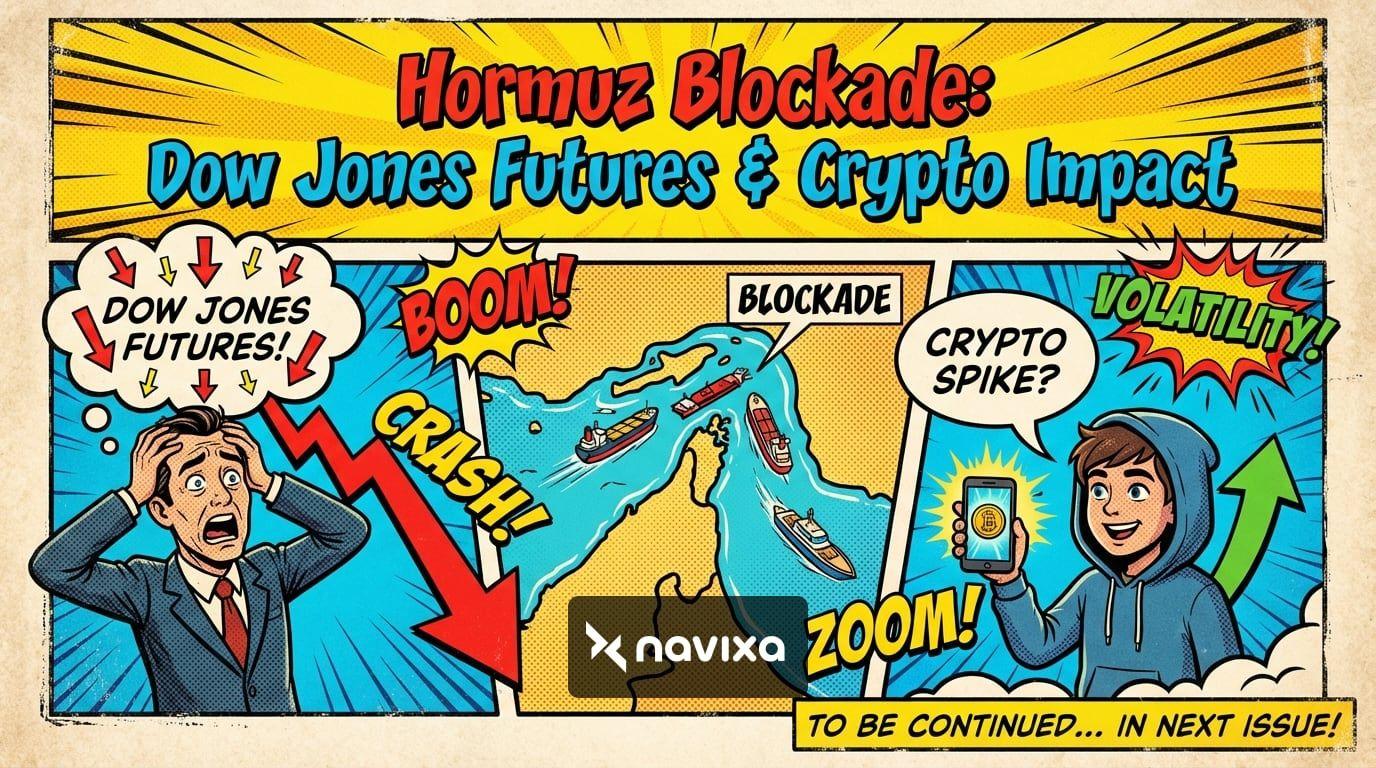
The convergence of global geopolitics, energy crises, and macroeconomic uncertainty has historically created intense volatility across financial markets. However, the recent naval blockade of the Strait of Hormuz has introduced an unprecedented stress test for modern asset classes. The interconnected nature of modern supply chains means that a localized standoff can instantly ripple through trading desks in Wall Street, London, and Tokyo. As crude oil prices breached the $100 per barrel mark and supply chain terrors loomed, the financial ecosystem experienced a fierce whiplash.
At the center of this storm are Dow Jones futures and the cryptocurrency market, two distinct asset classes that have reacted in drastically different ways to the chaos. Following a high-stakes standoff and an 11th-hour two-week ceasefire, the markets remain on edge. Traders are navigating a landscape defined by dramatic liquidations, sudden relief rallies, and the looming specter of persistent inflation.
In this comprehensive guide, we will analyze the geopolitical catalysts driving current market conditions, dissect the technical levels of Dow Jones futures, explore Bitcoin's shocking resilience, and provide actionable trading strategies for risk management during these volatile times.
The Hormuz Blockade: A Global Macroeconomic Shockwave
The Strait of Hormuz is the world's most critical energy chokepoint. Handling approximately 20% of global oil and liquefied natural gas (LNG) exports, any disruption in this corridor acts as a massive tax on the global economy. When military operations and blockades were announced, the energy markets panicked, triggering an immediate ripple effect across all equities.
Energy Spikes and Equity Contagion
The initial news of the blockade sent crude oil prices skyrocketing past $100 a barrel, effectively creating an inflationary shock. Higher energy prices squeeze corporate margins and erode consumer discretionary spending, which instantly damages the fundamental outlook for the industrial and consumer sectors heavily represented in traditional equity indices.
"Geopolitical bottlenecks like the Strait of Hormuz do not just impact energy; they directly reprice inflation expectations, shift central bank rate cut probabilities, and release a wave of risk aversion across equities."
During the peak of the panic, traffic through the Strait plummeted. Reports indicated that a mere 21 vessels transited the corridor over a weekend, a stark contrast to the standard daily volume of 80 to 130 ships. This severe bottleneck highlighted the fragility of the supply chain.
However, an unexpected two-week ceasefire injected a sudden wave of optimism. Oil prices crashed back down below $100, removing the immediate risk premium and providing a temporary sigh of relief for global markets.
Dow Jones Futures: Technical Analysis and Market Sentiment
The intense geopolitical whiplash has been perfectly mirrored in the charts of Dow Jones futures. As the premier indicator for blue-chip American equities, these futures have been the primary vehicle for institutions looking to hedge or speculate on the macro outcome of the Hormuz crisis.
The Anatomy of the Ceasefire Rally
When the news of the two-week ceasefire hit the wires, Dow Jones futures staged an explosive relief rally, surging nearly 2% during early trading sessions. The dramatic drop in crude oil prices lifted the heavy inflationary burden off the shoulders of the industrial sector, prompting algorithmic trading bots and retail investors alike to aggressively buy the dip.
Looking at the technical framework, Dow Jones futures pushed aggressively toward the critical 48,400 to 48,500 resistance zones. However, this bullish momentum quickly met overhead supply. As traders realized the ceasefire was only a temporary patch rather than a permanent resolution, futures retreated to test primary support blocks around 48,100 to 48,000.
Key Support and Resistance Levels
For active traders, the current structure of Dow Jones futures presents both tremendous opportunity and significant risk:
* Immediate Resistance (48,400 - 48,500): This is the psychological and technical ceiling. A daily close above this zone would signal that the market believes the worst of the energy crisis is fully priced in. * Primary Support (48,000): This is the crucial battleground. A break below the 48,000 level would likely trigger a cascade of stop-losses, pushing the index toward the 47,800 or 47,700 technical floors. * Macro Catalyst Wait-and-See: With U.S. Consumer Price Index (CPI) data looming, Dow Jones futures are highly sensitive. A "hot" CPI print combined with renewed Strait of Hormuz fears could easily force a retest of the lower support bounds.
Crypto Market Impact: Bitcoin's Remarkable Resilience
While Dow Jones futures were caught in a violent tug-of-war between inflation fears and ceasefire hopes, the cryptocurrency market showcased a fascinating decoupling. Historically, Bitcoin (BTC) has often traded as a high-beta tech stock, plunging alongside traditional equities during liquidity shocks. However, the Hormuz crisis has painted a remarkably different picture.
The $427 Million Short Squeeze
As traditional markets tumbled on the initial blockade news, over-leveraged crypto traders heavily shorted Bitcoin, assuming an equity contagion. But as the ceasefire was announced and oil prices dropped, Bitcoin held its ground fiercely above the $71,000 mark.
This unexpected strength catalyzed a brutal short squeeze, wiping out approximately $427 million in over-leveraged short positions across major exchanges. Bitcoin’s ability to defend the critical 0.236 Fibonacci support level (around $68,770) while traditional markets panicked is a testament to its maturing status as a global liquidity sponge.
Institutional Inflows and Spot ETFs
The crypto market's resilience is largely underpinned by aggressive institutional adoption. The recent launch of spot Bitcoin ETFs by major traditional finance institutions has structurally altered the market's foundation. With over $150 billion in assets now managed by spot BTC ETFs, the total crypto market cap has stabilized aggressively in the $2.5 trillion to $3.5 trillion range.
The integration of crypto into traditional finance portfolios has forced a re-evaluation of correlation matrices. Unlike the 2021 bull run, which was heavily driven by retail speculation, the current crypto landscape is anchored by enterprise-grade infrastructure and sovereign wealth adoption. As a result, when traditional finance markets face sudden geopolitical blockades, institutional capital no longer indiscriminately dumps Bitcoin. Instead, it is actively utilized to balance the heavy drawdowns seen in indices like the Dow Jones. For more in-depth insights on how global macroeconomic trends impact cross-border liquidity, check out this comprehensive analysis on global financial trends.
Trading Strategies for Navigating the Whiplash
In an environment characterized by 11th-hour geopolitical announcements and massive liquidity sweeps, traditional buy-and-hold strategies can be highly stressful. Traders must pivot toward dynamic, reaction-based methodologies.
1. Range-Bound Mean Reversion for Dow Jones Futures
Given that the ceasefire is temporary, Dow Jones futures are likely to remain trapped in a volatile range. Traders can utilize mean reversion strategies: * Selling into Resistance: If futures spike toward the 48,500 level on empty optimism, scaling into short positions with tight stop-losses above 48,600 can capture the inevitable pullback. * Buying the Support: Accumulating long positions near the 47,800 to 48,000 floor offers a high risk-to-reward ratio, provided the geopolitical situation does not suddenly escalate.
2. Trading the Fibonacci Levels in Crypto
For crypto assets, adhering to strict technical structures is vital. Bitcoin has established a clear battleground around the 0.236 Fibonacci retracement. Traders should watch this level closely: * Breakout Trades: A confirmed break above local resistance at $73,500 could trigger a secondary liquidation cascade, launching the price toward new highs. * Dip Buying: If broader market panic drags BTC down, the $68,770 level serves as a prime zone for spot accumulation, backed by heavy institutional bid walls. To learn more about specific technical indicators and their historical performance, you can read investopedia's guide on technical analysis.
Comprehensive Risk Management
No trading strategy is complete without bulletproof risk management, especially when trading highly leveraged instruments like Dow Jones futures.
Position Sizing and Volatility Adjustments
During periods of elevated geopolitical tension, intraday volatility expands dramatically. Traders must drastically reduce their standard position sizes. A wider stop-loss is necessary to avoid being whipsawed by algorithmic reactions to breaking news alerts, but a wider stop-loss must be paired with smaller capital exposure to keep the total portfolio risk constant at 1% to 2% per trade.
Cross-Asset Hedging
Sophisticated traders are utilizing the current disconnect between equities and crypto to build delta-neutral portfolios. By pairing long exposure in spot Bitcoin with short hedges in vulnerable industrial equities or targeted futures contracts, investors can insulate themselves from direct directional risk while capitalizing on relative asset performance.
Emotional Discipline and Trade Execution
In times of macro uncertainty, the psychological aspect of trading becomes just as critical as technical analysis. The 24-hour news cycle will consistently barrage traders with sensationalized headlines regarding ceasefire breakdowns, naval maneuvers, or emergency Federal Reserve meetings. Succumbing to the fear of missing out (FOMO) or panic selling during a temporary dip is the fastest way to drain an account. Traders must establish clear, pre-defined trading plans before executing a position. If a trade setup on Dow Jones futures requires a specific CPI outcome or a confirmed break of the 48,500 resistance, absolute discipline must be maintained to wait for that confirmation. Reacting to the noise rather than the price action guarantees poor execution.
Asset Comparison: Equities vs. Crypto
To truly understand how the Hormuz blockade has segmented the market, we must compare the immediate reactions and structural foundations of the two primary asset classes.
| Metric | Dow Jones Futures | Bitcoin & Crypto Majors |
|---|---|---|
| Primary Driver | Corporate earnings, inflation, interest rates | Institutional adoption, liquidity cycles, fiat debasement |
| Hormuz Blockade Reaction | Extreme volatility; heavy initial sell-off | Initial consolidation followed by a massive short squeeze |
| Ceasefire Reaction | Sharp 2% relief rally | Stable consolidation above key support ($71,000) |
| Inflation Sensitivity | Highly negative (erodes margins) | Generally positive (acts as a non-fiat hedge) |
| Trading Hours | Near 24/5 (with weekend gaps) | 24/7/365 continuous trading |
Practical Takeaways
* Geopolitics Rule the Tape: The two-week ceasefire at the Strait of Hormuz has created a temporary reprieve, but the fundamental supply chain threat remains unresolved. * Watch the Floors and Ceilings: Dow Jones futures are heavily bound between 48,000 support and 48,500 resistance. Breakouts from this zone will likely dictate the macroeconomic trend for the quarter. * Crypto is Maturing: The liquidation of $427 million in crypto shorts combined with Bitcoin's defense of the $71,000 level proves that digital assets are evolving into robust, institutional-grade safe havens during geopolitical crises. * Strict Risk Controls are Mandatory: With CPI data prints and ongoing Middle Eastern negotiations, sudden intra-day price shocks are highly probable. Reduce leverage and widen invalidation levels.
Conclusion
The naval blockade at the Strait of Hormuz and the subsequent 11th-hour ceasefire have delivered a stark reminder of how rapidly global markets can turn. While Dow Jones futures remain heavily tethered to the volatile realities of crude oil supplies and inflation metrics, the cryptocurrency market is demonstrating an unprecedented level of independence and strength.
As the global financial system waits to see if the ceasefire holds or if the energy crisis deepens, traders must prioritize capital preservation over aggressive speculation. By respecting key technical levels, acknowledging the macro catalysts, and deploying strict risk management protocols, investors can successfully navigate this geopolitical storm.
Ready to refine your edge in this volatile market? Stay closely tuned to breaking macroeconomic data, continuously adjust your technical support zones, and ensure your portfolio is diversified across uncorrelated asset classes.
Frequently Asked Questions
Why did Dow Jones futures react so violently to the Strait of Hormuz blockade?
The Strait of Hormuz is a vital global chokepoint that handles around 20% of the world's oil exports. A blockade causes an immediate spike in crude oil prices, which acts as an inflationary tax on the economy. This crushes corporate profit margins and consumer spending, leading institutions to heavily sell off traditional equities, directly tanking Dow Jones futures.
Is Bitcoin acting as a safe-haven asset during this crisis?
Yes, recent price action suggests a maturing role for Bitcoin. While traditional equities panicked over energy-driven inflation and supply chain disruptions, Bitcoin held strong above $71,000. Institutional inflows from newly launched spot ETFs have provided massive structural support, allowing BTC to act as a hedge against geopolitical instability.
What are the most important technical levels for Dow Jones futures right now?
Active traders are closely monitoring the critical support zone at 48,000. A break below this could trigger a steep decline toward 47,800. On the upside, resistance sits between 48,400 and 48,500. A daily close above this level is required to confirm a sustained bullish reversal.
How does the two-week ceasefire affect my trading strategy?
The temporary nature of the ceasefire means that geopolitical risk has been delayed, not eliminated. Traders should avoid heavy directional bias and instead focus on range-bound trading—buying near established support and selling near resistance—while maintaining tight stop-losses in case negotiations suddenly collapse.
How do energy prices impact the correlation between crypto and stocks?
Historically, high energy prices forced central banks to raise interest rates, hurting both stocks and crypto. However, massive institutional adoption and ETF integration have allowed crypto to partially decouple. While sustained oil shocks heavily pressure industrial stocks and Dow Jones futures, Bitcoin is increasingly viewed by institutions as "digital gold," maintaining its value even when traditional equities suffer.