
Introduction: The Mental Game of Trading HOOD
When discussing modern financial markets, few companies provoke as much emotion, debate, and retail enthusiasm as Robinhood Markets Inc. (NASDAQ: HOOD). Since its inception, Robinhood has been at the epicenter of the retail investing revolution, making it a cultural and financial battleground. However, investing in the platform's own equity requires a deep understanding of HOOD stock trading psychology. Because the company's revenue and market sentiment are heavily tied to the behavior of retail traders, cryptocurrency cycles, and broader macroeconomic conditions, trading HOOD is uniquely challenging.
In this comprehensive guide, we will explore the intricate dynamics of HOOD stock trading psychology, examine the behavioral biases that trip up novice investors, and provide actionable risk management strategies to help you maintain a strategic edge in volatile markets.
The Robinhood Phenomenon and Current Market Reality
To understand the psychology behind trading HOOD, we must first look at the stock's historical and current context. Robinhood became a household name during the 2020 and 2021 meme stock frenzy, positioning itself as a democratizing force in finance. The platform's gamified interface, commission-free trading, and accessible options and cryptocurrency markets brought millions of new participants into the financial ecosystem.
However, the reality of the market is ever-shifting. Fast forward to early 2026, and HOOD has experienced significant turbulence. Following a massive run-up to highs near $152 in late 2024 and 2025—fueled by a resurgence in cryptocurrency trading and new product rollouts—the stock faced a stark correction, dropping roughly 39% year-to-date in early 2026. This decline was largely driven by a sluggish cryptocurrency market, highlighted by a 38% fall in crypto transaction revenue in the fourth quarter of 2025, and broader macroeconomic pressures on equities.
In a move to signal long-term confidence, Robinhood's board approved a massive $1.5 billion share buyback program in early 2026. Furthermore, to fortify its capital position, the company secured a new $3.25 billion revolving credit facility led by JPMorgan. For traders, these wild price swings and major corporate actions create the ultimate testing ground for trading psychology.
Decoding HOOD Stock Trading Psychology
Why is HOOD stock trading psychology so unique? The answer lies in the asset's underlying business model. Robinhood's financial health is directly correlated with retail trading volume. When retail investors are euphoric, trading heavily in speculative options and cryptocurrencies like Bitcoin and Ethereum, Robinhood's revenues soar. Consequently, HOOD stock often acts as a proxy for retail market sentiment.
Attention-Induced Trading
Research into retail trading apps has highlighted a phenomenon known as "attention-induced trading". Traders flock to assets that are dominating the news cycle or social media feeds. Robinhood users are known to account for a massive percentage of daily trades among retail brokerages, and their collective action can rapidly move the market. Because Robinhood itself is frequently in the news—whether for launching its own Ethereum layer-2 network, securing massive credit facilities, or announcing stock repurchases—it frequently becomes the target of extreme attention-induced trading.
For the individual trading HOOD stock, this means you are often competing against extreme momentum. When the crowd rushes in, the price can become detached from fundamental valuations. When the crowd panics, the sell-offs can be equally exaggerated. Mastering the psychology here means learning to fade the crowd when euphoria peaks and finding the courage to buy when the herd is fleeing.
Core Behavioral Biases Affecting HOOD Traders
Every trader carries cognitive biases, but the volatile nature of HOOD stock tends to amplify these mental traps. Recognizing these biases is the first step toward neutralizing them.
1. The Fear Of Missing Out (FOMO)
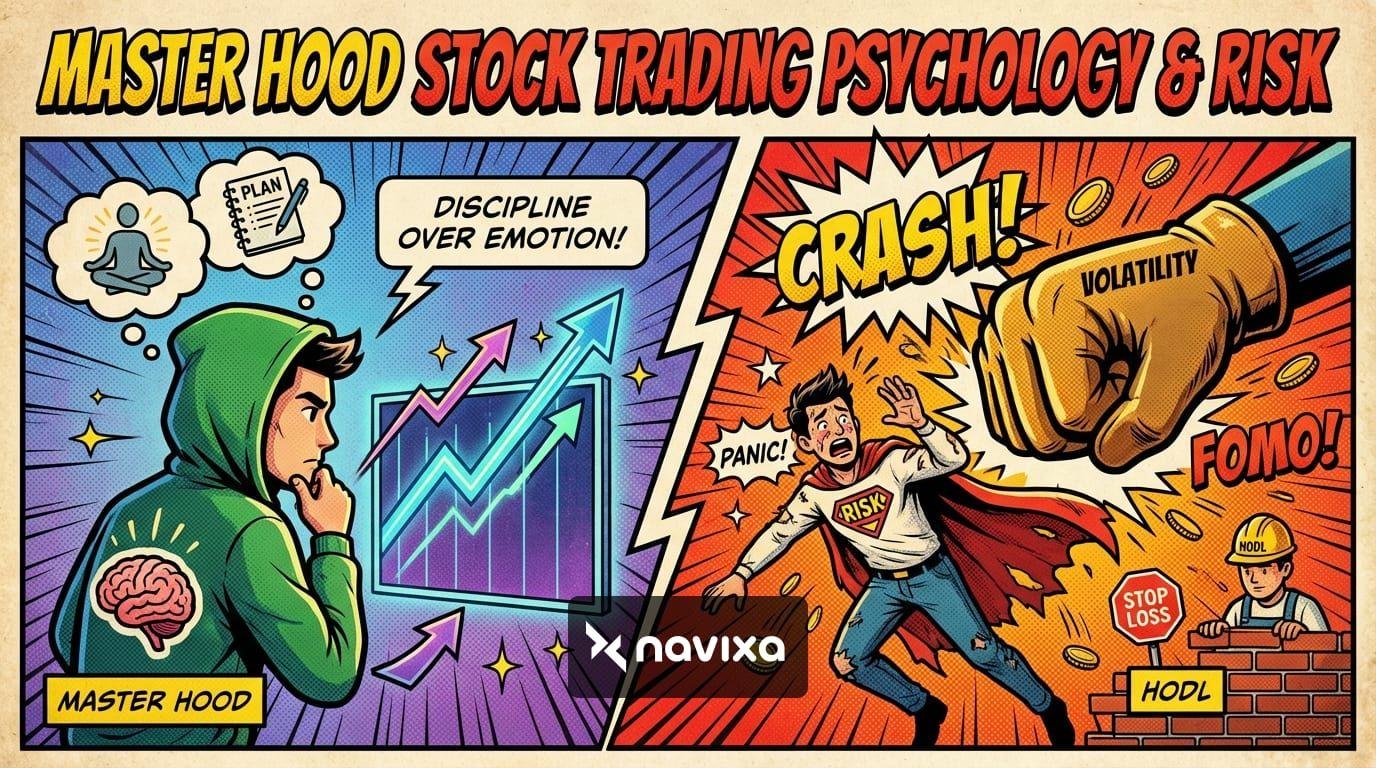
FOMO is perhaps the most notorious psychological trap in retail investing. When HOOD stock rallies aggressively, traders often abandon their strategies and buy at the top, terrified of missing the next leg up. FOMO clouds rational judgment, causing traders to ignore critical metrics like relative valuation or technical resistance levels.
2. Anchoring Bias
Anchoring occurs when a trader fixes their mind on a specific price point. For instance, an investor might look at HOOD's past all-time high of over $152 and anchor their expectations to that number, believing that at $70, the stock is automatically "cheap". While the stock may indeed offer value, relying solely on an old high ignores current market conditions, revenue headwinds, and macroeconomic shifts.
3. Loss Aversion and the Disposition Effect
Psychological studies show that the pain of losing money is twice as intense as the joy of making it. This leads to the disposition effect: traders sell their winning positions too early to lock in profits, but hold onto losing positions far too long, hoping they will bounce back. When HOOD stock entered its 39% slide in early 2026, many traders likely held on as their portfolios bled, paralyzed by the psychological pain of realizing a loss.
4. Recency Bias
Recency bias is the tendency to expect that whatever has happened recently will continue indefinitely. During a bull run, traders think the stock will go up forever. During a sharp decline, they believe it will plummet to zero. Overcoming recency bias requires zooming out, analyzing long-term charts, and maintaining a focus on the company's underlying fundamentals.
Strategic Risk Management for HOOD Stock
Mastering HOOD stock trading psychology is impossible without a robust risk management framework. Psychological discipline is significantly easier to maintain when you know your downside is protected.
Position Sizing
Never risk more than 1% to 2% of your total trading capital on a single trade. Because HOOD is susceptible to sudden, gap-down moves based on crypto market volatility or regulatory news, an outsized position can trigger panic. Proper position sizing keeps emotions in check, allowing you to make rational decisions even when the stock moves against you.
Utilizing Stop-Losses
A stop-loss order is a pre-determined exit point. Setting a stop-loss removes the emotional burden of deciding when to sell a losing position. If your thesis on HOOD is invalidated—for example, if it breaks a key technical support level on high volume—the stop-loss ensures you exit the trade before a minor loss turns into a catastrophic one.
Understanding Crypto Correlations
You cannot trade HOOD stock effectively without keeping an eye on the cryptocurrency markets. A significant portion of Robinhood's transaction-based revenue stems from crypto trading. If Bitcoin and Ethereum enter a bear market, Robinhood's bottom line is directly impacted. By monitoring global crypto trends via resources like CoinMarketCap, you can anticipate potential headwinds or tailwinds for HOOD stock and adjust your risk accordingly.
Technical Analysis Meets Trading Psychology
Technical analysis is often viewed as a purely mathematical endeavor, but in reality, charts are visual representations of human emotion. Support and resistance levels represent psychological battlegrounds between buyers (greed) and sellers (fear).
The Psychology of Support and Resistance
When HOOD stock approaches a major round number, such as $70 or $100, these levels act as psychological barriers. Retail traders naturally gravitate toward whole numbers for entry and exit points. If HOOD stock approaches a major support line during a broader market sell-off, a battle ensues. If buyers step in, it indicates that the perceived value outweighs the fear. If it breaks below, fear has overtaken the market.
Volume as an Emotional Indicator
Price action without volume is like a car without an engine. When HOOD stock rallies on low volume, the conviction is weak. Conversely, a massive sell-off accompanied by extreme volume indicates widespread panic and capitulation. By learning to read volume alongside price action, you can gauge the emotional state of the broader market and position yourself accordingly. For deeper insights into managing trader mindset, explore resources on Investopedia.
Comparing Trading Mindsets
To thrive when trading volatile equities like Robinhood, you must shift from a gambling mindset to a strategic investing mindset. The table below outlines the core differences.
| Trait | Retail Gambler Mindset | Strategic Investor Mindset |
|---|---|---|
| Entry Motivation | Social media hype, FOMO, chasing green candles | Technical setups, fundamental valuation, clear strategy |
| Risk Management | All-in on a single trade, no stop-loss | 1-2% risk per trade, strict use of stop-loss orders |
| Reaction to Losses | Averages down out of desperation, revenge trades | Accepts the loss, reviews the trading journal, moves on |
| Market Correlation | Ignores macro trends and crypto market influence | Monitors Bitcoin prices and SEC regulations closely |
| Patience | Needs constant dopamine, overtrades daily | Waits for high-probability setups, comfortable in cash |
Actionable Steps to Master HOOD Stock Trading Psychology
Achieving emotional mastery in the markets does not happen overnight. It requires deliberate practice, self-awareness, and strict adherence to a trading plan.
1. Maintain a Detailed Trading Journal
A trading journal is your ultimate psychological mirror. Record not only your entry and exit points but also your emotional state at the time of the trade. Were you feeling anxious? Euphoric? Bored? Over time, reviewing your journal will reveal destructive emotional patterns, allowing you to course-correct.
2. Embrace Emotional Detachment
The market does not know you exist, and it certainly does not care about your financial goals. Treat your trades as business transactions. If HOOD stock hits your stop-loss, it is not a personal failure; it is simply a business expense. Emotional detachment allows you to execute your strategy with robotic precision.
3. Develop a Multi-Scenario Plan
Before entering a trade on HOOD, write down exactly what you will do if the stock goes up, if it goes down, and if it trades sideways. When you have a pre-defined plan for every possible outcome, you eliminate the need to make stressful, on-the-fly decisions during live market hours.
4. Limit Social Media Consumption
While social platforms can be excellent sources of rapid news, they are also echo chambers of extreme emotion. During a HOOD stock rally, social media will convince you it is "going to the moon." During a crash, it will convince you the company is doomed. Limit your exposure to financial social media to protect your mental clarity.
Conclusion: Thriving in the Robinhood Ecosystem
Mastering HOOD stock trading psychology is a journey of self-discovery and rigorous discipline. Robinhood is a highly dynamic company, intricately linked to the fast-paced worlds of retail trading and cryptocurrency. This inherent volatility provides massive opportunities for the prepared trader and devastating risks for the impulsive gambler.
By understanding your cognitive biases, implementing strict risk management protocols, and reading the psychological landscape of the charts, you can transform market volatility from a source of anxiety into a source of consistent profitability. Remember, the ultimate battle in trading is never against the market—it is always against yourself.
---
Frequently Asked Questions
What drives the high volatility in HOOD stock?
HOOD stock experiences high volatility because its revenue model is deeply tied to retail trading volumes and cryptocurrency markets. When retail enthusiasm peaks, transaction revenues surge, driving the stock up. Conversely, during market downturns or "crypto winters," revenues can drop sharply, causing significant sell-offs.
How do cryptocurrency markets affect Robinhood's stock price?
Robinhood generates a substantial portion of its transaction revenue from crypto trading. Therefore, major price movements in assets like Bitcoin and Ethereum directly impact the company's bottom line. A bullish crypto market generally acts as a powerful tailwind for HOOD stock, while a bearish crypto market exerts downward pressure.
Why is trading psychology so important for retail stocks like HOOD?
Retail-heavy stocks are highly susceptible to emotional trading, social media hype, and herd mentality. Understanding trading psychology helps you avoid falling into behavioral traps like FOMO or panic selling, allowing you to capitalize on the irrational decisions made by the broader retail crowd.
How does Robinhood's $1.5 billion stock buyback impact investor sentiment?
The large stock buyback program authorized in early 2026 was designed to signal management's confidence in the company's long-term value, especially after a significant year-to-date decline. For investors, buybacks reduce the overall share count, potentially supporting the stock price and improving earnings per share, which can positively shift market psychology.
What is the best way to manage risk when trading HOOD?
The most effective risk management strategy involves strict position sizing (risking no more than 1-2% of your account per trade), setting firm stop-loss orders to protect your capital, and maintaining awareness of macroeconomic factors and crypto correlations that could trigger sudden price gaps.