
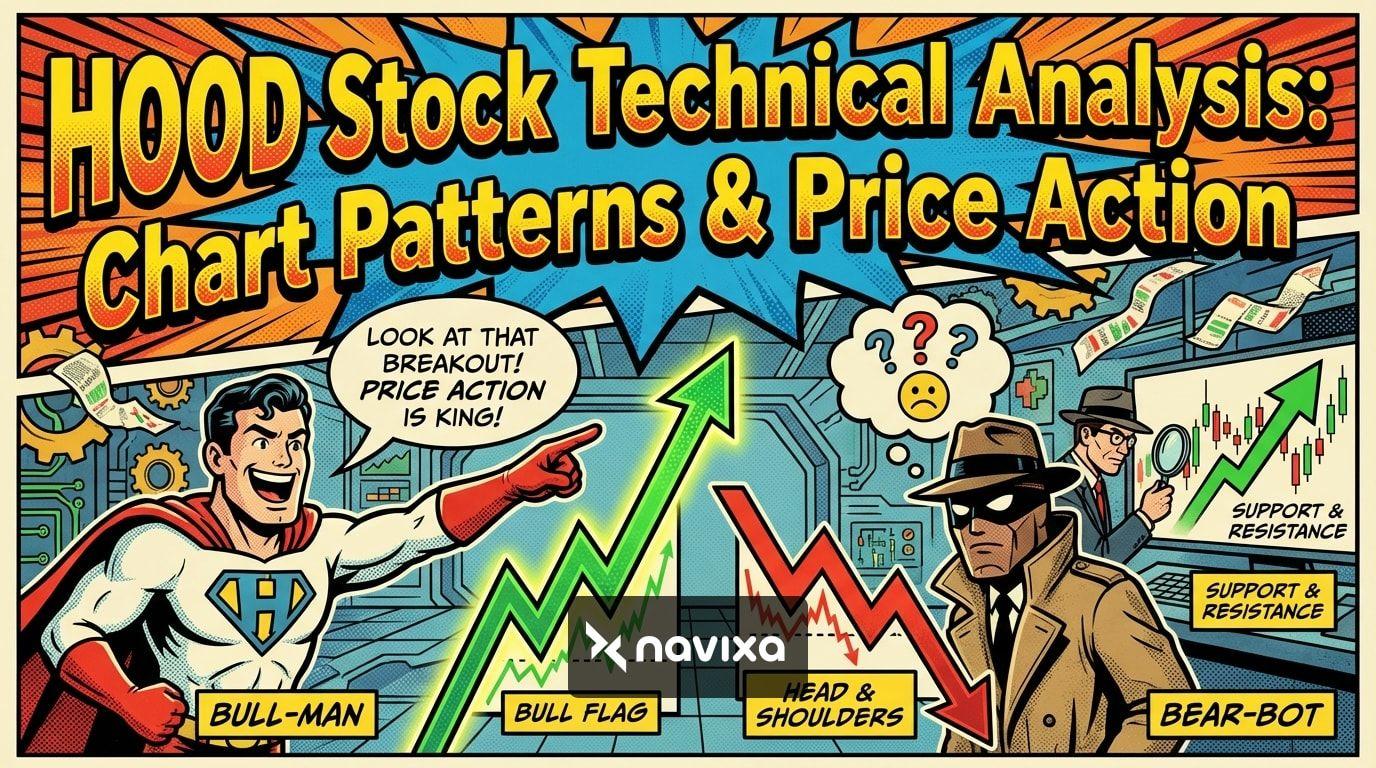
HOOD Stock Technical Analysis: Chart Patterns & Price Action
The intersection of decentralized finance, cryptocurrency, and retail stock trading has crowned Robinhood Markets Inc. (NASDAQ: HOOD) as a bellwether for retail market sentiment. Recently, the stock has experienced significant volatility and upside momentum, successfully breaking out of a prolonged consolidation phase. For active swing traders, day traders, and long-term equity investors alike, executing a comprehensive HOOD stock technical analysis is the cornerstone of navigating this dynamic price action.
Whether you are looking to enter a new position, manage an existing portfolio, or simply understand the macroeconomic forces currently driving FinTech equities, analyzing HOOD's chart patterns offers unparalleled insights. In this expert guide, we will break down the current technical structure of Robinhood's stock, examine its critical moving averages, analyze overbought and oversold oscillators, and outline highly actionable trading strategies strictly tailored to the current market environment.
Understanding HOOD Price Action & Market Sentiment
Before diving into the granular chart patterns, it is crucial to contextualize the recent price action. Technical analysis does not exist in a vacuum; it is deeply intertwined with market sentiment, fundamental business catalysts, and broader macroeconomic trends.
The Breakout Catalyst
Recently, HOOD experienced a powerful breakout, surging over 10% on heightened volume and trading near the $78 to $79 range. This upward trajectory was not purely coincidental but was directly fueled by several converging catalysts that forced short-sellers to cover and brought institutional buyers off the sidelines:
* Crypto Market Recovery: Robinhood's operational metrics are intimately tied to cryptocurrency trading volumes. A broader rally in digital assets has significantly lifted retail engagement and notional trading volumes on the platform. When Bitcoin and top altcoins surge, Robinhood acts as a high-beta proxy for the sector. * Share Repurchase Authorization: The board recently authorized up to $1.5 billion in share repurchases. In financial markets, buybacks function as a massive backstop for the stock, reducing the outstanding share float and signaling leadership's supreme confidence in the company's valuation. * Prediction Markets Expansion: Robinhood has leaned heavily into event contracts and prediction markets, which has quickly emerged as one of its fastest-growing segments. However, the company recently tightened access to certain higher-risk contracts to mitigate insider trading and manipulation risks, opting to partner exclusively with regulated venues like Kalshi and ForecastEx to ensure platform integrity.
"Robinhood's recent operating updates showed rising crypto notional volumes, funded customer growth and net deposits. Investors are also focusing on the board's authorization of up to $1.5B in share repurchases, which acts as a capital-return signal."
Analyst Sentiment and Price Targets
The technical momentum is further supported by Wall Street analysts adjusting their models. For instance, Sanford C. Bernstein reiterated an "Outperform" rating with a bullish price target of $130, driven by the crypto recovery and anticipated revenue generation from the aforementioned new product lines. Conversely, Truist adjusted its target to $100 but maintained a Buy rating, specifically noting that the recent consolidation around $70 provided an attractive entry point for buyers. These varying but generally optimistic analyst revisions create a battleground between bulls and bears, which manifests as volatile, tradable price action on the daily charts.
Core HOOD Stock Technical Analysis & Chart Patterns
A robust HOOD stock technical analysis requires examining multiple timeframes and overlaying various indicators to confirm structural market trends. Here is a detailed breakdown of the primary technical components currently dictating Robinhood's market behavior.
Moving Averages: Establishing the Trend
Moving averages (MAs) smooth out erratic price data to identify the overarching direction of the trend. Currently, HOOD is demonstrating a classic uptrend structure characterized by higher highs and higher lows on the daily and weekly charts.
* Short-Term Momentum (50-Day SMA): The 50-day Simple Moving Average is currently trailing near the $74.90 mark. The stock's ability to cleanly break above and consistently sustain trading above this crucial level acts as a strong bullish signal. This moving average is now serving as dynamic support; pullbacks to this region are actively bought by algorithms and retail traders seeking trend-following entries. * Long-Term Context (200-Day SMA): Longer-term indicators, such as the 200-day moving average, historically act as a pivot point for major institutional repositioning. Diverging data points suggest the 200-day SMA is trailing significantly lower, emphasizing how fast and steep the recent breakout has been. A sustained presence above longer-term averages overwhelmingly confirms a transition from a bearish or neutral phase into a confirmed bull market.
Oscillators: Momentum and Reversals
Oscillators are mathematically driven technical tools that are critical for timing entries and exits, especially in high-beta momentum stocks like Robinhood.
* Relative Strength Index (RSI): The Relative Strength Index is a momentum oscillator that measures the speed and change of price movements on a scale of 0 to 100. The 14-day RSI for HOOD recently touched 74.74. Traditionally, an RSI reading above 70 indicates that the asset is becoming overbought. While an overbought reading in a strong, catalyst-driven uptrend can persist as momentum carries the stock higher, it simultaneously serves as a warning sign that a short-term pullback or sideways consolidation is highly probable. * MACD (Moving Average Convergence Divergence): The MACD indicator has registered a bullish crossover. The MACD histogram expanding in positive territory validates the sheer strength of the current breakout, indicating that buyers firmly outnumber sellers. However, astute traders should persistently watch for any narrowing or flattening of the histogram, which would mathematically suggest that the upward momentum is decelerating.
Support and Resistance Levels
Identifying horizontal support and resistance lines is the bedrock of any actionable HOOD stock technical analysis.
* Immediate Support: The primary support zone sits between $70 and $72. This block was the impenetrable ceiling of the previous consolidation channel. In technical analysis, it is a cardinal rule that prior resistance, once decisively broken, becomes new structural support. * Overhead Resistance: The next major psychological and structural resistance level is $80. If HOOD can clear this hurdle on above-average volume, the algorithmic trading door opens for a swift run toward the $90 to $100 range, closely aligning with Wall Street's moderate to bullish price targets.
Actionable Trading Strategy for Robinhood Stock
Understanding the technical indicators is only half the battle; executing a structured trading plan is what separates consistently profitable professionals from novices. Depending on your personal risk tolerance and time horizon, there are two primary actionable strategies to consider based on the current chart structure.
1. The Pullback Entry Strategy
Given the elevated RSI reading that places the stock firmly in overbought territory, aggressively chasing the stock after a 10% daily surge can be an unnecessarily risky endeavor. The pullback strategy involves exhibiting patience and waiting for the initial enthusiasm to cool off.
* Entry Zone: Place limit buy orders systematically in the $72 to $75 range. This directly aligns with the 50-day moving average and the top of the previous breakout zone. * Stop-Loss: A strict stop-loss order should be placed just below the $68 level. A daily candlestick close below this mark completely invalidates the bullish breakout thesis. * Target: The initial profit target would be a retest of the recent swing highs near $79 to $80, with a secondary, long-term target at the $90 level.
2. The Momentum Breakout Strategy
For aggressive momentum traders who believe the cryptocurrency market resurgence and the upcoming late April earnings report will act as immediate jet fuel, a momentum breakout strategy might be more suitable.
* Entry Trigger: Initiate a long position only if the stock prints a strong daily close above the $80 psychological resistance level on trading volume that distinctly exceeds the 30-day average. * Stop-Loss: Place a trailing stop 5% below the entry price. This protects trading capital against sudden, algorithmic "fake-out" reversals. * Target: Ride the momentum aggressively toward the $100 target zone, dynamically raising the stop-loss to breakeven as the stock climbs higher.
For more comprehensive insights into broader market volume data and sector performance, traders regularly cross-reference stock performance via the NASDAQ Official Website. Additionally, keeping a diligent eye on official company filings and insider trading disclosures is highly recommended; you can seamlessly find these primary documents through the SEC Edgar Database.
Risk Management in FinTech Trading
FinTech stocks, particularly those intimately tethered to decentralized cryptocurrency markets, carry unique systemic risks that traditional equities do not. Effective risk management is completely non-negotiable.
1. Position Sizing: Never allocate more than 2% to 5% of your total trading portfolio capital to a single volatile asset. Because Robinhood consistently exhibits a high beta (historically indicating greater mathematical volatility than the broader S&P 500 market), smaller position sizes inherently help buffer your account against violent intraday swings. 2. Earnings Volatility: Robinhood is expected to release its highly anticipated Q1 earnings report on April 28. Holding short-term, speculative positions through an earnings announcement is virtually equivalent to a coin toss. Conservative traders often scale out of their positions or aggressively hedge their portfolios using options prior to the binary event. 3. Regulatory Headlines: The financial technology space is heavily scrutinized by global regulatory bodies. Robinhood's recent executive decision to curb certain prediction market offerings due to manipulation risks highlights the ongoing, complex regulatory balancing act. Sudden policy shifts, CFTC rulings, or SEC interventions can trigger massive technical breakdowns that entirely ignore conventional chart support levels. 4. Diversification: While HOOD offers excellent high-beta exposure to the FinTech and crypto sectors, it should not dominate a portfolio. Balancing a long position in Robinhood with broad-market index ETFs or less volatile blue-chip financial stocks can effectively smooth out equity curves during periods of extreme market turbulence.
Key Indicator Comparison Table
To effectively synthesize our complex findings, the following Markdown table clearly compares the current status of primary technical indicators for Robinhood stock and details their direct implications for future price action.
| Technical Indicator | Current Status | Market Implication |
|---|---|---|
| 50-Day SMA | ~$74.90 | Bullish: Acts as strong dynamic support; price is trading comfortably above this level. |
| 14-Day RSI | ~74.74 | Overbought: Suggests incredibly strong momentum but warns of a potential short-term pullback. |
| MACD (12, 26) | Positive / Bullish Crossover | Bullish: Confirms the upward price trajectory and increasing aggregate buyer momentum. |
| Price Action | ~$79.00 Breakout | Bullish: Cleared the $70 consolidation zone with higher highs and higher lows. |
| Volume | > 41 Million Shares (Spike) | Bullish: Breakout cleanly validated by trading volume significantly above the 29M moving average. |
Practical Takeaways
Consistently executing a successful trade requires deep discipline and a mastery of data synthesis. Here are the core actionable takeaways from our exhaustive HOOD stock technical analysis:
* Wait for Confirmation: While the stock is exhibiting immense fundamental and technical strength, overbought oscillators suggest a brief consolidation could offer a vastly safer entry point. * Watch the Fundamentals: Technicals lead the way, but macroeconomic catalysts sustain the move. Keep a very close eye on cryptocurrency prices, as Robinhood's operational volume is heavily correlated with digital asset rallies. * Respect the Technical Support: The $70 to $72 structural zone is the definitive line in the sand. As long as HOOD trades decisively above this area, the bulls unequivocally remain in firm control of the trend.
Conclusion
Conducting a thorough and meticulous HOOD stock technical analysis reveals a deeply compelling narrative of corporate recovery, robust institutional backing, and intensely renewed retail market enthusiasm. Driven by a revitalized cryptocurrency market, strategic billion-dollar buybacks, and an aggressively expanding suite of financial products, Robinhood has successfully broken out of a grueling, multi-month consolidation phase. While short-term overbought conditions may naturally induce brief pullbacks, the underlying structural trend distinctly points to continued upside potential in the intermediate future.
As always, active financial trading demands incredibly strict risk management and unwavering psychological adaptability. Stay disciplined, rigorously monitor the predefined support levels, and patiently let the charts dictate your execution. If you are deeply serious about capitalizing on market inefficiencies, continuous financial education and rigorous, daily chart analysis remain your absolute best tools for achieving profitability.
---
Frequently Asked Questions
Is HOOD stock currently a buy based on technical analysis?
From a purely technical perspective, HOOD recently triggered a resounding "Buy" signal by successfully breaking out of its stubborn $70 consolidation zone on trading volume that heavily exceeded its average. However, because short-term momentum oscillators like the RSI are currently sitting in overbought territory (near 74), conservative traders may wisely prefer to wait for a slight, natural pullback to the $74 support level before initiating a new long position.
What are the key support and resistance levels for HOOD?
The most critical immediate support level lies strictly in the $70 to $72 range, which previously acted as heavy, impenetrable resistance. If the share price unexpectedly dips, the 50-day moving average trailing near $74.90 also acts as vital dynamic support. On the upside, psychological resistance is immediately found at $80, with major structural resistance forming between the broader $90 and $100 price targets.
How does the cryptocurrency market affect HOOD's technical charts?
Robinhood generates a significant, highly lucrative portion of its transaction-based revenue directly from cryptocurrency trading. Consequently, the stock is heavily correlated with major digital assets like Bitcoin and Ethereum. When the broader crypto market rallies, Robinhood typically experiences a massive surge in retail trading volume and net funded deposits, which acts as a fundamental business catalyst that systematically drives bullish technical breakouts.
What role do prediction markets play in Robinhood's recent price action?
Prediction markets have rapidly emerged as one of Robinhood's fastest-growing and most heavily discussed business lines. Recent corporate news that the company is proactively curbing access to specific high-risk contracts to prevent manipulation demonstrated a serious commitment to long-term platform integrity. While it predictably sparked short-term price volatility, Wall Street analysts overwhelmingly view this risk-mitigation strategy as a highly positive step for long-term sustainable growth, supporting elevated analyst price targets.
When is Robinhood's next major catalyst that could disrupt the technicals?
The absolute next major fundamental event is the upcoming Q1 earnings report, officially scheduled for late April. Quarterly earnings reports consistently act as highly unpredictable binary events that can trigger massive percentage moves, frequently invalidating prior technical setups overnight. Professional traders typically respond by tightening their stop-loss orders, purchasing option hedges, or reducing their overall position sizes heading into such notoriously volatile market events.