
Introduction to HIMS Stock Trading
The landscape of digital healthcare has evolved rapidly, and few companies have captured the attention of both consumers and active investors quite like Hims & Hers Health, Inc. (NYSE: HIMS). When it comes to HIMS stock trading, market participants are consistently presented with a dynamic environment characterized by high volatility, rapid news-driven price swings, and profound structural shifts in the telehealth sector. Whether you are an intraday momentum trader or a swing trader looking to capture multi-week trends, understanding the underlying technicals of this stock is absolutely paramount.
Historically, HIMS has seen a dramatic 52-week range, fluctuating between steep lows near the $13.70 mark and impressive highs pushing above the $70 level. This vast trading range creates a fertile ground for technical analysis, allowing traders to identify distinct support and resistance zones. In this comprehensive guide, we will break down the essential technical indicators, fundamental catalysts, and proven trading strategies that can elevate your approach to HIMS stock trading.
"Volatility is not just risk; for the disciplined trader, it is the primary engine of opportunity."
The Fundamental Catalysts Driving HIMS Volatility
Before diving deep into the charts, it is critical to understand the macroeconomic and company-specific catalysts that fuel the daily volume in HIMS shares. Technical analysis tells us *when* to buy or sell, but fundamental analysis explains *why* the stock is moving with such velocity.
The GLP-1 Weight Loss Revolution
One of the most significant drivers of recent price action has been the company's aggressive expansion into weight loss treatments, particularly through high-profile partnerships involving GLP-1 medications like those from Novo Nordisk. By integrating highly sought-after treatments into their direct-to-consumer digital platform, Hims & Hers has tapped into a multi-billion dollar market. For anyone engaged in HIMS stock trading, news headlines regarding FDA updates, drug supply chains, and new pharmaceutical partnerships are immediate catalysts that can cause the stock to gap up or down significantly at the opening bell.
Earnings Momentum and Margin Expansion
Quarterly earnings reports are battlefield events for HIMS traders. The company has historically demonstrated strong year-over-year revenue growth, but the market often hyper-focuses on customer acquisition costs and gross margins. When the company proves it can scale its subscriber base while maintaining profitability, the stock tends to experience sustained bullish momentum. Conversely, any guidance suggesting a slowdown in subscription retention instantly invites short-selling pressure.
HIMS Stock Trading: In-Depth Technical Analysis
Navigating the price action of Hims & Hers Health requires a robust understanding of technical indicators. Relying on gut feeling is a fast track to capital depletion. Instead, traders must analyze moving averages, momentum oscillators, and volume profiles to find high-probability setups.
Moving Averages: Identifying the Trend
Moving averages smooth out price data to form a trend-following indicator. In the context of HIMS stock trading, the interaction between short-term and long-term moving averages dictates the bias of the market.
* 20-Day Simple Moving Average (SMA): This is the pulse of the short-term swing trader. When HIMS reclaims its 20-day SMA, it signals that short-term buyers are stepping in, often triggering algorithmic buying programs. This average acts as immediate dynamic support during an uptrend. * 50-Day Simple Moving Average: The 50-day SMA serves as the dividing line between an intermediate uptrend and a downtrend. A decisive cross above this line often signals the end of a consolidation phase and the beginning of a larger institutional accumulation cycle. * 200-Day Simple Moving Average: The ultimate barometer for long-term health. When HIMS trades below its 200-day SMA, the broader institutional bias remains cautious. Reclaiming this level is a critical technical milestone for a true, long-lasting bull market reversal.
Momentum Oscillators: RSI and MACD
The Relative Strength Index (RSI) and the Moving Average Convergence Divergence (MACD) are indispensable tools for timing entries and exits.
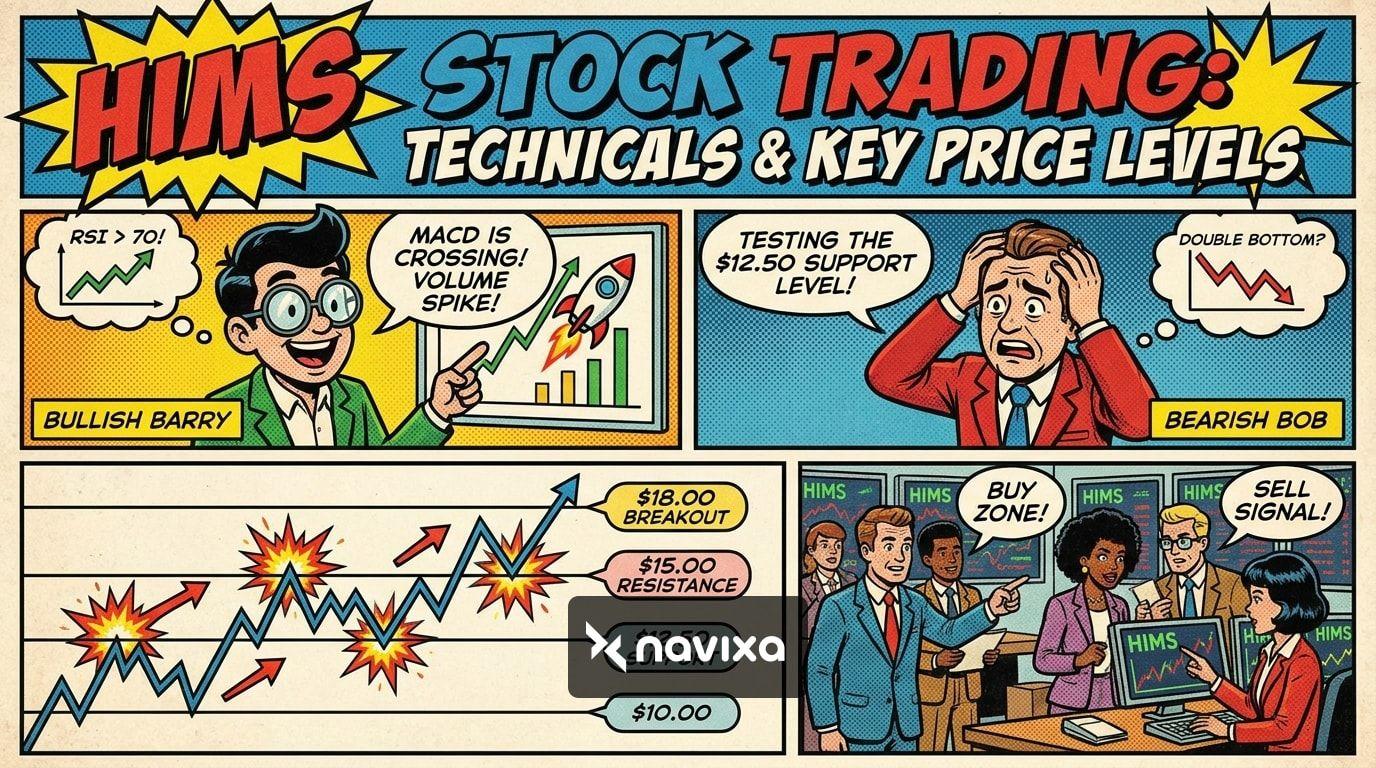
* Relative Strength Index (RSI): HIMS is notorious for rapid runs that push the 14-day RSI above 70, indicating an overbought condition. While a stock can remain overbought during a strong breakout, savvy traders use RSI divergence—where the price makes a higher high but the RSI makes a lower high—as a signal to take profits. Conversely, an RSI dipping below 30 often precedes a sharp relief rally. * MACD: The MACD histogram illustrates the distance between the 12-day and 26-day exponential moving averages. A bullish crossover below the zero line frequently provides early confirmation of a bottoming process in HIMS stock, serving as an excellent early entry signal.
Volume Profile and Institutional Footprints
While moving averages tell you where the price has been, volume tells you the conviction behind the move. In HIMS stock trading, observing volume spikes is crucial for confirming breakouts. A price move above a heavy resistance level on low volume is often a bull trap, destined to fail. Traders should utilize the Volume Profile indicator to identify "High Volume Nodes" (HVNs)—price areas where the most shares have changed hands. For HIMS, the mid-$20s range often acts as an HVN, serving as a magnet for price during times of market consolidation.
The Impact of Short Interest
Another critical factor unique to HIMS stock trading is its frequently elevated short interest. With short interest historically reaching highly elevated levels, HIMS is a prime candidate for short squeezes. When the stock begins to cross major resistance levels, short sellers are forced to buy back shares to cover their positions, adding aggressive upward pressure to the stock price. Traders looking for explosive moves should monitor short interest data regularly.
Key Price Levels to Watch
Successfully executing a HIMS stock trading strategy requires a meticulous mapping of support and resistance zones. These levels act as psychological barriers where supply and demand dynamics shift violently.
Critical Support Zones
1. The $25.50 - $26.50 Base: This zone acts as a major inflection point. It represents a level where institutional accumulation has previously halted massive sell-offs and is a critical line to hold during pullbacks. 2. The $18.00 - $21.00 Floor: Should macroeconomic pressures or sector-wide sell-offs occur, this lower technical band serves as a definitive line in the sand. A break below this level could trigger a cascade of stop-loss orders.
Major Resistance Ceilings
1. The $31.00 - $32.00 Pivot: This is a heavy psychological and technical resistance area. Traders who bought the dip previously often look to offload their shares here to break even, creating a massive liquidity wall. 2. The $38.50 Long-Term Hurdle: Aligning closely with historical 200-day moving average levels, a breakout above this zone requires a fundamental catalyst—such as an exceptional earnings beat or a major pharmaceutical partnership announcement.
Comparison: HIMS Stock vs. Telehealth Competitors
To contextualize the price action of HIMS, it is helpful to benchmark it against other players in the telehealth sector. Below is a comparison of HIMS against a primary competitor, illustrating why traders might prefer one over the other.
| Metric / Feature | HIMS (Hims & Hers Health) | TDOC (Teladoc Health) |
|---|---|---|
| Primary Market Catalyst | Direct-to-Consumer GLP-1 & Wellness | B2B Enterprise Healthcare Contracts |
| Price Volatility | Exceptionally High | Moderate to High |
| Trading Profile | Momentum and Breakout Trading | Reversal and Value Trading |
| Short Interest | Elevated (Frequent short-squeeze setups) | Moderate |
For more detailed corporate fundamentals and peer comparisons, you can review current data on Google Finance or check institutional holdings and metrics via Fidelity Investments.
Proven Trading Strategies for HIMS Stock
Now that we have established the technical framework, how do we actively trade HIMS? Here are two robust strategies favored by professional traders.
Strategy 1: The Gap-and-Go Breakout
Because HIMS is a headline-driven stock, it frequently gaps up at the open following positive news regarding subscriber growth or drug offerings.
1. The Setup: Wait for the stock to gap up above a key resistance level (e.g., $32.00) on pre-market volume that is at least 1.5x the 10-day average. 2. The Entry: Do not buy the immediate open. Instead, wait for the first 15-minute candle to close. If the price holds above the opening print and begins to make a new high, enter the trade. 3. The Exit: Place a stop-loss just below the low of the first 15-minute candle. Scale out of your position as the RSI approaches the overbought threshold of 75.
Strategy 2: The Moving Average Pullback
When HIMS establishes a strong daily uptrend, it rarely goes up in a straight line. The moving average pullback strategy allows traders to enter an established trend at a favorable risk-to-reward ratio.
1. The Setup: Identify a period where HIMS is trading consistently above its 20-day SMA. 2. The Entry: Wait for a routine market sell-off that pushes the price down to touch the 20-day SMA. Enter the trade when the stock prints a bullish reversal candlestick (like a hammer or a bullish engulfing pattern) bouncing off this dynamic support line. 3. The Exit: Target the recent swing high for taking profits, while keeping a tight stop-loss 2% below the moving average itself.
Risk Management in HIMS Stock Trading
No guide on HIMS stock trading would be complete without a stern warning about risk management. The very volatility that makes HIMS an attractive trading vehicle also makes it highly dangerous for the unprepared.
Strict Position Sizing
Never allocate more than 5% of your total trading portfolio to a single highly volatile stock like HIMS. Furthermore, ensure that your risk per trade—the amount you would lose if your stop-loss is hit—does not exceed 1% to 2% of your total account equity. This ensures that even a string of losing trades will not permanently damage your capital base.
Avoiding Earnings Roulette
Holding a full trading size through an earnings announcement is not trading; it is gambling. HIMS has a history of experiencing 15% to 20% overnight gaps in either direction following earnings reports. If you are a technical trader, it is often wiser to close your position before the bell and trade the resulting price action the following day once the market has digested the news and the spread has tightened.
Practical Takeaways
To summarize the core tenets of trading this telehealth disruptor:
* Respect the Volatility: HIMS requires wider stop-losses and smaller position sizes compared to traditional blue-chip stocks. * Watch the Averages: The 20-day and 50-day SMAs are your primary tools for short-to-medium trend identification. * Monitor Sector News: Telehealth and GLP-1 weight loss headlines will heavily override technicals in the short term. Always stay informed. * Trade the Chart, Not the Hype: It is easy to get caught up in the consumer excitement surrounding the Hims & Hers brand. Always let the price action and volume dictate your entries and exits.
Conclusion
Mastering HIMS stock trading requires a delicate balance of fundamental awareness and strict technical discipline. By understanding the key price levels, respecting the moving averages, and implementing rigorous risk management, you can transform the stock's inherent volatility into a consistent source of trading opportunities. Whether the stock is breaking out past massive liquidity walls or pulling back to structural support floors, the prepared trader is always ready to capitalize. Stay disciplined, trust your charts, and trade responsibly.
Frequently Asked Questions
What makes HIMS stock trading so volatile?
HIMS operates in the highly speculative direct-to-consumer telehealth sector. Its stock price is heavily influenced by regulatory news, FDA announcements, fluctuating short interest, and its aggressive expansion into trending medical categories like GLP-1 weight loss drugs.
How does the GLP-1 partnership affect HIMS stock?
The ability to distribute branded or compounded weight loss medications represents a massive revenue vertical for Hims & Hers. Positive news regarding drug supply or new pharmaceutical partnerships acts as a major bullish catalyst, driving high trading volume and violent upside price action.
What are the best technical indicators for swing trading HIMS?
For swing trading, the 20-day and 50-day Simple Moving Averages (SMAs) are excellent for trend identification. Additionally, the Relative Strength Index (RSI) helps identify overbought or oversold extremes, while volume profile analysis can highlight massive institutional support or resistance zones.
Should I hold HIMS stock through earnings reports?
For short-term technical traders, holding a full position through earnings is generally discouraged due to the massive overnight price gaps that can occur. It is often safer to reduce your position size or wait until the market digests the earnings data before entering a new trade with a clear risk profile.