
The financial markets are constantly evolving, and trading megacap technology stocks like Alphabet Inc. (NASDAQ: GOOGL) requires much more than just a surface-level understanding of earnings reports or algorithmic chart patterns. It demands ironclad emotional discipline. In an era where Google has aggressively expanded its footprint into artificial intelligence, custom silicon processors, and enterprise cloud solutions, market volatility remains a persistent companion for investors. Navigating these turbulent waters requires an edge, and mastering Google stock trading psychology is the definitive advantage that separates consistently profitable traders from those who merely gamble on mainstream headlines.
When trading high-profile tech equities, it is incredibly easy to fall victim to the euphoric highs of an artificial intelligence supercycle or the terrifying lows of sudden regulatory crackdowns. Trading psychology refers to the mental and emotional framework you utilize to make buy, sell, or hold decisions under pressure. If you do not have a profound understanding of your own cognitive biases and a robust risk management protocol, the stock market will inevitably expose your vulnerabilities.
This comprehensive guide will deconstruct the intricacies of Google stock trading psychology, explore the hidden mental traps that plague both novice and veteran traders, and deliver actionable risk management strategies to safeguard your capital.
The Unique Psychological Landscape of Trading Alphabet (GOOGL)
Alphabet is not just another blue-chip stock; it is a bellwether for the entire technology sector. Because Google is so deeply integrated into the daily lives of billions of people through Search, YouTube, and its Android ecosystem, traders naturally form strong emotional attachments and preconceived notions about the company's invincibility. This emotional attachment can be incredibly dangerous.
Historically, when a company transitions from a dominant digital advertising monopoly into an AI-first infrastructure powerhouse, the narrative driving the stock price becomes increasingly speculative. Traders are no longer just pricing in current ad revenues; they are attempting to price in the future of human-computer interaction. This highly speculative environment serves as a breeding ground for two of the most destructive emotions in trading: Fear and Greed.
The FOMO Trap and the Euphoria of AI Innovations
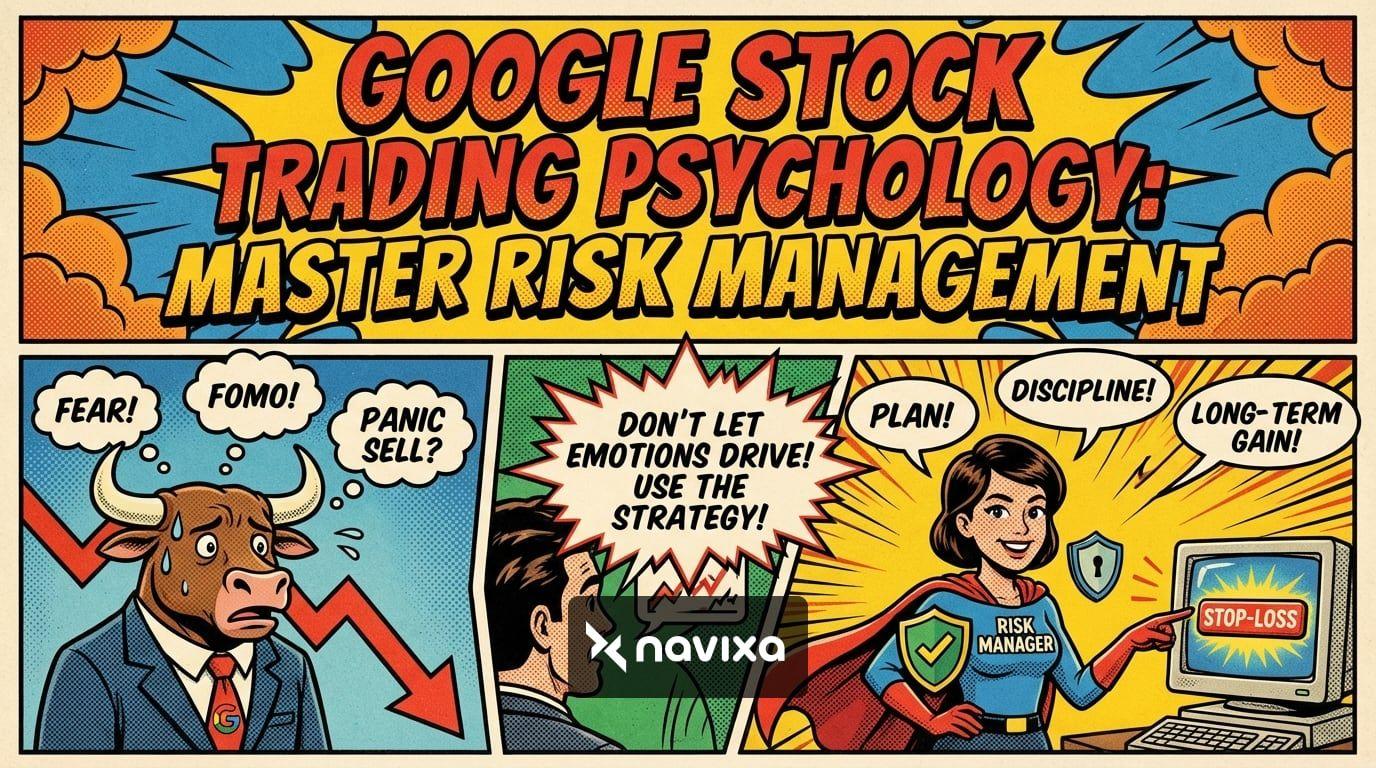
Fear of Missing Out (FOMO) is a psychological phenomenon that pushes traders to abandon their predefined strategies in a desperate attempt to catch a rapidly accelerating trend. When Google announces a breakthrough in its Gemini generative AI models or unveils a new custom enterprise chip to rival industry competitors, the financial media amplifies the hype. Retail and institutional traders alike rush to buy shares, driving the stock into overbought territory.
From a psychological standpoint, buying into a massive vertical rally feels incredibly safe because the herd is doing the same thing. However, professional traders understand that entering a position based on euphoria is a classic recipe for devastating drawdowns. Mastering Google stock trading psychology means learning how to sit on your hands when the market is euphoric and waiting patiently for high-probability technical pullbacks instead of chasing green candles.
Panic Selling During Regulatory and Macroeconomic Pressures
Conversely, Google is frequently the target of intense global scrutiny. Whether it is the U.S. Department of Justice probing antitrust violations, the European Union levying massive fines, or sudden fears regarding "AI contagion" and capital expenditure sustainability, bad news can cause violent intraday sell-offs.
When GOOGL shares suddenly gap down 3% or 4% in a single session, the untrained human brain perceives this financial loss as a literal physical threat. The amygdala triggers a "fight or flight" response, leading to panic selling at the exact moment when the stock might be entering a deep value zone. A seasoned trader relies on predefined risk management parameters rather than raw emotion, allowing them to objectively assess whether the sell-off is a fundamental shift in the company's thesis or simply short-term market noise.
Destructive Cognitive Biases to Conquer
To truly master your trading mindset, you must identify and neutralize the cognitive biases that distort your perception of market reality. Overcoming these mental hurdles is a core pillar of modern trading psychology.
Confirmation Bias
Confirmation bias is the tendency to search for, interpret, and remember information in a way that confirms your preexisting beliefs. If you are heavily invested in Google stock and believe it will hit new all-time highs, you might instinctively ignore bearish reports about declining search market share or rising infrastructure costs. You will only click on bullish articles and follow optimistic analysts on social media. To combat confirmation bias, actively seek out the opposing argument. If you are bullish on Google, read the bearish thesis. This practice grounds your expectations and prevents emotional blindness.
Recency Bias
Recency bias causes traders to weigh recent events more heavily than historical data. If Google has been on a massive six-month bull run, traders afflicted with recency bias will assume the stock can only go up, prompting them to over-leverage their accounts just as the trend exhausts itself. Conversely, after a brutal earnings miss, recency bias will convince traders that the stock is permanently broken. You must train your mind to view the market probabilistically, understanding that current trends are just one piece of a much larger historical puzzle.
Revenge Trading
Taking a loss on a tech giant like Google can severely bruise a trader's ego. The immediate psychological response is often "revenge trading"—jumping right back into a new position with larger size to aggressively win back the lost capital. This is driven purely by anger and frustration, not logic. The best traders in the world accept losses as a standard business expense. They step away from the monitors, recalibrate, and wait for their edge to reappear.
Core Risk Management Strategies for Google Stock
Trading psychology and risk management are two sides of the exact same coin. If you do not have rules in place to protect your capital, anxiety and stress will inevitably dominate your decision-making. By implementing rigid risk parameters, you remove the emotional burden from your trades.
1. Master Position Sizing
One of the most effective ways to lower your heart rate while trading is to scale down your position size. If a 2% drop in Google stock keeps you awake at night, your position is objectively too large. Professional traders rarely risk more than 1% to 2% of their total account equity on a single trade. This means that even if a catastrophic, unexpected event causes the stock to crash, your overall portfolio remains largely intact, and you preserve your mental capital to trade another day.
2. Implement Hard Stop-Loss and Take-Profit Orders
Hope is not a viable trading strategy. Before you even click the buy button, you must know exactly where you are going to exit if the trade goes against you, and where you are going to take profits if it goes in your favor. By entering stop-loss and take-profit orders directly into your brokerage platform, you automate your discipline. This prevents the psychological agony of watching a small loss turn into a massive, portfolio-destroying disaster.
3. Utilize Technical Analysis as an Emotional Anchor
When headlines are screaming that the sky is falling, technical analysis provides a cold, objective view of the market. Utilizing platforms like TradingView allows you to map out crucial support and resistance levels, moving averages, and volume profiles. When you base your decisions on data and probabilistic chart patterns rather than news sentiment, you effectively short-circuit your emotional responses.
Emotional Trading vs. Rule-Based Trading
To highlight the stark contrast between an amateur mindset and a professional mindset, let's examine how both approaches handle the volatility of Google stock.
| Feature | Emotional Trading | Rule-Based Trading |
|---|---|---|
| Entry Triggers | FOMO after a massive AI product announcement | Pre-defined technical breakout or support bounce |
| Exit Strategy | Panic selling during a DOJ antitrust headline | Executing a pre-set stop-loss or trailing stop |
| Position Sizing | Going "all-in" to maximize short-term profits | Adhering strictly to the 1% to 2% account risk rule |
| Market Outlook | Euphoric during peaks, catastrophic during dips | Objective, probabilistic, and emotionally detached |
| Review Process | Blaming algorithms or market manipulation for losses | Logging trades in a journal to review personal performance |
Actionable Steps to Master Your Trading Mindset
Understanding the theory of trading psychology is only half the battle; implementing it into your daily routine is where the real transformation occurs. Here are highly actionable steps to build psychological resilience.
Maintain a Detailed Trading Journal
Keeping a trading journal is the fastest way to improve your psychological awareness. Document not only the entry price, exit price, and setup of your Google trades, but also your emotional state at the time. Were you feeling anxious? Did you rush the entry out of boredom? By reviewing your journal weekly, you will start to identify toxic behavioral loops. Recognizing these patterns is the first step toward breaking them.
Practice Mental Rehearsal
Elite athletes visualize their performance before stepping onto the field, and elite traders do the exact same thing. Before the market opens, mentally rehearse your worst-case scenarios. Imagine Google stock instantly dropping 5% right after you buy it. Visualize yourself calmly accepting the loss and moving on without anger. By pre-experiencing the emotional pain, you strip it of its power when it actually happens in real time.
Focus on the Process, Not the Profits
Your primary goal as a trader is not to make money; it is to execute your trading plan flawlessly. The profits are simply a byproduct of disciplined execution. If you followed your rules, took the proper position size, and the trade still resulted in a loss, you should view that as a successful trade. Detaching your self-worth from the monetary outcome is essential for long-term survival in the financial markets.
For more profound insights into mastering market mentalities, reviewing foundational texts and resources, such as Investopedia's guide to Trading Psychology, can continually reinforce good habits.
Conclusion
Trading Google stock offers immense opportunities, but it also presents a psychological gauntlet. The intersection of artificial intelligence hype, regulatory fears, and macroeconomic shifts creates an environment where only the emotionally disciplined survive. Mastering Google stock trading psychology is not about completely eliminating your emotions—it is about recognizing them, accepting them, and refusing to let them dictate your actions.
By conquering cognitive biases, implementing strict position sizing, and adhering to a predefined rule-based system, you can neutralize the noise and trade with total clarity. The market does not care about your hopes or fears. It only rewards discipline. Start logging your trades, strictly define your risk per setup, and take absolute control of your trading mindset today.
Frequently Asked Questions
Why is Google stock trading psychology so important right now?
As Alphabet transitions deeply into the AI sector and faces ongoing regulatory probes, the stock's volatility has increased. Trading psychology is crucial because the constant barrage of high-impact news can easily trigger FOMO or panic selling, leading traders to abandon their logical strategies and make costly, emotion-driven mistakes.
How do antitrust lawsuits affect trader emotions regarding GOOGL?
Antitrust lawsuits introduce a high level of uncertainty. Because the human brain dislikes uncertainty, traders often default to fear, assuming the worst-case scenario (like a forced breakup of the company). This fear can cause irrational sell-offs, which disciplined traders often view as psychological overreactions and potential buying opportunities.
What is the best way to manage risk when trading highly volatile AI tech stocks?
The most effective risk management strategy combines strict position sizing (risking no more than 1-2% of your account per trade) with hard stop-loss orders. Additionally, diversifying your portfolio so that you are not overly exposed to a single megacap tech stock helps protect your mental capital during sector-wide downturns.
Does it matter if I trade GOOG or GOOGL when it comes to trading psychology?
Psychologically, there is virtually no difference. GOOGL shares have voting rights while GOOG shares do not, but they move in near lockstep due to institutional arbitrage. The psychological challenges—managing fear, greed, and emotional discipline—are identical regardless of which ticker you choose to trade.
How can I stop revenge trading after a big loss on Google stock?
The best way to stop revenge trading is to enforce a "cool-down" rule. If you hit your maximum daily loss limit or take a heavy unexpected hit, you must physically walk away from your trading station for at least 24 hours. Use this time to update your trading journal and logically analyze what went wrong, rather than letting anger dictate your next move.