
Trading Strategies
Google Stock Price Action: Top Technical Analysis Strategies
- Nov 26, 2025
- 8 min read
As of late 2025, Alphabet Inc. (GOOG/GOOGL) has firmly re-established itself as a titan in the artificial intelligence race. With the successful rollout of Gemini 3 and increasing vertical integration in chip manufacturing, the stock has broken through historical resistance levels, entering what technical analysts call "blue sky" territory. However, trading a stock at all-time highs requires a disciplined approach to price action and a reliance on robust technical indicators rather than pure speculation.
For traders and investors, understanding Google stock technical analysis is no longer just about reading basic charts; it is about interpreting institutional sentiment, volume flows, and the psychological barriers that emerge when a $3 trillion market cap company enters price discovery mode. This article explores the most effective strategies for trading Google stock, blending classical technical patterns with modern market dynamics influenced by AI and algorithmic trading.
The AI Factor: Fundamental Context Driving the Charts
Before diving into the indicators, it is crucial to understand the fundamental catalyst propelling the current trend. Throughout 2024 and 2025, Google’s aggressive push into generative AI and its custom TPU (Tensor Processing Unit) infrastructure reduced its reliance on third-party hardware suppliers like Nvidia. This shift improved margins and sentiment, creating a sustained uptrend.
Technical analysis often works best when aligned with a strong fundamental narrative. In Google's case, the "AI Supercycle" provides the volume and liquidity necessary for chart patterns to play out reliably. When news of a Gemini update hits the wires, we often see a specific price action response: a high-volume gap up followed by a consolidation period. Recognizing this recurring pattern is the first step in a successful strategy.
Trend Following with Moving Averages
The most reliable strategy for a mega-cap stock like Alphabet in a bull market is trend following. The primary tools for this are the Simple Moving Averages (SMA).
The Golden Cross Confirmation
Early in 2025, GOOGL experienced a textbook "Golden Cross," where the 50-day SMA crossed above the 200-day SMA. This signal remains valid today as the stock trades comfortably above both lines. For intermediate traders, the 50-day SMA (currently trending upward near the $280–$290 zone) acts as dynamic support. A pullback to this line often presents a high-probability buying opportunity, assuming the broader market structure remains intact.
Riding the 20-Day EMA
For shorter-term swing traders, the 20-day Exponential Moving Average (EMA) is a sharper tool. During strong momentum phases—such as the run-up following the Q3 earnings beat—GOOGL tends to "surf" the 20-day EMA. A close below this line can signal a short-term trend reversal or a transition into a sideways consolidation phase, prompting traders to tighten their stop-losses.
Momentum Indicators: RSI and MACD
While moving averages define the trend, momentum indicators help identify entry and exit points. With Google stock recently testing the $320 level, oscillators have been flashing specific signals.
RSI: The Overbought Dilemma
The Relative Strength Index (RSI) for GOOGL has frequently hovered above 70 this year. Novice traders often interpret this as a "sell" signal. However, in a strong uptrend, an asset can remain overbought for extended periods. This is known as an embedded overbought condition. The strategy here is not to short the stock immediately but to wait for a bearish divergence—where the price makes a higher high, but the RSI makes a lower high. Until that divergence appears, the trend remains your friend.
MACD Histogram
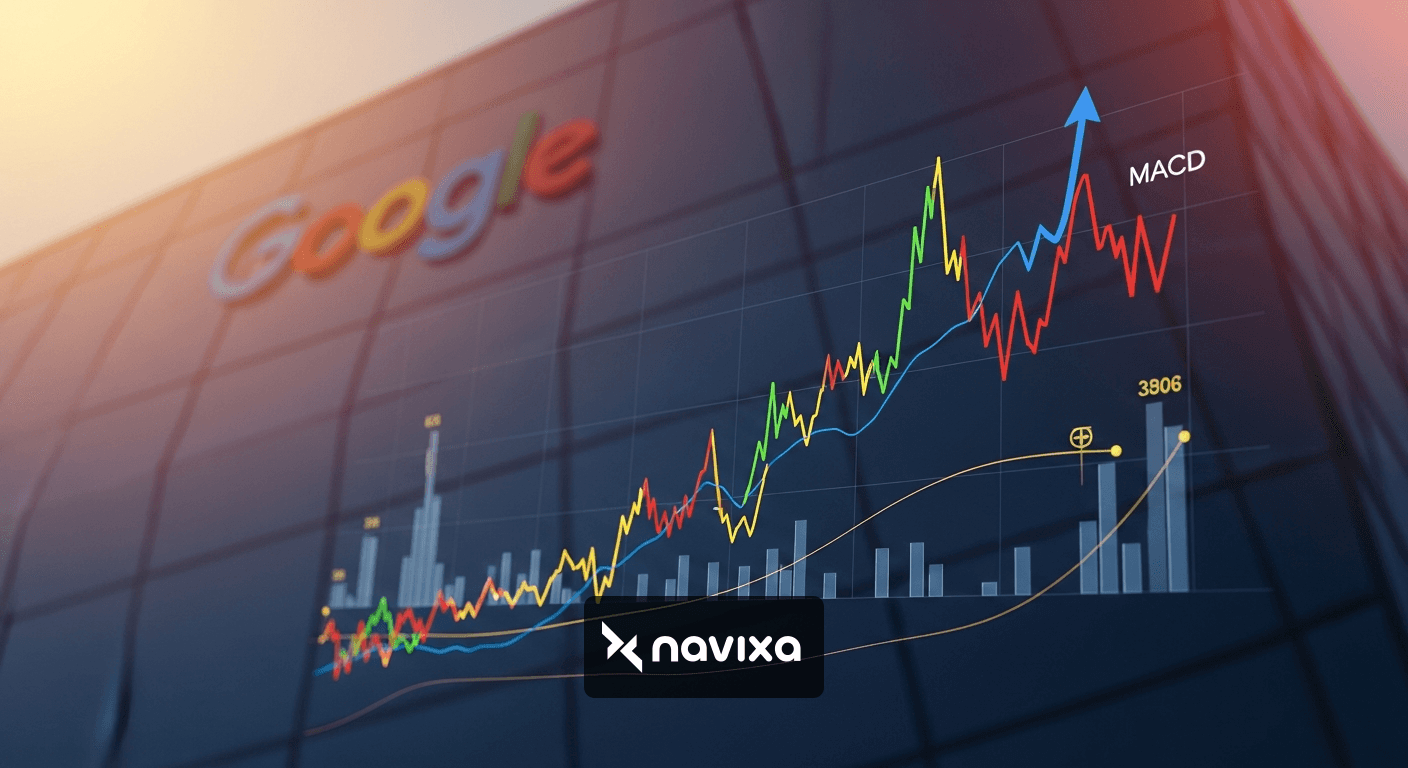
The Moving Average Convergence Divergence (MACD) is excellent for gauging the strength of the move. Currently, the MACD line is above the signal line on the weekly chart, confirming the long-term bullish bias. Traders should watch the histogram bars; if they begin to shorten (approach zero) while the price is still rising, it indicates waning momentum and a potential near-term pullback.
Price Action Strategy: Breakouts and Retests
Google's price action in late 2025 has been characterized by clear "step-up" patterns. The stock consolidates in a range (e.g., between $290 and $305) for several weeks, accumulating energy, before breaking out on high volume.
The Breakout-Retest Entry
A classic strategy is to wait for the daily candle to close above a resistance level (like the $310 mark recently). Aggressive traders buy the breakout immediately. However, a more conservative and often more profitable approach is to wait for the retest. If GOOGL breaks $310, rises to $318, and then falls back to $310, holding that level as new support is the ideal entry trigger. This confirms that previous sellers have been exhausted and buyers are stepping in to defend the price.
Automated Trading: Bots and Grid Strategies
Given the volatility introduced by AI news cycles, manual execution can sometimes be too slow. Many institutional and retail traders now employ automated strategies for stocks like Google. Utilizing platforms that support algorithmic logic—similar to those used in crypto markets—can enhance efficiency.
A popular method for GOOGL during consolidation phases is Spot Grid Trading. If the stock is ranging between $300 and $320, a grid bot can automatically place buy orders at incremental levels down to $300 and sell orders on the way up to $320. This captures profit from the "noise" of daily volatility without requiring the trader to stare at the screen. You can learn more about charting tools to set up these levels on platforms like TradingView.
Comparison of Technical Indicators for GOOGL
Choosing the right indicator depends on the current market phase. The table below compares the most effective tools for analyzing Google's stock price action in 2025.
| Indicator | Best Market Condition | Primary Signal for GOOGL | Risk Level |
|---|---|---|---|
| Moving Averages (50/200 SMA) | Trending (Bull/Bear) | Golden Cross (Long-term Buy) | Low |
| RSI (Relative Strength Index) | Overbought/Oversold | Divergence (Reversal warning) | Medium |
| Bollinger Bands | Consolidation/Volatility | Band Squeeze (Breakout imminent) | Medium |
| MACD | Momentum Shifts | Crossover & Histogram strength | Low |
| Volume Profile | Support/Resistance Discovery | Point of Control (Liquidity zones) | High (Advanced) |
Volume Analysis: The Truth Serum
Price can be manipulated, but volume rarely lies. In technical analysis, volume confirms the trend. During the recent surge to $320, observers noted that "up" days were accompanied by above-average trading volume, while "down" days saw lighter volume. This signifies strong institutional accumulation.
Traders should watch the On-Balance Volume (OBV) indicator. If GOOGL price consolidates sideways but OBV continues to make new highs, it suggests that smart money is quietly buying the dip, predicting another leg up. Conversely, if price rises but OBV flattens or drops, it warns of a "hollow rally" that is likely to fail. Detailed definitions of these volume indicators can be found on Investopedia.
Conclusion: Navigating the Blue Sky
Google's stock price action in 2025 offers a masterclass in bullish technical structure. The combination of a strong fundamental AI narrative with clear technical signals—Golden Cross support, constructive RSI behavior, and confirming volume—makes it a prime candidate for both trend-following and swing-trading strategies.
However, traders must remain vigilant. The higher the price goes into uncharted territory, the more volatile the corrections can be. By utilizing stop-losses below key moving averages (like the 50-day SMA) and watching for MACD divergences, you can manage risk while participating in Alphabet's growth story. Whether you are a manual trader or using automated bots, the key to success lies in patience and strict adherence to your technical rules.