

Gen Z Crypto Adoption: Long-Term Digital Wealth Thesis
- May 3, 2026
- 13 min read
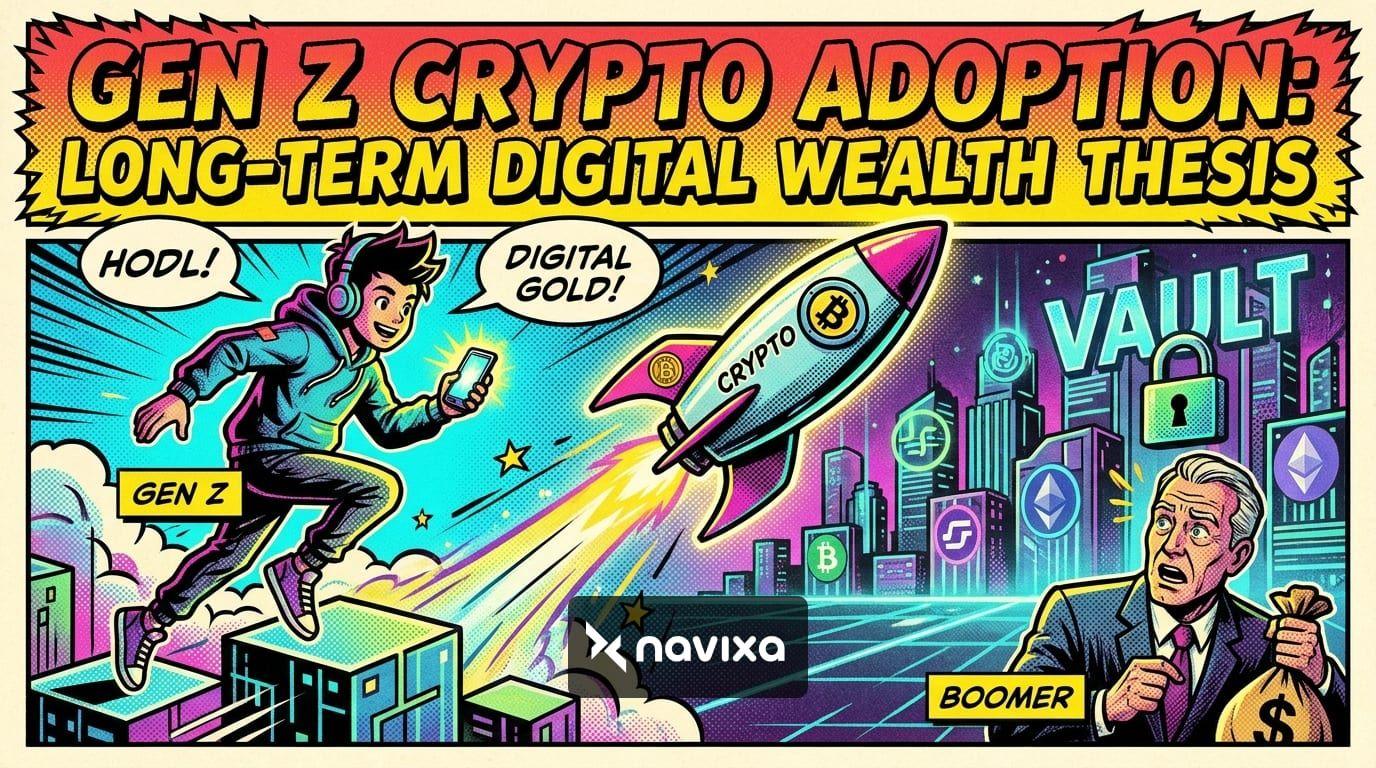
Gen Z Crypto Adoption: A Long-Term Digital Wealth Investment Thesis
The financial landscape is undergoing a tectonic shift, driven by a generation that views digital assets not as speculative novelties, but as foundational pillars of wealth generation. For Gen Z, born into a world of constant mobile connectivity, algorithmic information feeds, and recurring macroeconomic instability, traditional banking often feels antiquated and economically restrictive.
Today, with the global cryptocurrency market capitalization reaching an impressive $2.68 trillion and Bitcoin (BTC) hovering around $78,229, the empirical data paints a very clear picture. Recent industry surveys indicate that over 51% of Gen Z adults globally have owned cryptocurrency, significantly outpacing Millennials and Gen X. They are systematically shifting capital into decentralized networks to hedge against inflation, capture yield through on-chain staking, and participate in the ownership of tokenized real-world assets. The era of viewing digital currencies as mere "magic internet money" is over; we have decisively entered the age of the digitally native, agentic economy.
- Gen Z views cryptocurrency and decentralized finance (DeFi) as core tools for wealth building rather than fringe speculative plays.
- Over half of Gen Z adults have interacted with digital assets, heavily favoring liquid staking, AI tokens, and fractionalized ownership.
- Higher risk tolerance among young investors is a direct, calculated response to the economic inaccessibility of traditional asset classes.
- The convergence of AI and blockchain is leading to autonomous portfolio management, redefining modern trading strategies.

The Generational Shift: Why Web3 Wins Over Wall Street
To understand the surge in Gen Z crypto adoption, one must look at the macro-environmental factors that have shaped their financial worldview. Many young adults have entered the workforce during periods of historic inflation, seeing the purchasing power of fiat currencies erode before their eyes. The traditional American Dream of steady wage growth leading to homeownership feels increasingly out of reach.
Because younger demographics are frequently priced out of the conventional real estate market, evaluating bitcoin ROI versus traditional housing has transitioned from a theoretical exercise into a stark economic necessity. Why save for a decade in a low-yield savings account just to afford a down payment, when digital assets offer immediate access to global liquidity and fractionalized value?
Gen Z prefers networks they can mathematically verify. Instead of relying on centralized institutions, they place their trust in open-source smart contracts. This shift is reflected in the current market dominance metrics, where Bitcoin retains a 58.43% market share, but smart-contract platforms like Ethereum (trading at $2,303.68) and Solana (at $83.73) command immense loyalty due to their daily utility. These blockchains allow users to engage in liquid staking, earning decentralized yields that traditional legacy banks simply cannot match.
Market Analysis & Trading Psychology
Unlike previous generations that leaned heavily into the "set it and forget it" ethos of index fund investing, Gen Z operates in a hyper-financialized, 24/7 digital economy. This demographic has grown up with instant gratification via social media and gamified interfaces, which deeply influences their trading psychology and risk assessment parameters.
However, it is highly reductive to classify this behavior simply as a gambling mindset. When analyzing the macro environment as an expert SEO strategist and trader, it becomes evident that Gen Z's risk appetite is a highly rational response to an economic landscape characterized by structural disadvantages. The traditional path to wealth seems mathematically inaccessible to many without existing capital advantages. Thus, embracing higher volatility for the chance of asymmetric returns is viewed not as reckless, but as a mandatory strategy for economic mobility.
Many young traders rely on sophisticated sentiment analysis, decentralized application (dApp) metrics, and on-chain forensics to map out momentum. For example, comparing crypto to AI bubbles reveals how Gen Z dynamically shifts capital between competing technological narratives. They inherently understand that liquidity moves in distinct cycles and are entirely willing to take aggressive positions early in a technology's lifecycle. FOMO (Fear Of Missing Out) is undoubtedly a psychological driver—often amplified by algorithmic feeds—but it is frequently paired with a surprisingly deep understanding of network effects, tokenomics, and community-driven valuation models.
Emerging Primitives: AI Agents and Real-World Assets
The next frontier of digital asset integration is defined by automation and the bridging of physical and digital worlds. The simple act of buying and holding spot Bitcoin is often viewed as a basic strategy by younger market participants. The contemporary Gen Z portfolio is active, agentic, and highly diversified across innovative sectors.
One major trend dominating the market is the integration of artificial intelligence with blockchain infrastructure. We are witnessing the deployment of autonomous AI agents capable of managing crypto portfolios, executing micro-trades, and scanning smart contracts for vulnerabilities in real time. Projects in the decentralized science (DeSci) and AI intersection, such as Bio Protocol, are gaining massive traction because they represent a convergence of two massive technological leaps.
Furthermore, Real-World Asset (RWA) tokenization is dismantling the barriers to institutional-grade investments. Through RWAs, a young investor can own a fraction of a commercial high-rise in Manhattan, a piece of fine art, or tokenized US Treasuries directly from their mobile wallet. This push for complete digital ownership goes far beyond currencies, extending into decentralized media and Web3 gaming and DRM models where value extraction is flipped from corporate monopolies back to the individual user.

Generational Comparison: Gen Z vs. Traditional Strategies
To fully grasp the magnitude of this financial evolution, it is helpful to contrast the dominant strategies of Gen Z with those of older, traditional investors.
| Investment Feature | Gen Z Digital Native Strategy | Traditional Boomer Strategy |
|---|---|---|
| Primary Asset Focus | Digital Assets, AI Tokens, RWAs | Blue-Chip Stocks, Bonds, Real Estate |
| Foundational Trust Model | Smart Contracts, Open Source Code | Centralized Banks, Brokerages, FDIC |
| Yield Generation Engine | Liquid Staking, DeFi Liquidity Pools | Bank Interest, Stock Dividends, Rent |
| Market Accessibility | 24/7/365 Global Borderless Markets | Monday-Friday Trading Hours |
| Inherent Risk Tolerance | High (Actively Embraces Volatility) | Low (Prioritizes Capital Preservation) |
**Macro Context:** As traditional governments attempt to restrict global capital flows, decentralized networks become even more attractive to younger investors. The preference for permissionless financial architecture is a defining characteristic of modern youth investing.
Navigating Global Macro Trends and Geopolitics
Cryptocurrency does not exist in a vacuum; it is deeply intertwined with global macroeconomic policies and geopolitical shifts. Gen Z investors are acutely aware of how international regulatory actions impact their portfolios.
Consider the recent headlines regarding the Brazilian central bank banning stablecoin and cryptocurrency settlements in cross-border payments, as reported by CoinDesk. Rather than viewing this as a death knell for crypto, digital natives interpret such events as confirmation of their core thesis: centralized authorities will always attempt to control capital, making censorship-resistant, decentralized networks absolutely critical.
With stablecoins like Tether (USDT) and USD Coin (USDC) commanding a combined market capitalization of over $266 billion, these assets serve as a vital lifeline for individuals in countries facing hyperinflation or severe capital controls. Gen Z recognizes that holding self-custodial digital dollars is a profound act of financial sovereignty. Additionally, technical vulnerabilities in traditional IT infrastructure—such as the US CISA recently flagging critical Linux flaws detailed by Cointelegraph—reinforce the youth narrative that decentralized, distributed ledgers offer superior resilience against single points of failure.

Building a Resilient Digital Portfolio
Understanding the psychological and macroeconomic drivers is only half the battle; executing a sustainable trading strategy is where true wealth is generated. For young investors, managing a crypto portfolio requires a delicate balance between exploring high-yield opportunities and preserving core capital during inevitable market drawdowns.
Instead of panic-selling during macroeconomic downturns, utilizing a crypto long-term crash strategy allows digital natives to accumulate high-conviction assets at significantly depressed valuations. This means identifying protocols with robust developer activity, strong treasury reserves, and clear product-market fit—such as leading Layer-1 blockchains or established decentralized exchanges—and scaling into positions over time using dollar-cost averaging (DCA).
**Volatility Risk:** While high-yield opportunities in decentralized finance are economically enticing, smart contract vulnerabilities and sudden liquidity crunches remain severe risks. Always prioritize cold storage hardware wallets for your long-term holdings and never allocate capital you cannot afford to lose entirely.
While trading trending coins like Pudgy Penguins or participating in early ecosystem airdrops can yield spectacular short-term gains, these should be treated as speculative satellite positions rather than the core of a portfolio. A resilient thesis anchors itself in assets with proven longevity and institutional adoption, like Bitcoin and Ethereum, before allocating capital further out on the risk curve.

Practical Takeaways for the Modern Investor
For those looking to align their investment strategies with the leading edge of financial technology, several actionable steps emerge from Gen Z's approach: 1. Prioritize Self-Custody: True ownership means holding your own private keys. Utilize reputable hardware wallets to secure the bulk of your portfolio against exchange insolvencies. 2. Explore On-Chain Yield: Do not let assets sit idle. Research liquid staking derivatives and conservative liquidity provision to generate passive income on core holdings. 3. Stay Informed on AI and RWAs: Dedicate a portion of your research time to understanding how real-world asset tokenization and autonomous AI agents are streamlining market efficiency. 4. Embrace Volatility as Opportunity: Reframe market crashes not as terminal events, but as periodic liquidity resets that offer prime accumulation zones for disciplined investors.
Conclusion
The aggressive adoption of cryptocurrency by Gen Z is not a temporary fad fueled by internet culture; it is a fundamental restructuring of how a generation approaches capital, ownership, and trust. By rejecting the opaque, slow, and exclusionary mechanics of traditional finance, young investors are building a parallel economy that operates at the speed of the internet. Whether through AI-managed portfolios, tokenized real estate, or decentralized gaming economies, the blueprint for future wealth generation is unequivocally on-chain. To thrive in this new era, investors of all ages must adopt the agility, technological fluency, and open-mindedness characteristic of the digital native.
Frequently Asked Questions
Why is Gen Z more interested in crypto than traditional stocks?
Gen Z favors cryptocurrency because it offers global 24/7 access, fractional ownership, and the ability to generate yield directly through decentralized protocols. Furthermore, many feel priced out of traditional wealth-building avenues like real estate, making the high-growth potential of digital assets highly appealing.
How does Gen Z use cryptocurrency to hedge against inflation?
Instead of leaving capital in savings accounts where purchasing power is eroded by fiat inflation, many young investors hold Bitcoin as a digital store of value (digital gold) or utilize stablecoins to access decentralized finance (DeFi) protocols that offer yields outpacing traditional inflation rates.
Are Gen Z investors only buying speculative memecoins?
While memecoins capture significant social media attention, industry data reveals that Gen Z is heavily invested in foundational Layer-1 blockchains, liquid staking protocols, and the tokenization of real-world assets. They often use memecoins for short-term trading while maintaining long-term, high-conviction portfolios.
What role does Artificial Intelligence play in Gen Z crypto strategies?
AI is rapidly becoming central to modern trading. Digital natives are utilizing autonomous AI agents for real-time market sentiment analysis, automated portfolio rebalancing, and executing smart contract interactions, significantly increasing their operational efficiency and risk management capabilities.