
FOMC Trading Strategy: Step-by-Step Guide for Volatile Markets
- Apr 4, 2026
- 16 min read
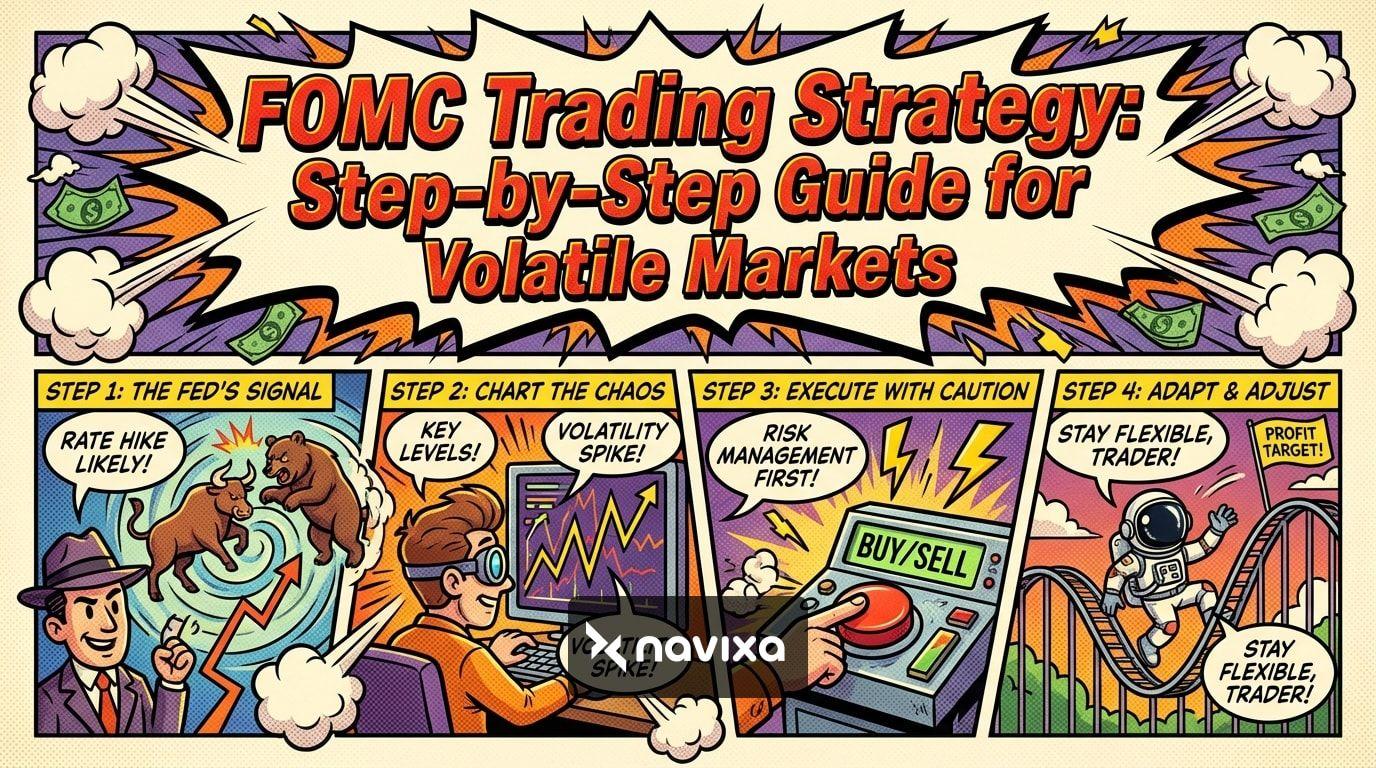
The Federal Open Market Committee (FOMC) meetings are widely considered the most highly anticipated macroeconomic events on the financial calendar. Occurring eight times a year, these meetings dictate United States monetary policy, establish benchmark interest rates, and consistently trigger explosive volatility across all financial markets. Whether you are trading traditional equities, forex, or cryptocurrencies, having a robust FOMC trading strategy is the difference between capitalizing on institutional capital flows and having your portfolio liquidated by erratic price action.
In this comprehensive guide, we will break down the exact mechanics of an FOMC announcement, highlight the distinct stages of meeting day volatility, and provide actionable, step-by-step strategies to help you navigate these turbulent waters with unwavering confidence.
"Trading the FOMC is not about predicting the Federal Reserve's exact interest rate decision; it is about strictly managing your exposure and expertly reacting to the resulting algorithmic volatility once the data is digested by the market."
Why FOMC Meetings Trigger Massive Volatility
To effectively execute an FOMC trading strategy, you must first understand the foundational reasons why these events cause such market disruption. The FOMC's primary mandate is to manage inflation and maximize employment, primarily through the manipulation of the federal funds rate.
Interest rates act as the financial gravitational pull on asset valuations. When rates are low, borrowing money is cheap, which drives vast amounts of liquidity into risk-on assets such as Bitcoin, Ethereum, and high-growth technology stocks. Conversely, when the Fed raises rates to combat inflation, capital flows out of risk assets and rotates into safer, yield-bearing instruments like United States Treasury bonds.
The Algorithmic Impact
On the day of an FOMC announcement, institutional algorithms, high-frequency trading (HFT) bots, and millions of retail traders are all positioned to react to the news. Moments before the actual release, liquidity often evaporates from the order books as market makers pull their resting orders to protect themselves. This sudden lack of market depth creates "air pockets," meaning that even a standard market order can cause a massive price swing and trigger cascading liquidations.
The Crypto Connection
For crypto traders, observing global data platforms like CoinMarketCap during these events will clearly show immediate, violent spikes in trading volume and price fluctuations. Digital assets have evolved into highly sensitive macro instruments. Because cryptocurrencies are inherently risk-on and highly liquid, they frequently serve as the ultimate barometer for global liquidity expectations, making them a prime target for aggressive FOMC day trading.
The Anatomy of an FOMC Meeting Day
A successful FOMC trading strategy requires the foundational understanding that the market reaction happens in very distinct phases. The release day is not one singular event; it is a sequenced timeline of psychological and algorithmic reactions.
Stage 1: The Build-Up and Chop Zone (Pre-Release)
From the start of the trading day until exactly 2:00 PM EST, the market typically enters a phase of low volatility paired with high anticipation. Price action often chops sideways within an extremely tight consolidation range. Attempting to trade standard breakouts during this period is highly dangerous, as the "smart money" institutional players are simply waiting on the sidelines.
Stage 2: The Initial Algorithmic Reaction (2:00 PM EST)
At exactly 2:00 PM EST, the Federal Reserve releases its policy statement and the official interest rate decision. Algorithms instantly scan the provided text for key phrases—measuring hawkish or dovish sentiment—and execute massive block trades in milliseconds. This causes the initial massive price spike, often referred to by technicians as "Wave A."
Stage 3: The Press Conference Reversal (2:30 PM EST)
Exactly thirty minutes later, the Federal Reserve Chairman begins a live press conference. This is where the nuanced context of the raw data is explained. It is incredibly common for the Chairman to utilize a tone that softens or completely contradicts the rigid tone of the initial written statement. Consequently, the market will frequently reverse the entirety of the 2:00 PM move. This predictable reversal is famously known as the "fade" or "Wave B."
Stage 4: The Aftermath and Trend Establishment
By 3:30 PM EST, the press conference concludes, the algorithmic whipsaws subside, and the market establishes its true directional trend based on the overarching macroeconomic outlook.
Top Actionable FOMC Trading Strategies
Now that we understand the chronological timeline, let's explore three distinct, proven frameworks for your personal FOMC trading strategy.
1. The 30-Minute Breakout Strategy (Avoiding the Chop)
This technical strategy is explicitly designed to keep you out of the chaotic "no-trade zone" and only enter the market when a true directional trend has been undeniably established.
Step-by-Step Action Plan: 1. Wait for the Release: Do not hold an active day-trade position going into the highly erratic 2:00 PM EST release. 2. Mark the Range: Switch your charting software to a 30-minute timeframe. Allow the 2:00 PM candle to close completely (which happens at 2:30 PM EST). Draw a horizontal line at the highest point (upper wick) and the lowest point (lower wick) of this specific candle. 3. Identify the No-Trade Zone: Utilize a Fibonacci retracement tool to identify the 50% midpoint of this 30-minute candle. The area between the high and low is your identified chop zone. 4. Wait for Confirmation: Exercise patience and wait for a subsequent 30-minute candle to close completely outside of the established high or low boundary. 5. Execute the Trade: A confirming candle closing above the high is the bullish trigger; a close below the low is the bearish one. Protective stops are typically placed just past the 50% midpoint of the original FOMC candle.
2. Fade the Initial Move (The Fake-Out Setup)
This strategy carries higher inherent risk but can be highly lucrative for experienced day traders who anticipate the classic 2:30 PM press conference reversal.
Step-by-Step Action Plan: 1. Plot Your Indicators: Open a 5-minute chart of Bitcoin (BTC) or the S&P 500. Apply a 21-period Exponential Moving Average (EMA). 2. Observe Wave A: Watch the explosive 2:00 PM directional move occur. Let the market run freely without you. Do not chase the giant green or red candles out of FOMO (Fear Of Missing Out). 3. Wait for the Press Conference: As the 2:30 PM speech begins, watch for a visible momentum slowdown. Look for a trusted reversal candlestick pattern, such as a bearish engulfing candle or a prominent shooting star. 4. Trade the Reversal (Wave B): Enter a position targeting the exact opposite direction of the initial 2:00 PM algorithmic move. Set your initial profit target at the 21 EMA, which consistently acts as a powerful magnetic mean-reversion level during times of high volatility.
3. The Pre-Event Volatility Straddle (Options Trading)
For options traders—whether in traditional equities or crypto options—attempting to guess the ultimate market direction is entirely unnecessary. Instead, you can systematically trade the anticipation of the event itself.
Step-by-Step Action Plan: 1. Enter Early: Approximately 10 to 14 days prior to the scheduled meeting (always verify dates via the Federal Reserve Economic Calendar), purchase an At-The-Money (ATM) Call and an ATM Put on your chosen asset. 2. Ride the Implied Volatility: As the meeting steadily approaches, market uncertainty drastically grows. This naturally causes Implied Volatility (IV) to surge, artificially inflating the premium value of both your call and put options simultaneously. 3. Exit Before the Announcement: Sell both options to close the position the day prior to the FOMC meeting. Once the 2:00 PM data is public, IV collapses instantly—a harsh phenomenon known as "IV Crush"—which ruthlessly destroys the premium value of unexercised options contracts.
Essential Technical Analysis & Indicators
To successfully implement an FOMC trading strategy, you must strictly rely on a defined set of technical analysis tools rather than raw emotion or "gut feeling."
* Exponential Moving Averages (EMA): The 21 EMA and 200 EMA are crucial navigational tools. During extreme FOMC volatility, price tends to stretch precariously far away from the 21 EMA. A rapid reversion to this mean is consistently one of the highest-probability setups available. * Fibonacci Retracement: This tool is essential for mapping out the hidden support and resistance within large institutional candles. The 50% and 61.8% retracement levels frequently act as unbreakable support walls during the 2:30 PM press conference. * Volume Profile: While standard vertical volume bars are helpful, implementing a Visible Range Volume Profile (VRVP) will show you exactly at what price levels the most institutional liquidity was exchanged. If the price successfully breaks out of a high-volume node established during the meeting, it strongly signifies sustained institutional backing for a new trend.
Risk Management: Protecting Your Capital
Trading the Federal Reserve's monetary policy announcements carries extreme, inherent risks. Your absolute primary objective on these volatile days is rigorous capital preservation.
* Slash Your Position Sizing: Because daily volatility can easily expand by 50% to 100% on meeting days, your potential percentage losses (and gains) will amplify exponentially. Mitigate this by actively cutting your standard base position size in half. * Account for Extreme Slippage: Standard stop-loss orders do not magically guarantee an exact exit price during severe liquidity vacuums. A market stop loss might trigger points—or potentially hundreds of dollars in the crypto markets—away from your target price. Ensure your total account margin can handle severe algorithmic slippage. * Avoid Over-Leveraging: High leverage combined with low order book liquidity is a guaranteed recipe for immediate liquidation. Stick to low leverage or spot trading exclusively during the two-hour window surrounding the event. * Widen Your Stops (Strategically): If you are trading the "Aftermath" trend, standard tight stop losses will easily be "hunted" by algorithmic volatility wicks. Give your well-planned trades the structural room they need to breathe.
FOMC Trading Setup Comparison
To help you objectively decide which trading methodology best fits your personal psychology, risk tolerance, and chosen asset class, here is a comparative breakdown of the core strategies.
| Strategy | Best Market Focus | Core Advantage | Primary Risk | Ideal Timeframe |
|---|---|---|---|---|
| 30-Minute Breakout | Crypto, Indices, Forex | Keeps you out of the algorithmic chop | Requires extreme discipline and patience | 30-Minute Chart |
| Fade the Initial Move | Day Trading (High Beta) | Catches the massive "true" trend reversal | High risk of stop-out on continuation | 5-Minute Chart |
| Pre-Event Straddle | Options (Equities/Crypto) | Profits strictly from IV expansion | Highly vulnerable to early IV crush | Multi-day (Swing) |
Practical Takeaways
* Never Front-Run the News: Guessing the rate hike outcome is gambling, not trading. Let the market digest the data, reveal its hand, and then execute your strategy based on confirmed price action. * Mark the Calendar: Always know exactly when the Fed meets. Unknowingly holding a high-leverage position through a surprise announcement can leave you entirely wiped out. * Watch the Clock: The difference in market mechanics between 2:00 PM and 2:30 PM is night and day. Accept that the initial written statement reaction is very often a trap, and the real sustained move accompanies the verbal press conference.
Conclusion
Mastering an FOMC trading strategy requires elite discipline, a clear foundational understanding of macroeconomic mechanics, and an unwavering commitment to risk management protocols. Whether you choose to wait for the dust to settle entirely using the 30-minute breakout, or you prefer the fast-paced action of fading the institutional algorithms during the press conference, the fundamental key is pristine execution without emotion. The Federal Reserve inadvertently provides incredible, highly liquid opportunities for profit eight times a year. Prepare your charts, manage your risk parameters relentlessly, and trade the market's reaction, never the prediction.
Frequently Asked Questions
What is the best timeframe for trading the FOMC announcement?
For aggressive day trading and attempting to fade the initial directional move, the 5-minute chart is optimal. However, for a much safer, more reliable trend continuation setup that filters out the initial algorithmic noise, the 30-minute chart is widely considered the professional gold standard.
Why does the market often reverse during the FOMC press conference?
At precisely 2:00 PM EST, the written policy statement is released, which quantitative algorithms immediately trade based on keyword sentiment. At 2:30 PM EST, the Fed Chair speaks live to provide context. The Chair frequently uses a diplomatic tone that either softens or contradicts the rigidity of the written statement, prompting human traders and adjusted algorithms to reverse their initial knee-jerk positions.
Can I use this FOMC trading strategy for cryptocurrencies like Bitcoin?
Yes, absolutely. Cryptocurrencies, particularly Bitcoin and Ethereum, are highly sensitive to United States dollar liquidity metrics and forward-looking interest rate expectations. Bitcoin often reacts with the exact same—if not far greater—volatility as traditional legacy equities like the S&P 500 or the Nasdaq during these central bank announcements.
What is 'IV crush' in FOMC options trading?
Implied Volatility (IV) measures the broader market's expectation of future asset price swings. Before an impending FOMC meeting, directional uncertainty is exceptionally high, so IV is inflated, making options contracts very expensive. The exact moment the Fed releases its decision, that core uncertainty disappears. IV subsequently drops in an instant, causing options premiums to rapidly lose their value, regardless of whether the underlying asset's price moves in your favor.
Should beginner traders actively trade during the FOMC release?
Beginner traders are strongly advised to sit on the sidelines and strictly observe the price action during the actual 2:00 PM release. The severe directional whipsaws, spread widening, and order slippage can easily wipe out small, undercapitalized accounts. Beginners should always paper trade the event to gain screen time, or simply wait until the following day when the newly established macro trend provides much safer continuation setups.