
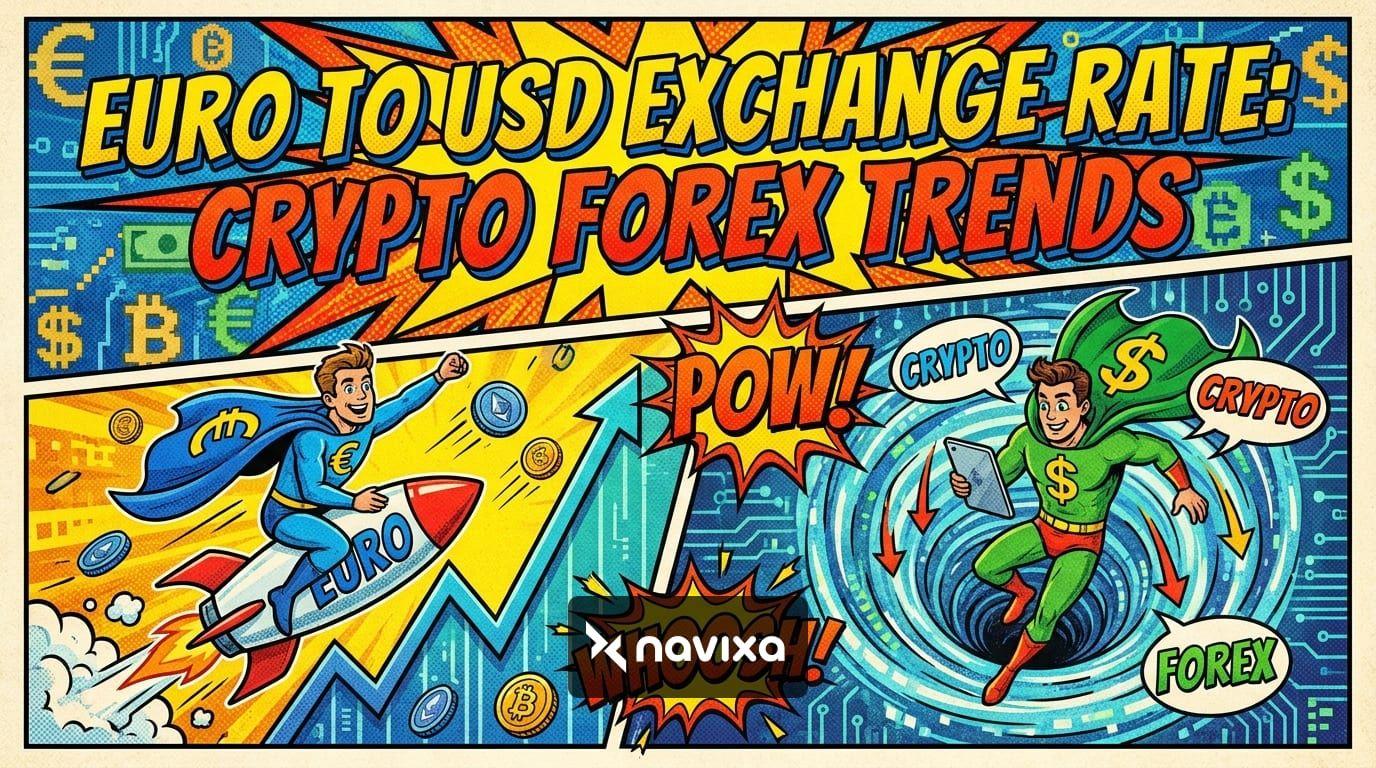
The euro to usd exchange rate has long been the crown jewel of the global financial markets. As the most widely traded fiat currency pair in the world, it serves as the ultimate barometer for international economic health, balancing the monetary policies of the European Central Bank (ECB) against the United States Federal Reserve. However, the financial landscape is undergoing a monumental shift. The traditional foreign exchange (forex) market is increasingly intersecting with the world of digital assets. Today, we are witnessing a paradigm-shifting convergence: the tokenization of fiat currencies on blockchain networks.
Whether you are a traditional macroeconomic forex trader analyzing interest rate differentials, or a decentralized finance (DeFi) enthusiast providing liquidity to stablecoin pools, understanding the modern euro to usd exchange rate requires a dual perspective. This comprehensive guide will explore the latest macroeconomic drivers shaping the EUR/USD pair, delve into the explosive growth of crypto forex trends, outline advanced trading strategies, and provide actionable insights for navigating this hybrid market.
The Macroeconomic Landscape Shaping the Euro to USD Exchange Rate
Before diving into blockchain innovations, it is essential to understand the fundamental drivers of the EUR/USD pair. The valuation of the euro against the US dollar is intrinsically linked to macroeconomic indicators, central bank policies, and geopolitical stability.
Current Trends and Key Price Levels
Recent market data places the euro to usd exchange rate in a highly contested zone, hovering around the 1.17 to 1.18 level. This represents a dynamic phase for the euro, driven largely by shifting expectations regarding monetary policy.
In the US, recent leading growth indicators, such as the ISM Manufacturing PMI, have shown signs of cooling, pulling the US Dollar Index (DXY) down from its previous highs. Consequently, markets have been pricing in a more dovish Federal Reserve, anticipating potential adjustments or an extended pause in restrictive policies. Conversely, the ECB has maintained a relatively neutral stance, supported by stabilizing inflation and steady Eurozone growth. This divergence in central bank posturing has periodically given the euro a distinct bullish edge.
From a technical perspective, the pair has recently tested a crucial resistance trendline near 1.18 to 1.19. A definitive breakout above this zone on high-timeframe charts could open the door to levels not seen in recent years, potentially targeting the 1.22 mark. Conversely, critical structural support lies at 1.1660; a break below this could signal a bearish continuation toward the 1.14 region.
"The modern forex trader must look beyond traditional economic calendars. In today's interconnected ecosystem, a deep understanding of tokenized liquidity and on-chain metrics is just as crucial as tracking Non-Farm Payrolls."
Crypto Forex Trends: The Tokenization of Currency
The most disruptive trend impacting how we interact with the euro to usd exchange rate is the explosive adoption of stablecoins. Historically, forex trading was confined to institutional platforms, prime brokers, and legacy banking rails that operated strictly 24 hours a day, 5 days a week. The advent of fiat-backed stablecoins has shattered these limitations, ushering in a 24/7/365 global trading environment.
The Dominance of USDC and the Rise of EURC
When we talk about tokenized dollars, Circle's USDC (USD Coin) and Tether's USDT dominate the landscape, functioning as the backbone of crypto liquidity. However, the tokenized euro market has recently experienced a massive catalyst.
Driven by the European Union's comprehensive Markets in Crypto-Assets (MiCA) regulation, the euro stablecoin sector has seen a regulatory "shakeout". Weaker, non-compliant players have been sidelined, allowing fully backed, regulated tokens like EURC to capture over 50% of the euro stablecoin market. For traders, this means that the EURC/USDC pair on decentralized exchanges now serves as an accurate, highly liquid, and on-chain proxy for the traditional euro to usd exchange rate.
Furthermore, enterprise payment giants are progressively integrating stablecoin settlement solutions. This shift means that businesses are increasingly utilizing tokenized euros and dollars not just for speculative trading, but for daily cross-border payroll, B2B settlements, and treasury management. When global enterprises route millions of dollars through on-chain EURC/USDC pools, the liquidity deepens significantly, matching the efficiency of tier-one banks.
DeFi Liquidity Pools and AMMs
In the traditional forex market, brokers act as intermediaries, matching buyers and sellers and profiting from the bid-ask spread. In the crypto forex ecosystem, Automated Market Makers (AMMs) like Uniswap and Curve Finance replace the middleman.
Traders can now swap EURC for USDC directly from their self-custodial wallets with near-instant settlement. Furthermore, liquidity providers can deposit both assets into concentrated liquidity pools, earning a percentage of the trading fees. Because EURC and USDC are stablecoins pegged to relatively stable fiat currencies, the risk of "impermanent loss" is drastically lower compared to volatile crypto pairs like Bitcoin or Ethereum.
Trading Strategy: Technical and On-Chain Analysis
Successfully navigating the euro to usd exchange rate in this hybrid era requires a robust trading strategy that merges traditional technical analysis with modern on-chain indicators.
1. Moving Averages and Momentum Indicators
For swing traders, utilizing the 50-day and 200-day Simple Moving Averages (SMA) is essential. When the 50-day SMA crosses above the 200-day SMA on the daily chart (a "Golden Cross"), it signals strong bullish momentum for the euro. Conversely, a "Death Cross" indicates impending downward pressure on the pair.
Pairing moving averages with the Relative Strength Index (RSI) helps identify overbought or oversold conditions. If the euro to usd exchange rate pushes past 1.18 while the RSI climbs above 70, the asset may be temporarily overbought, signaling a potential pullback or consolidation phase.
2. Scalping in DeFi Stablecoin Pools
For crypto-native traders, the EURC/USDC pair offers unique arbitrage and scalping opportunities. While the on-chain exchange rate closely mirrors the traditional forex rate, momentary dislocations can occur during times of high network congestion or sudden macroeconomic news (e.g., an unexpected CPI print). Traders utilizing algorithmic bots can exploit these micro-arbitrage opportunities, buying EURC on-chain when it briefly dips below the fiat market rate and selling when parity is restored.
3. Yield Farming as a Forex Hedge
Traditional forex traders often pay "rollover" or "swap" fees to hold positions overnight. In decentralized finance, providing liquidity to a EURC/USDC pool allows traders to earn a yield on their forex exposure. If a trader believes the euro to usd exchange rate will remain relatively flat (trading in a tight range), they can deploy capital into a tightly concentrated liquidity pool, harvesting trading fees while maintaining exposure to both fiat pegs.
4. Fibonacci Retracement Levels
Advanced traders frequently use Fibonacci retracement tools to identify potential reversal zones during a strong macroeconomic trend. For instance, if the euro to usd exchange rate rallies from a swing low of 1.15 to a swing high of 1.19, drawing a Fibonacci sequence can highlight the 38.2% and 61.8% retracement levels. These specific price points often act as hidden support zones where large institutional buyers and algorithmic bots step back into the market to accumulate positions at a favorable discount.
5. Volume Profile in Decentralized Markets
In legacy forex, actual traded volume is notoriously difficult to measure accurately because the market is decentralized across thousands of brokers. However, crypto forex completely solves this transparency issue. Traders can utilize blockchain scanners to view the exact on-chain volume of the EURC/USDC pairs across different decentralized exchanges. Analyzing spikes in on-chain volume provides a real-time sentiment indicator, helping traders confirm whether a breakout in the exchange rate is backed by genuine institutional capital or is merely a low-liquidity "fakeout."
Actionable Steps and Risk Management
Whether you are trading through a traditional brokerage or a Web3 protocol, strict risk management is non-negotiable. The leverage available in forex markets can amplify both gains and losses exponentially.
1. Define Your Stop-Loss Levels: Never enter a trade without a clear exit strategy. If you are long on the euro at 1.1750, placing a stop-loss just below structural support at 1.1660 ensures your downside is capped. 2. Monitor the Macro Calendar: Keep a close eye on high-impact events published on Trading Economics. ECB press conferences, US inflation data, and employment reports can trigger massive volatility. 3. Assess Counterparty and Smart Contract Risk: If trading traditional forex, ensure your broker is regulated by top-tier authorities (like the FCA or CFTC). If trading crypto forex, understand that DeFi protocols carry smart contract vulnerabilities. Only interact with thoroughly audited platforms and well-established stablecoins. 4. Understand Margin Requirements: Crypto exchanges and forex brokers offer varying degrees of leverage. High leverage means a fractional move in the euro to usd exchange rate can result in margin calls. Always use appropriate position sizing. 5. Diversify Stablecoin Holdings: While fully reserved stablecoins are designed to maintain their pegs rigidly, tail-risk events can happen. Diversifying your stablecoin exposure across different compliant issuers mitigates single-point-of-failure risks in your portfolio.
Traditional Forex vs. Crypto Forex
To better understand the shifting landscape, it is helpful to compare the mechanics of traditional fiat trading with modern tokenized forex.
| Feature | Traditional Forex (EUR/USD) | Crypto Forex (EURC/USDC) |
|---|---|---|
| Market Hours | 24/5 (Closed on weekends) | 24/7/365 (Never closes) |
| Intermediaries | Brokers, Banks, Clearinghouses | Smart Contracts, AMMs |
| Settlement Time | T+2 days (typically) | Near-instant (seconds to minutes) |
| Yield Generation | Interest rate differentials (Swaps) | Liquidity Provisioning (LP Fees) |
| Custody | Held by broker/bank | Self-custodial wallets |
| Transparency | Opaque institutional order books | 100% Transparent on-chain ledgers |
Practical Takeaways for the Modern Trader
- Stay Informed on Regulations: The implementation of MiCA in Europe is reshaping the stablecoin landscape. Regulated tokens like EURC will likely see increased institutional adoption, making them more reliable proxies for the fiat euro. - Diversify Trading Venues: Don't limit yourself to legacy platforms. Explore how on-chain liquidity on networks like Ethereum, Base, or Arbitrum can offer tighter spreads or better yields during low-volatility periods. - Watch the Central Banks: The fundamental driver of the euro to usd exchange rate remains the policy differential between the ECB and the Fed. Crypto trends provide the *infrastructure*, but macroeconomic data dictates the *direction*. - Leverage Blockchain Analytics: Utilize tools like CoinMarketCap to monitor the market capitalization and on-chain volume of fiat-backed stablecoins, as sudden spikes can indicate institutional capital flows.
Conclusion
The euro to usd exchange rate is no longer confined to the screens of Wall Street terminals. As blockchain technology matures, the tokenization of global forex markets is unlocking unprecedented efficiency, transparency, and accessibility. By bridging traditional macroeconomic analysis with innovative crypto forex trends, traders can position themselves at the forefront of this financial revolution. Whether you are scalping on-chain liquidity pools or swing trading based on central bank policies, staying educated and adaptable is your greatest edge. Take action today by reviewing your current forex strategies, exploring reputable stablecoin liquidity pools, and integrating a hybrid approach into your trading portfolio. The future of finance is already here—make sure you are ready to trade it.
Frequently Asked Questions
What are the main factors driving the euro to usd exchange rate today?
The primary drivers include central bank monetary policies (interest rate decisions by the ECB and the Federal Reserve), inflation reports, economic growth indicators (like GDP and PMI data), and geopolitical events.
How do stablecoins like EURC and USDC affect forex trading?
Stablecoins allow traders to trade forex pairs on blockchain networks 24/7 without traditional intermediaries. They provide near-instant settlement, lower cross-border transfer costs, and enable users to earn yield by providing liquidity to decentralized exchanges.
Is trading EURC/USDC the same as trading EUR/USD?
Fundamentally, the exchange rate closely mirrors the traditional fiat pair because the tokens are pegged to their respective currencies. However, the underlying mechanics differ. Crypto forex involves self-custody, smart contracts, and decentralized liquidity pools, whereas traditional forex relies on brokers and legacy banking infrastructure.
What is impermanent loss, and does it apply to stablecoin forex pairs?
Impermanent loss occurs in DeFi when the ratio of tokens in a liquidity pool changes due to price volatility. Because EURC and USDC are pegged to relatively stable fiat currencies, the price divergence is minimal compared to volatile crypto assets, making impermanent loss a much smaller risk for stablecoin liquidity providers.
How has the MiCA regulation impacted euro stablecoins?
The Markets in Crypto-Assets (MiCA) regulation in the EU has established strict capital and reserve requirements for stablecoin issuers. This has led to a consolidation in the market, heavily favoring compliant, fully backed tokens like EURC, thereby increasing institutional trust and safety in crypto forex ecosystems.