
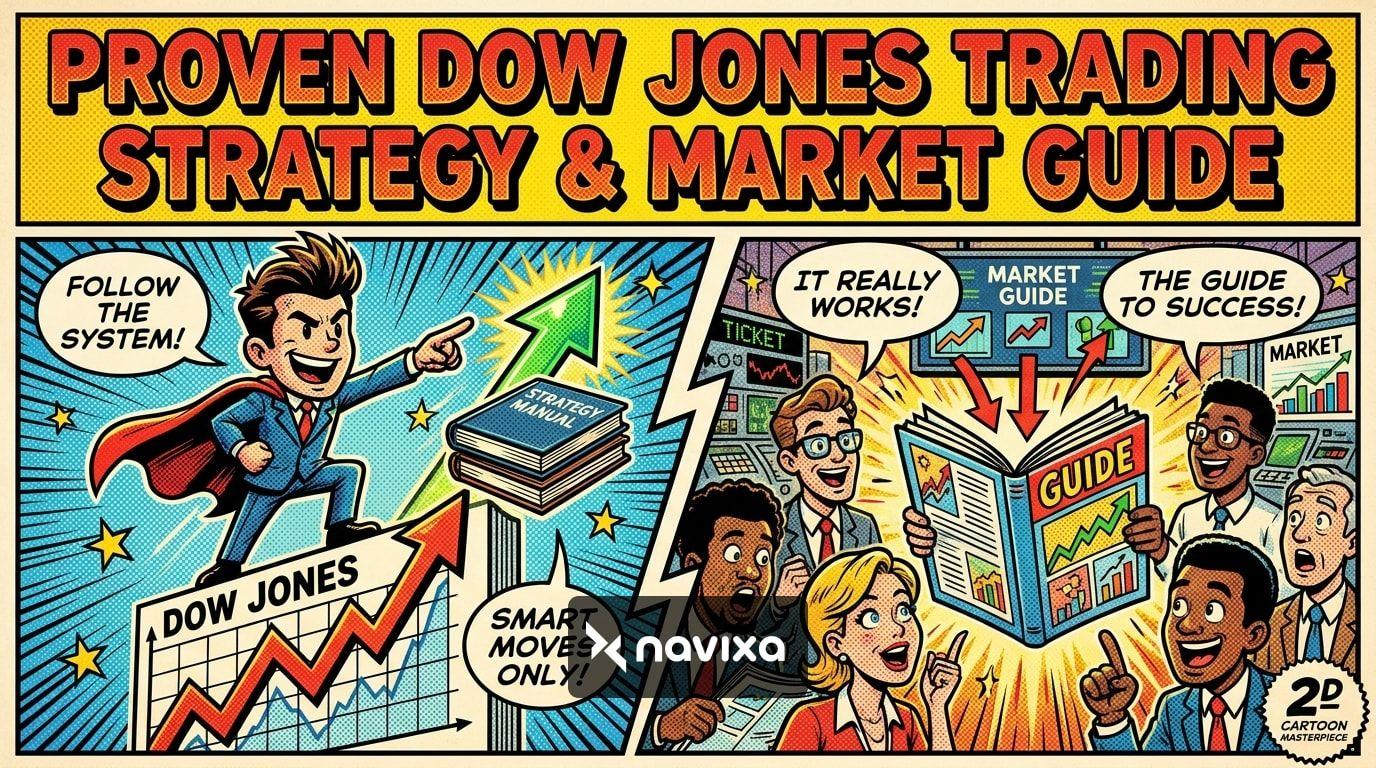
The Dow Jones Industrial Average (DJIA) stands as arguably the most recognizable financial barometer in the world. Originally created in 1896, the Dow tracks the performance of 30 prominent, large-cap companies listed on stock exchanges in the United States. For generations, traders and investors have looked to the DJIA as a primary indicator of overall market health and economic stability.
Developing a robust Dow Jones trading strategy is essential for anyone looking to capitalize on the movements of blue-chip American equities. Unlike broader indices like the S&P 500, the Dow requires a unique approach due to its distinctive price-weighted structure and concentrated component list. Whether you are a day trader looking to scalp quick intraday movements using futures contracts, or a swing trader capitalizing on macroeconomic trends, understanding how the index behaves is the foundation of long-term profitability.
In this comprehensive guide, we will break down the mechanics of the Dow, explore the best financial instruments for trading it, and provide actionable steps to build a strategy that works in both bull and bear markets.
Understanding the Dow Jones Industrial Average (DJIA)
Before deploying capital, a trader must understand what they are actually trading. The DJIA is composed of 30 blue-chip companies spanning multiple sectors, including technology, healthcare, financials, and industrials.
The Quirk of Price-Weighting
One of the most critical aspects of any Dow Jones trading strategy is understanding that the index is price-weighted. Most modern indices, such as the Nasdaq 100 or S&P 500, are weighted by market capitalization, meaning a company's total market value dictates its influence. In contrast, a company's influence on the Dow is determined purely by its share price.
For instance, a stock trading at $500 per share will have a significantly larger impact on the daily movements of the DJIA than a stock trading at $50, even if the $50 stock represents a much larger company by market capitalization. This means traders must keep a close eye on the highest-priced components within the index—such as Goldman Sachs, UnitedHealth Group, or Microsoft—because substantial price swings in these specific stocks will heavily skew the entire index.
Component Rebalancing
The composition of the Dow is not static. The selection committee periodically reviews the 30 components to ensure they accurately reflect the modern American economy. For example, recent years have seen major shifts, such as Nvidia replacing Intel, and Amazon being added to replace Walgreens Boots Alliance. Staying updated on these component changes is vital, as index reconstitutions can trigger significant volume and volatility.
Choosing the Right Instrument for Your Dow Jones Trading Strategy
Retail and institutional traders have several avenues to gain exposure to the Dow. Selecting the right instrument depends on your account size, risk tolerance, and trading timeframe.
E-mini and Micro E-mini Dow Futures
Futures contracts are among the most popular ways to day trade the DJIA. Traded on the Chicago Mercantile Exchange (CME), the E-mini Dow ($5) Futures (Ticker: YM) offer tremendous liquidity and leverage. The contract moves at $5 per index point. For traders with smaller accounts, the Micro E-mini Dow Futures (Ticker: MYM) offer the exact same exposure but at one-tenth the size ($0.50 per index point).
Futures allow you to trade nearly 24 hours a day during the trading week, providing the flexibility to react to overnight geopolitical events or global macroeconomic news before the New York cash session opens.
Exchange-Traded Funds (ETFs)
If futures are too highly leveraged for your risk profile, the SPDR Dow Jones Industrial Average ETF Trust (Ticker: DIA) is an excellent alternative. Known colloquially as "Diamonds," this ETF tracks the price and yield performance of the DJIA. It trades like a regular stock, making it highly accessible for swing traders and long-term investors.
Options on the Dow
Options contracts offer a flexible way to hedge existing portfolios or speculate on directional movements with defined risk. You can trade options directly on the DIA ETF or opt for options on Dow futures (OYM). Options are ideal for deploying complex strategies like iron condors, straddles, or covered calls.
Contracts for Difference (CFDs)
For international traders outside the United States, CFDs are a highly popular way to trade the index (often listed as US30 or Wall Street 30 by brokers). CFDs allow you to speculate on the price movement without owning the underlying asset, often providing fractional lot sizing for precise risk management.
Core Elements of a Winning Dow Jones Trading Strategy
To consistently extract profits from the market, your Dow Jones trading strategy must incorporate a blend of macroeconomic awareness, technical precision, and structural market timing. The DJIA recently tested historic levels near the 50,000 mark, underscoring the necessity of having strict analytical parameters.
1. Fundamental and Macroeconomic Analysis
The DJIA is a macroeconomic bellwether. Because it is comprised of massive, multinational corporations, the index is highly sensitive to broad economic data. Key fundamental drivers include:
* Federal Reserve Policy: Interest rate decisions and commentary from the Fed directly impact equity valuations. Lower rates generally fuel borrowing and corporate expansion, pushing the Dow higher, whereas rate hikes tend to compress valuations. * Economic Indicators: Reports such as the Consumer Price Index (CPI), Non-Farm Payrolls (NFP), and Gross Domestic Product (GDP) growth can trigger massive intraday volatility. * Corporate Earnings: During earnings season, the quarterly results of the top-weighted Dow components can single-handedly dictate the direction of the index for the day.
2. Technical Analysis and Charting
Technical analysis provides the exact entry and exit parameters for your trades. Due to the high liquidity of the Dow, it tends to respect technical levels quite well.
* Support and Resistance: Identifying historical price levels where buyers or sellers have previously stepped in is crucial. Breakouts from these zones often lead to sustained trends. * Moving Averages: The 50-day and 200-day Simple Moving Averages (SMA) are widely watched by institutions. A "Golden Cross" (50-day crossing above the 200-day) is generally seen as a bullish signal, while a "Death Cross" signals a bearish regime. * Momentum Oscillators: Tools like the Relative Strength Index (RSI) or the Moving Average Convergence Divergence (MACD) help identify overbought or oversold conditions, allowing traders to time pullbacks.
3. Time-of-Day Trading and Volatility
Market timing is an underappreciated element of day trading. The US stock market opens at 9:30 AM Eastern Time (ET) and closes at 4:00 PM ET.
"The opening hour of the New York session is where the institutional money leaves its footprint. If you can read the first hour, you can often map the rest of the day."
The highest volatility and trading volume occur during the first 90 minutes of the cash session and the final hour of the day. A popular day trading strategy involves waiting for the initial morning volatility to establish a high and a low for the first 30 minutes, and then trading the breakout of that established range.
Actionable Steps to Execute Your Trades
Ready to put theory into practice? Follow these actionable steps to execute your Dow Jones trading strategy:
Step 1: Determine Your Trading Style Decide whether you will be scalping (holding for minutes), day trading (closing before the end of the day), or swing trading (holding for days or weeks). Your style will dictate your chart timeframes.
Step 2: Set Up Your Charts Clean charts are critical. Apply a 15-minute timeframe for day trading, overlay the Volume Weighted Average Price (VWAP), and mark your key support and resistance zones from the daily chart.
Step 3: Define Your Entry Triggers Do not trade purely on gut feeling. Wait for a specific setup. For example, a valid entry trigger could be: "I will buy the US30 when the price pulls back to the VWAP on the 5-minute chart and forms a bullish engulfing candlestick."
Step 4: Execute and Manage Once the trigger appears, execute the trade. Immediately place your stop-loss order to protect your downside. As the trade moves in your favor, consider trailing your stop-loss to lock in profits.
Risk Management: Protecting Your Capital
Even the most brilliant Dow Jones trading strategy will fail without strict risk management. The leverage inherent in futures and CFDs can wipe out an account rapidly if not respected.
1. The 1% Rule: Never risk more than 1% to 2% of your total account equity on a single trade. If you have a $10,000 account, your maximum loss per trade should not exceed $100 to $200. 2. Position Sizing: Calculate your position size based on the distance to your stop-loss. If your stop-loss is 50 points away, ensure the dollar value of those 50 points aligns with your 1% risk rule. 3. Reward-to-Risk Ratio: Aim for a minimum reward-to-risk ratio of 2:1. If you are risking 50 points, your profit target should be at least 100 points.
Comparing Dow Trading Instruments
To help you decide which instrument best suits your Dow Jones trading strategy, review the comparison table below:
| Feature | E-mini Futures (YM) | Micro E-mini (MYM) | Dow ETF (DIA) | US30 CFDs |
|---|---|---|---|---|
| Multiplier/Size | $5 per point | $0.50 per point | 1 Share | Varies by Broker |
| Trading Hours | Nearly 24/5 | Nearly 24/5 | Regular Market Hours | Nearly 24/5 |
| Leverage | High | High | None (unless on margin) | Very High |
| Best Suited For | Pro Day Traders | Beginner Day Traders | Swing/Long-Term | International Traders |
| Capital Required | High Margin | Low Margin | Variable | Low Margin |
Practical Takeaways for Consistent Profits
* Monitor Top-Weighted Stocks: Since the Dow is price-weighted, routinely check the performance of the top 5 highest-priced stocks in the index. If they are trending down, longing the index is highly risky. * Use an Economic Calendar: Never hold a day trade into a major macroeconomic news release like the CPI or a Federal Reserve rate decision. The slippage can bypass your stop-loss. * Journal Your Trades: The key to refining your Dow Jones trading strategy is data collection. Keep a detailed log of every trade you take, noting the setup, time of day, and emotional state. * Leverage Educational Resources: Continuously study market mechanics. Trusted financial resources and exchanges often provide deep dives into contract specifications and market data (e.g., CME Group's Education Center and Investopedia's Market Insights).
Conclusion
Trading the Dow Jones Industrial Average offers a dynamic and rewarding pathway to engage with the US stock market. By understanding its unique price-weighted structure, selecting the appropriate financial instrument, and blending macroeconomic awareness with technical precision, you can develop a highly effective Dow Jones trading strategy.
Remember that consistency is built on the back of rigorous risk management and emotional discipline. Do not rush the process. Start by paper trading your strategy on a demo account, refine your edge, and only transition to live capital once you have proven your profitability. Take control of your financial journey today by studying the charts and building a strategy that aligns with your unique goals.
Frequently Asked Questions
What is the best time of day to trade the Dow Jones?
The optimal time to trade the Dow Jones is during the New York cash session, specifically between 9:30 AM and 11:30 AM Eastern Time. This two-hour window typically provides the highest trading volume and volatility, offering the best opportunities for day traders to capture significant price movements.
Why does the S&P 500 move differently than the Dow Jones?
The indices differ primarily in their weighting methodologies and component sizes. The S&P 500 includes 500 companies and is market-capitalization weighted, meaning larger companies have more influence. The Dow Jones includes only 30 companies and is price-weighted, meaning stocks with higher per-share prices drive the index's movements, regardless of the company's overall market cap.
Can I trade the Dow Jones with a small account?
Yes, traders with small accounts can trade the Dow Jones using Micro E-mini Dow Futures (MYM), which are sized at just $0.50 per index point. Additionally, many international brokers offer fractional US30 CFDs, allowing traders to participate in the market with very low margin requirements.
Is the Dow Jones suitable for long-term investing or just day trading?
The Dow Jones is suitable for both. Day traders utilize futures and CFDs to capitalize on intraday volatility, while long-term investors frequently buy and hold ETFs like the SPDR Dow Jones Industrial Average ETF (DIA) to benefit from long-term capital appreciation and dividend yields from established blue-chip companies.
How do Federal Reserve interest rate changes affect my Dow Jones trading strategy?
Federal Reserve interest rate decisions heavily impact equity markets. Generally, lowering interest rates decreases borrowing costs, boosting corporate profits and pushing the Dow higher. Conversely, raising interest rates can cool down economic growth and lead to a decline in the index. Traders must account for these macroeconomic shifts when determining their directional bias.