
Introduction
For both traditional investors and cryptocurrency traders, Dow Jones trading remains a cornerstone of global financial markets. The Dow Jones Industrial Average (DJIA) is one of the oldest, most prestigious, and widely recognized equity indexes in the world. While cryptocurrency markets offer unparalleled volatility and decentralized 24/7 price action, trading the Dow Jones provides exposure to established American blue-chip companies, consistent liquidity, and robust macroeconomic trends.
In this comprehensive guide, we will explore everything you need to know to successfully execute a Dow Jones trading strategy. Whether you want to hedge your digital asset portfolio, take speculative positions on the broader U.S. economy, or transition from crypto day trading to traditional index futures, mastering the intricacies of this index is absolutely essential. By the end of this article, you will have a clear, step-by-step strategy for entering your trades, managing systemic risk, and analyzing the price action of the DJIA like a seasoned professional.
What is the Dow Jones Industrial Average?
The Dow Jones Industrial Average (DJIA) tracks the performance of 30 prominent, publicly owned blue-chip companies listed on major stock exchanges in the United States. Created in 1896 by Charles Dow and Edward Jones, the Dow is unique because, unlike the S&P 500 or the Nasdaq Composite, it is a strictly price-weighted index.
The Price-Weighted Methodology Explained
In a market-capitalization-weighted index, a company’s impact on the overall index is determined by its total market value. In stark contrast, the Dow’s price-weighted methodology dictates that the constituent companies with the highest share prices have the absolute largest influence on the index's movement, regardless of their actual overall market capitalization.
For instance, as of 2026, companies like Goldman Sachs (GS) and Caterpillar (CAT) boast some of the highest individual stock prices within the index. Consequently, Goldman Sachs accounts for over 11% of the Dow's total weighting. This gives the financial giant significantly more influence over the index’s daily point movements than technology behemoths like Apple or Cisco, whose nominal share prices are much lower despite having vastly superior market caps.
"Understanding the price-weighted nature of the Dow is critical for modern traders. A 5% price movement in a heavily weighted stock like Goldman Sachs will drastically outpace the index impact of a 5% move in an artificially lower-priced stock."
The Role of the Dow Divisor
To ensure that events like stock splits or special dividends do not artificially distort the value of the index, the creators implemented the "Dow Divisor." The index is calculated by adding up the stock prices of all 30 components and dividing them by this specialized divisor. The divisor is continuously updated by S&P Dow Jones Indices to maintain historical continuity.
Why Should Crypto Traders Trade the Dow Jones?
Cryptocurrency traders are accustomed to high-risk, high-reward environments. However, heavily trending periods in crypto can often be followed by long, agonizing sideways markets or devastating "crypto winters." Incorporating Dow Jones trading into your overall market strategy offers several distinct advantages:
1. Portfolio Diversification: The Dow is heavily weighted toward the financials, healthcare, and industrials sectors. This offers vital defensive characteristics during periods when high-growth tech tokens or highly speculative crypto assets face aggressive macroeconomic sell-offs. 2. Unmatched Liquidity and Leverage: Futures contracts tied to the DJIA offer exceptionally deep liquidity. Traders can utilize margin to open significant positions with relatively low upfront capital requirements, eliminating the slippage often seen in altcoin markets. 3. Macroeconomic Correlation: Bitcoin and the broader crypto market have become increasingly correlated with traditional equities. Trading the Dow forces digital asset traders to keep a firm pulse on the macroeconomic data—such as Federal Reserve interest rate decisions, Non-Farm Payrolls (NFP), and CPI prints—that quietly drive all modern financial ecosystems.
Popular Instruments for Dow Jones Trading
Before executing a trade, you must thoughtfully choose the right financial instrument. Below are the most common vehicles used for trading the Dow Jones globally.
1. E-Mini and Micro E-Mini Futures
Futures contracts are the premier choice for day traders, swing traders, and proprietary trading firms. Traded almost around the clock on the Chicago Mercantile Exchange (CME) Globex platform, the E-mini Dow ($5) futures (Ticker: YM) strictly track the DJIA. Every 1-point move in the index equates to exactly a $5 change per contract.
For retail traders working with smaller account sizes, the Micro E-mini Dow futures (Ticker: MYM) operate at exactly 1/10th the size, offering a highly manageable $0.50 tick per point. This allows exact position sizing and aggressively minimizes risk for retail participants testing new strategies.
2. Exchange-Traded Funds (ETFs)
For swing traders, passive investors, and those wanting a simpler structure, the SPDR Dow Jones Industrial Average ETF (Ticker: DIA) is highly popular. This ETF tracks the Dow's price movements directly and also pays a monthly dividend based on the yields of the 30 underlying companies. Trading the DIA ETF is fundamentally identical to trading a traditional stock and is highly accessible across all major retail brokerage accounts.
3. Contracts for Difference (CFDs) and Tokenized Assets
For international traders or those operating natively in Web3 ecosystems, CFDs and synthetic tokenized indices provide direct price exposure without requiring cumbersome traditional brokerage accounts. Many offshore crypto exchanges and global CFD brokers allow you to trade price movements of the Dow (often listed under the ticker US30) with significant leverage using stablecoins like USDT or USDC as your underlying collateral.
Dow Jones Trading Instruments Comparison
| Instrument | Ticker Symbol | Leverage / Margin | Best Suited For | Market Trading Hours |
|---|---|---|---|---|
| E-mini Futures | YM | High | Experienced Day Traders | Nearly 24/5 (CME Globex) |
| Micro E-mini | MYM | Medium / High | Retail & New Traders | Nearly 24/5 (CME Globex) |
| Dow ETF | DIA | Low | Swing/Long-Term Investors | Regular U.S. Market Hours |
| CFDs / Tokens | US30 / Dow30 | Very High | Crypto & Global Traders | Nearly 24/5 (Broker Dependent) |
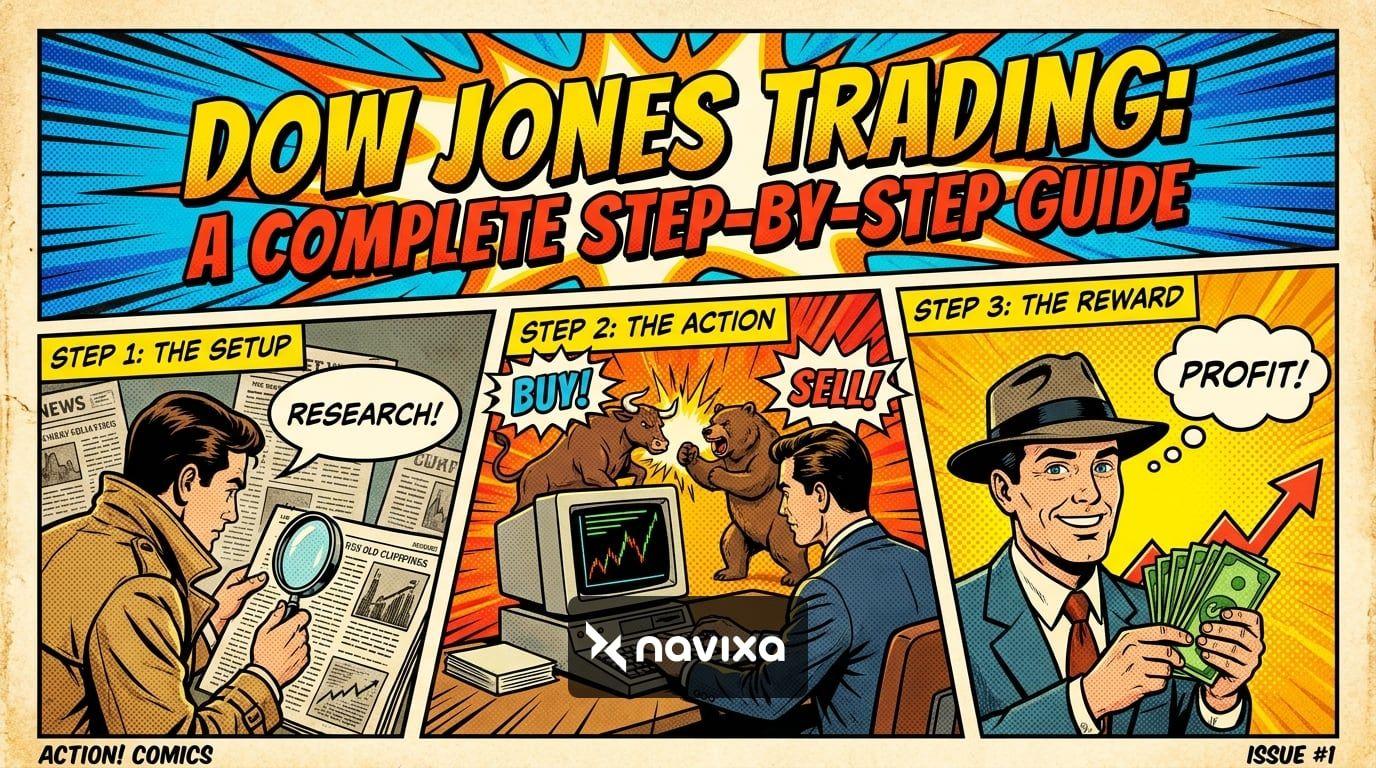
How to Trade the Dow Jones: Step-By-Step Guide
Executing consistently profitable trades on the Dow requires a structured, mechanical approach. Follow these actionable steps to formulate and execute your trading workflow.
Step 1: Select a Reliable Trading Platform
Choose a regulated broker or exchange that perfectly suits your chosen instrument. If you want to trade E-mini futures, you will need a dedicated futures broker such as NinjaTrader or TradeStation. If you prefer ETFs, traditional tier-one brokers like Fidelity or Interactive Brokers are ideal. Ensure your platform provides lightning-fast execution speeds, minimal commissions, and high-quality charting tools.
Step 2: Conduct Top-Down Market Analysis
Successful Dow Jones trading requires a nuanced blend of both fundamental and technical analysis.
Fundamental Analysis: Start by analyzing the broader macroeconomic environment. Are interest rates rising or falling? Is systemic inflation cooling down? Because the Dow consists of industrial and financial behemoths, it is highly sensitive to the broader economic cycle. Monitor corporate earnings heavily; if a heavily weighted stock like Microsoft or UnitedHealth issues weak forward guidance, it can drastically drag down the entire index.
Technical Analysis: Open your charting software and identify major support and resistance zones on the daily and weekly timeframes. Identify overall trend direction before zooming into the 15-minute or 1-hour charts for precise day-trading setups.
Step 3: Choose Your Strategy and Entry Point
Identify your specific edge in the market. Are you looking to capitalize on morning volatility, or are you hoping to catch a multi-week macro swing trade? Pinpoint exact entry levels using robust technical indicators such as Moving Averages, the Relative Strength Index (RSI), MACD, or Volume Profile. Wait patiently for the market to give you a definitive confirmation signal before deploying your hard-earned capital.
Step 4: Size Your Position and Set Stop-Losses
Before clicking "buy" or "sell," you must know exactly where your trade thesis is invalidated. Set a hard stop-loss order immediately to protect your trading capital from flash crashes or unexpected news events. A standard professional rule of thumb is never to risk more than 1% to 2% of your total account equity on a single Dow trade. Ensure your profit target offers a highly favorable risk-to-reward ratio, ideally 1:2 or greater.
Step 5: Execute, Monitor, and Journal
Enter the trade and allow your statistical edge to play out. Avoid the common pitfall of micro-managing a swing position on a 1-minute chart if your original setup was based on a 4-hour timeframe. Once the trade completely concludes—whether it successfully hits your take-profit or unfortunately triggers your stop-loss—record it meticulously in a trading journal. Note the setup, your psychological state, and the macroeconomic context of the day for future review.
Top Dow Jones Trading Strategies
If you are actively looking for specific market setups to implement, consider testing these three time-tested Dow Jones trading strategies.
1. The Opening Range Breakout (ORB)
The Opening Range Breakout is an absolute favorite among index day traders. The strategy involves carefully monitoring the first 15 to 30 minutes of regular cash market hours (9:30 AM to 10:00 AM EST). Traders identify the exact high and low of this opening range. If the DJIA price breaks decisively above the high with aggressively strong volume, traders execute a long position. Conversely, if it breaks fiercely below the low, they immediately initiate a short position to ride the downward momentum.
2. Macroeconomic News Trading
The Dow is heavily impacted by the monetary policy of the U.S. Federal Reserve. When the Federal Open Market Committee (FOMC) officially releases rate decisions, or when the Bureau of Labor Statistics aggressively publishes jobs reports, the Dow inevitably experiences extreme localized volatility. Smart news traders wait patiently for the initial erratic volatile spike to settle, identify the actual fundamental trend direction, and ride the institutional momentum. It is highly recommended that you consult data resources like the CME FedWatch Tool to anticipate broader market pricing before the news drops.
3. Moving Average Trend Following
For patient swing traders, utilizing moving average crossovers on the daily chart can indicate massively shifting macroeconomic momentum. A common historical strategy involves the 50-day and 200-day Simple Moving Averages (SMA). When the 50-day SMA powerfully crosses above the 200-day SMA (a "Golden Cross"), it signals long-term institutional bullish momentum. Conversely, a "Death Cross" can signal impending bearish action, appropriately prompting traders to build short positions or selectively hedge their long-term portfolios.
Risk Management for Dow Traders
Trading the Dow Jones, particularly through highly leveraged futures contracts or CFDs, carries a substantial inherent risk of capital loss. To survive in the financial markets long-term, you must view risk management as your absolute primary job.
* Deeply Understand the Tick Value: If you are actively trading the standard YM futures contract, remember constantly that every single point is worth $5. A perfectly normal, volatile 300-point swing in the Dow will impact your account equity by a massive $1,500 per contract. Size your daily positions accordingly. * Avoid the Trap of Overleveraging: Just because an offshore broker offers 100:1 leverage does not mean you should ever use it. Overleveraging leaves you incredibly vulnerable to normal daily market fluctuations, resulting in premature and devastating liquidations. * Monitor Individual Component Earnings: Because the Dow is strictly price-weighted, a massive earnings miss by a significantly high-priced constituent (e.g., UnitedHealth, Goldman Sachs, or Microsoft) can brutally cause the entire index to gap down, painfully taking your long position with it. Always check the corporate earnings calendar before holding positions overnight.
Conclusion
Dow Jones trading is a highly dynamic endeavor that demands a deep, fundamental understanding of market mechanics, macroeconomics, and strict risk control. By leveraging the right financial instruments—whether that involves high-octane E-mini futures, the conservative DIA ETF, or innovative tokenized Web3 assets—you can effectively navigate the lucrative volatility of the traditional stock market. Follow the structured step-by-step guide outlined above, vigorously backtest a robust trading strategy, and ruthlessly prioritize capital preservation to tilt the mathematical odds of long-term profitability deeply in your favor.
As global financial markets become increasingly interconnected, the most profitable traders are the ones who can seamlessly navigate both the bleeding-edge volatility of cryptocurrency and the foundational, structural trends of traditional blue-chip indices.
---
Frequently Asked Questions
What is the best time of day to trade the Dow Jones?
The most liquid and volatile time to trade the Dow Jones is during the regular U.S. cash market hours, which strictly run from 9:30 AM to 4:00 PM Eastern Standard Time (EST). The opening hour of the cash session usually sees the highest institutional trading volume, regularly presenting the absolute best opportunities for intraday breakout traders.
Why is the Dow Jones price-weighted instead of market-cap weighted?
The Dow was originally created in 1896, long before advanced algorithmic computational models existed. To easily calculate the index average manually, the founders simply added the stock prices of the companies together and divided them by a specific mathematical divisor. This historical, legacy methodology remains in place today, meaning companies with higher raw share prices inherently exert vastly more influence on the index than those with larger market capitalizations but lower share prices.
Can I trade the Dow Jones on a cryptocurrency exchange?
While you cannot officially trade the exact traditional CME futures contracts on standard spot crypto exchanges, many advanced cryptocurrency derivatives platforms and global CFD brokers now offer synthetic tokenized indices or perpetual swap contracts that explicitly track the price of the Dow (often conveniently labeled as US30). This natively allows crypto traders to gain direct equity exposure using stablecoins as their primary margin.
How much capital do I really need to start trading Dow futures?
If you are boldly trading standard E-mini Dow (YM) contracts, brokers typically require intraday margins ranging heavily from $500 to $1,000 per contract, though holding positions overnight can easily require margins exceeding $3,000. However, the modern introduction of Micro E-mini (MYM) contracts thankfully allows retail traders to begin trading with much smaller initial accounts, often requiring as astonishingly little as $50 in intraday margin per contract.