
stock technical analysis
DIS Stock Technical Analysis: Key Levels & Chart Patterns
- May 7, 2026
- 12 min read
Navigating the modern equity markets requires a blend of fundamental awareness and precise technical execution. For traders looking at the Walt Disney Company, mastering DIS stock technical analysis is essential to unlocking consistent opportunities in a highly volatile landscape. Disney has historically been viewed as a legacy entertainment giant, but its recent evolution into a streaming and digital experiences powerhouse has fundamentally altered how its stock behaves on the charts.
In recent market sessions, Disney shares have traded within a highly contested channel, bouncing between key support zones near $102 and resistance ceilings approaching $110. As institutional money rotates between sectors based on broader macroeconomic signals and consumer spending data, retail traders must rely on chart patterns, momentum oscillators, and volume profiling to time their entries and exits. This comprehensive guide breaks down the critical technical levels, psychological barriers, and proven strategies needed to trade DIS stock effectively.
- Disney's ongoing transition to streaming profitability creates distinct technical support and resistance levels.
- The $102.00 to $108.00 price channel serves as a critical battleground for bulls and bears.
- Moving averages, specifically the 50-day and 200-day EMAs, dictate the medium-term market momentum.
- Proper risk management and position sizing are essential when trading volatility and pattern breakouts.

The Macro Context: Disney's Financial Health and Sentiment
While technical analysis focuses on price action and volume, the underlying fundamental narrative often provides the catalyst for major breakouts or breakdowns. Disney's recent quarterly earnings have showcased a complex but promising picture. The company reported robust revenue figures of $25.17 billion, driven heavily by improvements in its streaming division. More importantly, the streaming segment has finally reached a profitability inflection point, generating substantial operating income and alleviating a major concern for long-term investors.
However, the market remains cautious due to normalization in international park attendance and broader consumer discretionary spending pressures. When analyzing sector-wide momentum, evaluating the technical setups for CMG reveals similar patterns in how consumer-facing brands react to macroeconomic shifts. If inflation remains sticky or interest rates fluctuate unpredictably, highly visible consumer discretionary stocks like Disney are often the first to experience algorithmic selling pressure.
Traders must overlay these macroeconomic realities onto their technical charts. A strong earnings report that fails to push the stock above a major resistance level is a classic bearish divergence, signaling that institutional sellers are using the liquidity event to unload shares. Conversely, negative news that fails to break foundational support indicates aggressive institutional accumulation.
Correlating Traditional Stocks with Digital Markets
Although Disney is a traditional blue-chip stock, modern financial markets are increasingly interconnected. The strategies utilized by contemporary traders often blend legacy equity analysis with the high-velocity tactics developed in 24/7 digital asset markets. As retail trading demographics shift, understanding the Gen Z digital wealth thesis becomes critical. Younger investors are actively applying crypto-native concepts—such as liquidity sweeps, order block trading, and aggressive momentum scaling—to traditional equities.
Furthermore, broader liquidity cycles dictated by central banks impact both the stock market and the cryptocurrency sector simultaneously. Periodic macro warnings from Warren Buffett regarding market valuations and speculative excess often signal upcoming volatility that bleeds across all asset classes. Traders who monitor Bitcoin dominance or stablecoin flows can sometimes anticipate risk-on or risk-off environments that directly impact the trading volume of mega-cap stocks like Disney.
DIS Stock Technical Analysis: Charting the Key Levels
To successfully trade DIS, one must map out the battlefield. The current technical landscape is defined by a clear horizontal channel and converging trendlines.
The foundational support level currently sits firmly in the $102.00 to $103.50 range. This zone has been tested multiple times over the past year, and each time, buyers have stepped in to defend the price. In technical terms, this represents a massive liquidity pool where institutional limit orders are clustered. A breakdown below $102.00 on high volume would be a severe bearish signal, potentially opening the door for a rapid descent toward the mid-$90s.
On the upside, the resistance ceiling is clearly established between $108.00 and $110.00. This area has historically acted as strong supply. Sellers consistently overwhelm buyers as the stock approaches $110, causing the price to reject and consolidate back toward the mean.

Moving Averages and Trend Alignment
Moving averages are lagging indicators, but they remain invaluable for confirming the primary trend. The 50-day Exponential Moving Average (EMA) and the 200-day EMA are the industry standards for institutional trend tracking.
Currently, DIS stock is oscillating around its 50-day EMA (near $101.80), which suggests short-term indecision. However, the 200-day EMA (hovering around $107.50) is acting as a dynamic line of resistance overhead. For a true bullish reversal to be confirmed, the price must not only break above the $110 horizontal resistance but also print consecutive daily closes above the 200-day EMA. Comparing this setup to legacy industrial turnarounds, such as the trading patterns in Ford stock, we see that breaking the 200-day moving average is often the prerequisite for a sustained, multi-month rally.
Market Analysis & Trading Psychology
Trading a highly publicized, mega-cap stock like Disney requires intense psychological discipline. Because retail traders are emotionally attached to the Disney brand—often conflating their love for the company's movies or theme parks with the viability of the stock—the market is prone to irrational exuberance and panic selling.
This is where E-E-A-T (Experience, Expertise, Authoritativeness, and Trustworthiness) principles in trading psychology come into play. Professional traders do not trade the company; they trade the chart. Cognitive biases, specifically anchoring bias, often trap amateur investors. An investor might anchor their expectations to Disney's all-time highs near $200 and perceive the current $105 price as "cheap." However, technical analysis dictates that an asset is never objectively cheap or expensive—it is only bullish or bearish relative to its current structure.
Institutions understand this psychological vulnerability and actively exploit it. They accumulate positions quietly during periods of low volatility and high retail despair (near support), and they distribute their shares during periods of high retail FOMO (near resistance).
**Beware of Earnings Volatility** Trading immediately before or after a quarterly earnings report can expose you to unpredictable overnight gaps. Always use strict stop-loss orders and consider waiting for the initial volatility to subside before executing a new position.
Key Chart Patterns and Breakout Zones
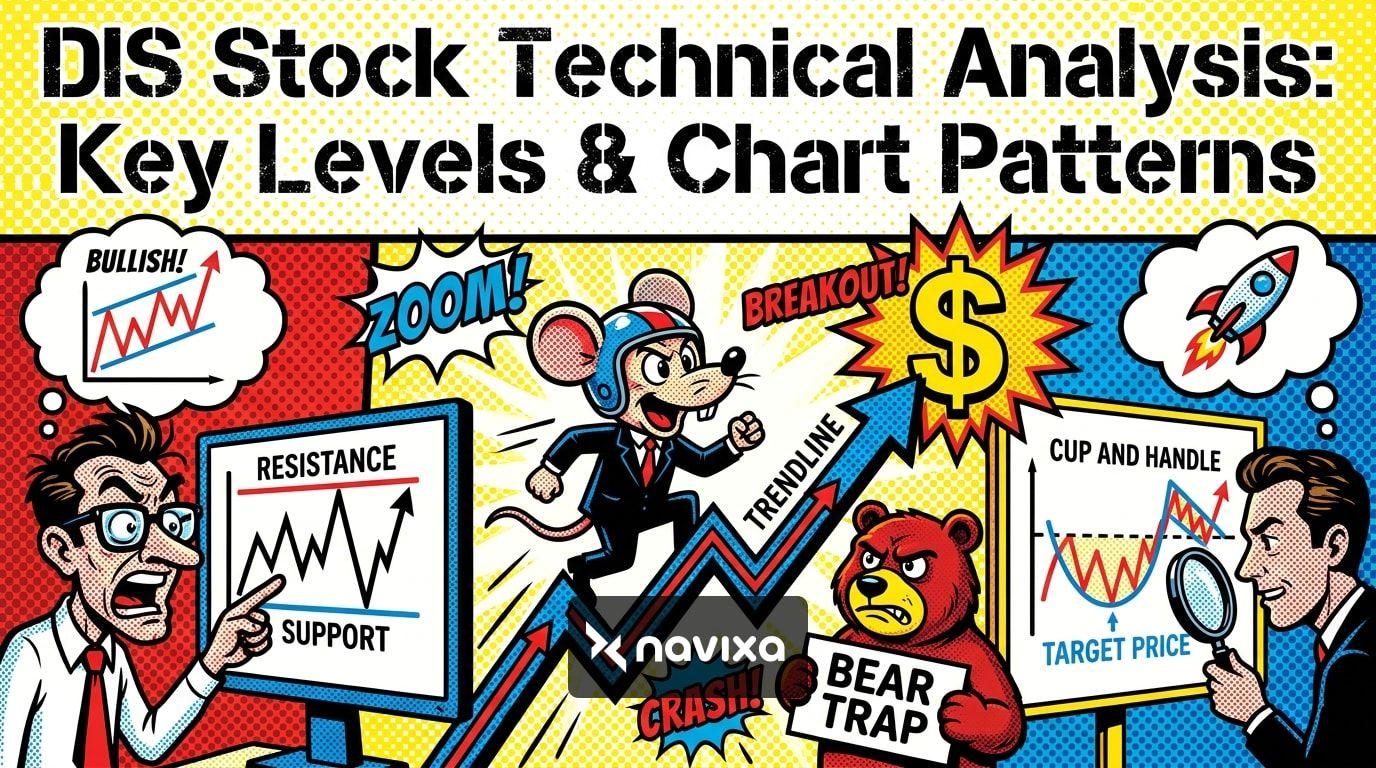
Chart patterns are the visual representation of market psychology. For DIS stock, two primary patterns dominate the current macroeconomic timeframe: the Consolidation Wedge and the Descending Channel.
The Consolidation Wedge
A consolidation wedge occurs when the price action compresses between a rising support line and a falling resistance line, indicating a decrease in volatility prior to a major explosive move. Disney has been printing lower highs and higher lows on the weekly chart, building tension.
To effectively capitalize on this, traders must wait for a decisive breakout. A daily candle closing outside the wedge boundary, accompanied by a surge in trading volume, serves as the confirmation signal. If you want to systematically track and trade these formations, employing a price action breakout strategy can help automate alerts when crucial trendlines are breached.

Key Technical Levels Breakdown
Monitoring exact price points is non-negotiable for precision trading. The table below outlines the critical zones for DIS stock based on current market data:
| Technical Indicator / Level | Current Value / Zone | Market Implication |
|---|---|---|
| Near-Term Support | $102.00 - $103.50 | Accumulation zone; strong buyer defense historically proven |
| Resistance Ceiling | $108.00 - $110.00 | Supply zone; breakout required to establish an uptrend |
| 50-Day Moving Average | ~$101.80 | Bullish indicator if price consistently maintains above this level |
| 200-Day Moving Average | ~$107.50 | Major long-term trendline acting as heavy dynamic resistance |
| RSI (14-Day) | ~69.00 | Approaching overbought territory; indicates potential for a short-term pullback |
In trading, what is comfortable is rarely profitable. Buying at major support often feels terrifying, while buying at resistance feels incredibly safe. The chart reveals the truth the emotions try to hide.
Actionable Steps and Risk Management
Executing a successful trade requires more than just drawing lines on a chart; it demands rigorous risk management. When trading DIS stock technical analysis setups, position sizing is your primary defense against ruin. Never risk more than 1% to 2% of your total account equity on a single trade setup.
If you are entering a long position near the $102 support zone, your stop-loss should be placed just below the psychological $100 barrier—perhaps around $99.50—to account for minor liquidity sweeps or fake-outs. To continuously validate the fundamental landscape underlying your technical assumptions, cross-reference your charts with institutional data from resources like Morningstar or official company filings via Disney Investor Relations.

**Scaling Into Positions** Instead of buying your full allocation at once, consider scaling into DIS stock. Buy a partial position at the support baseline and add the remaining capital only when a confirmed breakout occurs above the immediate resistance level.
For traders seeking to optimize their workflow, you can explore Navixa strategies to gain deeper insights into algorithmic pattern recognition and enhance your overall risk-adjusted returns.
Conclusion
Mastering DIS stock technical analysis provides an invaluable edge in a market dominated by algorithmic trading and macroeconomic uncertainty. By combining an understanding of Disney's fundamental streaming pivot with strict adherence to key technical levels—specifically the $102 support and $110 resistance—traders can systematically identify high-probability setups.
Whether you are executing short-term swing trades or accumulating shares for a long-term macroeconomic cycle, removing emotion and relying on empirical chart data is the ultimate key to longevity. To begin applying these methodologies and tracking real-time market opportunities, start trading with Navixa and elevate your financial strategy to the institutional level.
Frequently Asked Questions
What is the primary support level for Disney (DIS) stock right now?
The primary support zone currently sits tightly between $102.00 and $103.50. This is a critical level where institutional buyers have historically stepped in to defend the price during broader market pullbacks.
How does the streaming business impact DIS technical analysis?
While technical analysis is strictly focused on price action, the fundamental success of Disney's streaming profitability directly influences institutional accumulation. When streaming margins improve, institutional volume increases, which in turn drives the stock through major technical resistance levels.
Can I use crypto trading strategies on traditional stocks like Disney?
Yes. Many foundational technical analysis concepts—such as support/resistance flipping, RSI divergence, and MACD crossovers—apply universally across both digital assets and traditional blue-chip equities. However, traditional stocks generally exhibit lower intraday volatility compared to crypto.
Why is the 200-day moving average so important for DIS?
The 200-day moving average acts as the ultimate long-term trend indicator. When DIS trades below this line, the stock is generally considered to be in a macroeconomic downtrend. Crossing and holding above the 200-day EMA often signals a major, long-lasting bullish reversal.