
Introduction
For modern traders and investors navigating the fast-paced financial markets, identifying stocks with strong momentum and solid technological fundamentals is critical. While cryptocurrency markets often dominate the headlines for extreme volatility, legacy technology companies pivoting toward artificial intelligence (AI) have generated massive, trend-following opportunities. One of the most prominent examples of this shift is Dell Technologies Inc. (NYSE: DELL). Mastering a comprehensive DELL stock technical analysis is essential for anyone looking to capitalize on its recent price action and long-term potential.
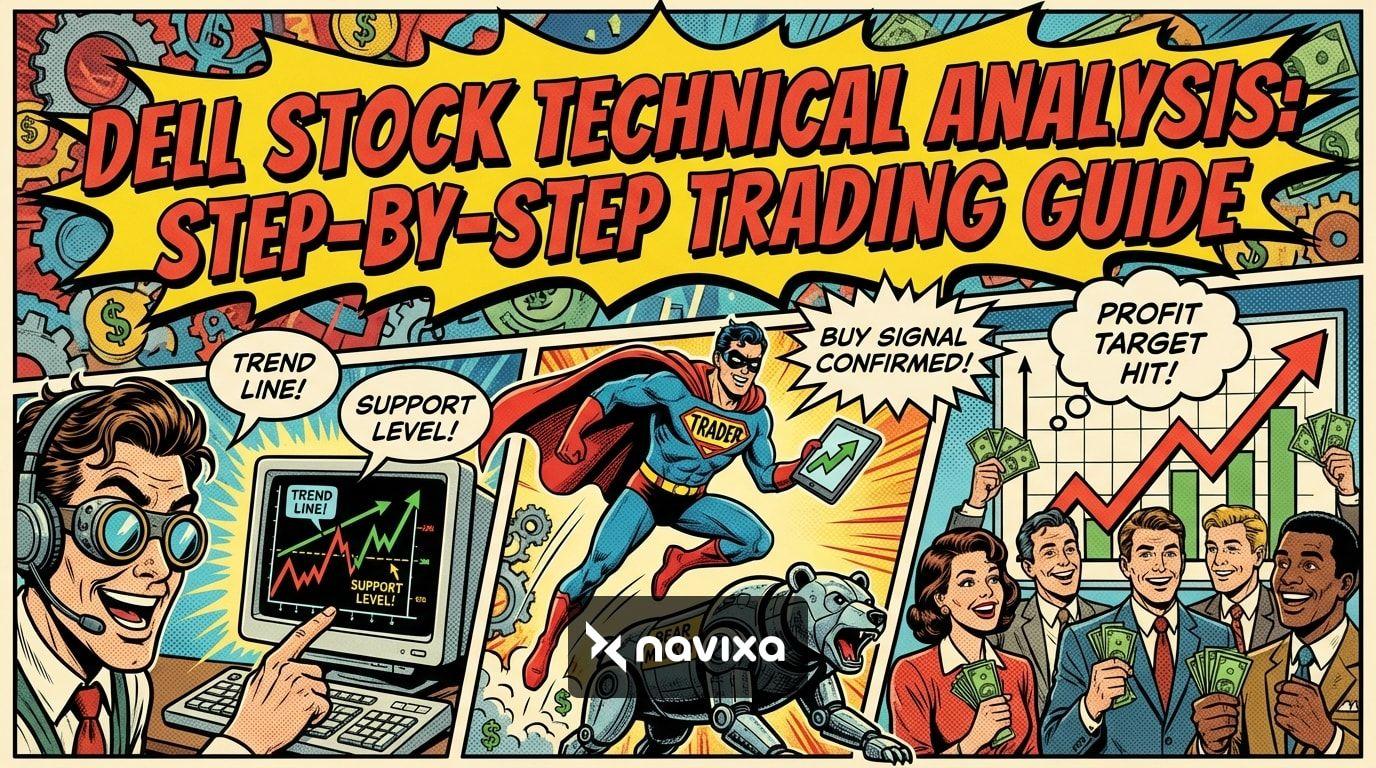
In this guide, we will break down the essential technical indicators, chart patterns, and trading strategies tailored specifically for DELL. Whether you are a seasoned day trader, a crypto investor diversifying into traditional equities, or a swing trader looking for the next breakout, this step-by-step trading guide will equip you with actionable insights to navigate DELL's market movements effectively.
"The trend is your friend until the end when it bends. Combining macroeconomic catalysts with precise technical analysis is the ultimate recipe for trading success."
By understanding how institutional order flow, volume spikes, and algorithmic trading influence Dell's price action, you can build a more resilient trading portfolio.
The Fundamental Catalyst Behind DELL's Price Action
Before diving into the charts, it is vital to understand *why* DELL stock is moving. Technical analysis rarely exists in a vacuum; it is the visual representation of fundamental catalysts and market psychology.
In recent years, Dell has transformed from a traditional PC and hardware manufacturer into a dominant force in enterprise AI infrastructure. As of 2026, Dell's AI server shipments are projected to hit roughly $25 billion for the fiscal year, driven by a massive $18.4 billion backlog. The company's integration of high-performance components, including NVIDIA technologies within its Dell AI Factory, has attracted major hyperscalers, government agencies, and enterprise buyers.
With consensus analyst price targets hovering around a median of $167—and high estimates reaching up to $220—the fundamental backdrop remains heavily bullish. This underlying strength provides a strong foundation for our DELL stock technical analysis, as strong fundamentals often result in sustained technical uptrends, making trend-following strategies highly effective.
Core Components of DELL Stock Technical Analysis
To execute profitable trades, you need to monitor the right indicators. Technical analysis relies on historical price data and volume to predict future price movements. Here are the most critical indicators to apply to your DELL stock charts.
1. Moving Averages (SMA and EMA)
Moving averages help smooth out price action and identify the overarching trend. For DELL stock, traders typically focus on: * 50-Day Exponential Moving Average (EMA): This indicator reacts quickly to recent price changes. When DELL's price trades above the 50-day EMA, the short-to-medium-term momentum is bullish. * 200-Day Simple Moving Average (SMA): This is the ultimate barometer for the long-term trend. A "Golden Cross" (when the 50-day EMA crosses above the 200-day SMA) is a classic bullish signal that has historically preceded massive rallies in tech stocks.
For more detailed definitions of these indicators, you can explore this Investopedia guide on Technical Analysis.
2. Relative Strength Index (RSI) & MACD
The Relative Strength Index (RSI) is a momentum oscillator that measures the speed and change of price movements on a scale of 0 to 100. * Overbought (Above 70): When DELL's RSI crosses 70, the stock may be overextended, signaling a potential pullback or consolidation phase. * Oversold (Below 30): If broader market panic or temporary tech sector weakness pushes DELL's RSI below 30, it often presents a lucrative buying opportunity for swing traders.
3. Support and Resistance Levels
Support and resistance are psychological price levels where buying and selling pressure equalize. * Support Zones: Based on recent trading data, DELL has established strong structural support in the $145–$150 range. If the price approaches this zone, buyers historically step in to defend the level. * Resistance Zones: Resistance often forms around previous all-time highs or psychological round numbers. A breakout above the $160–$168 resistance zone, supported by high trading volume, would confirm a continuation of the bullish trend toward the $200 mark.
Step-by-Step Trading Strategy for DELL
Now that we have established the tools, let's build a systematic trading strategy based on DELL stock technical analysis.
Step 1: Identify the Macro Trend
Start by looking at the weekly chart. Identify whether DELL is making higher highs and higher lows (an uptrend) or lower highs and lower lows (a downtrend). Given the strong AI narrative, DELL is predominantly in an uptrend. Align your trades with this macro direction. Shorting a strong tech stock in a bull market is a high-risk endeavor.
Volume analysis is also paramount here. Look for "accumulation days"—sessions where the stock price closes higher on volume that is significantly above the 30-day average. This indicates institutional buying. Conversely, "distribution days" are characterized by price drops on high volume, signaling institutional selling. When accumulation days outnumber distribution days over a quarterly period, the macro trend is solidified as bullish.
Step 2: Pinpoint Entry and Exit Levels
Switch to the daily or 4-hour chart to refine your entries. Use Fibonacci retracement tools drawn from the recent swing low to the swing high. Look for the price to retrace to the 0.382 or 0.618 Fibonacci levels. If these levels align with the 50-day EMA, you have a high-probability entry zone.
Another highly effective tool for entering trades is the Moving Average Convergence Divergence (MACD). Wait for the MACD line to cross above the signal line while below the zero axis to capture a reversal entry. Combine this with candlestick patterns like bullish engulfing candles or hammer formations at support to dramatically increase your probability of a successful trade.
For exits, consider scale-out strategies: sell half of your position at the first major resistance level, and let the remaining half run with a trailing stop to capture maximum upside.
Step 3: Implement Risk Management
Never enter a trade without a predefined exit plan. Place a stop-loss order slightly below the nearest major support level. For example, if you enter DELL at $152, placing a stop-loss at $143 ensures that a sudden breakdown does not wipe out your capital.
Fundamental vs. Technical Analysis for DELL Stock
Traders often debate whether to use fundamental or technical analysis. The most successful traders use a hybrid approach. Below is a comparison of how both methodologies apply to Dell Technologies.
| Feature | Technical Analysis (DELL) | Fundamental Analysis (DELL) |
|---|---|---|
| Primary Focus | Price action, trading volume, chart patterns. | Revenue, AI server backlog, profit margins. |
| Time Horizon | Short to medium-term (Intraday, Swing). | Long-term (Months to Years). |
| Key Metrics | RSI, MACD, Moving Averages, Support/Resistance. | P/E Ratio, EPS growth, $25B AI server pipeline. |
| Best Used For | Timing market entries and exits accurately. | Determining the underlying value of the company. |
By combining the AI infrastructure narrative (fundamental) with breakout patterns (technical), you drastically increase your win rate.
Actionable Steps and Risk Management
To trade DELL stock safely and profitably, you must adhere to strict risk management protocols. Even the best DELL stock technical analysis will fail if you do not protect your downside.
Position Sizing
Never risk more than 1% to 2% of your total trading capital on a single trade. If you have a $10,000 account, your maximum acceptable loss on a DELL trade should be $100 to $200. Adjust your position size based on the distance to your stop-loss.
Use Trailing Stops
Because tech stocks can be volatile, consider using a trailing stop-loss. As DELL's price rises and hits new highs, manually move your stop-loss up to protect your profits. This allows you to ride the trend while ensuring a winning trade does not turn into a losing one.
Hedging Strategies
Advanced traders often use options to hedge their underlying stock positions. If you are holding a large, long-term position in DELL but fear a short-term market correction, purchasing out-of-the-money put options can act as an insurance policy. This allows you to maintain your core position—avoiding short-term capital gains taxes—while protecting your portfolio's total equity from sudden drawdowns caused by sector-wide tech selloffs.
Avoid Earnings Roulette
Earnings reports can cause unpredictable, massive price gaps. While technical analysis is highly effective during normal trading days, holding a short-term leveraged position through a quarterly earnings announcement is akin to gambling. If you are swing trading, consider trimming your position before earnings to reduce exposure. You can track upcoming events and map charts on platforms like TradingView.
Practical Takeaways
* Contextualize the Trend: DELL's technical momentum is heavily supported by its fundamental pivot to enterprise AI and server infrastructure. * Watch Key Averages: The 50-day EMA and 200-day SMA are your best tools for trend confirmation. * Buy the Pullbacks: In an established uptrend, use oversold RSI conditions and Fibonacci retracements to find low-risk entries. * Protect Your Capital: Always use strict stop-loss orders and adhere to the 1-2% position sizing rule to survive market volatility.
Frequently Asked Questions
What is the current price target for DELL stock?
Based on 2026 analyst estimates, the median price target for DELL stock sits around $167, with optimistic high-end targets reaching up to $220. These targets reflect strong anticipated growth in their AI server infrastructure operations.
How does DELL's AI server business affect its stock technicals?
Dell's multi-billion dollar AI server backlog creates sustained institutional buying pressure. This fundamental strength limits downside risk, creating strong technical support levels and resulting in shallower pullbacks during broader market corrections.
Can cryptocurrency traders apply crypto strategies to DELL stock?
Yes. Crypto traders who utilize momentum trading, breakout strategies, and Fibonacci retracements will find that DELL's stock charts behave very similarly to high-cap altcoins, largely due to algorithmic trading and tech-sector volatility.
What are the main support and resistance levels for DELL?
Technically, DELL has formed a strong support base in the $145–$150 region. Immediate resistance is generally located around the $160–$168 zone. A high-volume breakout above this resistance could clear the path toward the $180 to $200 psychological levels.
Conclusion
Conducting a thorough DELL stock technical analysis provides a clear roadmap for navigating the complexities of the modern tech market. Driven by massive enterprise demand for AI servers and infrastructure, Dell Technologies has cemented itself as a premier trading vehicle offering both volatility and directional momentum. By implementing the technical indicators discussed—such as moving averages, RSI, and robust risk management—you can confidently identify high-probability entry and exit points.
Trading is not just about predictive modeling; it is about risk control and psychological discipline. Do not let FOMO (Fear Of Missing Out) dictate your trading decisions. Always wait for the price action to confirm your thesis before deploying capital. If you are new to technical analysis, consider paper trading on a simulated account to test these strategies before risking real money. Open your favorite charting platform, map out your support and resistance levels, and start trading DELL with precision today.