
Introduction
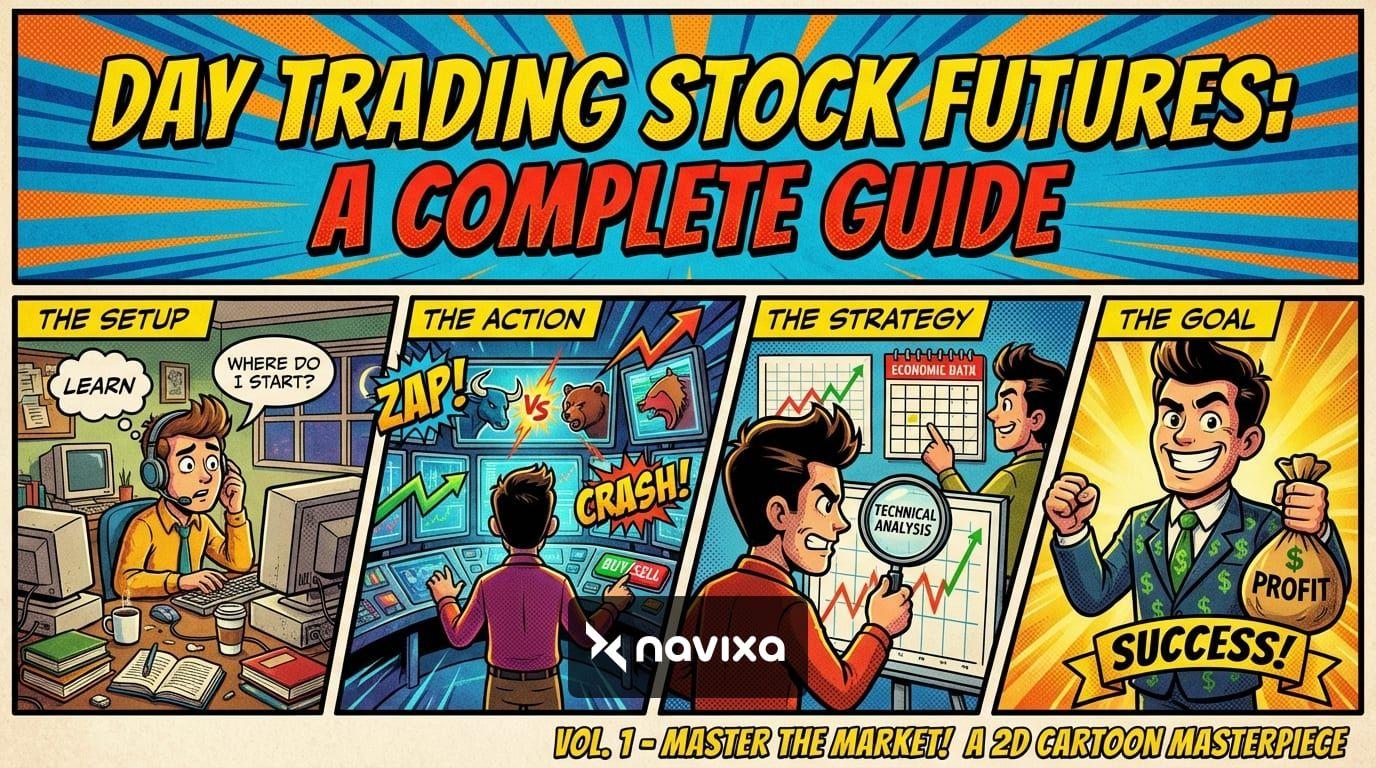
For active traders looking for liquidity, leverage, and flexibility, day trading stock futures has become an increasingly popular alternative to trading individual equities or cryptocurrency. Whether you are transitioning from the highly volatile crypto markets or moving away from capital-intensive stock day trading, the futures market offers a structured, transparent, and highly regulated environment.
Unlike traditional stock trading, which requires significant capital to bypass regulatory hurdles, stock index futures democratize access to major indices like the S&P 500 and the Nasdaq-100. By tracking the broader market rather than individual corporate earnings, traders can focus entirely on technical analysis, macroeconomics, and price action.
In this comprehensive guide, we will break down exactly how to start day trading stock futures, explore the unique benefits over crypto and spot stocks, and detail actionable strategies to help you navigate intraday volatility.
What Are Stock Futures?
Stock futures are standardized, exchange-traded financial contracts that obligate the buyer to purchase (or the seller to sell) a stock index at a predetermined future price and date. Rather than taking ownership of a physical asset, most futures traders speculate on the price direction of major indices, settling their contracts in cash before expiration.
When day trading stock futures, you are almost always dealing with index futures rather than individual single-stock futures. The most widely traded contracts in the world are offered by the Chicago Mercantile Exchange (CME).
E-mini vs. Micro E-mini Contracts
To understand the mechanics, you must understand the two primary contract sizes:
1. E-mini Contracts: The E-mini S&P 500 (ticker: ES) is the gold standard of futures trading. It has a multiplier of $50 per index point. If the S&P 500 moves one point, your contract value changes by $50. The minimum price fluctuation (a "tick") is 0.25 index points, meaning every tick is worth $12.50 per contract. 2. Micro E-mini Contracts: Introduced by the CME to accommodate retail traders, the Micro E-mini S&P 500 (ticker: MES) is one-tenth the size of the standard E-mini. At $5 per index point, a single tick (0.25 points) is worth just $1.25. This allows beginners to practice risk management with much lower capital.
"Micro E-mini contracts have revolutionized retail trading by providing direct access to the world’s most liquid equity markets at a fraction of the historical margin requirements."
Advantages of Day Trading Stock Futures
Traders coming from the cryptocurrency space or traditional stock brokerages often find the futures market superior for intraday action. Here is why:
1. No Pattern Day Trader (PDT) Rule
In the U.S. stock market, the Pattern Day Trader rule mandates that any trader executing four or more day trades within five business days must maintain a minimum account balance of $25,000. Futures markets are completely exempt from the PDT rule. You can execute as many intraday trades as you want with a much smaller account balance.
2. High Leverage and Low Margin Requirements
Capital efficiency in futures is unmatched. While stock trading normally requires a 50% margin (or 25% for intraday), futures utilize performance margins. Intraday margin requirements provided by brokers can be as low as $50 for a Micro E-mini contract and $500 for an E-mini contract. This allows you to control a large notional value of an index with a fraction of the capital.
3. Favorable Tax Treatment
In the United States, broad-based index futures fall under Section 1256 of the tax code. This means that any capital gains are taxed at a blended rate: 60% as long-term capital gains and 40% as short-term capital gains, regardless of how long you held the position. This is a massive advantage compared to day trading spot stocks or crypto, where all intraday profits are taxed as short-term ordinary income.
4. Nearly 24-Hour Trading
Cryptocurrency traders love the 24/7 nature of their markets. Stock futures offer the closest traditional finance equivalent, trading nearly 24 hours a day, five days a week (specifically, 23 hours a day with a one-hour maintenance break). This allows traders to capitalize on overnight news, Asian market opens, and European market sessions.
Market Comparison
To fully grasp the landscape, let's look at how day trading stock futures compares to spot stocks and cryptocurrency futures.
| Feature | Stock Index Futures | Spot Stocks | Crypto Futures |
|---|---|---|---|
| Trading Hours | 23 hours/day (Mon-Fri) | 6.5 hours/day (Core) | 24/7 |
| PDT Rule Applies? | No | Yes ($25k minimum) | No |
| Short Selling | Immediate, no borrow fees | Requires margin & borrow availability | Immediate |
| Tax Treatment (U.S.) | 60/40 Blended Rate | 100% Short-Term | 100% Short-Term |
| Centralized Clearing | Yes (e.g., CME Clearing) | Yes (DTCC) | No (Varies by Exchange) |
Proven Strategies for Day Trading Stock Futures
Success in the futures market requires strict discipline and a reliable methodology. Because indices reflect the aggregate data of underlying stocks, they adhere beautifully to technical analysis and volume data.
Volume Weighted Average Price (VWAP)
VWAP is arguably the most important indicator for institutional and retail futures traders alike. It displays the average price an instrument has traded at throughout the day, based on both volume and price. * The Strategy: Traders often use the VWAP line as a dynamic support and resistance level. If the ES contract is trading heavily above the VWAP, the intraday trend is bullish. A common entry strategy is buying pullbacks to the VWAP line during an established morning trend.
Order Flow and Volume Profile
Unlike decentralized crypto markets where volume is scattered across dozens of exchanges, CME futures data is centralized. This makes tools like the Volume Profile highly accurate. * The Strategy: The Volume Profile maps traded volume at specific price levels rather than time. Traders look for "High Volume Nodes" (areas where heavy trading occurred) to act as magnets for price, and "Low Volume Nodes" as areas where price will move quickly. Entering trades at the edge of a high-volume value area is a staple futures strategy.
Breakout and Pullback Trading
Because stock indices are highly liquid, key support and resistance levels are respected by algorithms and large institutions. * The Strategy: Identify pre-market highs and lows. When the regular trading hours (RTH) session opens at 9:30 AM EST, wait for the initial balance (the high and low of the first hour) to establish. Trading the breakout of the initial balance, followed by a successful retest of that level, is a high-probability setup.
For more technical insights into volume and price action, you can explore resources from the CME Group Educational Portal, which provides excellent foundational knowledge.
Actionable Steps: How to Start
If you are ready to begin day trading stock futures, follow this step-by-step framework to ensure you set yourself up for success without risking unnecessary capital.
Step 1: Choose a Futures-Specific Broker
While many traditional stock brokerages offer futures, specialized futures brokers often provide much lower day-trading margins, cheaper commission rates, and superior execution speeds. Look for platforms that offer direct market routing rather than payment for order flow.
Step 2: Set Up Your Charting Platform
Futures trading requires fast, tick-by-tick data. Platforms like TradingView are excellent for charting, but serious order flow traders often utilize software like Sierra Chart or NinjaTrader. You will also need to subscribe to a real-time data feed (such as CQG or Rithmic) for CME market data. For a deep dive into charting software, check out TradingView's Futures Section.
Step 3: Master the Micro E-mini (MES)
Never start trading the full E-mini (ES) or Nasdaq (NQ) contracts if you are a beginner. A sudden 10-point swing in the ES is a $500 loss per contract. In the MES, that same swing is only a $50 loss. Trade the micros until you have a proven track record of profitability over several months.
Step 4: Trade in a Simulator
Before risking live capital, spend at least a month trading in a simulated environment (often called paper trading). Treat the simulator exactly as you would live money. If you cannot be profitable in a simulator, you will not be profitable when actual emotions are involved.
Essential Risk Management Rules
The leverage that makes futures so attractive is the exact same tool that can blow up an account in minutes. Risk management is non-negotiable.
Calculate Risk per Trade
Never risk more than 1% to 2% of your total account equity on a single trade. If you have a $5,000 account, your maximum loss on a trade should be $50 to $100. This dictates your position size. If your stop loss requires you to risk $150 on an ES contract, you must switch to trading MES contracts to keep the risk within your threshold.
Implement a Daily Loss Limit
Emotional trading (tilting) destroys accounts. Set a hard daily loss limit with your broker. Many platforms allow you to lock your account from taking further trades once you hit a specific drawdown amount for the day. If your limit is $200, hitting it means you walk away from the screens until tomorrow.
Use Stop-Loss Orders Relentlessly
In the futures market, economic data releases (like CPI data or Federal Reserve announcements) can cause the market to spike wildly in milliseconds. Always use hard stop-loss orders placed at the exchange level to protect your capital from catastrophic black swan events.
Conclusion
Day trading stock futures provides a robust, highly liquid, and capital-efficient vehicle for generating intraday returns. By avoiding the PDT rule, capitalizing on lower margins, and taking advantage of favorable tax treatments, active traders can optimize their strategies far beyond what traditional equities allow.
Whether you are seeking to hedge a long-term cryptocurrency portfolio or simply looking for the purest form of price action trading, stock futures demand respect, education, and strict risk management. Start small with Micro E-mini contracts, respect your daily loss limits, and let the probabilities play out.
***
Frequently Asked Questions
What is the best time of day to trade stock futures?
The most liquid and volatile time to day trade stock index futures is during the U.S. Regular Trading Hours (RTH), which span from 9:30 AM to 4:00 PM Eastern Time. The first two hours (9:30 AM – 11:30 AM ET) generally offer the highest volume and best price action setups.
Can I day trade stock futures with $1,000?
Yes. Thanks to the introduction of Micro E-mini contracts (like the MES and MNQ), many futures brokers require intraday margins as low as $50 per contract. While $1,000 is enough to open an account and trade micros, it is highly recommended to have more capital to absorb inevitable drawdowns.
How are stock futures different from options?
Futures contracts represent a linear obligation to buy or sell an asset at a set price; your profit or loss moves tick-for-tick with the underlying index. Options give you the *right* (but not the obligation) to buy or sell, and their pricing involves complex variables like time decay (theta) and implied volatility, making them vastly different to day trade.
Do I actually have to buy the S&P 500 stocks if the contract expires?
No. Almost all stock index futures, including the E-mini and Micro E-mini series, are cash-settled. This means that at expiration, there is no physical delivery of shares. Your account is simply credited or debited the cash difference between your entry price and the final settlement price. However, day traders exit their positions before the daily close, avoiding expiration altogether.