
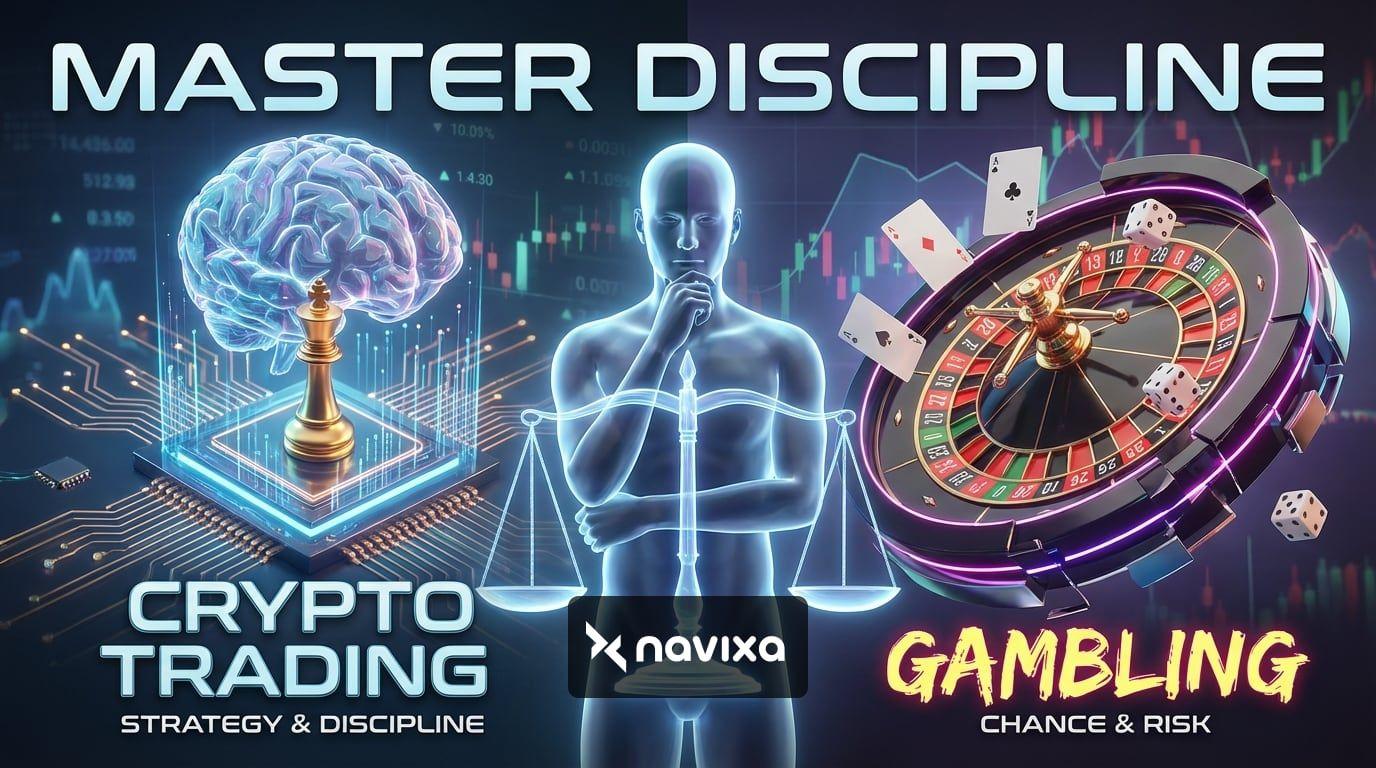
The cryptocurrency market is a financial frontier of unprecedented opportunity, but it is also a landscape fraught with devastating risk. As of early 2026, with Bitcoin (BTC) heavily consolidating in the $69,000 to $72,000 range and the total digital asset market capitalization approaching $2.44 trillion, the stakes have never been higher. Both institutional whales and retail participants are flocking to exchanges, eager to capture a slice of the digital gold rush. However, amid the flashing green and red candles, a vital distinction often gets lost. Are you executing a methodical financial strategy, or are you merely pulling the lever on a digital slot machine?
The debate of crypto trading vs gambling is one every market participant must confront. To build long-term wealth, you must master discipline, eliminate emotion from your execution, and treat your portfolio like a structured business rather than a casino balance. In this comprehensive guide, we will break down the psychological and mechanical differences between trading and gambling, and provide actionable steps to ensure you stay on the profitable side of the equation.
The Core Difference: Crypto Trading vs Gambling
At first glance, both trading and gambling look remarkably similar. Both involve risking capital in the present for an uncertain future reward. Both can deliver massive dopamine hits, and both can lead to financial ruin if mismanaged. But the similarities end there.
What is Gambling in Crypto?
Gambling relies fundamentally on hope, luck, and an inherent mathematical disadvantage. In a traditional casino, the house always has a built-in statistical edge. Over a long enough time horizon, the gambler will mathematically lose money. When applied to the digital asset markets, gambling manifests as:
* Buying without a thesis: Purchasing a meme coin simply because it is trending on social media without verifying its tokenomics or utility. * Over-leveraging: Using 50x or 100x leverage on a position without a strict stop-loss, essentially placing a "make or break" bet on a coin's short-term movement. * Revenge trading: Trying to aggressively win back money immediately after a loss, letting frustration rather than data dictate the next entry. * Ignoring macro factors: Failing to understand how external events, such as regulatory shifts or inflation data, might heavily impact asset valuations.
What is True Crypto Trading?
True crypto trading, on the other hand, is the continuous application of a verifiable statistical edge. A professional trader operates much like the casino itself, not the patron. By using technical analysis, fundamental research, and strict risk management, traders skew the probabilities in their favor.
* Executing a defined strategy: Buying an asset because it bounced off a historical support level on high trading volume, with a predetermined profit target and stop-loss. * Capital preservation: Never risking more than 1% to 2% of total capital on a single trade. * Expected Value (EV): Understanding that occasional losses are a normal business expense, and focusing purely on maintaining a positive expected value over 100 trades rather than the emotional outcome of a single trade.
Why the Crypto Market Feels Like a Casino
It is entirely understandable why the line in crypto trading vs gambling becomes blurred. The cryptocurrency market operates 24/7/365, unlike traditional stock markets that close on evenings and weekends. This constant accessibility means that a participant can execute a high-risk trade at 3:00 AM on a Sunday from their smartphone.
Furthermore, the user interfaces of modern crypto exchanges are often gamified. Bright colors, celebratory animations, push notifications, and competitive leaderboards can trigger the exact same dopamine loops as a Las Vegas slot machine. During bull markets, when "everything goes up," inexperienced participants are rewarded for reckless behavior. They confuse a rising tide with trading genius. When the market inevitably corrects, these individuals suffer catastrophic drawdowns because they lacked an underlying risk management framework.
Another psychological trap is Survivorship Bias. On platforms like X (formerly Twitter) and Reddit, you only see the massive success stories. You see the influencer who turned a small sum into a fortune trading an obscure altcoin. What you do not see are the thousands of retail participants who lost their entire life savings attempting the exact same feat. This skewed reality fuels FOMO (Fear Of Missing Out), pushing inexperienced individuals to buy into assets at their absolute peak.
"Trading is a game of probabilities. Gambling is a game of hope. To succeed in crypto, you must eliminate hope and embrace the math."
Master Discipline: Moving from Gambler to Trader
Transitioning from a gambler to a disciplined trader is not an overnight process. It requires a fundamental rewiring of your psychological relationship with money. Here are the core pillars to help you master discipline in the digital asset market.
1. Adopt a Strict Risk Management Protocol
If there is one non-negotiable rule in the crypto trading vs gambling paradigm, it is risk management. You must define your risk before you even click the "Buy" button. Utilize the 1% rule: Never risk more than 1% of your total account balance on a single trade. If you have a $10,000 portfolio, your maximum acceptable loss on a trade should be $100. This doesn't mean you only buy $100 worth of crypto; it means you set your stop-loss order so that if the trade goes against you, you are automatically exited from the market having lost exactly $100. For deeper insights into protecting your capital, explore established risk management strategies used by Wall Street veterans.
2. Rely on Technical and Fundamental Analysis
Stop listening to social media influencers and start reading the charts. Technical analysis (TA) involves studying historical price action and volume data to forecast future movements. Indicators like the Relative Strength Index (RSI), Moving Averages (MA), and Fibonacci retracements help traders find high-probability setups. Fundamental analysis (FA) is equally important, especially for altcoins. What problem does the blockchain solve? How active is the developer community? What is the tokenomics structure? A solid trade is backed by a confluence of both TA and FA.
3. Keep a Detailed Trading Journal
A gambler relies on their memory—which is notoriously biased. They remember their massive wins and conveniently forget their string of losses. A trader relies on data. Maintain a trading journal that logs every single trade. Include the date, the asset, your entry price, your exit price, the size of the position, and most importantly, your emotional state at the time of the trade. Reviewing this journal weekly will expose your profitable setups and highlight your costly emotional mistakes.
4. Control Your Position Sizing and Leverage
Leverage is a double-edged sword. While it can amplify your gains, it will ruthlessly accelerate your losses. Professional traders use leverage carefully to optimize capital efficiency, not to take massive directional bets. If you find your heart racing while a trade is open, your position size is mathematically too large. Scale down until you can watch the chart with complete emotional detachment.
Crypto Trading vs Gambling: A Direct Comparison
To further clarify the boundaries, let's break down the differences in a side-by-side comparison.
| Feature | Crypto Trading | Crypto Gambling |
|---|---|---|
| Primary Driver | Statistical edge, research, and data analysis. | Emotion, hype, and the desire for quick wealth. |
| Risk Management | Strict stop-losses, calculated position sizing, 1% rule. | No safety net, frequent use of maximum leverage. |
| Time Horizon | Focus on long-term portfolio growth and consistent ROI. | Need for instant gratification and immediate results. |
| Reaction to Losses | Viewed as a normal business expense; analyzed for improvement. | Leads to frustration, revenge trading, and larger erratic bets. |
| Tools Used | Charting software, fundamental analysis, trading journals. | Social media tips, gut feelings, unrealistic price predictions. |
Actionable Steps to Secure Your Portfolio
The cryptocurrency landscape of today is vastly different from the wild west of early crypto cycles. With the global crypto market cap holding strongly above $2.4 trillion, deep institutional liquidity is present. Wall Street algorithms and high-frequency trading bots are on the other side of your trades. You cannot beat them with luck; you can only navigate the waters with discipline.
1. Develop a Trading Plan: Write down your exact criteria for entering and exiting a trade. Do not deviate from this plan under any circumstances. 2. Automate Your Exits: Set your take-profit and stop-loss orders the moment you enter a trade. Let the exchange execute them automatically to remove mid-trade emotional decisions. 3. Separate Your Portfolios: A highly effective way to master discipline is to compartmentalize your funds. Keep 80% to 90% of your crypto capital in a long-term investment portfolio, stored safely in cold storage. Use the remaining 10% to 20% in a separate exchange account specifically for active trading. 4. Take Breaks: The 24/7 nature of crypto can lead to severe burnout. Screen fatigue leads to poor decision-making. Schedule mandatory days off to clear your mind. 5. Focus on the Process, Not the Profits: If you execute your trading plan perfectly and the trade still hits your stop-loss, it was a "good" trade. If you break all your rules and make money, it was a "bad" trade that reinforced terrible habits.
Frequently Asked Questions
Is day trading crypto considered gambling?
Not inherently. Day trading becomes gambling when it is executed without an edge, without a tested strategy, and without strict risk management. A professional day trader relies on technical analysis and strict parameters to secure consistent, small profits over time. If you are entering day trades based on gut feelings or social media hype, then you are gambling.
How can I tell if my crypto strategy is actually gambling?
Ask yourself these questions: Do you have a predefined stop-loss for every trade? Do you know your historical win rate and risk-to-reward ratio? Do you feel a rush of adrenaline when you enter a position? If you lack a verifiable statistical edge and are trading primarily for the emotional thrill or out of desperation for quick money, you are gambling.
What is the role of luck in crypto trading vs gambling?
In a single trade, luck plays a massive role. Any individual setup can fail due to unpredictable macroeconomic news or sudden whale movements. However, over a series of 100 or 1,000 trades, the impact of luck diminishes significantly, and the statistical edge of the strategy prevails. In gambling, luck is the only factor over the long term, and the house's edge guarantees you will eventually lose.
Can technical analysis completely remove the gambling aspect?
Technical analysis cannot predict the future with 100% certainty, so it does not completely eliminate risk. What it does is shift the probabilities heavily in your favor. By identifying historical support and resistance zones, you are making an educated, high-probability decision rather than a blind guess. Technical analysis paired with disciplined risk management transforms pure speculation into a structured business model.
Conclusion
Navigating the digital asset ecosystem is an incredibly rewarding endeavor, but it demands immense respect. The debate of crypto trading vs gambling ultimately boils down to your mindset and your mechanics. The market does not care about your hopes, your financial needs, or your luck. It only responds to supply, demand, and disciplined execution. By implementing strict risk management, relying on verifiable data over fleeting emotion, and treating your capital with respect, you can step away from the digital slot machine and step into the role of a professional trader. Master your discipline today, and secure your financial tomorrow.