
In the high-stakes world of cryptocurrency, your greatest enemy isn't the market, the algorithms, or the institutional whales—it is your own mind. Mastering crypto trading psychology is the single most critical skill that separates consistently profitable traders from those who repeatedly drain their portfolios. While technical analysis, chart patterns, and fundamental research are essential, they are entirely useless if you lack the emotional discipline to execute your plan.
With the total cryptocurrency market cap hovering near $3 trillion and Bitcoin displaying massive volatility—swinging between $67,000 and $72,000 in early 2026—the psychological pressure on traders is at an all-time high. The 24/7 nature of the crypto market creates an environment where emotions can easily hijack logical decision-making.
This comprehensive guide delves deep into the core elements of crypto trading psychology. We will explore the destructive forces of FOMO (Fear of Missing Out) and fear, and provide you with actionable, rule-based strategies to build an unbreakable trading mindset.
The Unique Psychological Landscape of Crypto
Unlike traditional stock markets that close at 4:00 PM and remain shut over the weekend, the cryptocurrency market never sleeps. This relentless accessibility creates a unique psychological strain on traders. You can wake up at 3:00 AM, check your phone, and discover that a token in your portfolio has surged by 40% or plummeted by 50%.
This constant exposure to extreme volatility acts as a magnifying glass for human emotions. In behavioral finance, markets are often described as pendulums swinging between two primary emotions: fear and greed. In the crypto space, this pendulum swings faster and harder. Understanding how these emotions manifest is the first step toward conquering them.
The Role of Cognitive Biases
Traders often fall victim to cognitive biases—subconscious errors in thinking that lead to irrational decisions. A few common biases in crypto trading include: * Confirmation Bias: Seeking out information that supports your existing belief about a coin's trajectory while ignoring warning signs. * Recency Bias: Believing that because a token has been pumping for the last three days, it will continue to pump indefinitely. * Loss Aversion: The psychological pain of losing money is twice as intense as the joy of gaining it, leading traders to hold onto losing positions far too long in hopes of a breakeven.
The Anatomy of FOMO (Fear of Missing Out)
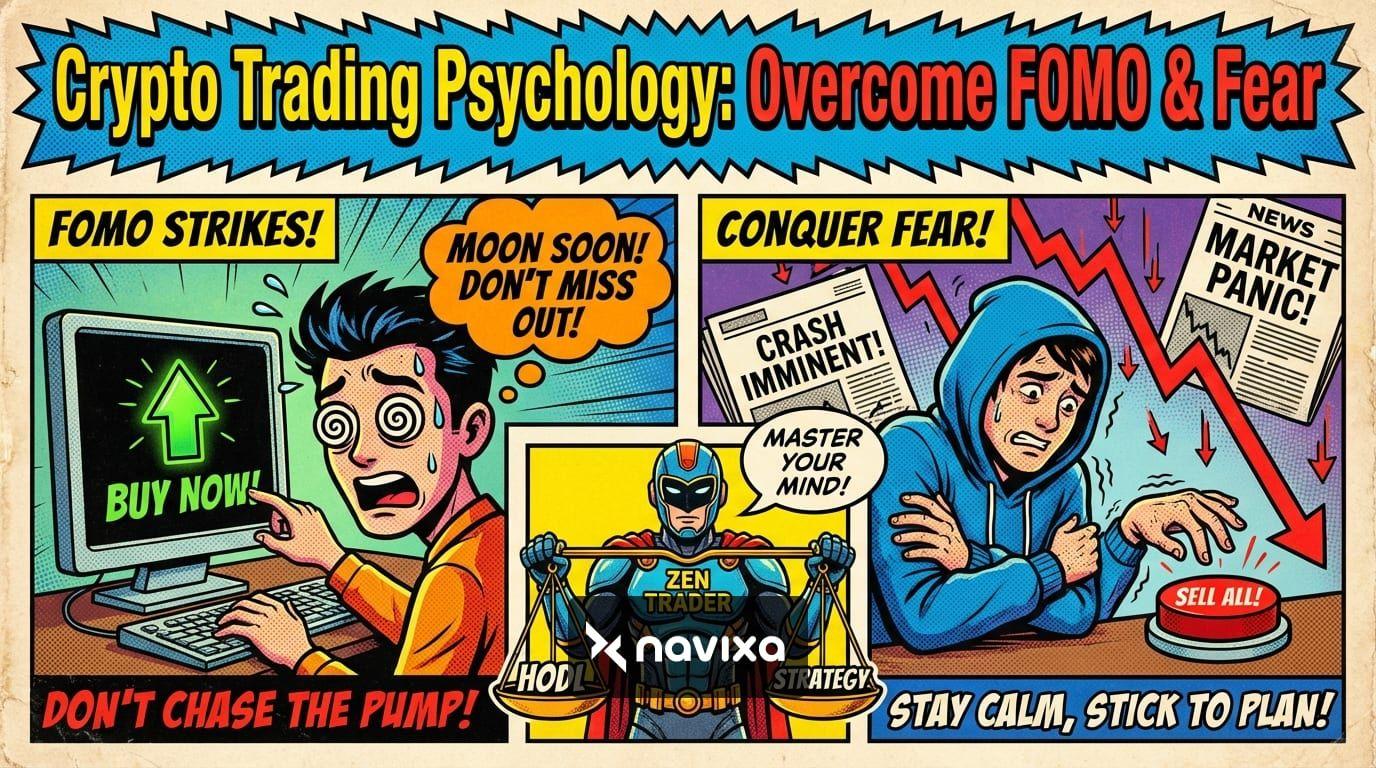
FOMO is arguably the most common psychological trap in cryptocurrency. It is the overwhelming anxiety that you are missing out on a massive financial opportunity while others are getting rich.
How FOMO Sabotages Your Portfolio
Imagine this scenario: A relatively unknown altcoin starts trending on social media. You watch as it climbs 20%, then 50%, then 100%. You initially told yourself it was just a pump-and-dump, but as the green candles keep forming, your resolve weakens. Driven by the fear of missing a generational wealth-building opportunity, you buy at the absolute top. Minutes later, early investors take their profits, the price crashes, and you are left holding the bag.
FOMO forces you to abandon your trading strategy. It strips away logical risk assessment and replaces it with impulsive, adrenaline-fueled actions.
"The market is a device for transferring money from the impatient to the patient." – Warren Buffett
In crypto, patience means waiting for your specific setup to materialize rather than chasing green candles. If a coin has already surged 200% in a few days, the optimal entry point is long gone.
The Paralysis of Fear and Panic Selling
On the opposite end of the emotional spectrum is fear. While FOMO tricks you into buying at the top, fear tricks you into selling at the exact bottom.
FUD and Market Contagion
The crypto market is highly susceptible to FUD (Fear, Uncertainty, and Doubt). Whether it is a rumor about strict new regulations, macroeconomic pressures like unexpectedly high inflation reports, or geopolitical tensions, negative news can trigger immediate market-wide sell-offs.
When traders see their portfolio value dropping rapidly, the brain's "fight or flight" response is activated. Logical analysis is overridden by the urgent need to stop the pain of losing money. This leads to panic selling.
Panic selling is the result of not having a predefined exit strategy. If you enter a trade without knowing exactly where your stop-loss is and why you placed it there, you are leaving your exit up to your emotional state during a crisis.
Technical Analysis vs. Emotional Reality
Many novice traders spend months learning complex technical analysis (TA). They memorize candlestick patterns, master Fibonacci retracements, and configure their charts with RSI, MACD, and Bollinger Bands. However, when real money is on the line, they completely ignore their own analysis.
Why? Because technical analysis tells you what the market is doing, but crypto trading psychology dictates what *you* do in response.
For instance, your RSI indicator might show that an asset is severely overbought, signaling a potential reversal. Your rational brain knows you should take profits. But your emotional brain, infected by greed, whispers, "What if it goes 50% higher?" You ignore the TA, the reversal happens, and your profits vanish.
A successful trader uses technical analysis not just to predict price movements, but to establish emotional anchors. Your charts should dictate your entry, your stop-loss, and your take-profit levels *before* you enter the trade.
Emotional Trading vs. Disciplined Trading
To visualize the stark contrast between an amateur mindset and a professional mindset, review the comparison table below.
| Feature | Emotional Trading | Disciplined Trading |
|---|---|---|
| Entry Catalyst | Social media hype, FOMO, rapid price spikes | Pre-defined technical setups, fundamental triggers |
| Risk Management | All-in on a single trade, no stop-losses used | 1-2% risk per trade, strict stop-loss placement |
| Reaction to Losses | Revenge trading, anger, doubling down on bad trades | Acceptance, reviewing the trading journal, moving on |
| Taking Profits | Holding out for unrealistic 100x gains, greed | Scaling out at predetermined resistance levels |
| Mindset | Seeking excitement and instant wealth | Treating trading as a boring, methodical business |
Actionable Steps to Master Your Trading Mindset
Understanding the psychology of trading is only half the battle. The other half is implementing systems that protect you from yourself. Here are proven, actionable strategies to optimize your crypto trading psychology.
1. Develop a Rule-Based Trading Strategy
You cannot control the market, but you can control your process. A rule-based strategy removes ambiguity and emotional guesswork from your trading. Before entering any trade, you should be able to answer the following questions: * What is the specific technical or fundamental trigger for this entry? * Where exactly is my stop-loss if the trade goes against me? * Where are my take-profit targets? * What percentage of my total portfolio am I risking?
If you cannot answer these questions, you are not trading—you are gambling. Write your rules down and keep them visible near your trading desk.
2. Implement Strict Risk Management
Proper risk management is the ultimate cure for trading anxiety. If you are sweating, losing sleep, or constantly checking your phone, your position size is too large.
Professional traders typically risk no more than 1% to 2% of their total capital on a single trade. If you have a $10,000 portfolio, risking 1% means that if your stop-loss is hit, you only lose $100. This size is small enough that a loss won't trigger an emotional spiral, allowing you to move on to the next setup with a clear head.
Always utilize automated stop-loss orders. Do not rely on "mental stop-losses," because when the time comes to pull the plug, your emotions will likely convince you to hold on just a little longer. To deepen your understanding of these tools, consider reading through Investopedia's guide on risk management.
3. Keep a Detailed Trading Journal
A trading journal is the most powerful tool for improving your crypto trading psychology. It forces you to be accountable for your actions and provides concrete data on your emotional patterns.
For every trade, log the following information: * The date, asset, and direction (long or short). * Your entry price, stop-loss, and take-profit targets. * The setup or reason for taking the trade. * Your emotional state: Were you feeling anxious? Confident? Bored? FOMO? * The outcome of the trade and lessons learned.
Over time, you will notice patterns. You might discover that trades taken when you felt "bored" or "anxious" have an 80% failure rate. This self-awareness is invaluable for correcting destructive behaviors.
4. Detox from Crypto Social Media
Platforms like X (formerly Twitter), Reddit, and YouTube are breeding grounds for FOMO and FUD. Crypto influencers often have vested interests in pumping specific tokens, and the constant barrage of "moon" predictions can heavily distort your market perception.
If you find yourself constantly swayed by the opinions of others, it is time to mute the noise. Curate your feed to only include objective data sources, on-chain analysts, and educational content. Trust your own charts and your own strategy. You can also monitor objective metrics on platforms like CoinGecko rather than relying on social media sentiment.
5. Accept That Losses Are Part of the Business
In any other business, there are operational costs. A restaurant owner must pay for ingredients, rent, and staff. In trading, your operational costs are your losing trades.
Perfection is impossible in the crypto market. Even the best traders in the world have win rates hovering around 50% to 60%. They achieve profitability not by winning every trade, but by ensuring their winning trades are significantly larger than their losing trades. Once you accept that taking small, controlled losses is just the cost of doing business, the fear of being wrong will dissipate.
Practical Takeaways for Everyday Trading
To summarize, integrating a strong psychological framework into your daily routine involves: * Preparation: Never trade on a whim. Plan your trades when the market is quiet and execute them when your specific criteria are met. * Detachment: Treat your capital as inventory. Do not fall in love with a specific cryptocurrency; they are merely vehicles for generating a return. * Patience: If there are no high-probability setups, do nothing. Cash is a valid position. * Review: End each week by reviewing your trading journal. Celebrate your discipline, not just your profits.
Conclusion
Mastering crypto trading psychology is a lifelong journey. The cryptocurrency market is designed to test your patience, trigger your fears, and exploit your greed. However, by acknowledging these emotional pitfalls and actively implementing rule-based systems, you can build an impenetrable psychological shield.
Remember, successful trading is not about predicting the future; it is about managing risk and controlling your own actions. Stop chasing the market, start executing your plan, and commit to mastering your mindset today. Your future portfolio will thank you.
Frequently Asked Questions
What is the best way to stop revenge trading?
Revenge trading occurs when you try to win back a loss immediately by jumping into a new, often poorly planned trade. The best way to stop this is to implement a "cool-down" rule. For example, mandate that after any losing trade, you must step away from your charts for at least two hours. This physical break allows your emotional brain to settle and your logical brain to regain control.
How do I manage the anxiety of holding a winning position?
Anxiety during a winning trade often stems from the fear of losing your unrealized profits. To combat this, use a scaling-out strategy. Take 25% or 50% of your profits at predetermined logical resistance levels, and move your stop-loss to breakeven. This guarantees a profitable trade and removes the psychological pressure of trying to perfectly time the absolute top.
Can technical indicators help with trading psychology?
Yes, absolutely. Technical indicators provide objective, mathematical data that counters subjective emotional feelings. If you feel FOMO and want to buy a token, but your RSI indicator reads 85 (heavily overbought), the indicator acts as a logical stop sign, reminding you that buying at that moment carries immense risk.
How much of a crypto portfolio should I risk per trade?
The industry standard for professional risk management is risking 1% to 2% of your total trading capital per trade. This means the difference between your entry price and your stop-loss should not exceed 1-2% of your account size. This strict sizing ensures that a string of inevitable losses will not severely damage your portfolio or your mental health.
Why is crypto trading more emotional than traditional stocks?
Crypto trading is uniquely emotional due to its 24/7 nature, extreme price volatility, and heavy influence from social media. Unlike the stock market, which has opening and closing bells to provide natural mental breaks, crypto's continuous operation forces traders to constantly monitor their positions, leading to rapid decision fatigue and heightened emotional stress.