
The cryptocurrency market is famous for its relentless 24/7/365 operational cycle. Unlike traditional stock markets that ring a closing bell and observe national holidays, digital asset exchanges never sleep. However, just because the market is open does not mean it behaves the same way it does on a standard Tuesday. Implementing a robust crypto holiday trading strategy is essential for any trader looking to navigate the treacherous, yet opportunistic, waters of festive periods.
During global holidays—such as Christmas, Easter, Lunar New Year, or Thanksgiving—the underlying structure of the crypto market undergoes a significant transformation. Institutional money makers step away from their desks, over-the-counter (OTC) desks slow down, and overall market liquidity often thins out dramatically. Historical data has shown that during major holidays, 7-day trading volumes can plunge significantly below their yearly averages, sometimes dropping by over 50%.
This drop in participation creates a unique environment. Thinner order books mean that a relatively small market order can cause an outsized price swing, leading to sharp, unpredictable volatility spikes. Conversely, the market can also stall completely, trapping day traders in tight, untradable ranges. Understanding how to adapt to these shifts is the cornerstone of a successful crypto holiday trading strategy.
How Holidays Impact Cryptocurrency Markets
To master a crypto holiday trading strategy, one must first understand the mechanics of holiday market behavior. The crypto ecosystem is heavily influenced by both retail and institutional participants. Since the widespread approval of spot Bitcoin ETFs and the integration of digital assets into traditional finance portfolios, institutional influence has grown exponentially.
The Institutional Vacuum
When Wall Street and global financial hubs close for holidays, the automated algorithms and large-scale market makers that typically provide deep liquidity temporarily scale back their operations. The total crypto market cap suddenly lacks the steady flow of capital required to absorb large buy or sell orders. This phenomenon is known as a "liquidity void."
Retail Dominance and Regional Shifts
While Western institutions may be offline during major regional holidays, retail traders globally remain active. In fact, localized holidays can produce the opposite effect. For example, during Eid or national holidays in the Middle East and North Africa (MENA), retail trading activity has historically surged by 15% to 20% due to increased leisure time. A comprehensive crypto holiday trading strategy must always account for these geographical and cultural nuances.
"The absence of institutional market makers during major holidays removes the market's shock absorbers. Traders must adapt to an environment where minor catalysts can trigger major liquidations."
Regular Trading vs. Holiday Trading
Understanding the fundamental differences between standard market conditions and holiday environments is crucial. Below is a comparison to help visualize the shift in market dynamics.
| Market Characteristic | Regular Trading Days | Holiday Trading Days |
|---|---|---|
| Liquidity & Order Depth | Deep order books, high volume. | Thin order books, reduced volume. |
| Institutional Activity | High (ETFs, hedge funds active). | Low (offices closed, algorithms paused). |
| Price Volatility | News-driven, macro-responsive. | Unpredictable, prone to "whipsaws." |
| Bid-Ask Spreads | Tight, minimal slippage. | Wide, higher risk of slippage. |
| Retail Influence | Moderate. | Dominant in specific time zones. |
Step-by-Step Crypto Holiday Trading Strategy
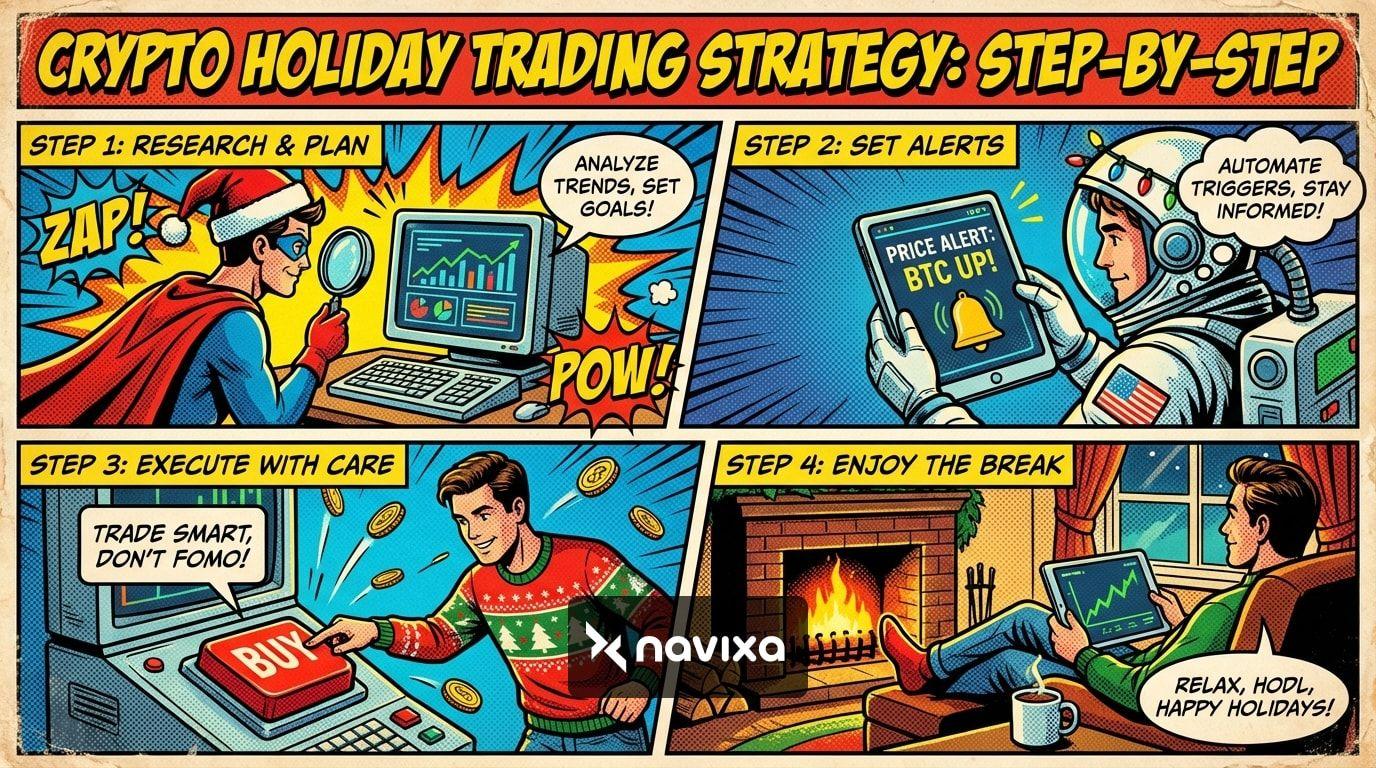
Succeeding during holiday lulls requires a tactical pivot from your everyday trading routine. Here is a comprehensive, step-by-step crypto holiday trading strategy designed to protect your capital and exploit unique market conditions.
Step 1: Pre-Holiday Technical Analysis
Preparation begins days before the holiday actually strikes. You need to map out the macro and micro levels. Since trading volume is expected to decline, the market is more likely to respect major historical support and resistance zones rather than breaking through them with conviction.
1. Identify the Range: Zoom out to the daily and 4-hour charts. Mark the upper and lower boundaries of the current consolidation phase. 2. Analyze Volume Profiles: Use tools like the Volume Profile Visible Range (VPVR) to identify areas of high liquidity (Point of Control). The market will naturally gravitate toward these nodes when volume dries up. 3. Review Funding Rates: Check the perpetual futures funding rates. If leveraged short or long exposure is heavily skewed, a low-liquidity holiday environment is the perfect setup for a sudden "squeeze" triggered by larger players to liquidate over-leveraged traders.
Step 2: Adjusting Position Sizing and Leverage
The golden rule of any crypto holiday trading strategy is capital preservation. Because thinner liquidity translates to wider bid-ask spreads and sudden price wicks, your standard position sizing is too risky.
* Cut Position Sizes: Reduce your typical trade size by 30% to 50%. This allows you to weather unexpected volatility without hitting your invalidation point prematurely. * Lower Leverage: High leverage in a low-liquidity environment is a recipe for disaster. A sudden 2% wick can liquidate a highly leveraged position before the price reverts to the mean. Stick to spot trading or minimal leverage during major holidays.
Step 3: Utilizing Automated Grid Trading
When the market lacks the volume to push a definitive trend, it often chops sideways in a defined range. This makes trend-following strategies highly ineffective. Instead, a mean-reversion or grid trading approach becomes highly lucrative.
Grid trading bots automate the process of buying low and selling high within a predetermined range. By setting a grid between the support and resistance levels identified in Step 1, you can passively capture profits from the endless "chop" of holiday trading.
Step 4: Setting Strategic Alerts
Staring at a slow-moving chart during a holiday is mentally exhausting and leads to forced, emotional trades. A professional crypto holiday trading strategy relies heavily on automation and alerts.
Set price alerts at your extreme support and resistance levels. Furthermore, utilize platforms like CoinGecko or CoinMarketCap to set alerts for sudden spikes in overall trading volume. If volume suddenly surges while the rest of the world is offline, it is a strong indicator that a significant move is underway and institutional players might be stepping back in.
Technical Analysis Tools for Holiday Markets
To effectively execute this strategy, certain technical indicators are far more reliable than others during low-volume periods.
Bollinger Bands
Bollinger Bands are excellent for visualizing volatility. During a holiday, the bands will typically contract, signaling a period of low momentum. When the bands are tight, the market is accumulating energy. A breakout from these contracted bands on low volume can often be a fake-out, so wait for a true volume confirmation before entering a trade.
Volume Weighted Average Price (VWAP)
The VWAP is a vital tool for day traders. It acts as a dynamic mean. In a low-liquidity environment, price tends to drift away from the VWAP and snap back to it repeatedly. Buying below the VWAP at key support levels and selling at the VWAP is a reliable mean-reversion tactic.
Relative Strength Index (RSI) Divergences
Because momentum is generally weak during holidays, standard RSI overbought or oversold readings can remain relatively static. However, spotting RSI divergences on lower timeframes (like the 15-minute or 1-hour chart) can signal short-term reversals, allowing you to scalp profits from impatient traders who enter late into a stagnant trend.
Risk Management: The Shield of Your Strategy
A solid strategy is only as strong as its risk management protocols. Trading during holidays exposes you to specific dangers, primarily slippage and stop-hunting.
Beware of Slippage: Slippage occurs when your market order executes at a different price than intended due to a lack of buyers or sellers at your desired level. Always use limit orders instead of market orders during holidays to ensure you get the exact entry and exit prices you want.
Avoid the Stop-Hunt: Whales and market makers know that retail traders place their stop-losses just below obvious support levels or just above obvious resistance. In a thin market, it costs very little capital to push the price past these levels, trigger the stop-losses (creating forced selling or buying), and then immediately reverse the price. To combat this, place your stop-losses slightly wider than usual, compensating for the wider stops by strictly reducing your position size.
Alternative Approaches: Earning While You Rest
Sometimes, the best crypto holiday trading strategy is not actively trading at all. If the market conditions look unfavorable or too unpredictable, consider putting your capital to work in decentralized finance (DeFi) platforms.
Staking your digital assets, providing liquidity to decentralized exchanges, or participating in yield farming allows you to earn passive income while you step away from the screens to actually enjoy the holidays. Maintaining a cash (or stablecoin) position is also a highly valid strategy. A stablecoin position insulates a portfolio from holiday volatility and leaves capital available if a sudden flash crash occurs while the broader market sleeps.
Conclusion
The crypto market's continuous operation is a double-edged sword. While it offers boundless opportunities, it also demands extreme vigilance, especially when the rest of the financial world is on pause. A successful crypto holiday trading strategy requires a fundamental shift in mindset: moving from aggressive, trend-following tactics to defensive, range-bound methodologies.
By cutting your position sizes, utilizing limit orders to avoid slippage, leveraging grid trading bots for sideways momentum, and remaining hyper-aware of the liquidity voids caused by absent institutional participants, you can turn holiday market lulls into highly profitable ventures. Remember, preserving capital during these unpredictable periods is just as important as growing it. Stay disciplined, rely on your pre-holiday analysis, and never let the boredom of a slow market trick you into a bad trade.
Frequently Asked Questions
Why does crypto volatility sometimes increase during holidays?
Volatility can increase during holidays because market liquidity is significantly lower. With institutional market makers offline, there are fewer buy and sell orders populating the order books. Consequently, a single large trade by a "whale" can cause the price to spike or crash much more dramatically than it would on a regular, high-volume trading day.
Is it better to use market orders or limit orders during a holiday?
It is highly recommended to use limit orders. Because order books are thin, a market order can suffer from severe slippage, meaning your trade might execute at a much worse price than you anticipated. Limit orders guarantee that your trade will only execute at your specified price or better, completely removing the risk of slippage.
What is the best trading style for a crypto holiday trading strategy?
Since markets often lack the volume to sustain long-term directional trends during major holidays, mean-reversion and range-trading strategies tend to be the most effective. Techniques like grid trading or scalping between well-established historical support and resistance zones work best in this sideways environment.
Do regional holidays affect the market the same way as global holidays?
No. Global holidays like Christmas or New Year's Day typically see a massive drop in institutional trading volume worldwide. Regional holidays, however, might actually see a localized surge in retail trading. For instance, holidays in regions with high crypto adoption can lead to temporary increases in trading volume as retail investors use their time off to engage with the markets.
Should I close all my positions before a major holiday?
It entirely depends on your personal risk tolerance and trading timeframe. Long-term spot investors generally do not need to alter their portfolios for a holiday weekend. However, day traders or swing traders holding highly leveraged derivative positions should strongly consider closing or significantly reducing their exposure to protect against unpredictable, low-liquidity price wicks.